
On August 7, 2026, the official Reachy Mini purchase-page source listed Lite at $299 and Wireless at $499. Lite uses your computer over USB; Wireless adds a Raspberry Pi 4, Wi-Fi and an IMU for a more self-contained setup. Recheck the live checkout before ordering because price, tax, customs, stock and delivery can change.
There is an important official-page mismatch: the July 2025 launch article still shows $399 for Lite and $499 for Wireless. The dated launch price should not override the current buying screen. Both versions are open-source desktop kits for human-robot interaction, coding and AI experiments—not household humanoids that clean or carry groceries.
Choose Lite for a tethered desk, Wireless for portable demos
Lite includes the expressive mechanism, camera and audio hardware but no onboard computer, so it relies on a supported Mac, Linux or Windows host over USB. If a laptop will always sit beside the robot, the $200 difference can fund peripherals or model access instead.
Wireless includes a Raspberry Pi 4, storage, Wi-Fi and an IMU, making it easier to run supported apps without a permanently attached PC. This does not mean every large vision or speech model will run locally at useful speed; some projects will still need a workstation or remote service.
| Decision point | Lite | Wireless |
|---|---|---|
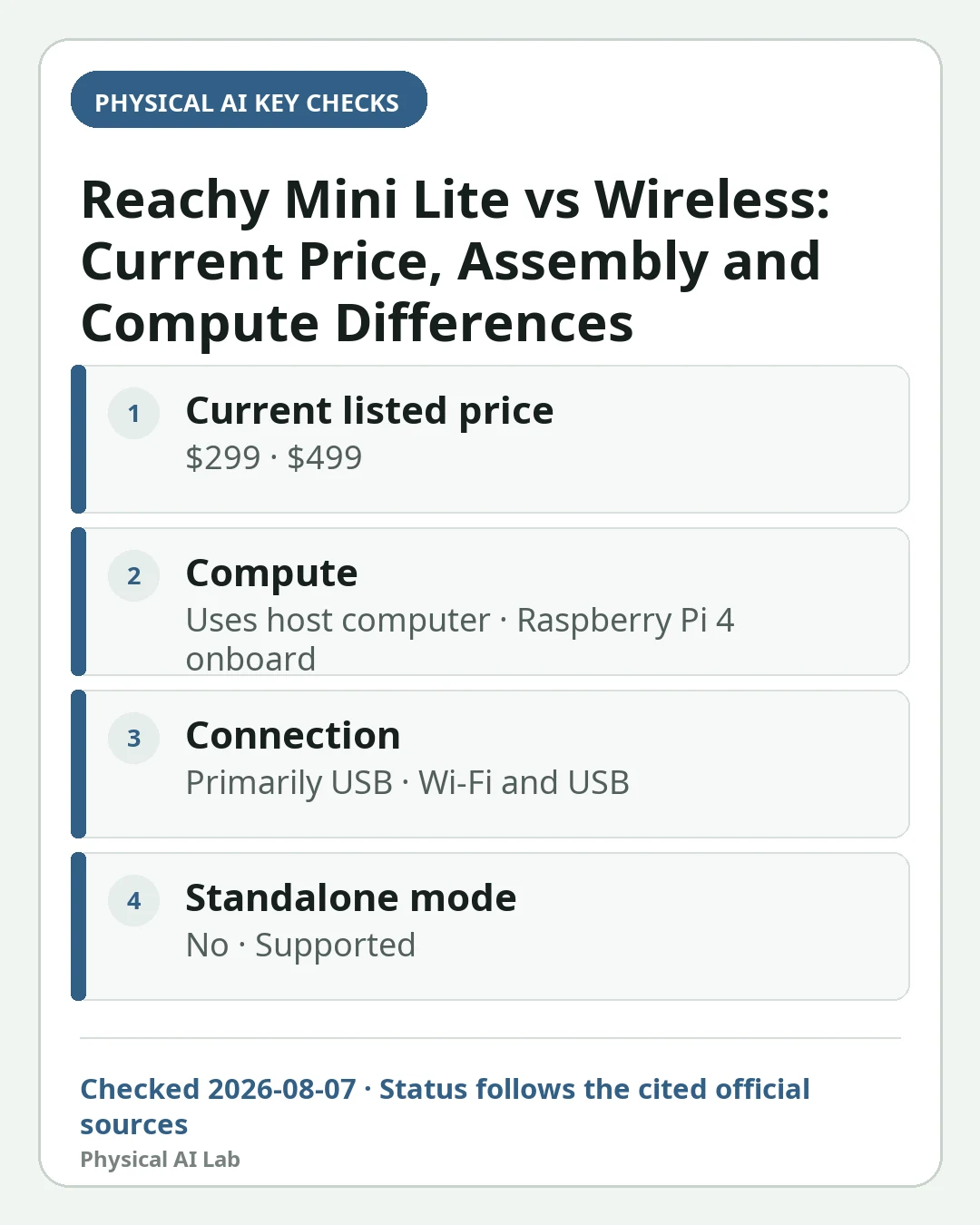
| Current listed price | $299 | $499 |
| Compute | Uses host computer | Raspberry Pi 4 onboard |
| Connection | Primarily USB | Wi-Fi and USB |
| Standalone mode | No | Supported |
| Best fit | Learning and desk development | Portable demos and installations |
Why both $299 and $399 appear in search results
The 2025 announcement recorded the launch-era price of $399 for Lite. The newer purchase interface encoded $299 in both its product data and purchase button while Wireless remained $499. Two official pages from different dates therefore produce two different figures.
Save the final checkout showing currency, tax, shipping, import responsibility, stock and expected dispatch before paying. Older delivery or warranty language does not supersede the terms attached to the current order. The figures in this article are a dated check, not a permanent price guarantee.
The expressive mechanics are largely shared
The current comparison lists five servo motors, six-degree-of-freedom head motion, 280-degree body rotation and two animated antennas for both versions. A wide-angle camera, four-microphone array and 5W speaker are also common, so Wireless is not a completely different robot body.
Most of the premium pays for where applications run and how the robot connects. An app may combine sight, language and motion, but that does not automatically make every Reachy Mini behavior a general vision-language-action model.
_robot_Octavia_at_the_Office_of_Naval_Research_(ONR)_exhibit_during_Fleet_Week_New_York_2010.jpg)
Onboard compute does not guarantee AI throughput
The Raspberry Pi 4 can host device control and lightweight applications, but model latency still depends on architecture, precision, input rate and networking. Test frames per second, response time and recovery after a connection loss with the exact app you plan to show.
Lite can be the stronger development choice when it connects directly to a GPU laptop or workstation. Wireless earns its premium when cable management, room-to-room movement or unattended restarting matters more than raw local inference.
| Project | Likely starting point | Test before buying |
|---|---|---|
| Python lessons at a desk | Lite | Supported OS and USB stability |
| Classroom rotation or event demo | Wireless | Battery runtime and Wi-Fi policy |
| Large vision or speech model | Either | External GPU or cloud latency |
| Long-running installation | Wireless first | Heat, power and restart behavior |
It is a kit, so assembly and support matter
The purchase interface describes roughly two hours of assembly with no soldering and lists printed structures, motors, electronics, camera and audio parts. Actual time varies with experience, and support for a pinched cable or assembly error should not be assumed to match consumer-appliance service.
The Reachy Mini documentation separates real-hardware, simulation, Lite and Wireless paths. Starting in simulation can expose the SDK and application model before hardware arrives. For the distinction between a robot kit and reusable AI capability, see the robot foundation model guide.
Write the operating scene before opening checkout
List the host OS, available USB ports, Wi-Fi restrictions, battery need, model compute and camera or microphone privacy policy. After choosing a version, verify customs, taxes, return and warranty rules, replacement parts and the current delivery estimate for your country.
Reachy Mini is strongest as an expressive desktop interface. It is the wrong purchase if the requirement is carrying objects or automating chores. Apply the teleoperation and remote-compute demo checklist when evaluating behaviors shown online.
Frequently asked questions
Is Reachy Mini Lite currently $299 or $399?
The purchase interface checked on August 7, 2026 listed $299, while the dated 2025 launch article still showed $399. Verify the live price, taxes, shipping and stock at checkout before ordering.
Does Lite have the same movement and camera as Wireless?
The official comparison gives both the same core mechanism, six-DOF head, body rotation, camera, microphones and speaker. The main difference is external host compute versus onboard Pi, Wi-Fi and IMU.
Is Reachy Mini a household-service humanoid?
No. It is an open-source desktop kit for interaction, creative coding, education and AI experiments. It is not sold as a robot that carries loads or performs household chores.
Official sources checked
- Reachy Mini current purchase-page source
- Reachy Mini official documentation
- Reachy Mini 2025 launch article
Last checked: 2026-08-07