A robot demo cannot be classified as teleoperated or autonomous from appearance alone. Operator hardware, mirrored body motion, first-person video and network equipment can provide clues, but each clue has alternative explanations. The reliable answer comes from an explicit description of who selected the actions during the recorded trial.
Teleoperation is not evidence that a robot is fake. It is a real control method used for hazardous work, remote inspection, research and data collection. The problem is a labeling mismatch: a continuously human-controlled trial should not be presented as autonomous execution, and an autonomous run should disclose any takeover or reset that changed the outcome.
Use the five checks below together with the general robot video evaluation method. The goal is not to accuse a video. It is to assign the correct control category, preserve unknowns and understand what the demonstration contributes to engineering evidence.
Visible operator equipment is the clearest clue
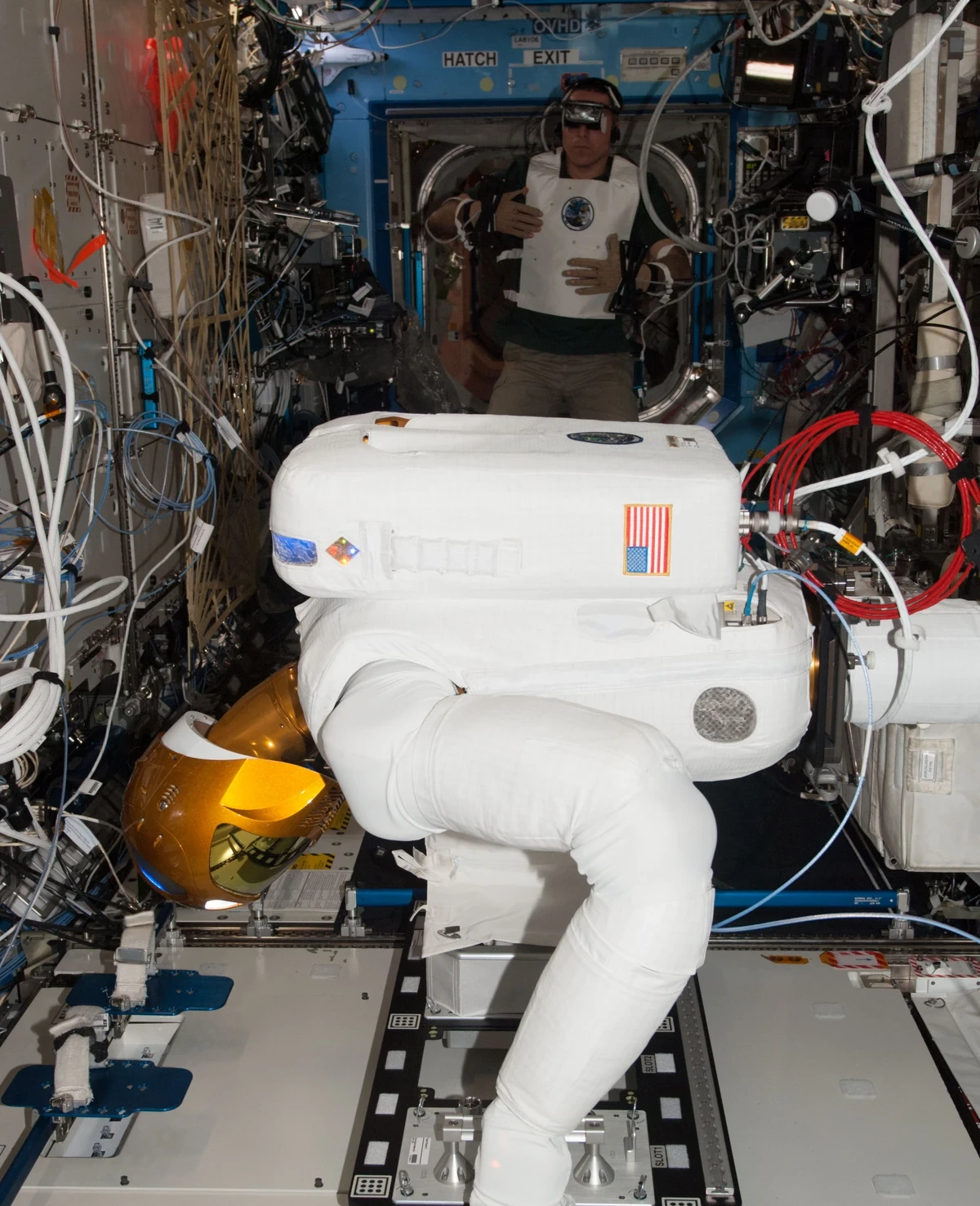
Look for joysticks, motion-capture suits, gloves, exoskeleton arms, VR headsets, control stations and live camera monitors. When the operator and robot move together, the video may be showing bilateral or whole-body teleoperation. This is strong evidence when the equipment is connected and the caption identifies the control mode.
An operator standing nearby is not proof of teleoperation. The person may be supervising safety, monitoring diagnostics or preparing the task. Conversely, a remote operator can be outside the camera frame. Record what is visible, then confirm it against the official description, paper, code or behind-the-scenes documentation.

Motion resemblance can suggest a question, not answer it
A robot that closely mirrors human posture, hand trajectory or timing may be teleoperated. Short pauses can coincide with an operator repositioning. Yet learned policies are often trained on human demonstrations and may reproduce similar motion. Onboard planners can also generate hesitation as perception or collision checks update.
Do not use fluidity as an autonomy detector. Teleoperation can be smooth, and autonomous control can be slow or irregular. Stabilization, inverse kinematics and safety filters may transform human input before it reaches the joints, making the final motion unlike the operator’s. Motion is supporting context, not a control label.
First-person views and network displays need context
A live robot-camera feed presented beside the task can indicate that an operator is using the robot’s viewpoint. Latency meters, radio links and control overlays can strengthen that interpretation. The same imagery can also be ordinary perception debugging, autonomous-policy visualization or post-run analysis.
Ask whether the displayed view was used to command the robot in real time. A research paper should describe the observation delivered to the operator, the input device, command rate and mapping to robot actions. A product demo should say whether the connection is continuous control, occasional assistance or monitoring only.
Latency and hesitation are ambiguous
Network delay can create a pause between operator motion and robot response. Human decision time can produce hesitation around difficult contacts. These patterns are sometimes visible, especially in long-distance control. They are not unique to teleoperation because autonomous systems also wait for inference, planning, synchronization or a safety condition.
A better record separates communication latency, model inference, controller cycle and mechanical response. If the source publishes none of those values, keep the cause unknown. Guessing from playback is especially risky when a video has been sped up, slowed down or synchronized from separate cameras.
| Video clue | Possible teleoperation explanation | Other explanation | Evidence to request |
|---|---|---|---|
| Mirrored motion | Human pose maps to robot motion | Imitation-trained policy | Control interface description |
| First-person feed | Operator views robot camera | Perception debugging | Who consumed the feed |
| Pause before action | Human decision or network delay | Inference or safety check | Timing breakdown |
| Fast recovery | Operator corrects the robot | Autonomous recovery policy | Intervention log |
Failure recovery often reveals the operating boundary
Watch what happens after a weak grasp, blocked path or dropped object. A person may immediately take over, the robot may request help, or an autonomous policy may retry. If the video ends at failure, the recovery mechanism remains unknown. A cut to a new start position should be counted as a reset unless documented otherwise.
Shared autonomy makes the boundary more subtle. A human might choose a target while the robot plans the local trajectory and maintains balance. An autonomy supervisor might intervene only when confidence falls. Report both responsibilities rather than forcing the system into a binary human-versus-robot category.
Technical documentation should name the control mode
The most reliable sources are the official project page, paper, manual, code documentation and unedited trial description. Look for terms such as leader-follower, whole-body teleoperation, kinesthetic teaching, shared control, behavior cloning, autonomous rollout and human intervention. Each term describes a different link in the control chain.
A caption that only says AI-powered or intelligent is insufficient. Ask which inputs the model received and what outputs it produced during the clip. If a person continuously supplied end-effector targets, the run is teleoperated even if AI handled perception or stabilization. If the policy selected actions and a person only monitored, the run may be autonomous within stated limits.
Teleoperation can create the data used for autonomy
The Mobile ALOHA project describes a whole-body teleoperation system for collecting demonstrations and then trains policies with imitation learning. The teleoperated data-collection videos and autonomous skill videos represent different experiment phases. Collapsing them into one label would hide the method.
A training episode needs synchronized observations, robot state, task context and actions, as explained in the robot action data guide. The operator is valuable because the recorded actions provide examples of task completion. Evaluation must then test the learned policy without quietly substituting continuous human control.
Control exists on a spectrum
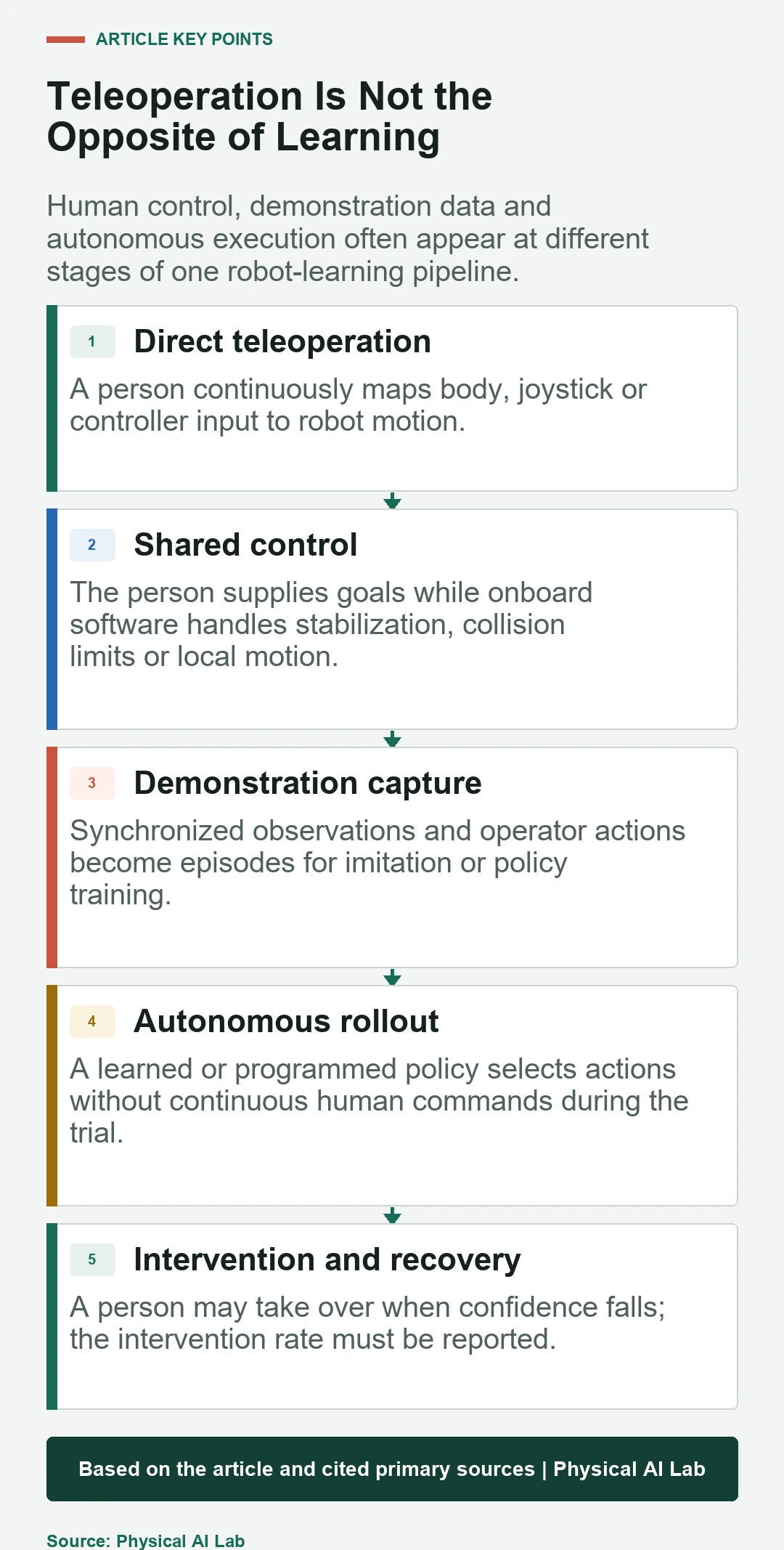
Direct teleoperation, shared control, demonstration capture, autonomous rollout and human intervention can all appear in one system. The right description answers who set the goal, who selected the trajectory, who stabilized the robot and who acted when the system became uncertain. For a road-vehicle example, see our comparison of robotaxi remote assistance and remote driving, which explains control authority, link loss and jurisdiction-specific definitions.
This spectrum is more useful than a simple teleoperated-or-autonomous label. It preserves important engineering contributions while keeping autonomy claims precise. It also reveals operating cost, because continuous control and exception-only intervention require different staffing, network reliability and response times.
Use consistent labels for demonstrations
For every trial, state control selection, stabilization, perception, recovery and reset roles. A concise label might read: autonomous task policy with onboard balance control; remote operator intervened in two of twenty trials. Another might read: full-body teleoperation used only to collect training demonstrations.
These labels avoid moral judgment. Teleoperation can be the correct product design for remote hazardous work, while autonomy can be the correct objective for repetitive local work. Accuracy lets viewers compare systems by their actual operating model and decide which evidence matters for the intended application.
| Control category | Human role | Robot role | Metric to report |
|---|---|---|---|
| Direct teleoperation | Continuous motion commands | Tracks commands and enforces limits | Latency, tracking error, task success |
| Shared control | Goal or high-level action | Local planning and stabilization | Intervention boundary and failures |
| Autonomous rollout | Starts and monitors trial | Selects task actions | Success, recovery and intervention rate |
| Exception handling | Takes over on uncertainty | Operates until threshold | Takeovers per hour or task |
A five-step verification workflow avoids overclaiming
First find the original upload rather than a repost. Second read the caption and linked technical source. Third list visible operator and interface clues. Fourth map human and robot responsibilities. Fifth record unknowns and keep the conclusion narrower than the evidence.
When the source is unclear, ask a neutral question: was this trial continuously teleoperated, autonomously executed, or run with shared control and intervention? A precise answer benefits the developer as well as the viewer because it identifies the real technical achievement.
- Find the primary source and original caption.
- Check for operator hardware and live robot views.
- Read the control and data-collection method.
- Separate autonomous rollout from human intervention.
- Keep ambiguous control modes labeled unknown.
Frequently asked questions
Does teleoperation mean a robot demo is fake?
No. Teleoperation is a legitimate control method and a common way to collect demonstrations. The video becomes misleading only when continuous human control is presented as autonomous execution.
Can video motion prove that a robot is teleoperated?
No. Mirroring, hesitation and latency are clues with alternative explanations. Confirm the control mode through primary documentation or explicit disclosure.
What is shared autonomy?
Shared autonomy divides responsibility. A person may choose goals while robot software plans motion, stabilizes the body, avoids collisions or performs low-level control.
How does teleoperation become robot training data?
The system synchronizes observations and robot state with the operator’s actions. Those episodes can train an imitation or behavior-cloning policy that is evaluated in autonomous rollouts.
What should an autonomous demo disclose about people?
It should report whether anyone supplied actions, changed goals, reset the scene or took over, along with the number and timing of interventions.
Control Disclosure Note
Control modes can change between a product demonstration, a data-collection session and a later autonomous evaluation. Verify the exact trial and current primary documentation before drawing conclusions.