
Isaac ROS NITROS is NVIDIA's implementation of ROS 2 type adaptation and type negotiation for accelerated graphs. The official NITROS concept documentation states a decisive system assumption: all NITROS-accelerated nodes must run in the same process to obtain the zero-copy benefit.
That means a graph does not become end-to-end zero-copy merely because several boxes are labeled NITROS. A standard ROS node, a process boundary or a remote machine can introduce conversion, memory copies or serialization. Use the ROS 2 QoS guide for delivery behavior; this guide maps the memory path.
Start with the three conditions behind the zero-copy claim
First, adjacent publishers and subscribers must both support the relevant NITROS representation. Second, the NITROS nodes whose buffers are meant to remain shareable must be composed in the same process. Third, type negotiation must select a compatible accelerated format across that connected segment rather than fall back to a standard representation.
The documentation also assumes only one negotiating publisher for a negotiated topic and constant received frame IDs during runtime. A graph that violates these assumptions should not rely on the product name as proof of a particular transport path; inspect the negotiated format and runtime behavior.
| Check | Favorable to zero-copy | Copy-risk signal |
|---|---|---|
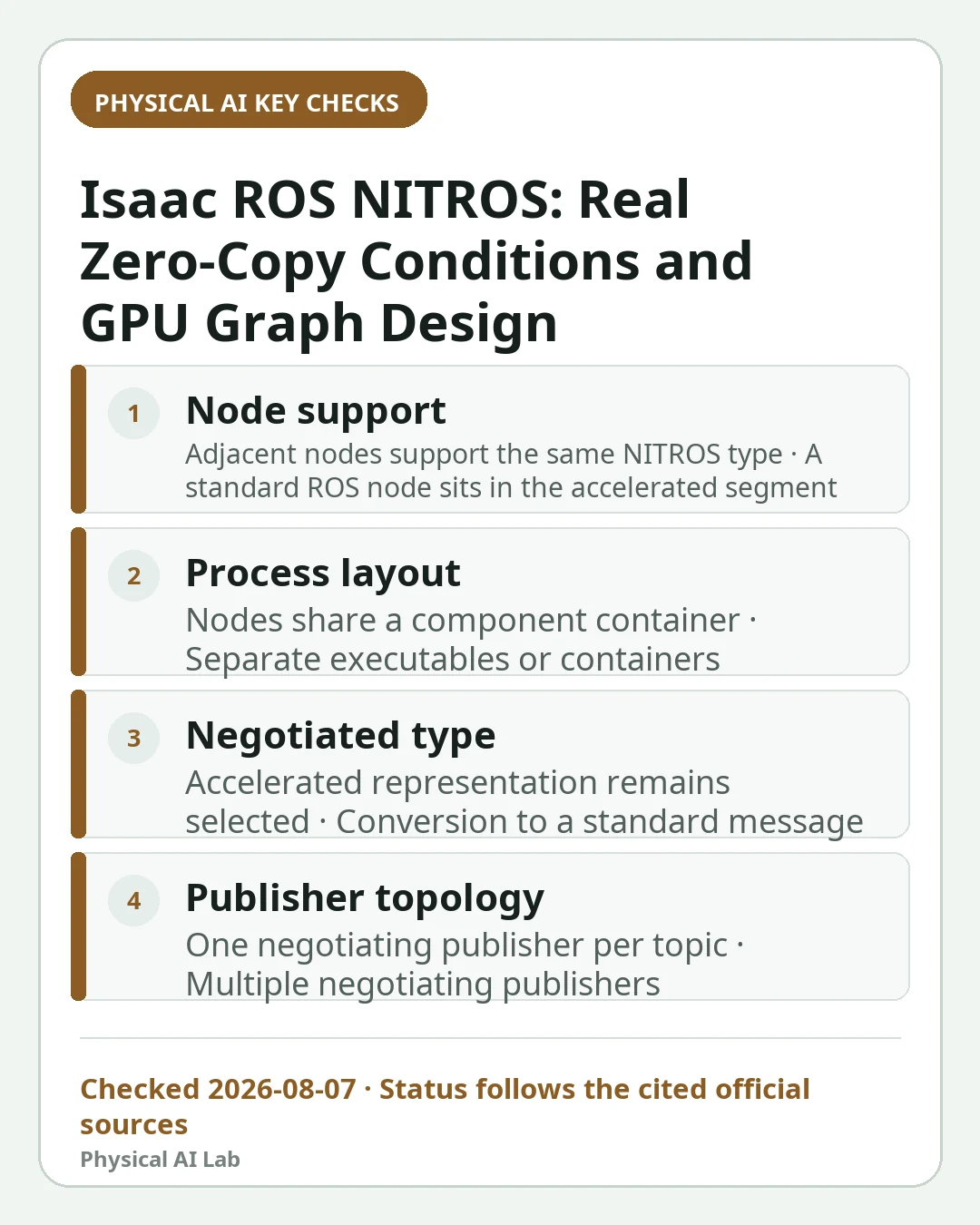
| Node support | Adjacent nodes support the same NITROS type | A standard ROS node sits in the accelerated segment |
| Process layout | Nodes share a component container | Separate executables or containers |
| Negotiated type | Accelerated representation remains selected | Conversion to a standard message |
| Publisher topology | One negotiating publisher per topic | Multiple negotiating publishers |
| Frame identity | Received frame ID stays constant | Runtime frame-ID mutation |
Type adaptation and type negotiation solve different parts
Type adaptation maps a ROS-facing message to a representation that suits an accelerator. NITROS provides one-to-one relationships such as NitrosImage to sensor_msgs/Image and NitrosPointCloud to sensor_msgs/PointCloud2, preserving compatibility while allowing an accelerated internal format.
Type negotiation lets connected nodes advertise supported formats and choose a compatible result. Negotiation support does not prove that every endpoint shares a GPU pointer. Capture the negotiated types at runtime and distinguish compatibility, which may include conversion, from a buffer path that actually avoids a copy.
For camera pipelines, find the first and last conversion
A camera driver may begin with a standard Image message, so entering an accelerated segment can involve an adaptation or copy. Once inside, composing rectification, resize, tensor conversion and TensorRT nodes in one process can keep large images and tensors from repeatedly crossing between CPU and GPU memory.
The exit matters just as much. NVIDIA's custom ROS graph article gives the example of a non-NITROS decoder: the GPU-resident NITROS tensor is converted into a typical ROS 2 message and brought to CPU memory, introducing CPU copies. That boundary remains valid even when the upstream stages are accelerated.


PointCloud graphs magnify bandwidth and lifetime mistakes
PointCloud2 frames can be large enough that avoidable serialization and copies consume substantial CPU time and memory bandwidth. Keep the compatible NitrosPointCloud segment continuous from depth or stereo output through filtering and perception where practical, and explicitly mark every conversion to a standard consumer.
Avoiding a nominal copy is not sufficient. Buffer-pool size, the number of in-flight frames, GPU stream synchronization and subscriber retention time can produce extra allocation, queueing or dropped frames. The lifetime of the shared object is part of the transport design.
| Graph boundary | Likely data path | Evidence to collect |
|---|---|---|
| NITROS to NITROS in one process | Accelerated representation may be shared | Negotiation logs and memory profiling |
| Standard camera to NITROS | Entry adaptation or copy may occur | CPU-GPU copy trace |
| NITROS to standard decoder | GPU-to-CPU conversion may occur | Per-node time and memcpy events |
| NITROS nodes in separate processes | Do not assume blanket zero-copy | Trace each process and bridge |
| Remote machine | Network serialization and transport | End-to-end latency and bandwidth |
Composition trades process isolation for a faster buffer path
Same-process composition is central to the documented zero-copy benefit, but it changes failure containment. A crash in one component can affect the rest of the container, and callbacks share process scheduling resources. Memory efficiency must be designed together with recovery and isolation requirements.
A slow service, logger or blocking callback in the wrong group can create long latency tails even after copies are removed. Review executors, callback groups and thread allocation with the ROS 2 executor guide so that the optimized data path remains schedulable under load.
Pin the Isaac ROS release before repeating performance claims
The Isaac ROS release notes list version 4.5.0 on July 6, 2026. Supported types, packages, known issues and performance conditions can change with the Isaac ROS, JetPack, ROS distribution, CUDA and driver combination, so a result without a version tuple is not portable evidence.
Pin a release or commit in the official isaac_ros_nitros repository, and record the hardware, image or cloud dimensions, frame rate, process topology and build configuration. A benchmark from the latest branch cannot simply be assigned to an older deployed stack.
Prove the path with profiling rather than graph appearance
Inventory every node, topic, process and negotiated message type, then measure CPU use, GPU use, memory bandwidth, memcpy events, frame drops and end-to-end latency. Replacing one intermediate node with a standard-message equivalent can reveal the conversion boundary and quantify its actual cost.
Report p95, p99 and maximum latency in addition to the mean, using the sensor timestamp through the point where the result affects control. The robot inference latency budget guide separates preprocessing, inference, postprocessing and transport, which prevents a local NITROS gain from being mistaken for an equal improvement in the full control loop.
Frequently asked questions
Does using NITROS make an entire ROS 2 graph zero-copy?
No. The documented benefit applies most clearly to adjacent NITROS-capable nodes using a compatible accelerated type in the same process. Standard-node, process and machine boundaries can introduce conversion, copying or serialization.
Can a NITROS node connect to a non-NITROS node?
Yes. NITROS types map to standard ROS message types for compatibility, but the boundary may convert a GPU representation into a CPU message and add copies. Measure that boundary rather than assuming it is free.
How can I verify that a path is zero-copy?
Inspect negotiation logs and process placement, then use CPU and GPU profiling to trace memory-copy events, serialization, bandwidth and latency. A node name or a lower average latency alone is not proof.
Official sources checked
- Official NVIDIA Isaac ROS NITROS concept documentation
- Official NVIDIA Isaac ROS release notes
- Official NVIDIA Isaac ROS NITROS GitHub repository
- NVIDIA technical article on custom ROS graphs with NITROS
Last checked: August 7, 2026