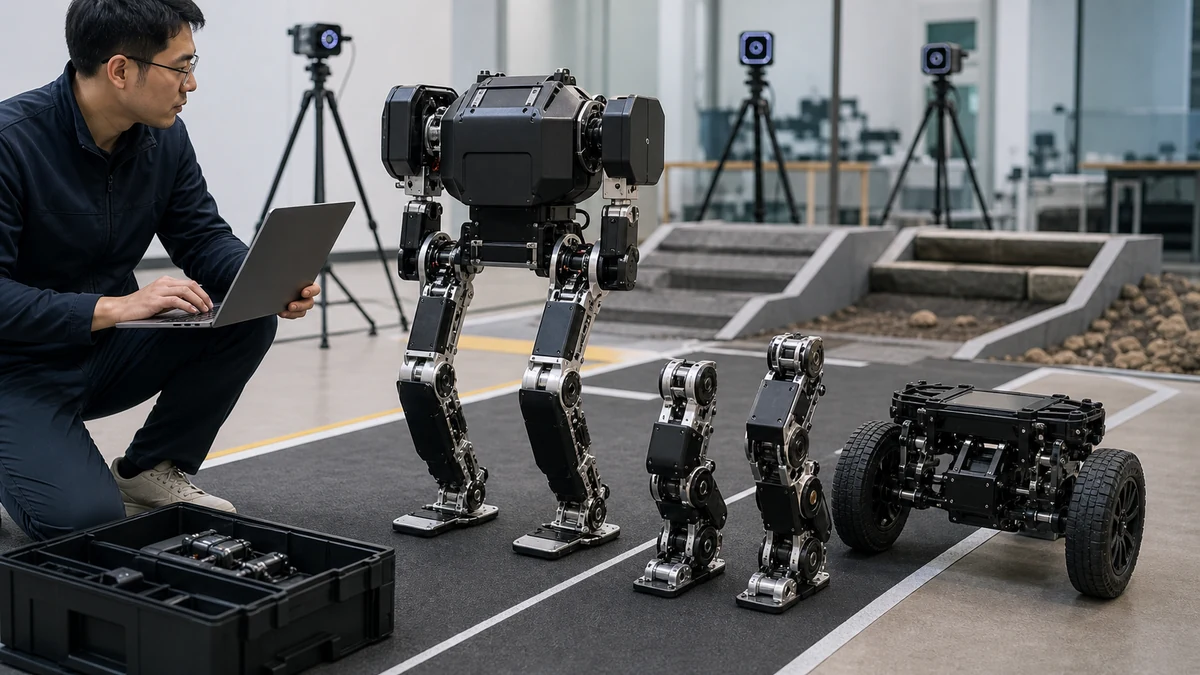
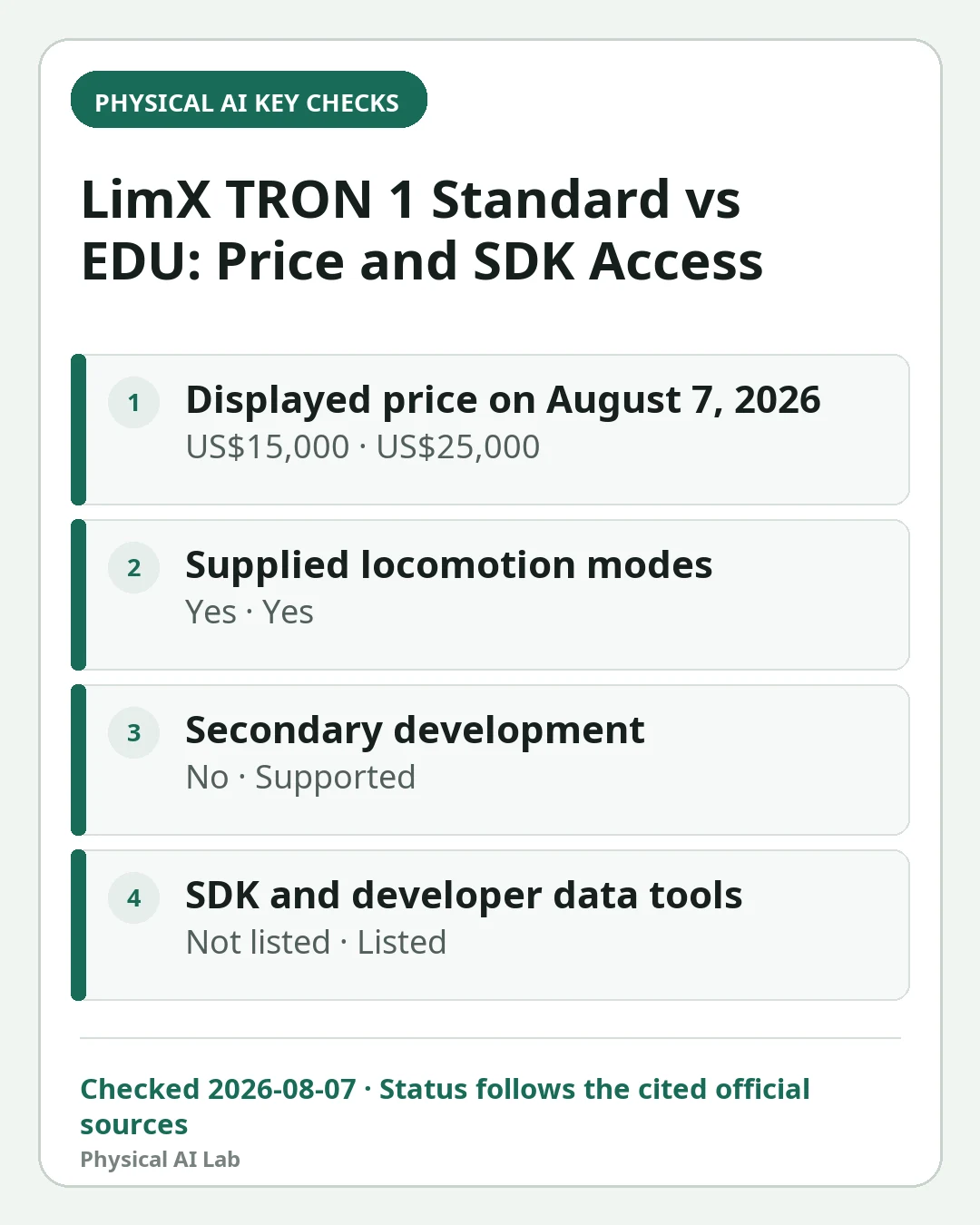
As checked on August 7, 2026, LimX lists the TRON 1 Standard Edition at US$15,000 and the TRON 1 Educational Edition at US$25,000. Both pages displayed an Add to cart control. The decisive difference is not a faster chassis: Standard is explicitly marked as not supporting secondary development, while EDU lists SDK access, data tools, joint-control development and simulation support. Buy Standard for its supplied operating modes; choose EDU when your project must change, measure or deploy robot behavior through code.
Neither displayed price is a landed project cost. Freight is calculated at checkout, import duties and taxes are excluded, and LimX ships only to listed destinations unless it approves another region. Before raising a purchase order, define the experiment with the robot simulator comparison, the Sim-to-Real transfer guide and the humanoid robot price guide. That work reveals whether the extra $10,000 buys an interface the team will actually use or prevents a much more expensive mismatch.
If your deliverable includes your own controller, start with EDU
The Standard product page carries an unusually clear boundary: it does not support secondary development and directs buyers who need that feature to the Education Edition. Standard still runs the supplied locomotion modes and can serve demonstrations, mobility classes or hardware familiarization. It is not presented as a cheaper license for loading an independently trained joint policy. A team that must read developer IMU data, record trajectories or command joints should treat the missing SDK as a blocking requirement, not a feature it can casually add later.
EDU's official comparison adds secondary development, an SDK, data visualization, recording and playback, joint-control algorithms and simulation platforms. Those labels establish product scope, but they do not guarantee that every low-level interface, firmware component or training asset is open. Ask LimX to identify the API level, repository or package version and any safety limits that apply to the exact unit on the quotation.
| Purchase question | Standard | EDU |
|---|---|---|
| Displayed price on August 7, 2026 | US$15,000 | US$25,000 |
| Supplied locomotion modes | Yes | Yes |
| Secondary development | No | Supported |
| SDK and developer data tools | Not listed | Listed |
| Best fit | Operation and demonstrations | Research, teaching and algorithm validation |
Most of the chassis specification is shared
The current TRON 1 specification gives both editions dimensions of no more than 392 by 420 by 845 mm, a net weight of no more than 20 kg, a 48 V 240 Wh removable battery and at least two hours under rated operating conditions. Both list a 12th-generation Intel i3 computer with 16 GB of RAM and 512 GB of storage. Point-foot, sole and wheeled modules are part of the same three-mode concept in both columns.
The shared mechanics matter because the price premium should not be sold internally as a simple performance upgrade. The table gives both versions the same 30 Nm rated and 80 Nm peak actuator figures and the same basic movement modes. Test conditions still matter: wheeled speed, climbing, payload and runtime are mode- and condition-dependent claims, not promises that can all be achieved simultaneously in every lab.
Standard is operational, but its integration ceiling is deliberate
Standard lists the handheld remote, a remote emergency stop, a physical emergency-stop button and software upgrades. Its built-in point-foot actions include directional movement, turning, in-place stepping and squatting; the sole mode adds static standing, while the wheeled mode adds differential steering. That makes Standard a functioning robot rather than a display shell. It may be perfectly adequate when a course teaches morphology or compares the three foot ends without modifying the controller.
Its limitation appears when the project needs a data path. The official comparison does not list the EDU developer ports, developer-accessible IMU data, SDK, visualization tools or joint-control work for Standard. A physical mounting point is not the same as a supported electrical and software interface. If the roadmap contains an external camera, LiDAR, arm or custom policy, obtain a written answer about the upgrade route before approving Standard; the public store does not promise a later license conversion.

Treat EDU as a versioned development stack, not a magic open box
EDU lists USB 3.0 and gigabit Ethernet, a 24 V peripheral supply, optional RGB-D camera support and developer IMU access. LimX also promotes Python-based development, URDF assets and use with NVIDIA Isaac, MuJoCo and Gazebo. Check the official LimX document center for the material that is actually current, then ask which files and examples are delivered with the order. The phrase fully open SDK should not be stretched into a claim that all firmware source, motor drives or safety functions are unrestricted.
Freeze the documentation boundary in the purchase record. An older manual and the live specification page can state different operating limits, and code examples may target a particular firmware release. Record the quotation date, SDK release, robot firmware, simulator asset version, supported operating system and technical-support period. Reproducibility depends on that matrix more than on a marketing list of compatible simulators.
| Evidence to request | Decision it supports |
|---|---|
| SDK and firmware version numbers | Whether examples and the delivered robot match |
| Documented command level | Whether the project gets navigation, joint targets or lower-level access |
| Included sensor and port configuration | Whether optional hardware must be budgeted |
| Simulator assets and deployment examples | Whether support goes beyond a URDF model |
| Update and support term | Whether the stack will remain usable through the project |
The checkout price excludes several unavoidable costs
LimX's official shipping policy lists destinations in North America, Europe, Asia and Australia, including South Korea and Japan. Unlisted countries require confirmation, and the policy excludes PO boxes and remote islands. Orders are normally processed within 30 calendar days after payment confirmation unless another time is stated; international carrier and customs time comes after that processing window.
Freight is calculated from product, quantity, weight and package dimensions and displayed during checkout. Customs duty, VAT or other import fees are not included in the product price or shipping charge and remain the customer's responsibility. A realistic total therefore separates robot, freight, duties and tax, optional RGB-D camera or spare battery, insurance, training, integration and maintenance. An active Add to cart button demonstrates a purchase path, not allocated inventory or guaranteed delivery to every address.
A one-sentence experiment makes the edition choice defensible
Write the intended result as a testable sentence: for example, ‘students will compare supplied gait modes’ or ‘researchers will train a policy in MuJoCo and deploy it while recording joint data.’ The first can justify Standard; the second immediately depends on EDU capabilities. If nobody can name the data, command or code artifact the project will create, pause the order and run a smaller design review instead of buying development access on speculation.
On the day of purchase, reopen both product pages and confirm price, cart status, destination, freight, taxes, edition name, included foot ends and accessories. Put the exact SDK and document versions plus support obligations on the quote. The values in this article were checked on August 7, 2026 and can change. Most importantly, do not assume Standard can inherit EDU development rights after delivery unless LimX confirms that path in the contract.
Frequently asked questions
Does TRON 1 Standard include the SDK?
No. On August 7, 2026, LimX's official comparison marked Standard as not supporting secondary development and did not list an SDK. Buyers who need custom control or data tools should confirm the EDU package and its versioned deliverables.
Is $15,000 or $25,000 the delivered price?
No. Those are the displayed product prices. Freight is calculated at checkout, while customs duties, VAT and import fees are excluded. Destination approval, stock allocation and optional hardware must also be confirmed.
Is EDU mechanically faster or more powerful than Standard?
The live comparison gives the editions largely shared dimensions, battery, actuator and built-in locomotion figures. EDU's main premium is developer access, ports, SDK and data tooling rather than a separately specified high-performance chassis.
Official sources checked
- LimX Dynamics official TRON 1 Standard product page
- LimX Dynamics official TRON 1 EDU product page
- LimX Dynamics official TRON 1 specification
- LimX Dynamics official document center
- LimX Dynamics official shipping policy
2026-08-07