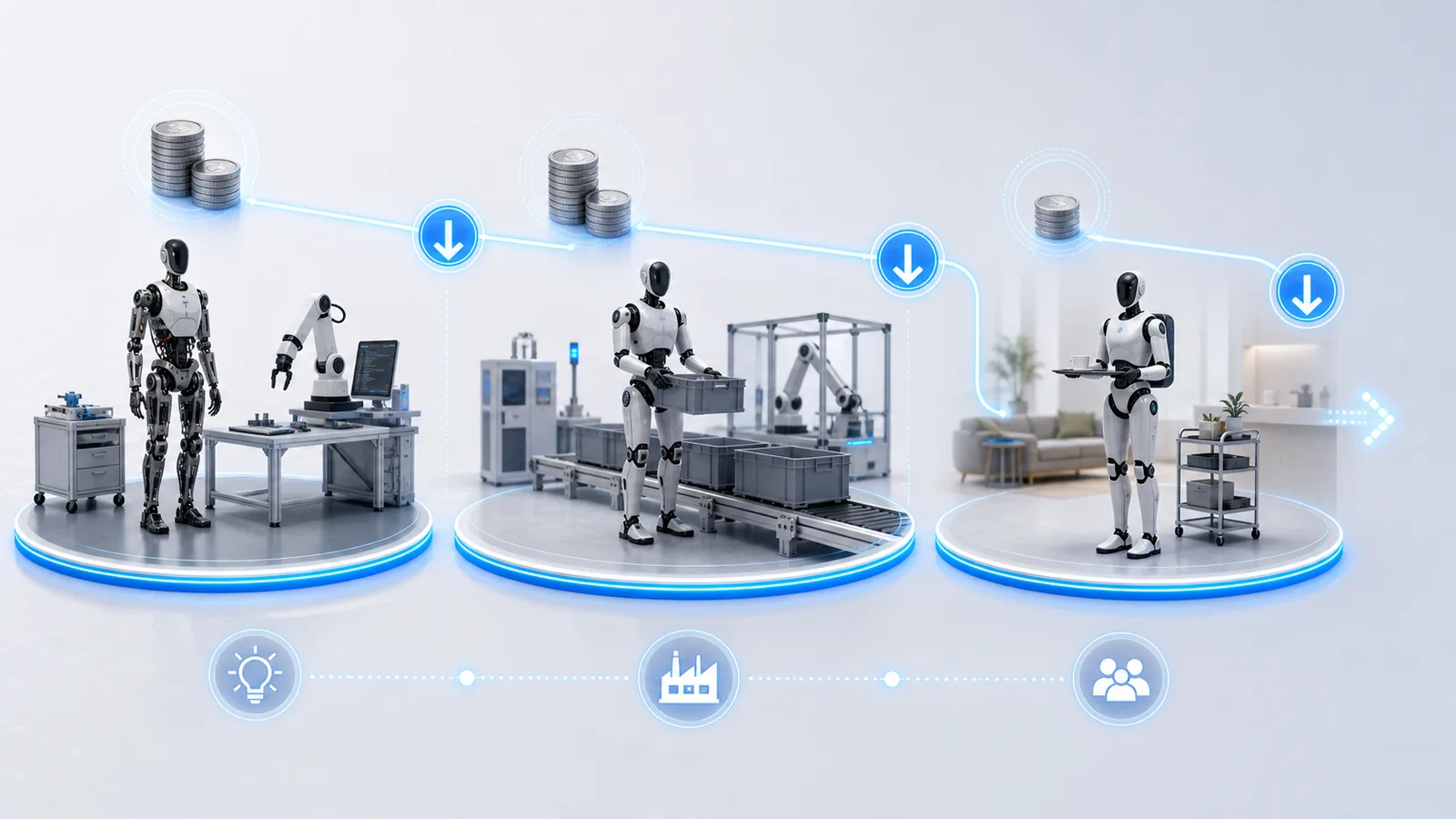
A humanoid robot can cost a few thousand dollars as a compact developer platform, tens of thousands for an early-access system, or far more as an enterprise deployment with integration and support. Many high-profile industrial humanoids do not have a public retail price at all.
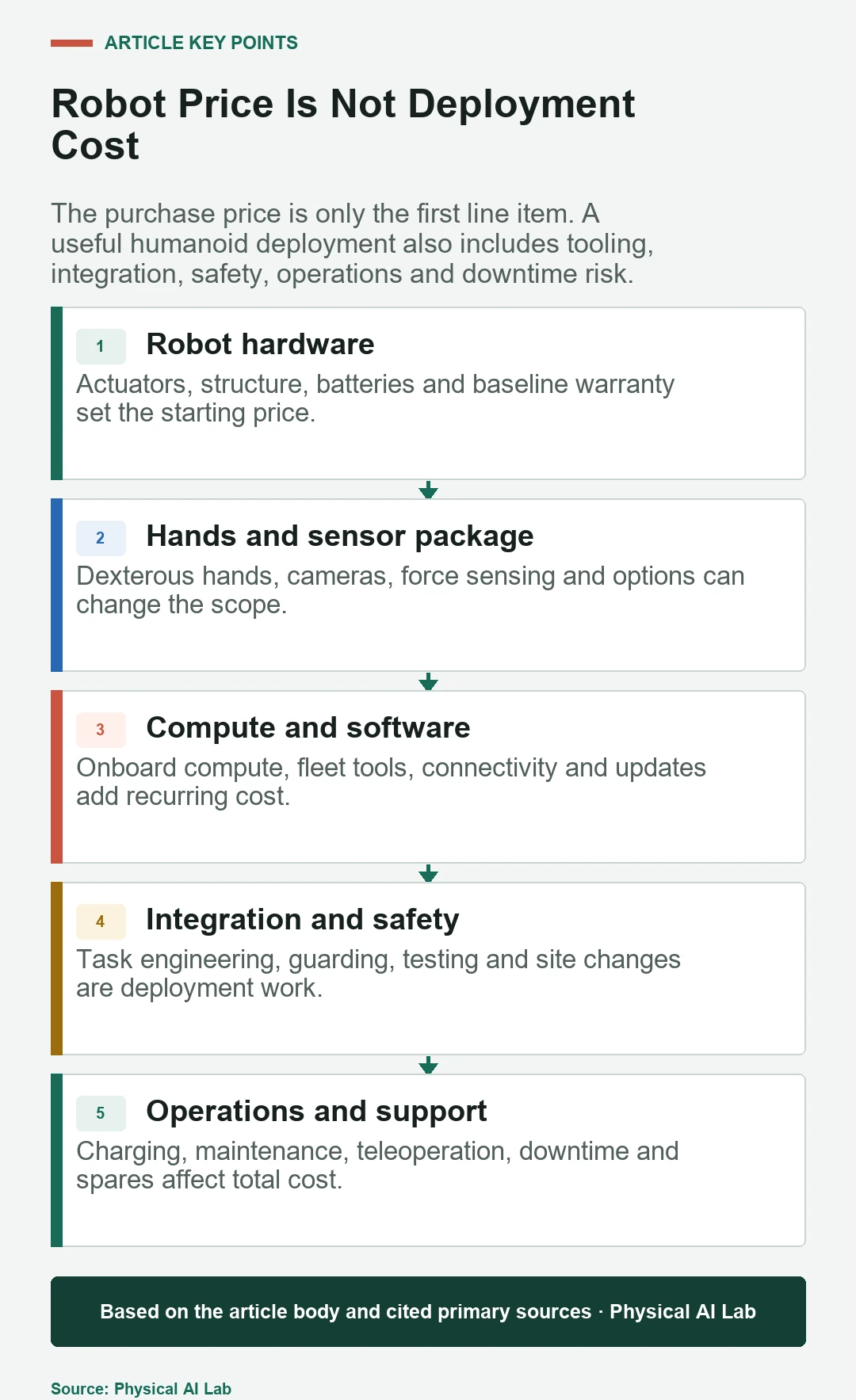
The list price is not the same as the cost to perform useful work. Freight, import charges, compute, end effectors, site preparation, safety engineering, software integration, supervision, maintenance and downtime can exceed the hardware purchase in a pilot.
This guide separates public offers from announced targets and shows how to calculate total deployment cost. Prices were checked against official vendor pages on July 28, 2026 and can change without notice.
Current public humanoid robot prices
Unitree currently lists the R1 AIR at US$4,900 and R1 at US$5,900, while R1 EDU pricing requires contacting sales. Unitree states that listed prices exclude tax and shipping, and the R1 page describes about one hour of battery life.
1X lists NEO Standard at US$499 per month and an Early Access ownership option at US$20,000, with a refundable US$200 deposit. Its order page says U.S. deliveries start in 2026 and describes scheduled Expert Mode support for complex tasks. These offers are not directly equivalent in hardware, service or intended use.
| Official offer checked July 28, 2026 | Public price | Important condition |
|---|---|---|
| Unitree R1 AIR | US$4,900 | Tax and shipping excluded |
| Unitree R1 | US$5,900 | Tax and shipping excluded |
| Unitree R1 EDU | Contact sales | Education and development configuration |
| 1X NEO Standard | US$499 per month | Subscription offer |
| 1X NEO Early Access | US$20,000 | Ownership; U.S. early access |
Official price sources and what they do not prove
The current Unitree figures come from the official R1 product page. The current NEO figures come from the official 1X order page. A reseller quote, social post or prototype target should not replace a dated official offer.
A published price does not prove task readiness. It may exclude hands, batteries, compute, software features, warranty coverage or commercial-use support. Confirm the exact configuration, region, lead time and terms in a written quote before budgeting.
Why many enterprise humanoids have no list price
Enterprise humanoids are often supplied through pilots or commercial agreements because the vendor must define the task, site, fleet size, support and risk allocation. Companies such as Figure present systems and applications publicly without a consumer checkout price for the robot.
No public price is not evidence that a system is unaffordable or available. It means the cost cannot be compared responsibly without a quote and scope. Record it as ‘contact vendor’ instead of filling the gap with an announced future target.
Research platform, early access and production deployment are different products
A research platform is optimized for developer access, experiments and component visibility. An early-access product may include remote support and a changing software roadmap. A production deployment needs repeatability, service response, spare parts, security and operational acceptance.
Comparing only purchase prices collapses those differences. First classify what is being sold: bare hardware, a developer kit, subscription service, managed pilot or task-level outcome. Then compare offers inside the same category.
Total deployment cost model
Total deployment cost equals acquisition plus integration, site preparation, safety, operations, support and expected downtime, minus any residual value. The time horizon and fleet size should be stated because one-time engineering costs spread differently across units.
Use ranges for uncertain items and identify who supplies each component. A low hardware price can still produce an expensive pilot if custom tooling, constant supervision or overseas repair dominates the budget.
| Cost group | Examples | Evidence to request |
|---|---|---|
| Acquisition | Robot, hands, batteries, compute, freight | Itemized quote and configuration |
| Integration | Task software, fixtures, data and testing | Engineering estimate and acceptance scope |
| Safety and site | Risk assessment, guarding, network, charging | Site plan and validation deliverables |
| Operations | Supervision, resets, charging, training | Labor minutes per operating hour |
| Support | Spares, maintenance, warranty and downtime | SLA, repair location and lead time |
Integration cost can exceed the robot
A general humanoid still needs a defined task workflow, grasp strategy, environment map, failure handling and interfaces with existing systems. Custom fixtures or containers may be the cheapest way to make the task reliable, even if the robot is marketed for human-designed spaces.
Software work may include adapting a robot foundation model, collecting site data, integrating fleet management and building monitoring. Budget for validation and regression testing, not only initial programming.
Safety and compliance are deployment costs
Risk assessment, safety-rated devices, reduced-speed zones, emergency stops, training and documentation are part of the system. Their cost depends on contact scenarios, payload, speed and how closely people share the workspace.
Do not assume a human shape makes a robot safe around humans. Validate the complete application, including tools and carried objects, and identify who is responsible for system integration and ongoing change control.
Battery, charging and utilization
Quoted battery time does not equal productive shift time. Subtract walking, waiting, charging, task setup, recovery and maintenance. If battery swapping is supported, include spare packs, chargers, storage procedures and labor.
Utilization should be measured from logs. Calculate completed useful cycles per scheduled hour and track the reasons for idle time. A robot that is inexpensive to purchase but available for few productive hours may have a high cost per task.
Support, spares and downtime
Humanoid robots contain many actuators, transmissions, sensors and cables. Ask which parts are field-replaceable, where repairs occur, how long diagnostics take and whether software support is tied to a subscription.
Model expected downtime as a cost rather than assuming perfect availability. Include spare inventory, shipping time, technician labor and the operational impact when the robot is unavailable.
Lease, subscription or purchase
Purchase provides ownership but concentrates technology and residual-value risk. A subscription can reduce upfront cost and may bundle service, yet total payments and use restrictions need review. A pilot agreement may be appropriate when task feasibility is still unknown.
Compare options over the same term and workload. Include deposits, cancellation conditions, data rights, software updates, support hours and end-of-term return or ownership conditions.
Calculate cost per successful task
Convert the total cost into an operational denominator: successful picks, totes moved, inspections completed or productive robot hours. Count only outcomes that meet quality and safety acceptance criteria.
A simple annual measure is total annualized cost divided by accepted tasks. Test low, expected and high utilization scenarios because intervention and downtime often improve during a pilot and then change again at larger scale.
- Define one accepted task and its quality threshold.
- Measure autonomous completion and human labor minutes.
- Annualize acquisition over a stated useful life.
- Add support, energy, consumables and expected downtime.
- Compare with the existing process at the same service level.
A buyer checklist for humanoid robot quotes
Request the exact robot configuration, included hands and batteries, payload and speed limits, onboard and cloud compute, software license, API access, delivery region, warranty, spare availability and support response. Ask which capabilities have been demonstrated on your task.
Then run a measured pilot inside a defined physical AI operating envelope. Record interventions, successful task rate, recovery, safety stops, energy and maintenance. Purchase decisions should follow task evidence rather than a target price or a presentation video.
How to read future price announcements
Separate an available order price from a forecast, prototype cost or long-term mass-production target. Note the announcement date, volume assumption, included hardware and whether delivery terms exist.
Prices may fall as manufacturing scales, while capable hands, compute, service and integration remain significant. Update the cost model when an official configuration and commercial terms become available.
Frequently asked questions
What is the cheapest humanoid robot in 2026?
Among the public official offers checked for this article, Unitree lists R1 AIR at US$4,900. It is not directly comparable with a managed household or industrial deployment, and tax and shipping are excluded.
How much does a 1X NEO robot cost?
The official order page checked July 28, 2026 lists Standard at US$499 per month and Early Access ownership at US$20,000, with a refundable US$200 deposit.
Can a humanoid replace a worker at its purchase price?
No reliable comparison can use purchase price alone. Include integration, supervision, task success, operating hours, safety, maintenance and downtime.
Why do some humanoid companies not show a price?
Many systems are sold through enterprise pilots or scoped agreements. Configuration, support, task integration and volume affect the quote.
What is the best cost metric?
Cost per accepted task or productive hour is more useful than hardware price because it includes utilization, interventions and support burden.
Price and Availability Can Change
Prices and commercial terms can change. Check the linked official vendor pages and obtain a written quote. This article is an engineering cost framework, not purchasing or financial advice.