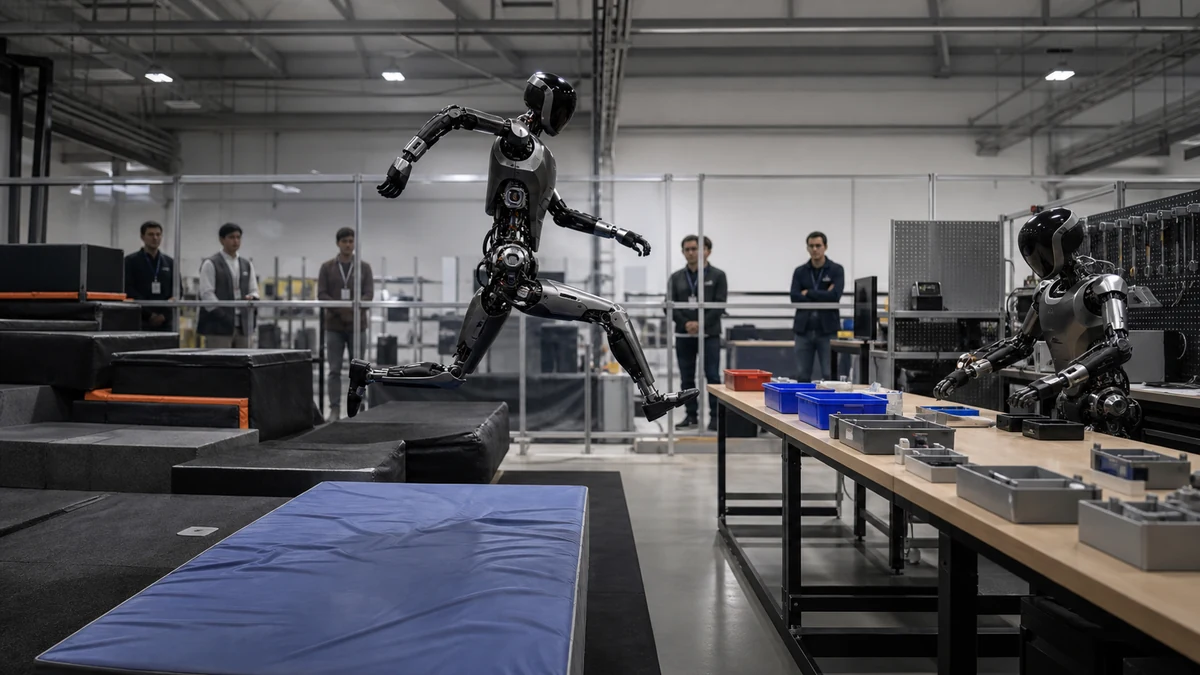
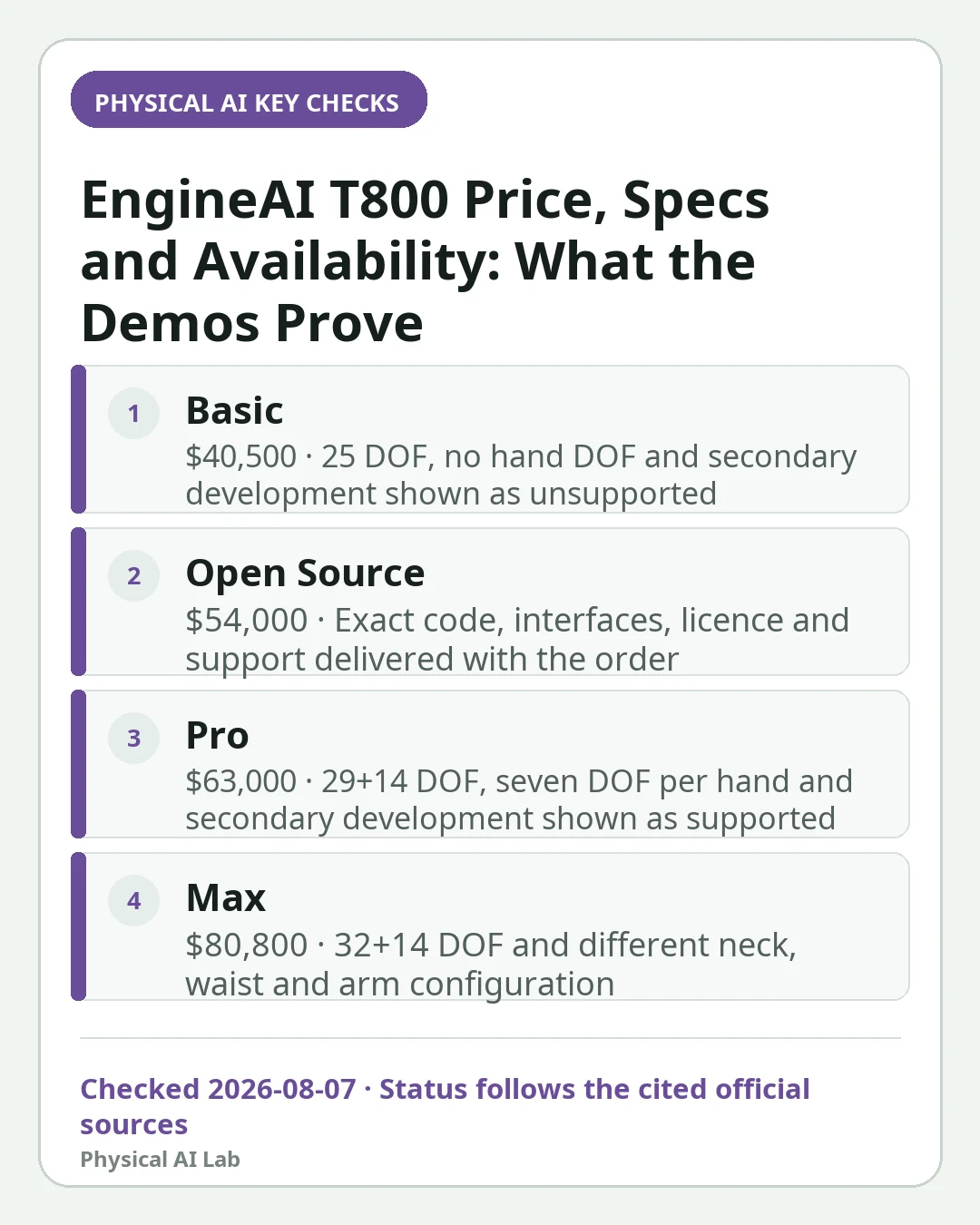
As of August 7, 2026, the EngineAI T800 is more than a concept reveal: it has a current product page with edition-level prices and specifications. The official T800 product page lists the Basic edition at $40,500, Open Source at $54,000, Pro at $63,000 and Max at $80,800. It does not publish a live stock count, a country-by-country delivery list, taxes, freight or a guaranteed lead time. A price table supports a sales conversation; it does not prove that a buyer can check out online and receive a robot immediately.
The punches, flying kicks and linked motion sequences are useful evidence of actuator output, balance and dynamic control in the setup shown. They are not evidence that the same robot can understand an unfamiliar warehouse or household request and complete it safely without supervision. A buyer should compare the exact edition, development rights and acceptance task before treating the phrase general purpose as a delivered capability. The humanoid demo evaluation guide provides a useful way to separate a recorded result from an operating envelope.
Published prices do not answer stock, delivery or total cost
EngineAI's December 2025 launch article said the launch process had begun and gave a China starting price of RMB 180,000. The current English product page goes further by displaying four US-dollar edition prices. That is stronger commercial evidence than an exhibition announcement, but neither page states that every edition is in stock for every region or gives a binding delivery date.
The visible purchase route is consultation-led rather than a conventional cart with shipping terms. Ask the seller to identify the edition, hand configuration, perception package, computer, battery option, SDK and API deliverables, warranty, training, import route and lead time in one signed quotation. The purchase price also excludes much of the integration and safety work discussed in the 2026 humanoid robot price guide.
| Edition | Current listed price | Decision point to confirm |
|---|---|---|
| Basic | $40,500 | 25 DOF, no hand DOF and secondary development shown as unsupported |
| Open Source | $54,000 | Exact code, interfaces, licence and support delivered with the order |
| Pro | $63,000 | 29+14 DOF, seven DOF per hand and secondary development shown as supported |
| Max | $80,800 | 32+14 DOF and different neck, waist and arm configuration |
Read the specification table one edition at a time
The current table describes a 173 cm platform weighing 75 to 85 kg depending on edition, with maximum joint torque of 450 N·m and a hardware-supported movement speed of at least 3 m/s. It lists a ternary lithium battery as standard, a solid-state battery as an option, and a four-to-five-hour battery-life figure. The page also warns that parameters vary with business scenario, device posture and other conditions, so the battery number is not a guaranteed shift length under payload.
Basic is shown with an Intel depth camera and Orin NX 16G. Pro and Max list a proprietary stereo-vision-plus-LiDAR perception system and AGX Orin 64G, with computing upgrades described as customisable. Those lines should not be collapsed into one T800 specification because a quoted Basic and a displayed Max have different hands, joints, sensors and development access. Ask for the revision and document date that govern the actual shipment.
The 2025 debut numbers describe a different point in the product's history
The official World Robot Conference 2025 report described the debut unit as 1.85 metres tall, 85 kg and equipped with 41 high-degree-of-freedom joints. The current commercial page uses 173 cm and separates Basic, Open Source, Pro and Max configurations, with body and hand degrees of freedom shown differently by edition. The official sources therefore document an evolving platform rather than one timeless data sheet.
Do not combine the old 1.85 m height, a current Max DOF count and today's price as though they belonged to the same configuration. Use the current edition table for screening, then require a contract specification for procurement. This is especially important for software teams: a change in hands, waist, sensor suite or compute alters the control schema, calibration work and the policy that can be deployed.
| Evidence type | What it supports | What it does not establish |
|---|---|---|
| Current edition table | Listed price, joints, sensors and compute by edition | Stock, destination eligibility, guaranteed lead time or field output |
| High-mobility video | Dynamic movement in the displayed setup | Open-ended task planning or repeated autonomous success |
| Application-scene images | The vendor's intended markets | A paying deployment, productivity or safety result |
| Launch or production statement | The company's stated commercial stage | Independently audited volume or certification scope |
_in_November_2014.JPG)
Martial-arts motion is a dynamics test, not a general-intelligence test
The product page presents combination punches, flying kicks, roundhouse kicks, capoeira and walking. These clips can reveal rapid weight transfer, joint coordination, recovery and mechanical stiffness. They do not disclose every failed attempt, the safety equipment outside the crop, whether the sequence was teleoperated or played from a trained policy, or how often it succeeds from different starting states.
EngineAI can reasonably position the platform for research and multiple application domains, but general purpose remains a broad product claim until task evidence narrows it. A convincing work trial would include natural or structured instruction, changed objects and locations, several dependent steps, recovery from a miss, safe behaviour near people, repeated success rates and operating time. The guide to humanoid robot types helps distinguish a development platform from a validated job-specific system.
The URKL resources are useful but competition-limited
EngineAI's URKL online qualifier page provides a concrete development trail: T800 URDF and mesh resources, a MuJoCo-compatible XML, 30 Hz human and remapped boxing motion data, and base training and simulation-deployment code. That is meaningful evidence that participants can work with the robot's structure and reproduce a defined motion-policy pipeline, rather than merely watching a promotional clip.
The same page limits the released models, data and code to the event and forbids violent, dangerous, illegal and non-competition use. Competition resources therefore cannot be represented as the commercial SDK licence for every T800 edition or as an open stack for unrestricted industrial work. Procurement should specify which interfaces, examples, source files and deployment tools are licensed to the buyer, along with the support level and permitted use.
A buyer needs a task acceptance test, not a highlight reel
Write one target task in measurable terms before requesting a demonstration. For box handling, define object dimensions and mass, shelf heights, travel distance, floor, lighting, human access, required cycles per hour, charging plan and the recovery expected after a failed grasp. Run the same test repeatedly and record manual interventions, drops, protective stops, resets and cycle-time variation.
Then map the task to the edition. Basic may be unsuitable if dexterous hands or secondary development are essential; Max may add joints and compute without improving the bottleneck that governs the job. The acceptance document should cover success rate, safe stop, logs, data ownership, update process, spare parts and who restores the robot after a failed release. That evidence is more useful than maximum torque without a duty cycle.
What the official record supports today
The EngineAI home page includes T800 in the current product family and publishes its headline height, degrees of freedom and torque. Taken with the detailed product table, launch article and competition resources, the official record supports four priced editions, a high-mobility hardware platform and a defined simulation workflow for the competition. It is reasonable to approach the company for a formal quotation and evaluation.
The public pages do not, by themselves, prove immediate stock in a chosen country, a guaranteed ship date, a particular safety certification, independently verified production volume or unsupervised success across general work. Commercialisation evidence is stronger than a concept, but it is not the same as a broadly validated autonomous worker. If the seller cannot turn the desired task and edition into contractual acceptance criteria, the capability claim remains too open for a purchase decision.
Safety boundaries belong in the order, training and test plan
The launch article explicitly warns buyers to understand the product's limits, follow local law, avoid dangerous modification and treat extreme actions as technical validation under professional supervision. A full-size platform with a listed peak joint torque of 450 N·m demands a controlled test area, emergency-stop access, trained operators and a risk assessment matched to the actual tool and task.
Do not reproduce fighting motions simply because model data exists. Use the vendor's approved procedures, keep people outside the test envelope and verify the applicable machinery, workplace, radio and electrical requirements in the destination. The article cannot establish certification or legal suitability for a deployment; those decisions require product documents and qualified local professionals.
Frequently asked questions
Can I buy an EngineAI T800 online today?
The official product page publishes edition prices, but it does not show a live stock count, conventional checkout, country-by-country shipping or a guaranteed delivery date. Request a written quotation that fixes the edition, region, total cost and lead time.
Do the T800 punching and kicking videos prove general-purpose autonomy?
No. They show dynamic motion in the displayed setup. Unfamiliar task understanding, long autonomous operation, repeat success, human-safe recovery and field productivity require separate, measurable tests.
Why do older and current T800 specifications differ?
The 2025 debut article described an earlier public configuration, while the current page separates Basic, Open Source, Pro and Max editions. Do not mix figures across dates or variants; procure against the latest edition-specific contract specification.
Official sources checked
- EngineAI official home page and current product family
- EngineAI T800 current specifications and prices
- EngineAI T800 official launch and product cautions
- EngineAI WRC 2025 T800 debut report
- EngineAI URKL T800 online qualifier resources
2026-08-07