
Robot training data should never be cleared under one assumed license. Before collecting, combining, training, redistributing or commercializing it, identify the dataset terms, code license, consent for people in video, audio and action traces, permission for the location, and rights in third-party objects or screens. The word open-source does not grant all of those permissions.
Keep technical history in robot dataset versioning and lineage, and use the dedicated structures for robot action data and teleoperation data. This is an operational governance framework, not legal advice. Copyright, database rights, privacy, biometrics and valid consent differ by jurisdiction and facts.
Separate the intended action from every rights layer
Downloading for internal research, training a customer product, publishing a merged dataset and redistributing the original files are different acts. State the purpose, users, geography, retention period, audience and revenue activity in plain language, then test whether each proposed act is authorized.
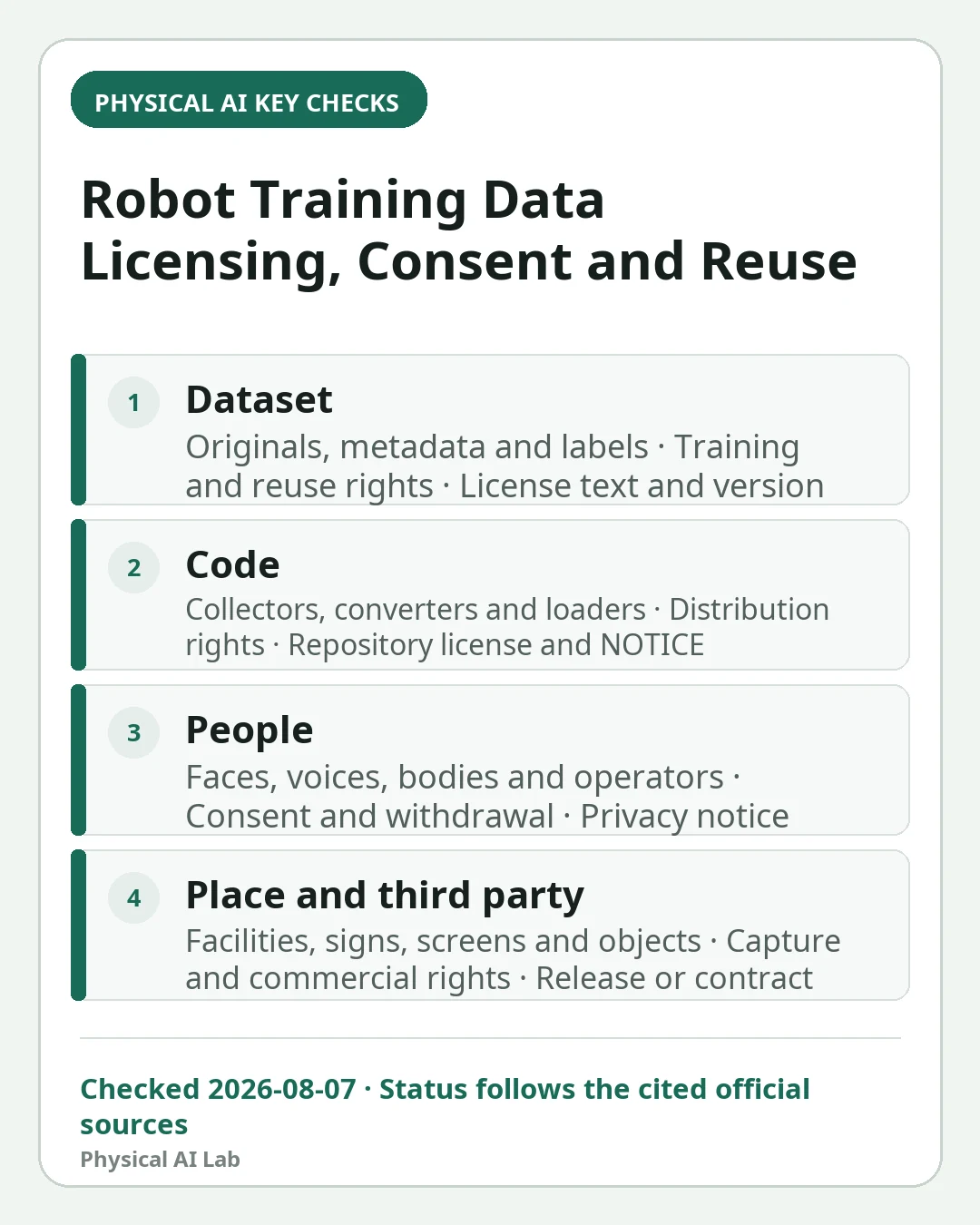
One archive may contain camera video, joint and force streams, language annotations, calibration, metadata, collection software and documentation. A dataset license does not necessarily govern code, and a code license does not settle consent for a person's face, voice or worksite. Treat each artifact as a separate entry until evidence connects it to a common grant.
| Rights layer | Artifact to inspect | Decision question | Evidence |
|---|---|---|---|
| Dataset | Originals, metadata and labels | Are training, modification, redistribution and commercial use allowed? | Exact license text and version |
| Code | Collectors, converters and loaders | Will code be distributed with the deliverable? | Repository license and NOTICE |
| People | Faces, voices, bodies and operators | Does consent cover each purpose and withdrawal? | Consent record and privacy notice |
| Place and third party | Facility, signs, screens and objects | Is capture, disclosure and commercial use authorized? | Location release or contract |
Create an artifact register before the first collection run
Track source, collection date, device, file and field type, whether a person appears, sensitivity, license, consent ID, retention rule and owner at stream or artifact level. A dataset-level note is too coarse when one camera contains workers while another stream contains only robot state.
Link originals to shards, annotations, derived features, benchmark splits and checkpoint training manifests. Without that lineage, the team cannot answer a removal request, identify which model consumed a disputed sample or prove that a restricted subset was excluded from a commercial release.
Assign separate collection, privacy, security, model and release owners. Document who can open raw media, what an annotation vendor receives, where replicas are created and how long access logs remain available. This responsibility map turns policy language into controls that can be audited.
Read the project page, repository and dataset card together
The DROID dataset project site is an official starting point for scope and project context, while the DROID GitHub repository is where code, documentation and current repository terms can be inspected. Do not enlarge a statement from one page into permission for every component; record the retrieval date and hash of the license file reviewed.
LeRobot separates technical format from individual repositories. The LeRobotDataset v3 documentation describes the storage and interface, while community_dataset_v3 exposes a particular dataset card and files. A format specification cannot grant rights in every community dataset that adopts it.
Inspect nested archives, referenced source datasets and generated labels as well as the top-level card. If a repository lacks a clear license, that absence is not an implied unrestricted grant. Quarantine it from release workflows until the owner supplies evidence or qualified counsel approves a narrower use.

Consent must say more than permission to record
A usable notice explains the collection purpose, sensor streams, face, voice and body movement, annotation, model training, third-party access, public release, commercial use, retention and withdrawal route in language participants can understand. Preserve the notice version and the purpose accepted at the time of collection.
Employment, patient care, education and other unequal relationships may undermine whether consent is freely given, so provide alternatives and obtain jurisdiction-specific review. A location owner may authorize entry without authorizing publication of workers, visitors, production screens or confidential processes.
Face blurring is only one control. Voices, badges, reflections, screen content, body characteristics, Wi-Fi identifiers, timestamps and location metadata can still identify a person or expose a facility. Validate de-identification by modality and recheck after streams are combined.
Review combinations and derivatives from the strictest component
The Creative Commons license guide distinguishes conditions such as attribution, ShareAlike, NonCommercial and NoDerivatives. Preserve the exact license name and version; recording only ‘CC’ destroys the information needed to decide compatibility or downstream obligations.
Whether model weights are a derivative of training data, whether a merged corpus creates a protected database, and whether embeddings retain personal or confidential information depend on law and facts. Do not state a universal answer in a dataset card. Escalate uncertain public or commercial releases to qualified counsel in the relevant jurisdictions.
Run the gate below for the concrete deliverable. A restriction may permit internal experiments yet block publication of raw examples, a hosted API, customer fine-tuning files or a dataset mirror. Record both what was approved and what was explicitly excluded.
| Planned action | Required check | Hold signal | Operational result |
|---|---|---|---|
| Internal training | Purpose, access, retention and training permission | No license or unclear consent scope | Isolate or approve |
| Dataset combination | License compatibility, lineage and duplicate people | Conflicting conditions or lost provenance | Keep separate or seek review |
| Redistribution | Rights for original and derived files, attribution | Third-party media remains | Exclude, redact or hold |
| Commercial use | NC terms, contracts and consent purpose | Relies only on an open-source label | Proceed only after written approval |
Make removal requests traceable through replicas and models
Define an intake channel, identity verification, search process, legal-retention exceptions, response time and outcome notice. A sample ID should resolve to originals, shards, annotations, caches, mirrors, benchmarks and the training manifests of checkpoints that consumed it.
For backups that cannot be immediately erased for technical or legal reasons, record access restriction and expiration. Notify authorized downstream recipients when required, block the sample from future training and document whether retraining, a model update, restricted use or another remedy is appropriate.
Test the process with a synthetic request before release. The exercise should reveal orphaned copies, exports outside the registry and checkpoints whose training set cannot be reconstructed without using any real participant's data as a test case.
Use a signed release gate and reopen it when conditions change
Before release, owners sign off on artifact-register completeness, exact license texts, attribution and NOTICE files, consent and location permission, sensitive-data scans, security access, removal workflow and downstream conditions. Missing evidence is a hold, not permission by default.
Reopen the review when a dataset card or repository license changes, a vendor contract is replaced, purpose or jurisdiction expands, a sensor is added, or distribution changes from internal files to weights, API access or public data. Preserve each decision with the evidence and legal assumptions that supported it.
Keep a working contact address and version-specific rights record after publication. If a restriction or consent problem is reported, pause affected distributions, preserve evidence, identify downstream copies and let the assigned owner coordinate technical, privacy and legal response.
Frequently asked questions
Can an open-source robot dataset automatically be used in a commercial product?
No. Check the exact dataset license and version, code terms, consent for people and locations, third-party material and contractual restrictions for the planned commercial act.
Does blurring faces remove every privacy issue?
No. Voice, body characteristics, badges, screens, location and combined behavior can identify people or reveal confidential information. Test de-identification across all modalities.
Must a trained model always be deleted after a data-removal request?
There is no universal answer. Applicable law, consent, contracts, lineage, technical feasibility and risk determine whether retraining, an update, restricted use or another remedy is required.
Official sources checked
- DROID dataset official site
- DROID GitHub repository
- LeRobotDataset v3 documentation
- LeRobot community_dataset_v3
- Creative Commons license guide
Last checked: August 7, 2026