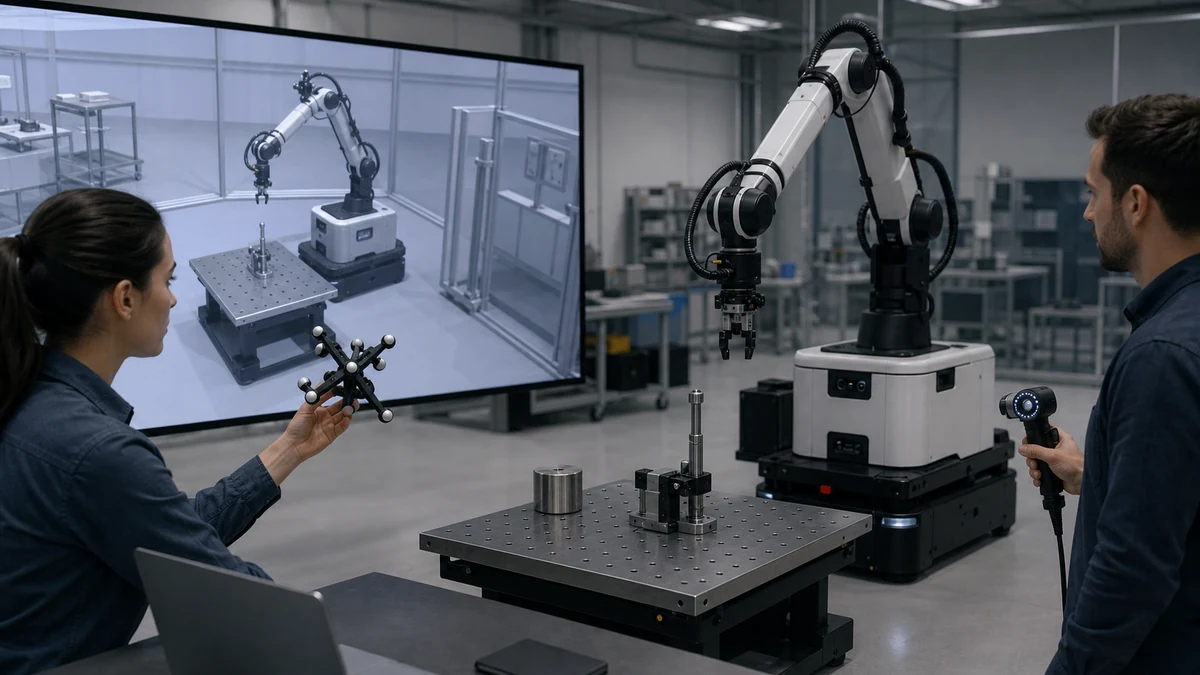
A robot simulation is accurate enough only when the physical quantities that control the intended task agree with repeatable real measurements inside predeclared tolerances. Contact-rich insertion and free-space planning need different acceptance matrices, and a pass for one task does not qualify every policy, payload or site.
Use sim-to-real failure modes to form hypotheses and robot system identification to estimate measured parameters. Apply domain randomization to approved uncertainty, and keep virtual commissioning and digital twins distinct by purpose. These tests do not replace hardware safety validation.
Derive subsystem tolerances from the task and its failure
List the variables to which the policy is sensitive and the consequence of getting each one wrong. Balance may depend on actuator delay and contact impulse, insertion on friction and compliance, and mobile inspection on sensor timing and dropout. Assign a real reference, metric, tolerance, repetition count and owner to every gate.
A tolerance should come from measurement uncertainty and a sensitivity test that shows when task performance degrades, not from a simulator default. Compare variance, tails, directional bias and repeatability as well as the mean. A model that matches one average can still fail at breakaway friction or the edge of a joint range.
Freeze the acceptance matrix before tuning so the team cannot move thresholds toward a convenient result. Use a separate holdout fixture or trajectory for final approval and state whether the gate qualifies training, regression testing, virtual commissioning or only visualization.
| Subsystem | Real input or fixture | Comparison metric | Pass decision |
|---|---|---|---|
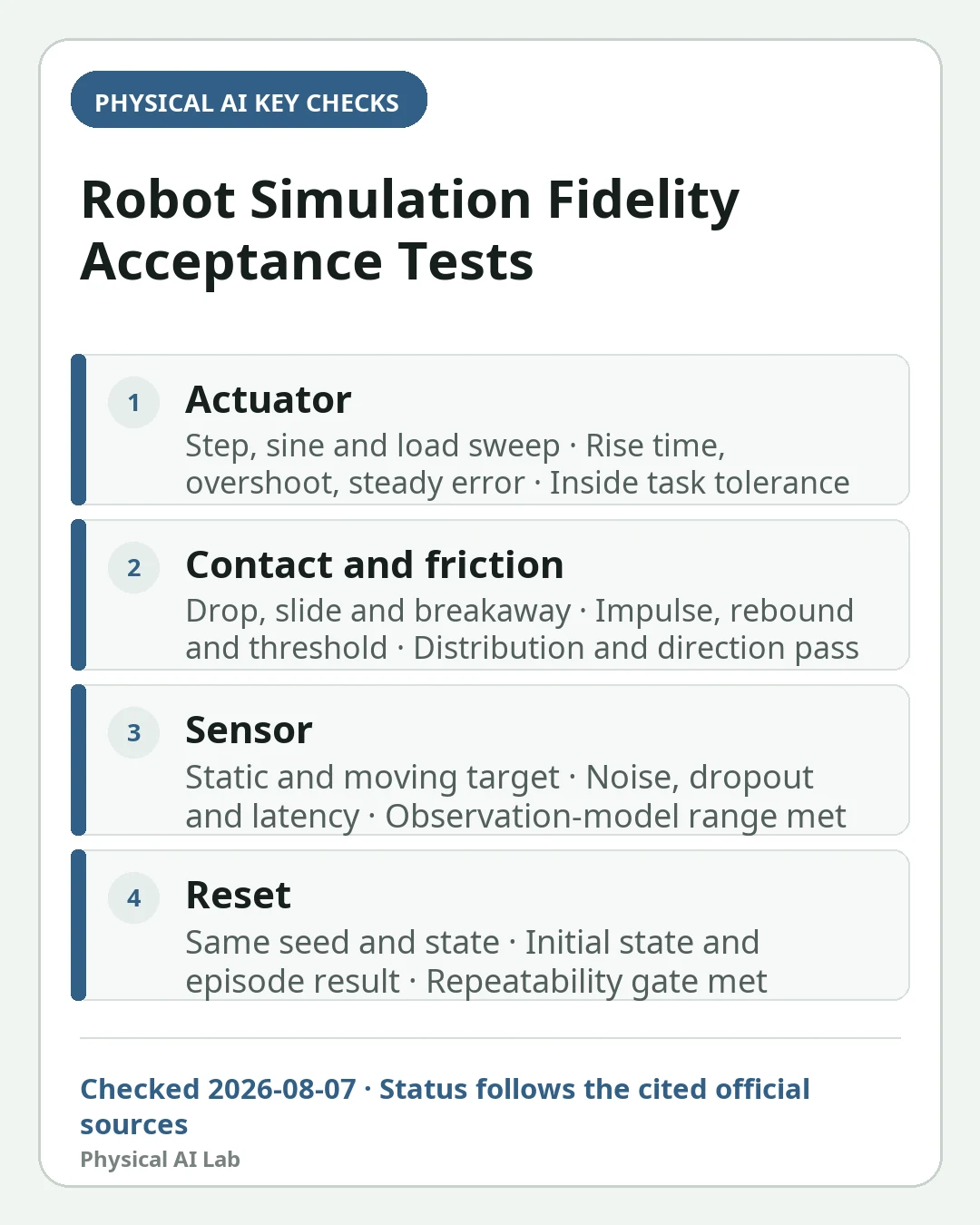
| Actuator | Step, sine and load sweep | Rise time, overshoot, steady error | Inside task tolerance |
| Contact and friction | Drop, slide and breakaway | Impulse, rebound and threshold | Distribution and direction pass |
| Sensor | Static and moving target | Noise, dropout and latency | Observation-model range met |
| Reset | Same seed and state | Initial state and episode result | Repeatability gate met |
Freeze an identical test contract for hardware and simulation
Bundle URDF, MJCF or USD assets, meshes, inertias, actuator and sensor settings, controller, solver, timestep, substeps, contact parameters, random seeds and software versions in a manifest. On hardware record firmware, payload, battery and temperature state, sample rate, calibration and protective limits.
Apply the same command sequence, initial pose, fixture dimensions, payload and surface, then align timestamps to a common definition. Supplying ideal ground truth only in simulation or filtering only the hardware trace measures pipeline mismatch rather than physics fidelity.
Retain raw signals and the transformation code used for comparison. If the simulator logs requested torque while hardware logs estimated motor torque, document that semantic difference and create a comparable signal instead of plotting the two labels as if they were equivalent.
Match actuator step response and joint limits before contact
The Isaac Lab actuator API is an official reference for actuator models and configuration. Run safe step, sine and load sweeps on hardware and simulation, then compare rise time, overshoot, steady-state error, saturation, deadband and rate limits.
Validate position, velocity and effort limits, soft stops, gear ratio, reflected inertia, controller gains and command delay separately. A no-load match that diverges under payload points toward torque-speed limits, thermal protection, structural compliance or a controller state absent from the model.
Test positive and negative directions and several joint positions because gravity, cable routing and transmission friction can make the response asymmetric. Preserve untuned holdout runs so a visually attractive curve is not the result of overfitting one motion.
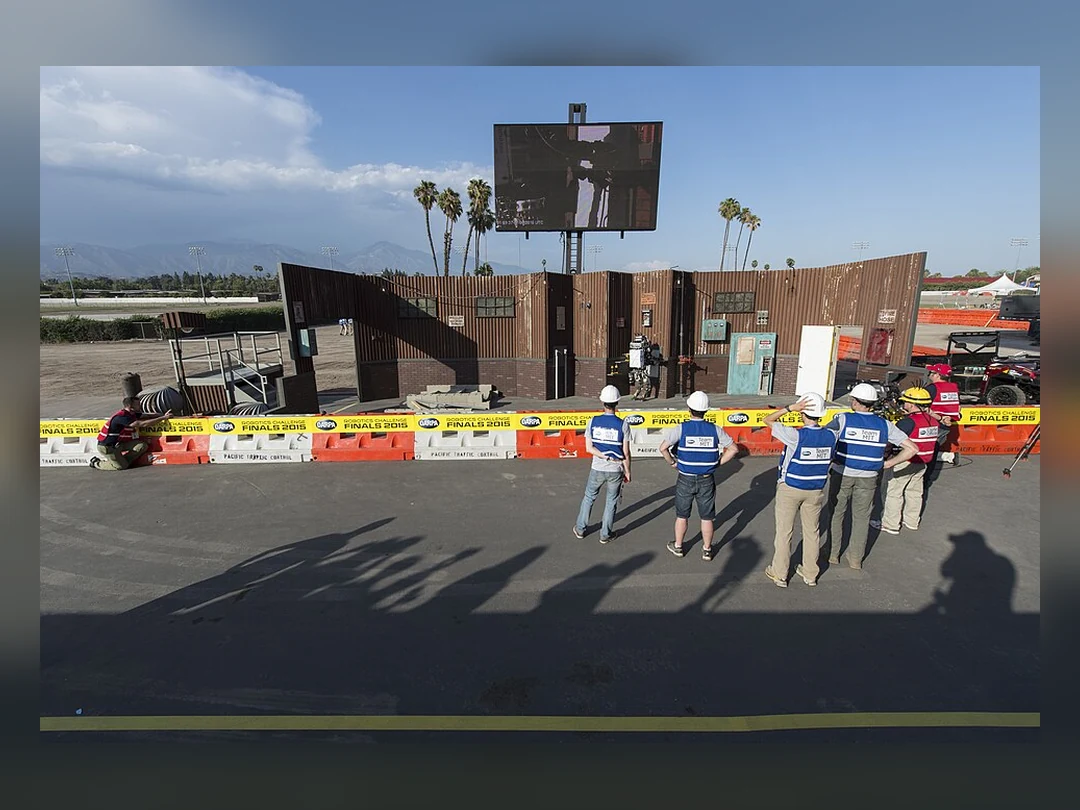

Test contact, friction and payload alone before combining them
Use the MuJoCo modeling documentation to interpret model elements and solver settings. Begin with simple fixtures: impact and rebound from a controlled drop, static breakaway and dynamic slide on known surfaces, gripper squeeze, and posture response with a measured payload.
Do not tune penetration or bounce for one scene and declare the contact model complete. Hold out speeds, approach directions, masses and surfaces, then check whether changing friction or compliance for one contact pair damages a different task.
Report the measurement apparatus and uncertainty. A force plate, motor-current estimate and vision-derived motion do not have the same bandwidth or error. Comparing unsynchronized peaks can make the solver appear wrong when the instrumentation is responsible.
Model sensor statistics and the entire control delay
Use the Gazebo sensors documentation to verify each sensor's update rate, noise, frame, field and plugin settings. With static targets compare bias and variance; with moving targets compare latency, dropout and motion effects; across sensors compare timestamp skew.
End-to-end command delay includes sampling, middleware, inference, controller and hold behavior. Reproduce jitter and p95 or p99 tails, not only an average. The simulator's queue, drop and stale-observation behavior must match the deployed pipeline when deadlines are missed.
Keep the observation transformation identical. Resolution, crop, quantization, frame convention and filtering can dominate a policy input even when the simulated ray geometry is correct. Qualify raw and policy-ready signals as separate gates.
Add reset repeatability and sim-to-sim checks to release
From the same seed and snapshot, test whether initial contacts, joint and sensor state, and the first action outcome repeat. If environment count, CPU versus GPU, threading or solver changes the result, document the deterministic boundary and qualify the expected stochastic distribution instead of promising bitwise identity.
The Isaac Lab Newton sim-to-real guidance is a reference for reviewing backend and sim-to-real behavior. Training in one engine and evaluating a holdout in another can expose engine-specific assumptions, but two simulators can share the same wrong asset or parameter.
Use sim-to-sim as a diagnostic, then retain a real holdout. A disagreement should be traced to asset semantics, solver, controller, timing or sensor implementation before widening randomization or accepting a policy.
| Gate | What stays fixed | Compared result | Response to failure |
|---|---|---|---|
| Repeatability | Seed, snapshot and hardware | State and metric variance | Isolate nondeterminism |
| Sim-to-sim | Assets and controller | Task metric by backend | Separate shared and engine errors |
| Real holdout | Unused fixture and trajectory | Error against hardware | Retune or narrow scope |
| Policy check | Checkpoint and observation | Success, constraint and intervention | Hold large-scale training |
Publish the qualified scope and every remaining gap
The evidence pack includes task and environment scope, asset and solver versions, hardware fixture, raw logs, alignment code, metrics, tolerances, results, known gaps and owners. Word the decision as ‘this configuration is adequate for this task under these conditions,’ never as certification of an entire simulator.
Re-run affected gates after an asset, controller, solver, timestep, sensor, payload, hardware or task-range change. Automate the suite before expensive policy training, but independently complete reduced-risk real-environment evaluation and hardware safety validation before deployment.
A failure is useful evidence, not a reason to tune every parameter. If the uncertain quantity has little task sensitivity, record the gap and leave it alone; if it changes safety or success, improve measurement or narrow the approved operating envelope.
Frequently asked questions
Can simulation fidelity be reduced to one pass score?
Usually not. The important subsystems and tolerances differ by task, so qualify actuator, contact, sensing, delay, repeatability and task metrics separately.
Does a successful simulated policy reduce the need for hardware testing?
Simulation can reject weak candidates, but it cannot replace real-environment evaluation or hardware safety validation because unknown model and site gaps remain.
Does broad domain randomization remove the need for fidelity tests?
No. Unsupported ranges can make training harder or produce unrealistic behavior. Base randomization on measured parameters, residual error and task sensitivity.
Official sources checked
- Isaac Lab actuator API
- Isaac Lab Newton sim-to-real
- MuJoCo modeling documentation
- Gazebo sensors documentation
Last checked: August 7, 2026