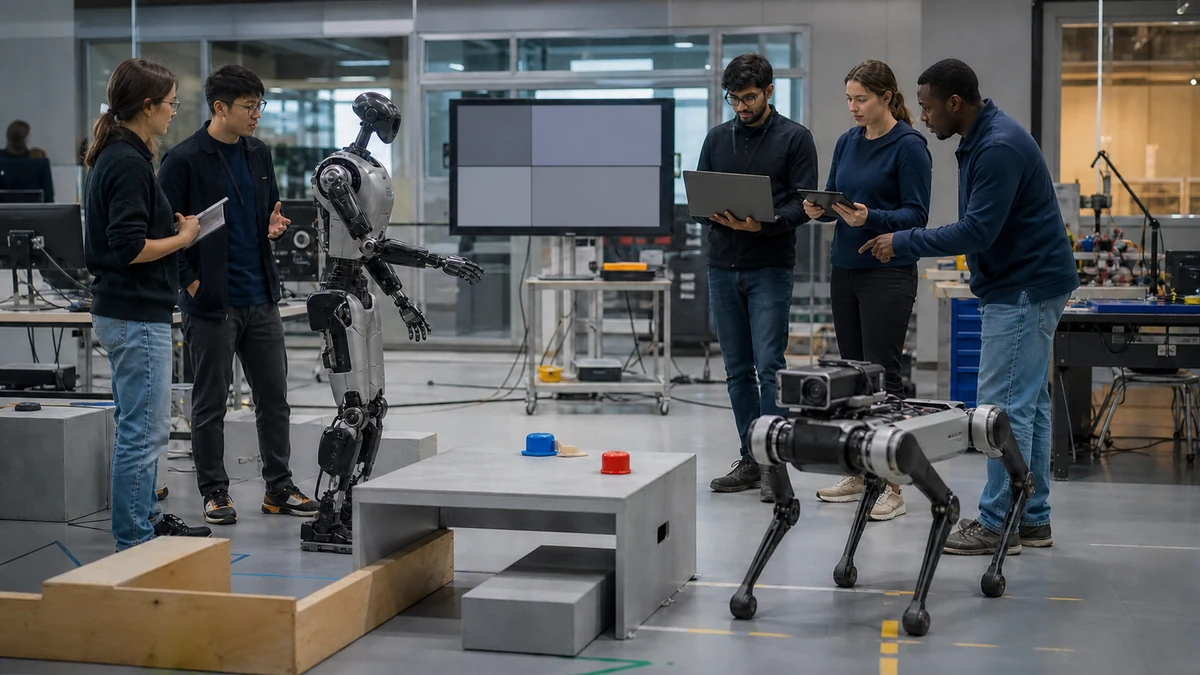
No. As checked on August 7, 2026, Google does not own Boston Dynamics; Boston Dynamics' partnership announcement identifies Hyundai Motor Group as its majority shareholder. Google DeepMind is an AI research partner for Gemini Robotics work with Atlas, plus selected AI integrations involving Spot and Orbit.
Use the Atlas, Spot and Stretch lineup comparison for product roles, the Atlas 2026 buying guide for commercial access, and the Spot price and TCO guide for procurement. An AI partnership is not an equity acquisition, proof of scaled Atlas factory deployment or evidence that every Spot function is autonomous.
Separate the shareholder, research partner and product provider
The official Boston Dynamics and Google DeepMind partnership announcement identifies Hyundai Motor Group as Boston Dynamics' majority shareholder and describes Google DeepMind as a strategic AI partner. It does not announce that Google repurchased the company or took a controlling stake.
A Hyundai Motor Group account of the Boston Dynamics acquisition explains Hyundai's acquisition rationale and expected manufacturing and logistics synergies. Ownership and technical collaboration can coexist, but they answer different questions and should not be used as synonyms.
For a buyer, the practical map has more than two boxes: Boston Dynamics provides the robot and parts of its software stack, Google DeepMind provides or develops AI models and services, and Hyundai Motor Group holds the shareholder role. Contracts must identify which entity supports each component.
| Relationship | Parties | Officially supported statement | Unsupported conclusion |
|---|---|---|---|
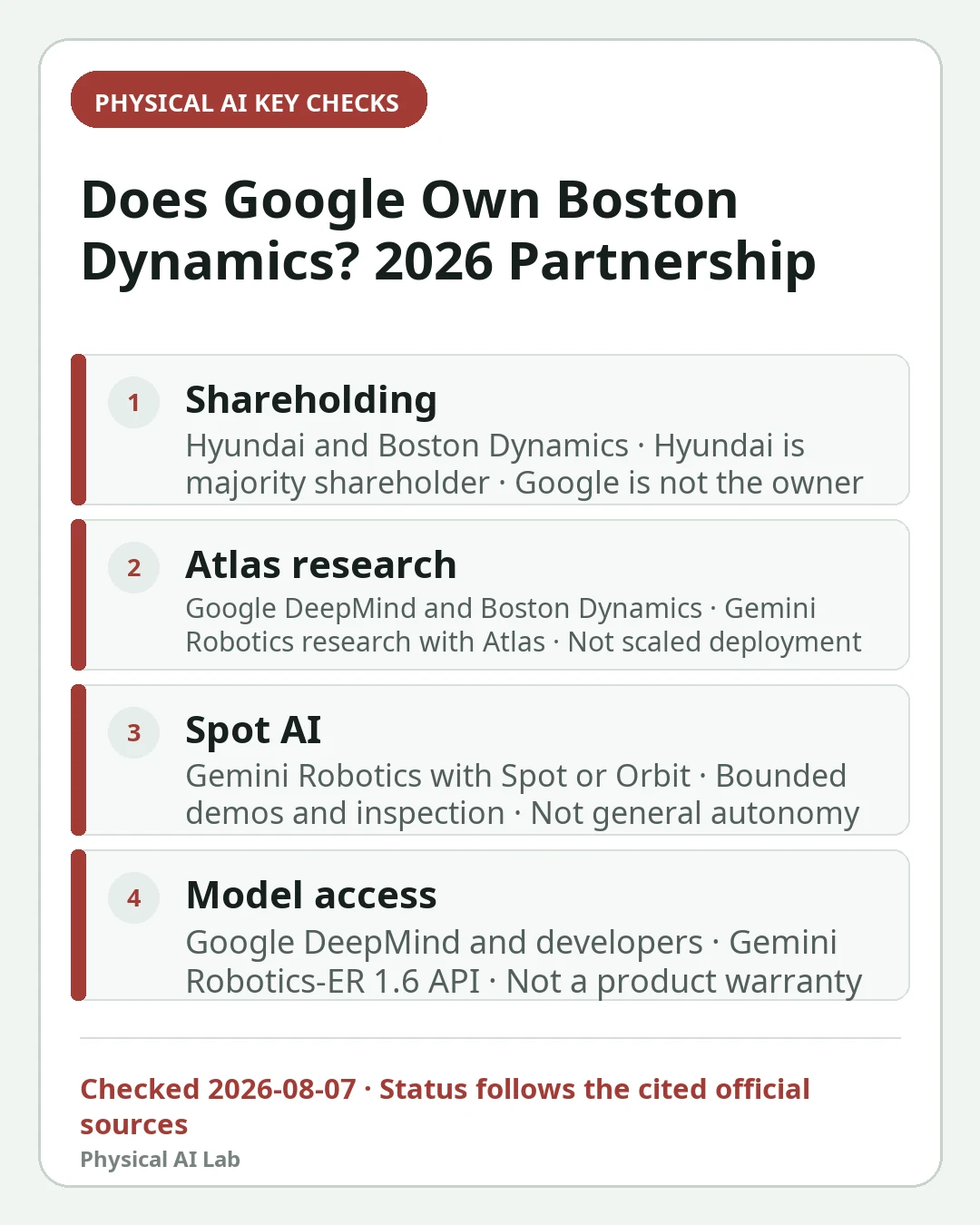
| Shareholding | Hyundai Motor Group and Boston Dynamics | Hyundai is the majority shareholder | Google is not the current owner |
| Atlas joint research | Google DeepMind and Boston Dynamics | Research on Gemini Robotics models with Atlas | Not evidence that scaled commercial deployment is complete |
| Spot AI use | Gemini Robotics with Spot or Orbit | Bounded tool demo and visual-inspection enhancement | Not evidence that every Spot has general autonomy |
| Model access | Google DeepMind and developers | Gemini Robotics-ER 1.6 API availability | Not a Boston Dynamics product warranty |
The Atlas program is joint research announced for 2026
The partnership was announced on January 5, 2026. The companies said joint research would begin that year, combining Gemini Robotics foundation models with a new fleet of Atlas robots and conducting work at both organizations. The stated direction includes varied industrial tasks, beginning with automotive manufacturing.
Those statements establish participants, intent and an expected start; they do not identify a customer-orderable Gemini Atlas configuration, list price, safety certification, production volume or completed deployment at a named factory. ‘Joint research’ and ‘production deployment’ must remain separate status labels.
A foundation-model integration also does not replace Atlas's low-level motion, controls or safeguards. A useful architecture review asks which model selects goals, which controller produces motion, where action limits are enforced and what happens when the model or network is unavailable.
Gemini Robotics-ER 1.6 describes a high-level reasoning layer
The Google DeepMind Gemini Robotics-ER 1.6 announcement describes visual and spatial understanding, task planning and success detection, with the ability to call tools such as VLAs or user-defined functions. It says the model became available to developers through the Gemini API and Google AI Studio on April 14, 2026.
The same post presents instrument reading as a facility-inspection capability discovered through work with Boston Dynamics. Its benchmarks and demonstrations are evidence under the described evaluation conditions, not automatic measurements of Atlas or Spot system cycle time, uptime, safety integrity or success in every open environment.
Read model and robot versions together. A cloud reasoning model can change independently from robot firmware, SDK, perception payload and on-site rules, so a result should preserve date, model identifier, prompt or tool contract, robot software and sensor configuration.
.jpg)
Spot work is at more than one product-maturity level
The Boston Dynamics Spot and Gemini Robotics tools article describes a bounded integration in which Gemini selects tools built over the Spot SDK for navigation, image capture, object identification, grasping and placement. Spot's existing stack continues to handle locomotion, navigation and manipulation details.
Boston Dynamics calls the to-do-list demonstration an experimental step rather than a hardened application. The same article separately says AIVI-Learning visual-inspection enhancements powered by Gemini Robotics-ER 1.6 have been rolled out for Spot and Orbit. Those two statements should not be collapsed into one claim that the experimental manipulation demo is a generally available product.
The bounded-tool design matters: Gemini cannot invent capabilities beyond the exposed API in that demonstration. A deployment review should enumerate every available tool, precondition, permission, rate limit, confirmation point and failure response instead of treating natural-language access as unrestricted robot control.
Match each headline to the evidence it actually contains
A partnership release supports organization and research-plan claims; a model release supports model features and publisher-run evaluations; a product engineering article supports a particular integration and scenario. When combining them, state robot, model version, date and whether the evidence is research, demonstration or released product functionality.
A successful video does not establish repeatability outside the filmed setup, recovery from failures, safety, operating cost or support. Procurement still requires a site pilot with failure logs, human intervention, latency, connectivity, data governance, safeguards and commercial support terms.
Avoid upgrading future language. Phrases such as aims to, expected to and points to a future describe direction. Preserve them instead of rewriting them as deployed, proven or available to all customers.
| Evidence | What it can confirm | What it cannot confirm | Next check |
|---|---|---|---|
| Partnership release | Participants, goal and planned start | Equity transfer or delivered product | Contract and product release |
| Model release | Feature description, publisher eval and API status | Robot-specific safety or uptime | System qualification |
| Spot demo | Bounded tools linked to the existing stack | Unlimited action or hardened application | Supported functions and site pilot |
| Inspection update | Named product-function improvement | Completion of Atlas research | Version, license and region |
Responsibility boundaries matter more than the logo pairing
A buyer or developer needs to know who supports the robot hardware, SDK, model endpoint, data processing, field integration and incident response. Ask how a model-service outage, policy change or API deprecation affects the workflow and whether an offline or conservative fallback exists.
Spot inspection services and Atlas research data may follow different architectures. Verify where images are transmitted and retained, who approves model updates, which stack enforces physical action limits and whether logs can reconstruct a decision after an incident.
Commercial terms also differ from research access. Do not infer that developer API availability grants the right to embed the model in every robot product, or that a robot support plan covers a third-party model service. Read the exact agreements for the intended configuration.
Watch for verifiable product milestones, not broader labels
For Atlas, useful milestones are published joint-research results, repeatable task evaluations, a safety case, named pilot scope, a commercial configuration and support terms. For Spot, check the exact software version, hardware and license requirements, supported region, data path and failure handling of each Gemini-powered feature.
When another announcement appears, answer ownership with shareholder evidence and capability with robot-specific product and test evidence. Keeping corporate relationship, model release, demonstration and supported function separate makes the real change visible beneath the headline.
Record a last-checked date because ownership, API access and product status can change independently. A future equity filing, product release or customer deployment should update only the affected claim instead of causing a wholesale rewrite of unrelated evidence.
Frequently asked questions
Does Google currently own Boston Dynamics?
No. The 2026 partnership announcement identifies Hyundai Motor Group as Boston Dynamics' majority shareholder and Google DeepMind as an AI research partner.
Is Gemini already a commercial feature on Atlas?
The official announcement describes joint research beginning in 2026. It does not establish a customer-orderable configuration, scaled deployment, price or completed safety certification.
Are the Spot Gemini demonstration and visual-inspection feature the same product status?
No. The to-do-list tool demonstration is described as experimental, while the AIVI-Learning visual-inspection enhancement is discussed separately as a rolled-out function.
Official sources checked
- Boston Dynamics and Google DeepMind AI partnership
- Google DeepMind Gemini Robotics-ER 1.6
- Boston Dynamics Spot and Gemini Robotics tools
- Hyundai Motor Group Boston Dynamics acquisition context
Last checked: August 7, 2026