
The published 2026 World Humanoid Robot Games program named factories, hotels and model homes as scenario-test environments. That design raises a useful question: can a robot keep working as spaces, objects and people change? It does not prove every trial ran as planned.
What changes when a competition program uses operating spaces
The official guide says the scenario events are designed for autonomous work that is both complex and sustained in real environments. The exact room layouts and object placements still need to be checked in each event's rules.
This article separates confirmed information from interpretation. Event and company claims stay within the date and scope of their original sources; unpublished prices, lead times and success rates remain unknown.
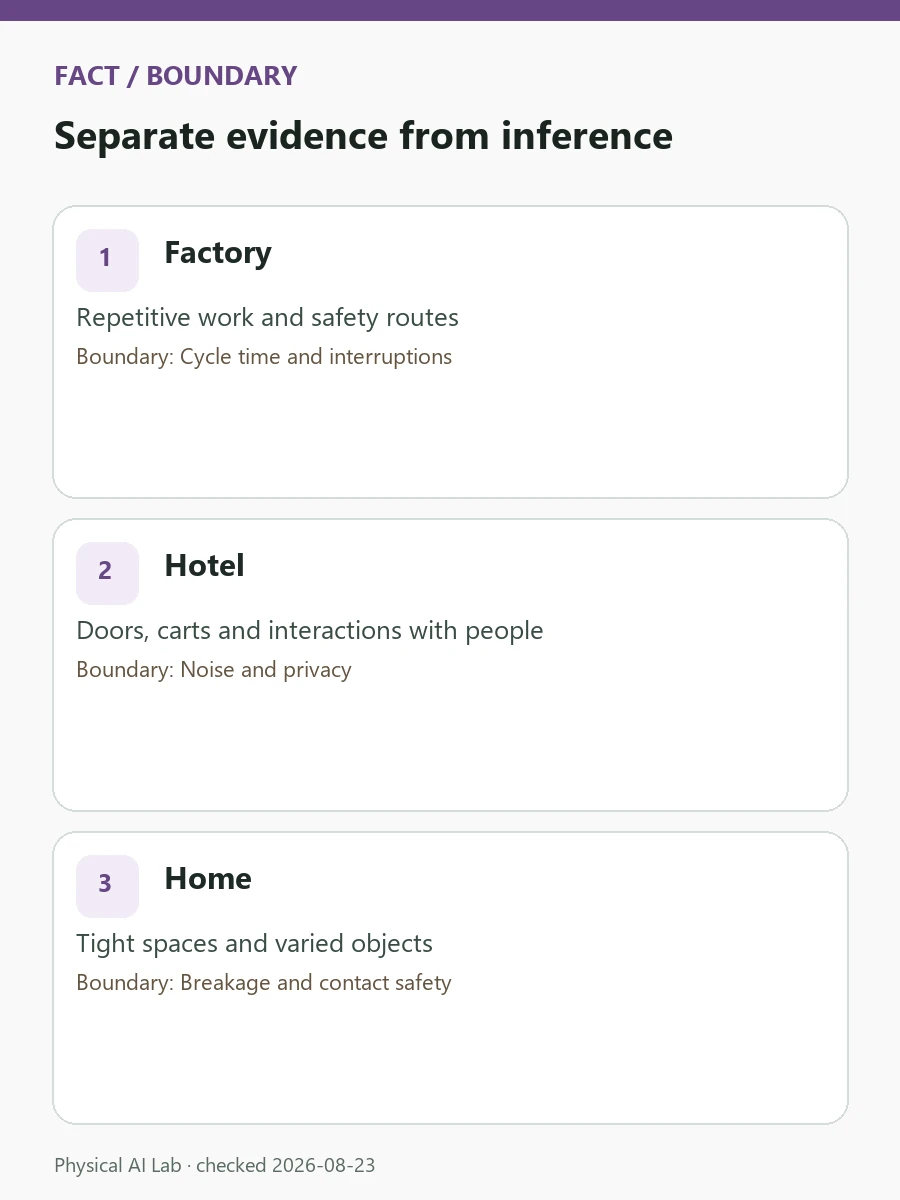
| Environment | What it introduces | What to measure |
|---|---|---|
| Factory | Repetitive work and safety routes | Cycle time and interruptions |
| Hotel | Doors, carts and interactions with people | Noise and privacy |
| Home | Tight spaces and varied objects | Breakage and contact safety |
Real rooms keep changing while the robot is working
Lighting, reflections, floor friction, moving people and object locations shift continuously in an operating space. The robot has to update its state, revise its plan and recover from failures rather than rely on one perception result.
Physical AI performance is therefore a full loop: sensor time synchronization, state estimation, planning, low-level control, safety limits and recovery must remain connected for the task to repeat.
Vary the environment, run long enough and record recovery
Ask for failure conditions before the successful clip. Record repeat attempts, points of human intervention and time to recover after a stop. That evidence separates an arena demonstration from a system that can operate in a building.
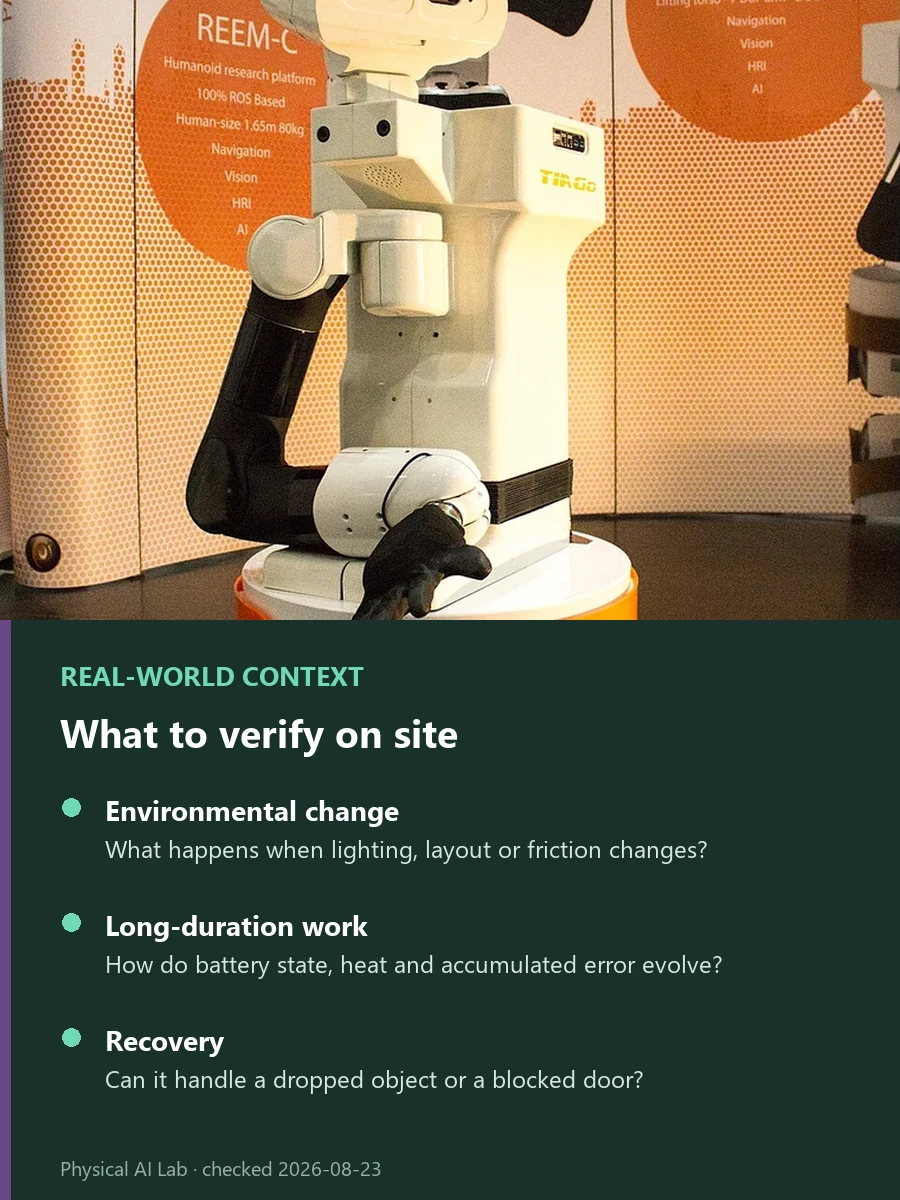
| Test dimension | Question to ask |
|---|---|
| Environmental change | What happens when lighting, layout or friction changes? |
| Long-duration work | How do battery state, heat and accumulated error evolve? |
| Recovery | Can it handle a dropped object or a blocked door? |

“Real world” is meaningful only with a disclosed test envelope
The label alone does not establish field deployment. Operating time, repeat count, safety zones, prior maps, object markers and remote support all need to be disclosed.
The current sources are event and government communications. Customer-site records, independent tests and regulatory documents should update the assessment when they become available.
Systems that support a humanoid inside a building
The warehouse picking robot guide provides repeat-task metrics, Open-RMF multi-robot integration covers building interfaces and VIO versus SLAM explains localization choices. This August 2026 review applies them to occupied indoor spaces.
The point of leaving the arena
The published 2026 program placed factories, hotels and model homes on the scenario-task agenda. That design could expose variation a dedicated arena hides, but only post-event records can show which trials ran and whether the work was repeatable under disclosed conditions.
Frequently asked questions
What would show that a model-home humanoid learned the task rather than the room?
Move objects, change lighting and furniture, alter the route and introduce an unfamiliar interruption while preserving the task goal. Stable completion and recovery across those changes are stronger evidence than success in the original setup.
Which metric best exposes memorization of the test environment?
Change lighting, object position, floor friction and room layout while tracking success, intervention and recovery. A large drop after small changes suggests the policy is tied too closely to the original setup.
How should a hotel protect guests during a humanoid trial?
Define operating zones, speed and force limits, emergency stops, staff takeover, privacy rules and incident logging before the robot meets guests. Start in supervised areas before expanding access.
Official sources checked
- Beijing municipal government's official guide to the 2nd World Humanoid Robot Games
- Beijing municipal government's official WRC 2026 event guide
- Beijing municipal government's World Humanoid Robot Games operations update
Last checked: August 23, 2026