LG's robotics business is not centered on a single humanoid. Its portfolio places Robostar industrial robots, Bear Robotics commercial systems and CLOiD-led home robots on three market pillars, with actuators and Data Factory as shared infrastructure. The CEO-level Robotics Business Center launched in July 2026 to coordinate those pieces from business development through manufacturing and operations.
The Robotics Business Center changes who owns the outcome
According to LG's reorganization announcement, the Robotics Business Center began on July 1, 2026. Reporting directly to the CEO, it is an end-to-end organization spanning business development, sales, supply chain and manufacturing operations. Launching it 4 months ahead of LG's usual year-end reorganization also signals the priority assigned to robotics.
An organization chart does not automatically create revenue or a finished product. What changed is the line of accountability for decisions and execution. Commercial maturity still has to be measured through paying customers, installed systems, operating hours, renewals and service performance.
| Business layer | Asset disclosed by LG | Boundary to verify now |
|---|---|---|
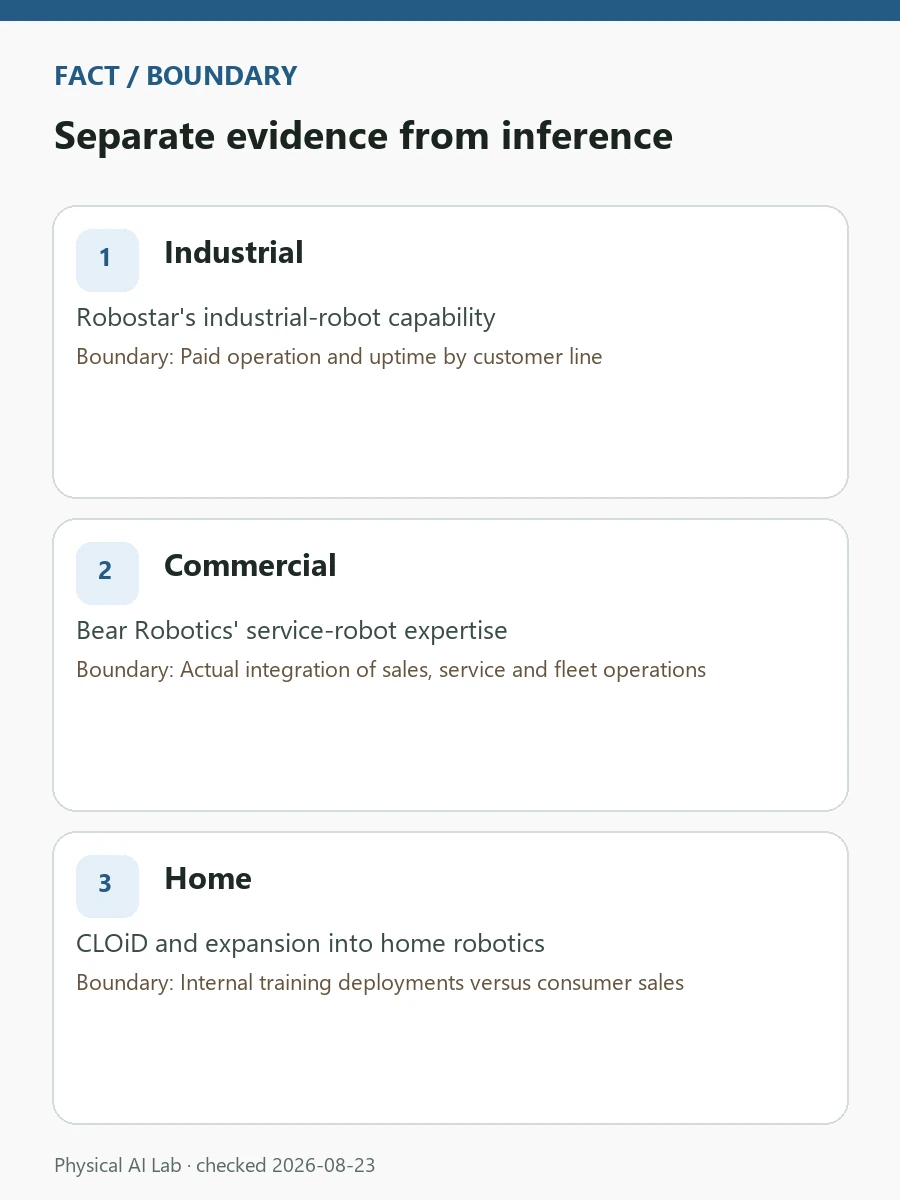
| Industrial | Robostar's industrial-robot capability | Paid operation and uptime by customer line |
| Commercial | Bear Robotics' service-robot expertise | Actual integration of sales, service and fleet operations |
| Home | CLOiD and expansion into home robotics | Internal training deployments versus consumer sales |
| Components | Preparation for domestic actuator production | Production yield, lifetime, cost and external supply scope |
| Data | Yangjae Data Factory and field data from LG companies | Actual utilization and conversion into product performance |
Robostar lives or dies by production repeatability and downtime cost
Industrial robots need high repeatability and long uptime in defined processes. That is why LG identifies Robostar's industrial-robot capability as a business pillar. On a factory floor, recovery time after a line stop, recalibration for a new workpiece, and command priority between the safety PLC and higher-level AI can matter more than top robot speed.
Physical AI does not remove those requirements. A learned model may adapt to part position or process variation, but slow fault detection or frequent false alarms can still reduce throughput. Progress in the Robostar layer should be judged by cycle time, intervention rate, mean time between failures and recovery time on real production lines—not by a demo reel.
Bear Robotics is an everyday service operation, not only a robot body
Commercial robots encounter different failures from factory systems. Chairs protrude into restaurant or hotel aisles, children approach, and elevators or automatic doors may not behave as expected. The ease with which staff can take over an incomplete delivery is part of the product.
Bear Robotics' asset includes fleet operations and field-service experience, not only hardware. How fully that capability is integrated with LG's sales and operating organization still needs evidence. Shared accounts, a unified support desk, parts inventory, remote-support hours and renewal rates would show whether portfolio ownership has become operating synergy.

CLOiD is both a home-data producer and a future product candidate
CLOiD trains on cleaning and object movement in home environments, and on moving, stacking and assembling parts in simulated manufacturing spaces. The LG–NVIDIA partnership announcement says multiple CLOiD units will generate data at the Yangjae Data Factory.
That deployment should not be confused with consumer availability. Running robots at scale in a research and training facility does not mean that price, sales region, ship date and warranty are set. Homes vary far more than factories in flooring, tight passages, lighting, children, pets and furniture placement. A consumer product would first need repeat success and safe-stop behavior across those conditions.
In-house actuators must prove lifetime and serviceability, not just cost
LG says it is preparing domestic actuator production based on more than 60 years of motor technology. An actuator combines motor, reduction gear, sensors and control to move a robot joint. In a high-joint-count humanoid, weight, efficiency, heat, noise and backlash influence the whole system.
Domestic production could improve supply resilience and cost control, but it is not yet evidence of mass production. Evaluation should include target price, yield, life at rated load, precision after heating, repairability and replacement time. Whether LG uses the parts only internally or also supplies outside customers will also change the size of the opportunity.
| Actuator test | Why it matters | What failure looks like |
|---|---|---|
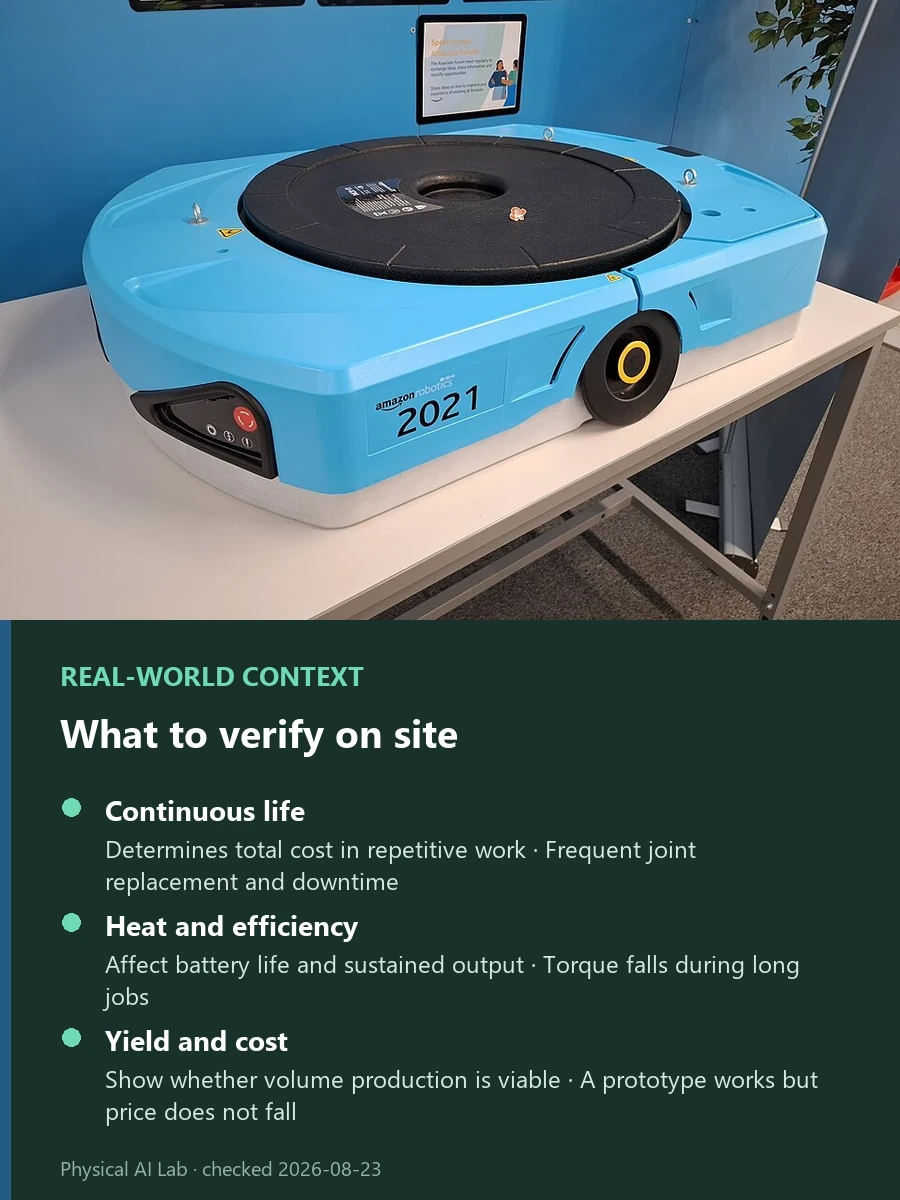
| Continuous life | Determines total cost in repetitive work | Frequent joint replacement and downtime |
| Heat and efficiency | Affect battery life and sustained output | Torque falls during long jobs |
| Yield and cost | Show whether volume production is viable | A prototype works but price does not fall |
| Service system | Controls field recovery time | The whole robot waits for one module |
Data Factory links three product groups without making them identical
Industrial, commercial and home robots perform different jobs, but their data operations share a pattern. Teams organize sensor, action and intervention data from the field; augment rare cases with simulation and synthetic data; evaluate a model; and deploy it back to robots. The Yangjae Data Factory is intended to run that loop across LG companies.
The connection to the NVIDIA robotics platform adds simulation, world models and robot-development tools. A common data system does not mean one model will perform equally in all three markets. Factory assembly data will not automatically solve human avoidance in a restaurant or tidying in a home. Shared representations and tools still require product-specific data, safety criteria and service procedures.
A broad portfolio wins only if LG reduces the cost of connecting it
LG can bring together robot bodies, components, operating sites, data and IT capabilities across the group. The risk is fragmented responsibility. One operating document should identify who receives an industrial-robot incident, who corrects a labeling error, and who bears recovery cost if a model update stops production.
The right portfolio question changes by market.
- Industrial: Did uptime and recovery time improve on a paying production line?
- Commercial: Do Bear Robotics fleets and LG sales and service operate as one system?
- Home: Are CLOiD price, sales region and support terms officially defined?
- Infrastructure: Do actuator yield and Data Factory operating metrics translate into product results?
Use the physical AI company ecosystem, robot simulator comparison and edge AI for robots to place the portfolio in context. Together, those layers separate ownership of several robotics companies from an integrated operating business.
LG's next milestone is recurring revenue and operating data by product family, not another organization chart. Robostar, Bear Robotics and CLOiD must produce results in their markets while actuators and Data Factory make those results faster and less expensive. Only then do the five layers become one business.
Frequently asked questions
What are the 3 official pillars of LG's robotics business?
LG describes industrial, commercial and home robots as its three pillars, building around Robostar's industrial capability, Bear Robotics' commercial expertise and an expanding home-robot portfolio.
Can consumers buy CLOiD today?
The public materials describe CLOiD units deployed for training inside Data Factory. Consumer pricing, sales regions, delivery schedules and warranty terms have not been separately confirmed.
Will LG's in-house actuators immediately lower robot prices?
Not necessarily. Domestic production may improve cost and sourcing, but the actual effect depends on production yield, volume, lifetime and service cost.
Official sources checked
- LG's official announcement on robotics cooperation with NVIDIA
- LG's official Robotics Business Center announcement
- Official NVIDIA robotics platform
Last checked: August 23, 2026