The Seeing Machines Physical AI Platform is more than an obstacle detector that locates a person. It interprets posture, gaze, attention and behavioral state, then predicts movement or risk and sends that signal to robot navigation, handoff and safety supervision. The company positions it as a platform for multiple robot form factors, not one robot body, but it does not replace the robot's full functional-safety system or certification.
The human-reading loop is See, Understand, Anticipate and Act
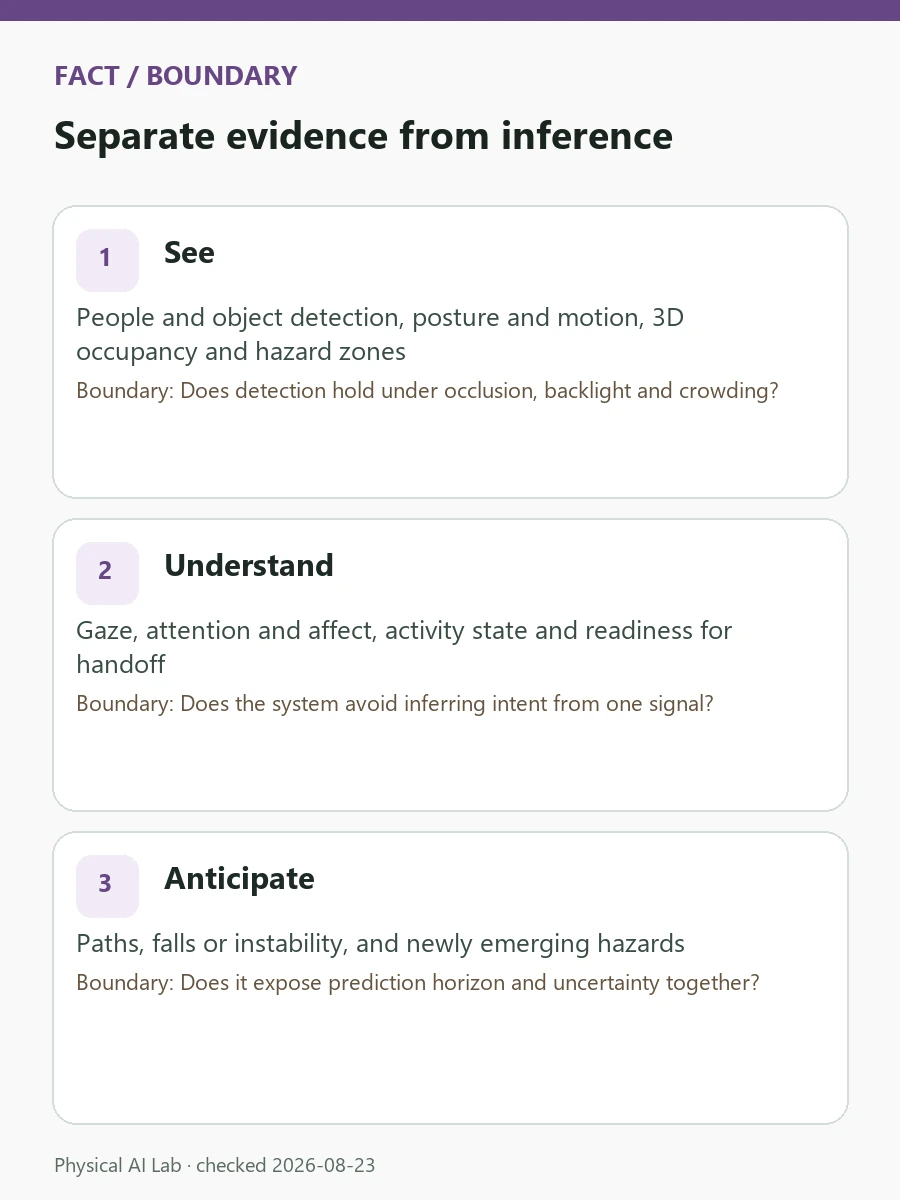
The official Seeing Machines robotics page describes four stages. See detects people and objects and maps 3D space. Understand interprets gaze, attention, activity and interaction context. Anticipate predicts human paths and emerging hazards. Act passes the result into safe-action recommendations or robot functions.
Although the names form a sequence, a deployed system cycles among them continuously. If a person reaches toward a shelf, the robot has to revisit whether the motion signals a handoff, an unrelated gesture or a loss of balance. Every new frame updates the prediction and the response.
| Layer | Capability described on the official page | Field limit to test |
|---|---|---|
| See | People and object detection, posture and motion, 3D occupancy and hazard zones | Does detection hold under occlusion, backlight and crowding? |
| Understand | Gaze, attention and affect, activity state and readiness for handoff | Does the system avoid inferring intent from one signal? |
| Anticipate | Paths, falls or instability, and newly emerging hazards | Does it expose prediction horizon and uncertainty together? |
| Act | Safe-action recommendations, navigation and manipulation support, remote exception handling | Are emergency stops and final control independent? |
If See misses a person, a sophisticated prediction cannot recover the input
Knowing only that a person is in front of the robot is not enough. The system needs their orientation, hand and foot position, and the space they are likely to occupy next. A factory worker may be hidden behind a box, a hospital patient behind a bed rail, and a child or pet may enter a home camera view without warning.
A single average detection rate can hide the risk. Performance may be strong in bright frontal video but latency may rise under backlight, reflective workwear, low light, crowds or camera shake. An acceptance test should vary occlusion, lighting, number of people and camera placement. Record both missed frames and the time required to reacquire the person.
Seeing Machines describes the platform as hardware- and sensor-agnostic. That is a modularity goal, not a guarantee of identical performance on every camera and processor. Field of view, resolution, frame rate, mounting height and calibration all change the input.
Understand estimates the present; Anticipate estimates what happens next
Understand is closest to answering, “What is the person doing now?” It estimates gaze and attention, readiness to receive an object, and whether the person has noticed the robot. Anticipate goes further by estimating whether paths will cross, whether fall risk is rising or whether a new hazard zone is forming.
Both outputs are probabilistic. Looking at the robot does not prove willingness to cooperate, and an extended hand does not prove readiness to take weight. A conservative design uses multiple signals over time and stops or hands control to a person when uncertainty is high.
The Seeing Machines Human Factors overview cites more than 20 years of real-time human-behavior research, while the robotics page emphasizes more than 25 years across human factors, embedded AI and production engineering. That record indicates accumulated research and data; it does not substitute for customer-specific accuracy or certification of the robotics functions.

Act can recommend behavior, but it is not an emergency-stop circuit
The Act layer includes safe-action recommendations, navigation and manipulation support, human-aware handoff, vision-language-action models, teleoperation, exception handling and behavior gates. This is where perception reaches physical motion.
A safe-action recommendation is not the same as certified safety control. A model may recommend slowing when it predicts a person's approach, but it does not automatically replace functional-safety sensors, braking control or an emergency-stop circuit. Independent protection must still put the robot into a safe state if the model misses the person or communication fails.
Consider medicine delivery in a hospital room. If a patient sits up while a caregiver crosses the robot's path, the platform could interpret posture and trajectory, slow the approach or send an exception to a remote operator. Braking distance and collision protection remain the responsibility of the robot body's safety design.
Factories, hospitals and homes expose different human-perception failures
The cost of reading a person incorrectly changes by setting. Frequent false alarms can stop production in a factory. Hospitals face higher costs from misses and privacy exposure. Homes contain so much user and environmental variation that out-of-distribution scenes are common.
| Environment | Scenario that must be included | Failure metrics |
|---|---|---|
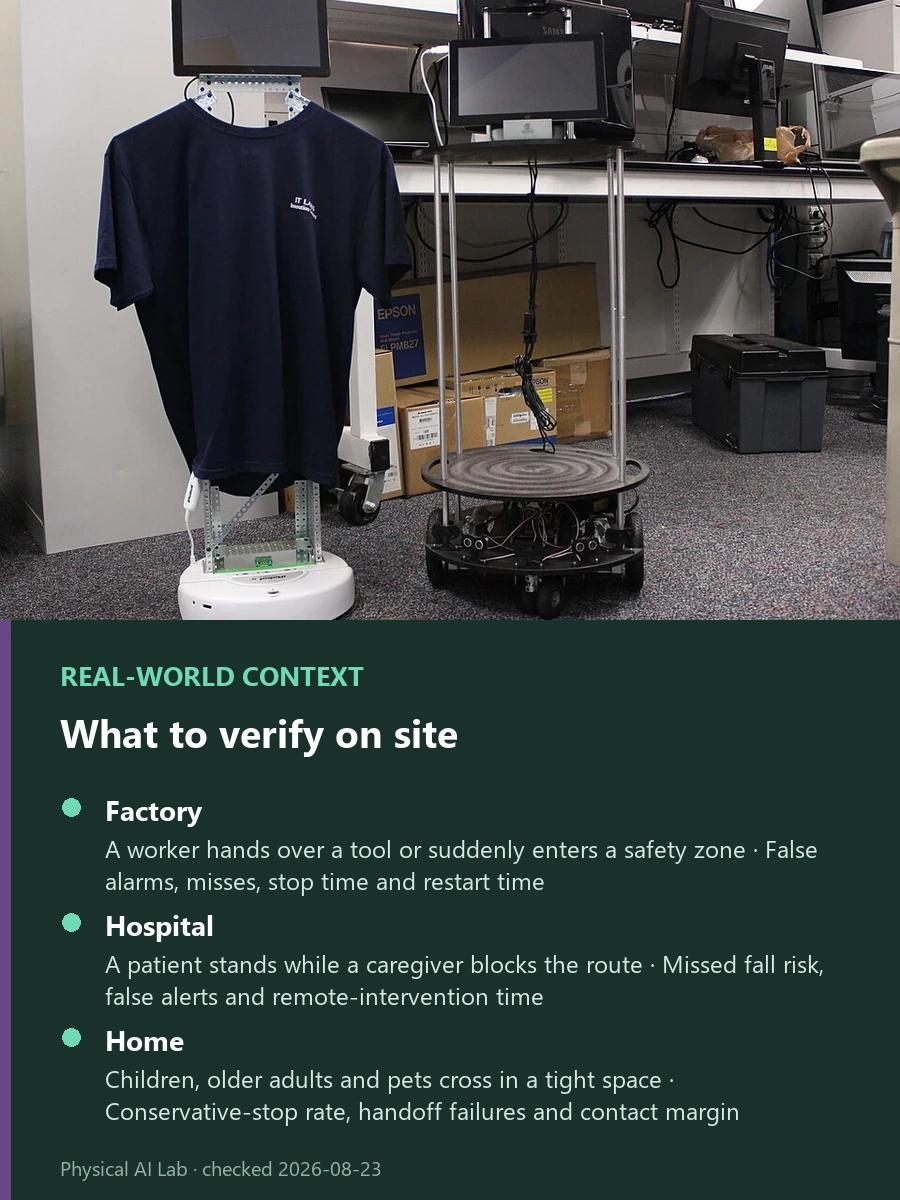
| Factory | A worker hands over a tool or suddenly enters a safety zone | False alarms, misses, stop time and restart time |
| Hospital | A patient stands while a caregiver blocks the route | Missed fall risk, false alerts and remote-intervention time |
| Home | Children, older adults and pets cross in a tight space | Conservative-stop rate, handoff failures and contact margin |
| Logistics | Carts and workers move in several directions | Path-prediction error, fleet congestion and successful rerouting |
Object handoff exposes especially small timing errors. There is a gap between a user extending a hand and being ready to support the weight. Releasing too early can cause damage or injury; releasing too late can pull the person's hand. Readiness estimation and force or tactile control need to be tested together.
Edge processing and Managed AI create a privacy architecture problem
Seeing Machines proposes deploying models at the edge under latency and power constraints, supplementing rare or dangerous scenes with synthetic data, and monitoring fleets through Managed AI. Remote event review and OTA improvement can help multi-robot operations, but they also raise the question of where human video and behavioral data travel.
Operators should separate raw video from event features and define storage location, authorized users, retention and deletion. Contracts should also specify what a remote operator can see and what can be reused for model improvement. Whether data crosses national borders and whether a customer may opt out of training use are procurement questions.
An acceptance test should reveal the direction of error, not one accuracy score
A robot OEM or systems integrator needs more than one accuracy number. Sensor conditions, processing latency, prediction horizon, false positives, false negatives, confidence output and behavior-gate failure modes should arrive as one evidence package.
Testing should move beyond a clean demo. Partially occlude the camera, lower the light, have a person change direction abruptly and drop an object. Check whether the robot stops when confidence falls, whether a bad prediction propagates into low-level control, and how quickly normal work resumes after remote intervention.
For context, see what physical AI means, robot foundation models and the core ideas behind Sim-to-Real. The Seeing Machines platform should be judged not by a claim to “read minds,” but by how early it detects risk in a crowded real environment and how safely it backs away when it is wrong.
Frequently asked questions
Can the Seeing Machines platform determine a person's intent exactly?
No. It uses posture, gaze, attention and behavioral context to estimate future motion and interaction probability. The result remains uncertain.
Does the Seeing Machines platform eliminate separate safety sensors?
No. Perception and behavior recommendations do not replace functional-safety sensors, braking control, emergency stops or a site-specific risk assessment.
Does Seeing Machines work only with one camera or robot?
The company describes a modular, hardware- and sensor-agnostic design. Actual supported sensors, processors, robot interfaces and performance limits still need to be confirmed in the integration specification.
Official sources checked
- Official Seeing Machines Robotics page
- Official Seeing Machines Human Factors overview
- Seeing Machines explanation of how the technology works
Last checked: August 23, 2026