Gravis Robotics is less a new-excavator manufacturer than an autonomy company adding sensing, compute and control to existing heavy equipment. It raised a $200 million Series A from SoftBank in August 2026 and says it has deployments on four continents, but it has not disclosed paid units or operating hours by customer. Its commercial stage sits between “retrofit systems working on jobsites” and “a product with verified, repeatable revenue at scale.”
The $200 million round funds expansion; it does not validate performance
Gravis' Series A announcement says SoftBank invested $200 million on August 17, 2026. Gravis describes it as the largest Series A in construction robotics history. The capital can accelerate hiring and global deployment, but it is not customer revenue or a confirmed order value.
Gravis spun out of ETH Zurich in 2022. The release says Gravis Rack has been installed on equipment from Caterpillar, Case, Develon, John Deere, JCB, Hitachi, Sumitomo, Yanmar and Volvo, with jobsites on four continents. That is evidence beyond the lab. Paid duration, units by customer and contract renewals still require separate disclosure.
| Confirmed item | Company disclosure | What an investor should verify |
|---|---|---|
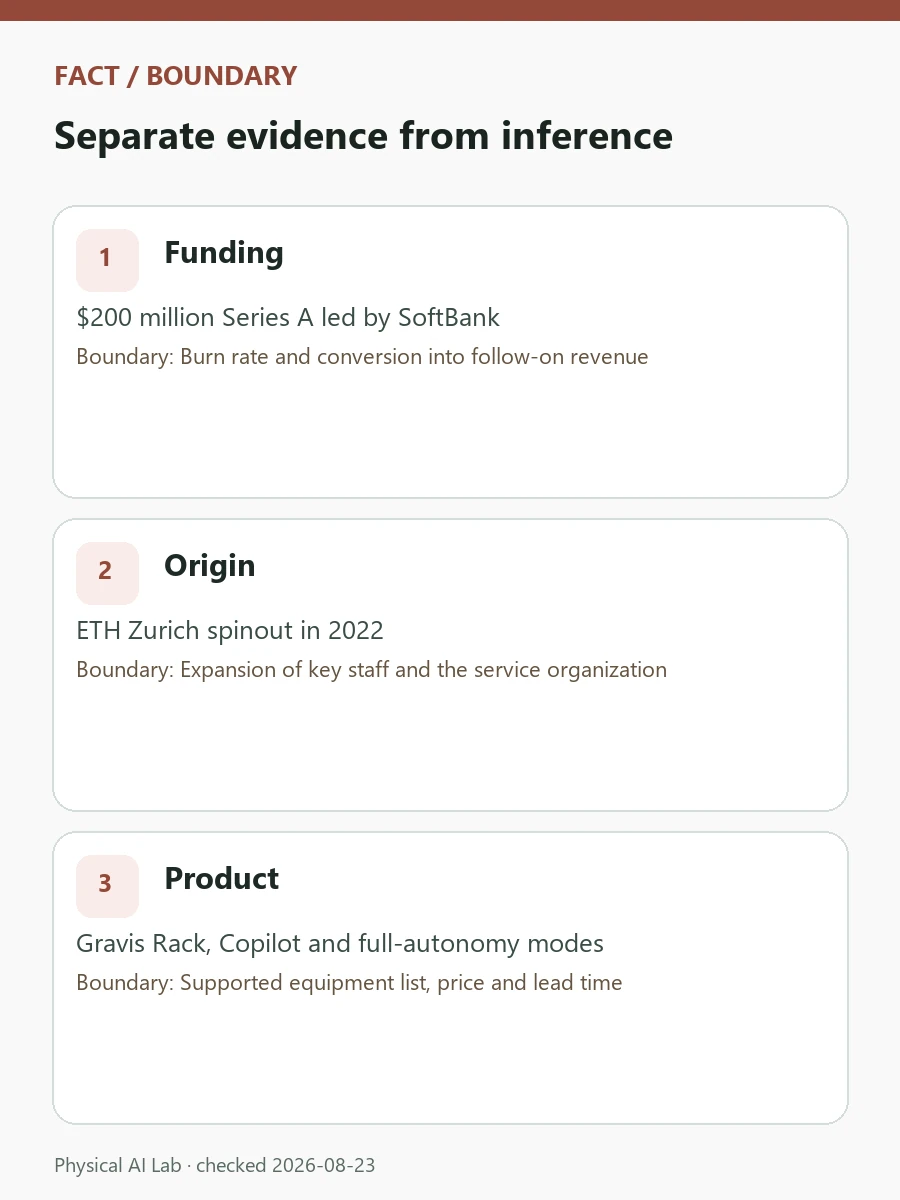
| Funding | $200 million Series A led by SoftBank | Burn rate and conversion into follow-on revenue |
| Origin | ETH Zurich spinout in 2022 | Expansion of key staff and the service organization |
| Product | Gravis Rack, Copilot and full-autonomy modes | Supported equipment list, price and lead time |
| Field use | Deployments on four continents and the UK CAM Pathfinder | Paid units, monthly hours and renewal rate |
Gravis Rack retrofits the mixed fleets contractors already own
Contractors rarely operate equipment from only one brand. Dealer relationships, maintenance skills and existing attachments produce a mix of excavator sizes and manufacturers. Gravis accepts that reality: install the Gravis Rack autonomy kit on existing machines and run a common software layer across them.
The company says the same core software can operate a compact excavator and a machine 5 times larger without custom reprogramming. Treating that as field compatibility requires a matrix of model, year, bucket, hydraulic valve and safety-circuit approvals. Supporting several brands is not the same as supporting every machine at a given site immediately.
The official Gravis Rack page presents Rack as the equipment layer connecting sensors, compute and control. Procurement should include installation, restoration after removal, sensor replacement and hydraulic recalibration in the retrofit's real cost—not only the time needed to fit the kit.
Excavation changes the world as the robot works
An autonomous vehicle avoids obstacles while moving over an existing surface. An excavator breaks and lifts soil, continually altering the terrain. After every scoop, load, slope and next entry angle change. Buried rock or wet clay may appear only during the motion.
Experienced operators read engine sound, vibration and hydraulic resistance. Gravis says it maps those signals into equipment telemetry and models, and uses simulated soil variation to narrow the Sim-to-Real gap. The meaningful test is not one type of dry soil on a clear day. It is how output and intervention change across clay, gravel, rock, moisture, bucket wear, slope and sensor vibration.

Copilot and full autonomy assign responsibility differently
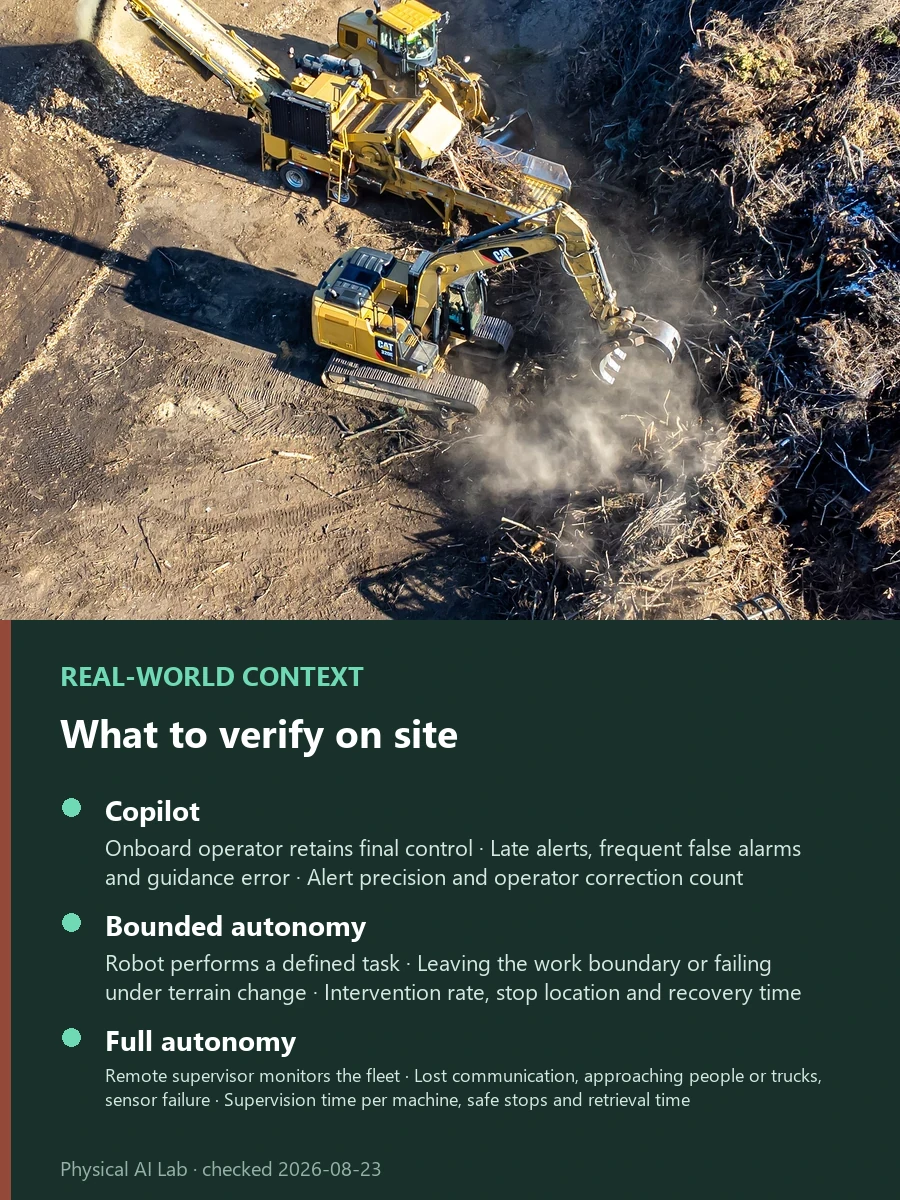
The official Gravis Slate page describes a path from operator assistance to autonomous operation. In Copilot, an onboard operator receives real-time 3D guidance and hazard detection. In full-autonomy mode, the intended model is for an operator in a safe location to supervise several machines.
Assisted operation raises questions about final control when an alert is missed and fatigue from excessive warnings. Full autonomy raises different ones: how many machines can one remote supervisor truly cover, when must a person take control, and where does the equipment stop after a communication failure? The safety requirements and labor economics differ even when both modes share a software stack.
| Operating mode | Human role | Failure condition | Required record |
|---|---|---|---|
| Copilot | Onboard operator retains final control | Late alerts, frequent false alarms and guidance error | Alert precision and operator correction count |
| Bounded autonomy | Robot performs a defined task | Leaving the work boundary or failing under terrain change | Intervention rate, stop location and recovery time |
| Full autonomy | Remote supervisor monitors the fleet | Lost communication, approaching people or trucks, sensor failure | Supervision time per machine, safe stops and retrieval time |
| Mixed fleet | Several brands operate at one site | Calibration, firmware or part mismatches | Version by machine and installation or recalibration time |
The “up to 30%” productivity claim needs a matched-site retest
Gravis claims up to 30% higher jobsite productivity than top-tier manual operation. “Up to” may describe the best case or a specific condition; it does not mean every machine, soil type and task will reproduce a 30% gain.
A fair test holds work area, earth volume, soil, haul distance, bucket and shift length constant. Put hourly earth moved, fuel use, cycle time, human intervention and post-failure recovery for the baseline operator and autonomous mode on the same sheet. Fast digging may not improve the full process if the excavator waits for trucks or a person must redo finish grading.
Safety evidence belongs beside productivity. Buyers need to know which independent sensors and controllers detect people, trucks and underground utilities; whether the machine can stop if the learned model behaves abnormally; and who approves changes to the hazard zone. A gain created by shrinking safety margin is not a deployment case.
The UK CAM Pathfinder matters for its deployment model, not only its size
Gravis says it leads the UK government-backed $8 million CAM Pathfinder project with Flannery Plant Hire, a heavy-equipment rental company that supplies operators. The plan is to apply Gravis Rack to an existing excavator fleet and offer autonomous capability when a customer needs it.
The project matters because it tests retrofit autonomy through a rental channel rather than direct manufacturer sales. Success should be measured by repeat use, site-changeover time and service responsibility, not just kits installed. The $8 million is the total project size and should not be counted directly as Gravis revenue.
A construction pilot should search for the operating boundary
The first test should use the contractor's own machine and intended site, not a flat soil pile prepared by the vendor. Establish a manual baseline, then vary soil, slope and bucket condition until autonomy breaks down. Limit communications and partially occlude sensors to test safe stops and recovery.
The contract should state supported equipment, tasks and site-preparation requirements. It should assign cost and responsibility for accidents, false alarms, lost communications and sensor damage, and preserve the customer's right to decline an update or roll back.
Use the physical AI company ecosystem, robot simulator comparison and edge AI for robots to place Gravis in context. The commercial question is not the size of its financing but whether it can reduce intervention and repeatedly raise output across different machines and soils.
Numbers that would move Gravis from deployment to commercialization
After the financing, installed and active units, monthly operating hours per machine, the paid-contract share and renewal rate matter more than customer count alone. Product evidence should also include growth in supported models and years, average installation time, intervention by site and service recovery time.
Four-continent deployment is a meaningful field signal. It is not evidence of completed global mass production until long-duration operation and repeat revenue are documented. Gravis' potential advantage is one autonomy layer for mixed fleets; it becomes a commercial moat only when the same economics repeat across customer sites.
Frequently asked questions
Does Gravis Robotics manufacture excavators?
Its main model is retrofitting existing Caterpillar, Case, Develon, John Deere, JCB, Hitachi, Sumitomo, Yanmar and Volvo equipment with Gravis Rack and software.
Is the $200 million funding customer revenue?
No. It is Series A capital invested by SoftBank. It is distinct from customer revenue, order value and company valuation.
Does Gravis always improve productivity by 30%?
The company says “up to 30%.” The result has not been independently repeated across identical equipment, soil, workload and haul conditions, so each site needs its own matched pilot.
Official sources checked
- Official Gravis Robotics Series A announcement
- Official Gravis Robotics Rack page
- Official Gravis Robotics Slate page
Last checked: August 23, 2026