R-dog is a quadruped delivery concept designed to complete the last 100 m across stairs, curbs, thresholds and uneven ground where wheeled robots stop. It combines a delivery box with two advertising displays and is expected to use Robot.com's REMI operations layer and FieldAI autonomy. As of August 2026 it is not a mass-produced product for sale; commercial deployment is planned for 2027.
R-dog is a disclosed concept; the purchasable specification is still missing
Robot.com's R-dog release unveiled the concept on August 11, 2026. The company describes climbing and descending stairs, crossing curbs and thresholds, and moving over mixed terrain in cities, residential areas, universities, hospitals, corporate sites and industrial campuses.
The release combines a multi-item cargo compartment, unattended handoff and mobile advertising. Payload, speed, battery life, IP rating, noise, price, warranty and sales regions remain undisclosed. Planned commercial deployment in 2027 does not mean delivery to a named customer is confirmed.
| Category | Disclosure as of August 2026 | Information still needed before release |
|---|---|---|
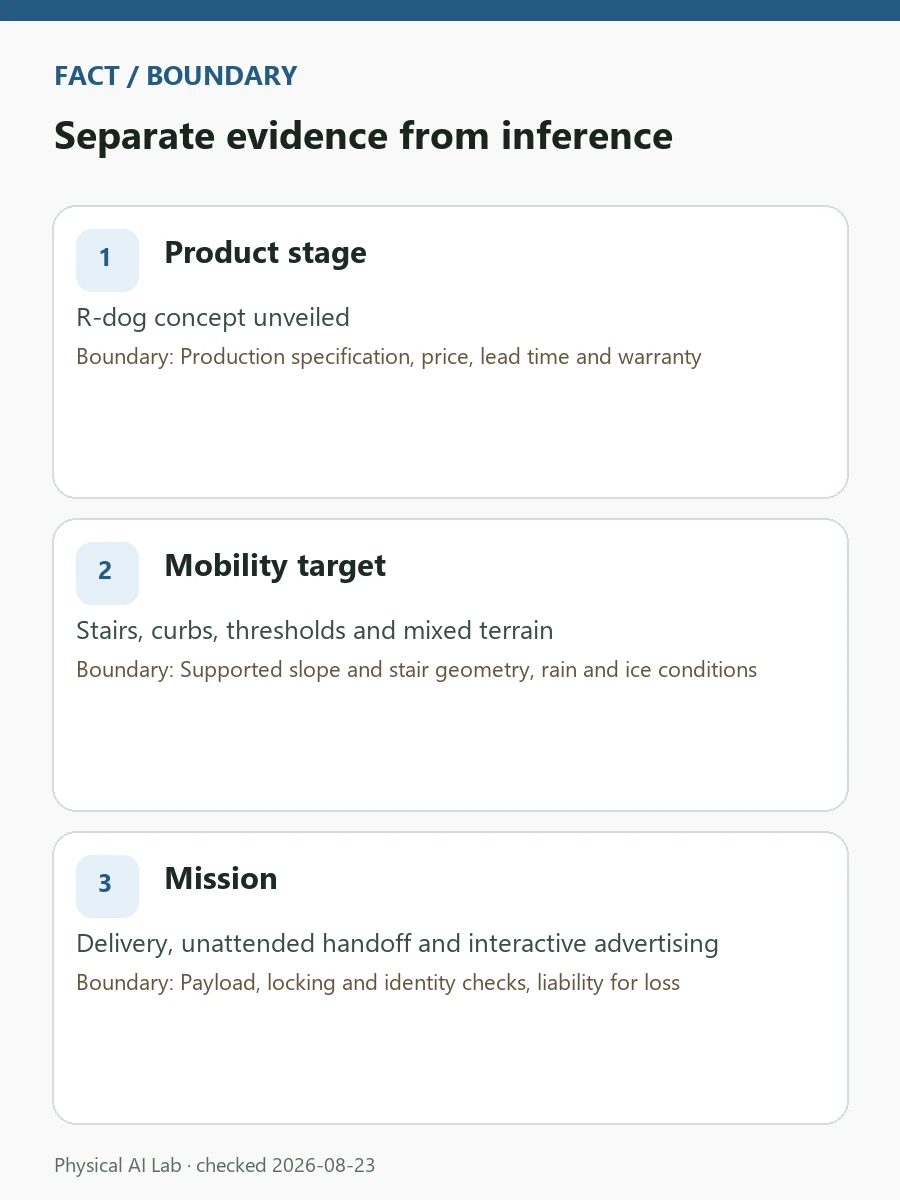
| Product stage | R-dog concept unveiled | Production specification, price, lead time and warranty |
| Mobility target | Stairs, curbs, thresholds and mixed terrain | Supported slope and stair geometry, rain and ice conditions |
| Mission | Delivery, unattended handoff and interactive advertising | Payload, locking and identity checks, liability for loss |
| Timing | Commercial deployment planned for 2027 | Actual customer delivery and local operating approval |
Quadruped mobility targets the point after the road ends
The distance from curbside drop-off to a front door may be only 80 m. Add six outdoor steps, a curb, a heavy fire door and building-access authentication in sequence, however, and a wheeled robot has to hand the mission to a person. R-dog proposes using four legs to cover that last segment.
Independent foot placement can cross height changes, but it adds balance control and joints. Moving the same load may consume more energy and require more maintenance. Climbing a staircase once therefore does not establish delivery economics.
A real test should vary step height and width, railings, turning stairs, wet surfaces, loose gravel and pedestrian crossings. Buyers should also ask whether the robot can self-right, enter a safe state without blocking a path, and maintain service while retrieval staff are on the way.
The cargo box and advertising screens create two different businesses
R-dog's proposed compartment is meant to carry several items, including food orders and standard e-commerce parcels, then complete an unattended handoff before the next mission. A real service still needs recipient authentication, compartment-level locks, temperature control, and rules for misdelivery or theft.
The second use is R-ads. Robot.com plans to upload campaigns remotely to two video displays and operate them as mobile out-of-home advertising. Ads could subsidize delivery, but screen power and weight may cut range, draw pedestrians toward the robot and create congestion. Public-advertising rules and privacy around captured interaction data also apply.
Delivery and advertising need separate KPI sets. Delivery is measured by completed orders and intervention cost; advertising by impressions and campaign revenue. High ad revenue does not make the last-mile service successful if delivery is delayed or handoff remains incomplete.

REMI runs the fleet while FieldAI supplies the autonomy layer
The portfolio on the official Robot.com website points toward one operating system for delivery, logistics, humanoid and advertising robots. REMI is described as a physical API layer that integrates, controls and orchestrates fleets across teleoperation, performance and deployment. R-dog is intended to sit on that existing foundation.
The official Field AI website describes Field Foundation Models as an autonomy layer for different robots and environments. The R-dog release frames the partnership around dynamic spaces with limited prior knowledge or supporting infrastructure, physics-informed models and multi-robot collaboration.
Dividing roles does not finish the integration. At a staircase, FieldAI must expose uncertainty and REMI must decide among stopping, remote intervention and reassignment. The operating design also needs a safe offline wait time and an on-site recovery procedure.
Robot.com's 500 robots and 2.5 million tasks are not R-dog results
Robot.com says it has deployed more than 500 robots and completed over 2.5 million tasks across the United States, Canada, Dubai, the Middle East and North Africa. Those figures cover the company's existing portfolio, including R-kiwi and R-cargo. They do not mean 500 R-dog units or 2.5 million stair deliveries.
Existing fleet experience can support remote operations and service for a new product. A quadruped also adds joint maintenance, stair failures and fall recovery that may not exist in a wheeled fleet. Company-wide operating history and validation of the new body need to remain separate.
| Pilot metric | How to measure it | Signal to reconsider deployment |
|---|---|---|
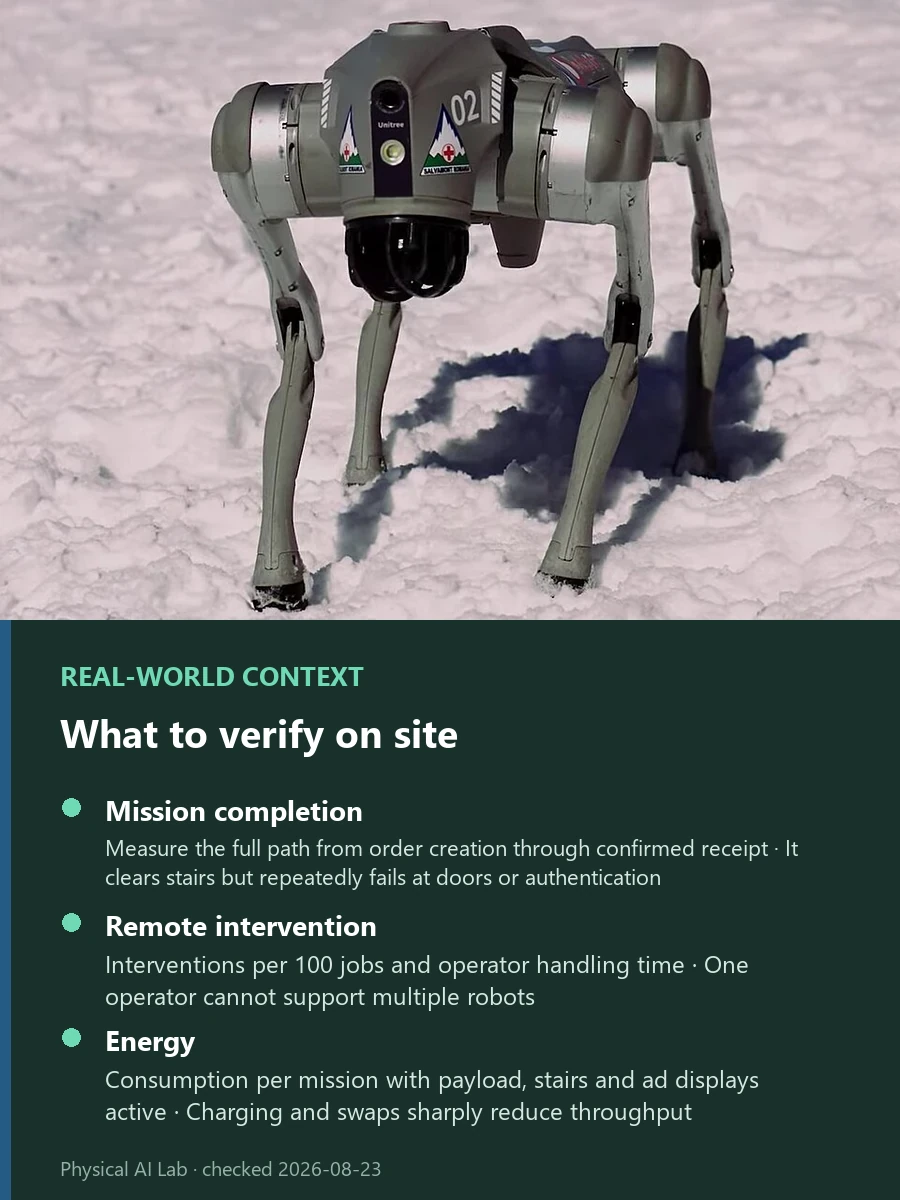
| Mission completion | Measure the full path from order creation through confirmed receipt | It clears stairs but repeatedly fails at doors or authentication |
| Remote intervention | Interventions per 100 jobs and operator handling time | One operator cannot support multiple robots |
| Energy | Consumption per mission with payload, stairs and ad displays active | Charging and swaps sharply reduce throughput |
| Recovery | Time to resume after falls, locked doors and lost communication | Frequent field retrieval blocks the route |
| Total cost | Divide robot, operator, maintenance and retrieval cost by completed deliveries | It costs more than a person handling the last 100 m |
After the stairs, R-dog still has to pass the door and complete handoff
The last 100 m is not only a terrain problem. Building call systems, elevators, automatic doors, recipient authentication and cargo-box access all have to work before an order is complete. If the recipient does not answer, the service needs rules for secure placement and redelivery.
A quadruped may share narrow stairs with people. Tests should cover yielding to someone coming the other way, stopping when a child touches a joint, noise and fear responses. If advertising screens attract a crowd, ordinary collision avoidance is not enough; crowd formation becomes its own scenario.
Use R-dog only where obstacle labor outweighs quadruped cost
On a mostly flat campus, a wheeled robot may win on energy and maintenance. R-dog makes sense where a meaningful share of orders requires human takeover at stairs or curbs, and where that labor and delay exceed the quadruped's additional cost.
Survey obstacle type and frequency before selecting a site: share of stair orders, manual handoff time, access systems, average payload, rain or ice days and retrieval-staff location. Then compare wheeled and quadruped completion, intervention, energy and maintenance in the same area.
Continue with Open-RMF multi-robot integration, the VDA 5050 3.0 guide and VIO versus SLAM. R-dog's 2027 test is not a staircase demo; it is completed orders from loading through receipt and total cost per delivery.
Commercial signals to look for in 2027
A production specification and customer operating documents would show that deployment is approaching. Buyers need payload, ground and stair speed, battery, IP rating, noise, maintenance interval, price and service region. Months of paid operation, intervention rate and recovery time across several regions matter more than a named customer alone.
R-dog is notable because it redesigns the last segment wheeled robots abandon. A long gap remains between a concept and a production service: safety, building access, recipient handoff and operating economics.
Frequently asked questions
Can customers buy R-dog now?
The August 2026 announcement describes a concept and planned commercial deployment in 2027. Public pricing, lead time and service regions have not been released.
Are all 500 Robot.com robots R-dog units?
No. More than 500 robots and over 2.5 million tasks describe the company's existing fleet as a whole, not R-dog performance.
Is R-dog always better than a wheeled delivery robot?
No. A quadruped may cross more obstacles but can add energy, joint-maintenance and stability costs. Compare completed orders and total cost per delivery at the intended site.
Official sources checked
Last checked: August 23, 2026