AgiBot's GO-2, GE-2, BFM and GCFM are not four competitors solving the same problem. GO-2 plans and executes long manipulation tasks; GE-2 predicts how the world may change after an action. BFM learns motion from demonstrations, while GCFM generates whole-body movement from text, audio or video conditions. The useful question is therefore not “Which model is best?” but “Which capability is missing from this workflow?”
Start by placing the four models on different layers of the robot stack
At its April 17, 2026 partner conference, AgiBot introduced 8 foundation AI products under a “one robot body, three types of intelligence” framework. GO-2 and GE-2 were placed under manipulation intelligence; BFM and GCFM under locomotion and motion intelligence. Their appearance in one announcement does not make them suitable for one leaderboard because their inputs, outputs and failure meanings differ.
The official AgiBot announcement describes each model's direction, but it is not a complete disclosure of customer-site success rates, compute requirements or supported robot bodies. The table separates what the announcement says from evidence an implementation team still needs.
| Model | Role stated in the announcement | What deployment testing must establish |
|---|---|---|
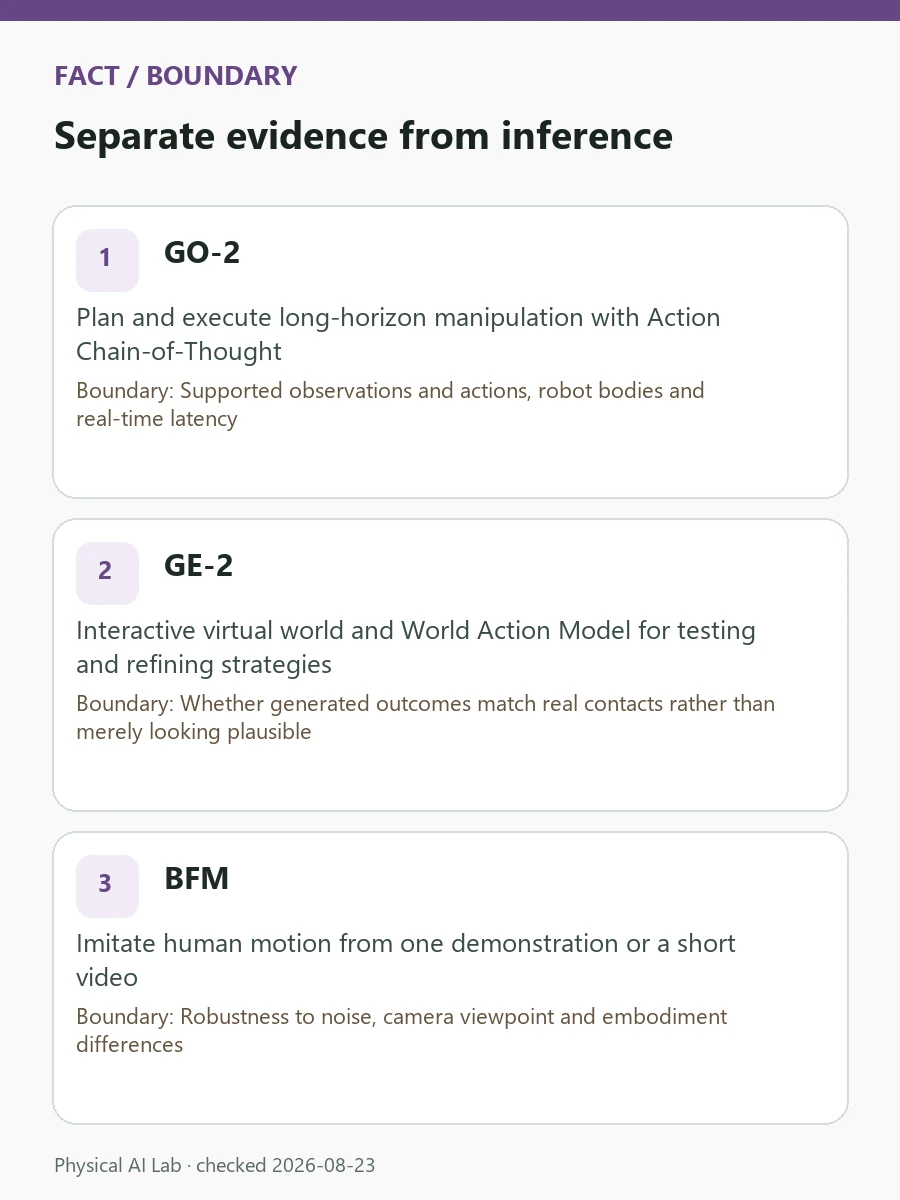
| GO-2 | Plan and execute long-horizon manipulation with Action Chain-of-Thought | Supported observations and actions, robot bodies and real-time latency |
| GE-2 | Interactive virtual world and World Action Model for testing and refining strategies | Whether generated outcomes match real contacts rather than merely looking plausible |
| BFM | Imitate human motion from one demonstration or a short video | Robustness to noise, camera viewpoint and embodiment differences |
| GCFM | Generate context-appropriate robot motion from text, audio or video | Real-time compliance with joint, balance and collision constraints |
This map is a starting point for reading the product names. AgiBot's performance language refers to company-selected data and conditions. It should not be expanded into independent proof of long-term field reliability or superiority over third-party models.
GO-2 turns a long manipulation request into connected actions
GO-2 centers on tasks that extend beyond a single grasp. “Clear the dining table” becomes a sequence: find a cup, assess whether its handle is visible, grasp around obstacles and carry it to the designated shelf. AgiBot calls GO-2 a ViLLA Embodied Foundation Model and says Action Chain-of-Thought links planning with execution.
Visible language-like reasoning does not guarantee correct motion. Occlusion or an object moving away from its planned pose can propagate an early error through later steps. Practical value depends on whether the policy notices a slipped hand, observes again, revises the plan and resumes at a defined point after human intervention.
Do not record only final success. Keep step-level outcomes, wrong-grasp count, replanning count, teleoperator interventions and termination reasons in the same trace. Before connecting a controller, establish whether actions represent joint position, velocity or action chunks.
Early success can create a misleading impression on long tasks. Even if each of the first three stages succeeds at 95%, the probability of completing all ten in sequence falls sharply. Test task lengths of 2, 5 and 10 stages, perturb an object mid-task, and compare restart-from-zero with recovery from the failed stage. Recovery time can matter as much as nominal completion time.
GE-2 tests the likely consequence of an action before hardware executes it
GE-2 is presented less as a policy that sends joint commands and more as a World Action Model that predicts the scene and state after an action. It can unfold candidate outcomes for reaching toward a shelf and help reject strategies that look unsafe or likely to fail before a physical robot attempts them.
A convincing video is not necessarily an accurate physics forecast. Fingers may appear to meet a cup naturally while incorrect friction and contact force would make the real cup slip. Cloth, liquid, transparent objects and tight clearances make the gap larger. Evaluate GE-2 by the agreement of predicted contacts, object poses and failure rankings with measurement—not by visual quality alone.
GE-2 output is additional evidence for policy selection, not a safety certificate. Force limits, collision monitoring and emergency stops must remain active as independent layers on the real robot.
A selector also needs calibrated uncertainty. A confidently wrong forecast is more dangerous than an uncertain one. If the system produces three candidate actions, retain each predicted outcome beside the executed result, not just the winner. Pilot teams can then find when rankings reverse and set a threshold that routes uncertain scenes to a person instead of automatic execution.

BFM transfers demonstrated motion across a different robot body
BFM stands for Behavioral Foundation Model. AgiBot says it can imitate human movement from one demonstration or a short video and remain stable in noisy environments. The goal is to reduce the cost of programming every new motion joint by joint.
The central problem is embodiment mismatch. Copying human arm length, joint range and foot spacing can exceed a robot's limits or destabilize its balance. A single-camera video also hides joints and depth. A demo showing motion from one clip must therefore be separated from evidence that it repeats across different heights, viewpoints and speeds.
Evaluation should go beyond “looks similar.” Log end-effector position error, joint-limit violations, foot slip, balance recovery and the additional data needed to transfer the motion to another body. Those measures define where BFM reuse is credible.
GCFM generates whole-body motion, but a safety controller still owns the limits
GCFM means Generative Control Foundation Model. AgiBot describes it as producing context-appropriate robot motion in real time from text, audio and video. Examples include improvising to music in entertainment or generating a whole-body posture in response to a work signal.
Natural appearance and safety are separate metrics. A smooth-looking turn may leave little foot-contact margin or drive joint temperature upward. Near people, audio latency or a misrecognized cue can trigger an unexpected motion. Joint limits, self-collision, work-zone boundaries, speed and torque should be checked by a controller between generation and the motors.
Field tests should measure input latency, response to a stop command, heat and accumulated pose error during at least 30 minutes of repetition—not just motion variety. A company description of “real time” does not establish the frame rate or worst-case delay on a buyer's hardware.
One workflow may use all four roles without turning them into one product
Consider finding a cup and placing it on a shelf. GO-2 can decompose the task and propose manipulation actions. GE-2 can forecast candidate outcomes and screen risky paths. BFM becomes relevant when a person demonstrates new waist-and-arm coordination, while GCFM may generate locomotion and upper-body posture for the context.
That does not mean the four models connect automatically as a finished system. Coordinate frames, update rates and confidence representations must align, and the system needs a rule that stops downstream layers when an upstream one is late or wrong. If a world model predicts success but tactile sensing detects slip, the system—not a model name—must define which signal wins.
| Interface | Record the integration team should keep | Condition that counts as failure |
|---|---|---|
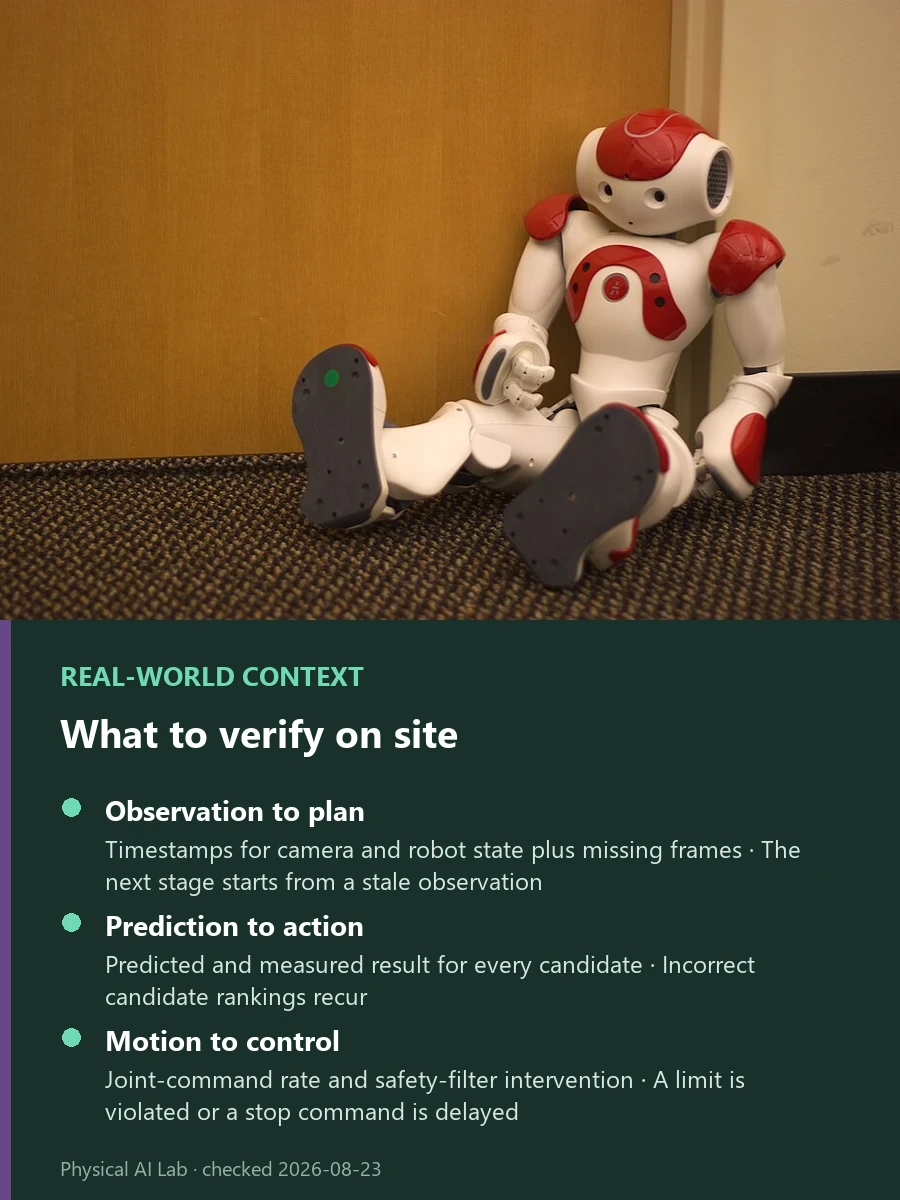
| Observation to plan | Timestamps for camera and robot state plus missing frames | The next stage starts from a stale observation |
| Prediction to action | Predicted and measured result for every candidate | Incorrect candidate rankings recur |
| Motion to control | Joint-command rate and safety-filter intervention | A limit is violated or a stop command is delayed |
| Failure to recovery | Re-observation, replanning and teleoperation history | The same error repeats or the robot cannot return to a safe state |
An announced model is not necessarily a downloadable or commercially licensed asset
A public model name does not imply that checkpoints, training code, evaluation tools and a commercial license are all available. The official AgiBot World open-source page separates datasets, models and papers. If a specific version is absent from the current catalog, an announcement alone is not evidence that it can be downloaded.
For each repository, preserve the model card, license, supported framework, memory requirement and update date. Research release and permission to embed in a commercial product are different. If an example targets a particular AgiBot body, budget for adapters and additional data needed on another robot.
A reproducibility record should include downloaded-file checksums, repository commit, inference settings, GPU and driver. A page update can change an asset under the same model name. Also separate “the code ran” from “the official demo result was reproduced”: the task must repeat without hidden teleoperation, manual initialization or undisclosed preprocessing.
The official AgiBot website is the current entry point for product families and documentation. Because support can change after an announcement, procurement should rely on versioned technical documents and written supplier answers rather than a changing web summary.
Choose a model through one small, falsifiable reproduction test
Define the problem in one sentence: stabilize multistage object manipulation, compare outcomes before execution, transfer a short demonstration to a new body, or generate conditioned whole-body motion. Even if all four capabilities appear useful, connecting them at once makes failure attribution difficult.
Use what physical AI means, robot foundation models and Sim-to-Real fundamentals to separate the model layer from real-world validation. Then repeat a small task with the same robot, object and lighting while adding occlusion, sensor delay, object displacement and communication loss one at a time.
Pass criteria should include worst-case latency, safety-filter intervention rate, recovery after failure, human setup work, and model and firmware versions—not average success alone. Announcement-stage models may differ from purchasable packages, so price, support, lead time and commercial licensing remain separate checks.
Frequently asked questions
Should a manipulation team choose GO-2 or GE-2 first?
GO-2 and GE-2 solve different layers. Start with GO-2 when long tasks repeatedly break during planning and execution; examine GE-2 when the need is to compare likely outcomes before a real action.
Can BFM and GCFM be evaluated with the same motion score?
Not by one score alone. BFM needs evidence that a demonstration transfers across viewpoints and bodies; GCFM also needs conditioned-motion quality, command latency and safe whole-body control.
Can AgiBot's four announced models be integrated immediately?
The announcement does not guarantee that. Verify body support, observation and action schemas, update rates, licenses and safety interfaces for each model, then connect one bounded task at a time.
Official sources checked
- Official AgiBot 2026 model-stack announcement
- Official AgiBot World open-source page
- Official AgiBot website
Last checked: August 23, 2026