A physical AI excavator does more than look at soil and replay a fixed trajectory. It reads hydraulic resistance and machine telemetry as the bucket contacts the ground, estimates the terrain again after every pass, and selects the next path from the changed site. Field deployment depends on stopping and replanning when soil behavior or hydraulic response differs from the model.
Every bucket pass changes the environment the excavator must understand
Warehouse robots usually move through floors and racks that remain in place. Excavators do the opposite: the bucket breaks and piles material, changing slope and load with every motion. Hidden rock, buried infrastructure and moisture-dependent adhesion can make the same trajectory produce a different result. Yesterday's map is not enough.
The official Gravis Robotics Series A announcement frames this as the difference between traversing a static world and operating a machine that deconstructs and remakes the world. Gravis says it links world models trained across simulated soils and machine characteristics with real equipment telemetry. That is the company's technical description, not independent proof of equal performance at every site.
| Information layer | What the system must know | Failure when it is wrong |
|---|---|---|
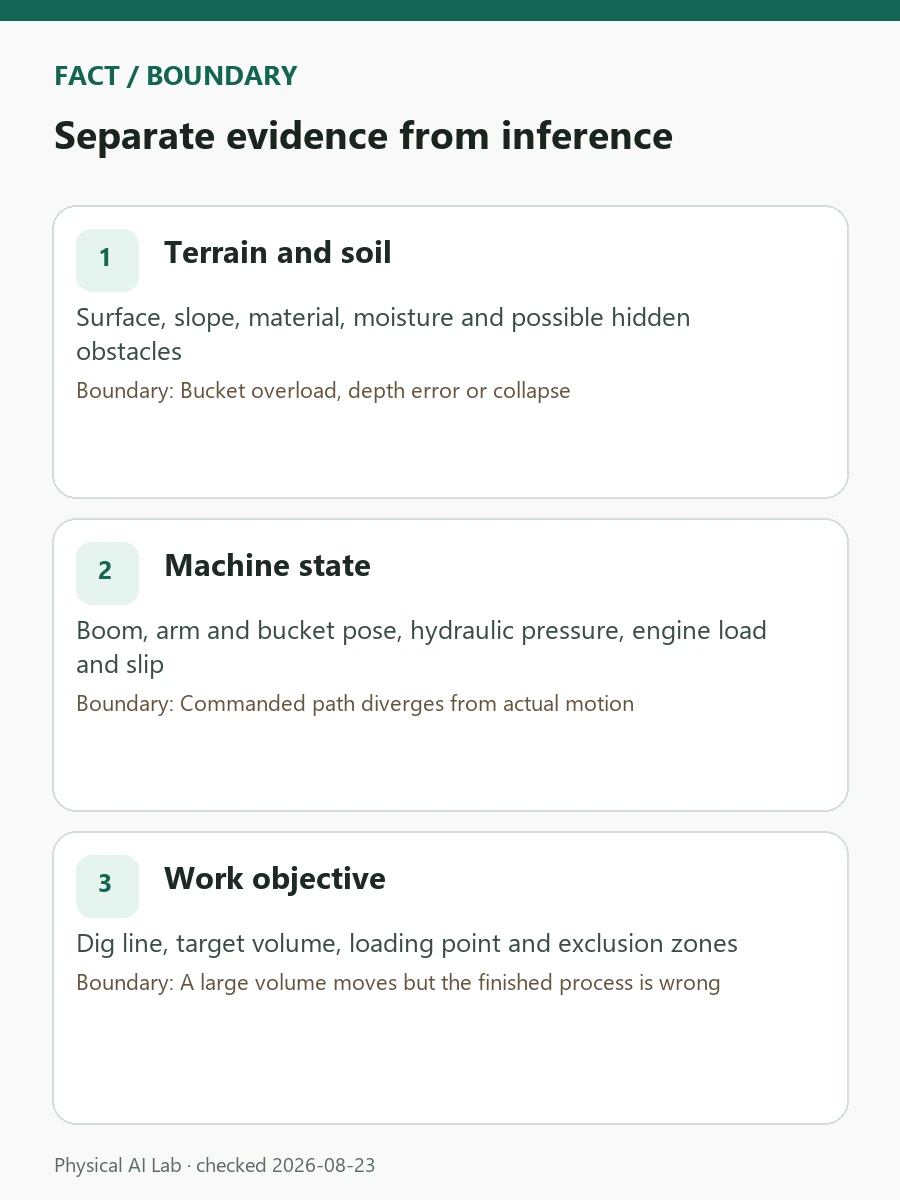
| Terrain and soil | Surface, slope, material, moisture and possible hidden obstacles | Bucket overload, depth error or collapse |
| Machine state | Boom, arm and bucket pose, hydraulic pressure, engine load and slip | Commanded path diverges from actual motion |
| Work objective | Dig line, target volume, loading point and exclusion zones | A large volume moves but the finished process is wrong |
| Safety state | People, vehicles, buried utilities, communications and stop system | Hazard entry or cascading failure |
Soil response is read through resistance, not color alone
Cameras and LiDAR can measure surface shape and bucket pose, but they do not expose everything below grade. Dry sand, wet clay and buried rock may look similar from above. During entry, the system updates its estimate from hydraulic pressure, joint speed, engine load and chassis vibration.
Pressure rising sooner than expected while bucket speed drops can indicate a harder layer or obstacle. Applying more force is not automatically the right answer. The controller may reduce entry depth or change bucket angle, move to another point, and escalate repeated anomalies. Vehicle attitude and track slip must be considered because a tilted chassis can create similar signals.
Operational response is often more useful than a soil-class name. Map pressure rise per entry distance, fill ratio, time for material to leave the bucket and re-dig count to the work coordinates. The result becomes a risk map for the next pass.
A higher bucket-fill ratio is not always better. An overloaded bucket can reduce stability during upper-structure rotation, lengthen dumping time or spill material to the side. The planner must balance moved volume and cycle time with swing load, truck position and the required finish surface. Material moved outside the designated zone is a process failure even when the bucket looked full.
Hydraulic telemetry reveals the gap between a command and machine motion
An excavator does not respond like a small electric robot. The same valve command can produce different boom and bucket motion as oil temperature, engine speed, hose condition and load change. That is why older and newer machines, and compact and large machines, cannot be assumed to share one response.
The official Gravis Robotics Rack page describes a retrofit control kit for existing heavy equipment. The company says Gravis Rack has been installed on machines from Caterpillar, Case, Develon, John Deere, JCB, Hitachi, Sumitomo, Yanmar and Volvo. Installation across brands is not a claim of identical performance on every model; valve response and sensor quality still require machine-specific calibration.
The controller compares target and measured joint paths at a short interval. It should slow when pressure limits or response delay increase and stop outside the permitted envelope. A telemetry dropout or frozen value is a reason to enter a safe state, not to continue digging from the last known-good value.
Commissioning starts with an empty bucket and expands toward rated-load conditions. Measure valve behavior with cold oil in the morning and fully warmed oil later, and do not reuse calibration blindly after sensor replacement or maintenance. Even self-calibration needs an allowable-error band and abort condition. Running software on a new machine is not evidence that the certified work envelope transferred with it.

The world model replans after each pass instead of trusting the old ground
A world model predicts how the terrain and bucket may change if a candidate action is executed from the current machine state. It compares not only the fastest path for moving the target volume, but also overload, instability and collision risk with nearby equipment. New point clouds and telemetry then quantify prediction error before the next plan.
If the first pass carries less material than predicted, making the second pass deeper may be unsafe. The system must distinguish soil slip, rock deflection and chassis movement. When cause is uncertain, a small probing motion can gather evidence; persistent disagreement should call an operator.
The official Gravis Robotics Slate page describes software layers from assisted driving to autonomous operation. A company Copilot mode that gives an in-cab operator 3D guidance and hazard detection is not the same automation level as an autonomous fleet supervised from a safe location. Responsibility and intervention points should be documented per function.
Billions of simulated cubic yards cannot substitute for real-soil evidence
Gravis says its virtual training moved billions of cubic yards across conditions from soft clay to rocky soil. Simulation is useful for repeating hazardous conditions and varying machine size. But the volume exists inside a physics simulator; it is not a claim that the same amount was excavated autonomously on real construction sites.
Real machines combine bucket wear, hydraulic leakage, rain, freezing, point-cloud occlusion and buried debris that a model may not contain. A policy that passes simulation should begin with low speed and shallow cuts, then expand one soil and machine condition at a time. Feed large measured errors back into simulation without contaminating the held-out site evaluation.
A soil envelope is not a permanent certificate. Resistance changes after rain, during a dry week and as digging reaches another layer. Define the pilot with moisture range, particle size, slope, bucket type and allowable depth, and slow or escalate outside that envelope. Expand one documented boundary at a time.
To demonstrate simulator fidelity, compare distributions of bucket trajectory, pressure curves and moved volume with real measurements under the same initial condition. A polished excavation video is not enough.
Productivity belongs to the full construction process, not one fast scoop
Always identify the baseline behind a peak-performance statement. Gravis says its system improved jobsite productivity by up to 30% against top-tier manual operation. “Up to” describes a company-measured result on particular equipment, soil and work; it is not an average site gain or a guaranteed investment return.
Treat hourly volume, finished-grade error, fuel or energy, interventions, rework, recovery time and safety stops as one KPI set. Faster digging does not improve the process if trucks are absent or people must correct the final surface. Compare the same machine, soil, haul path and shift length.
A faster excavator can simply lengthen the dump-truck queue. Test safe waiting and restart as truck arrival and loading position change, and record which passes are repeated when survey results miss the target. If one operator supervises several machines, isolate overlapping intervention demand. Productivity means the site bottleneck shrank, not that one robot moved more often.
| Pilot area | Metric under matched conditions | Example failure criterion |
|---|---|---|
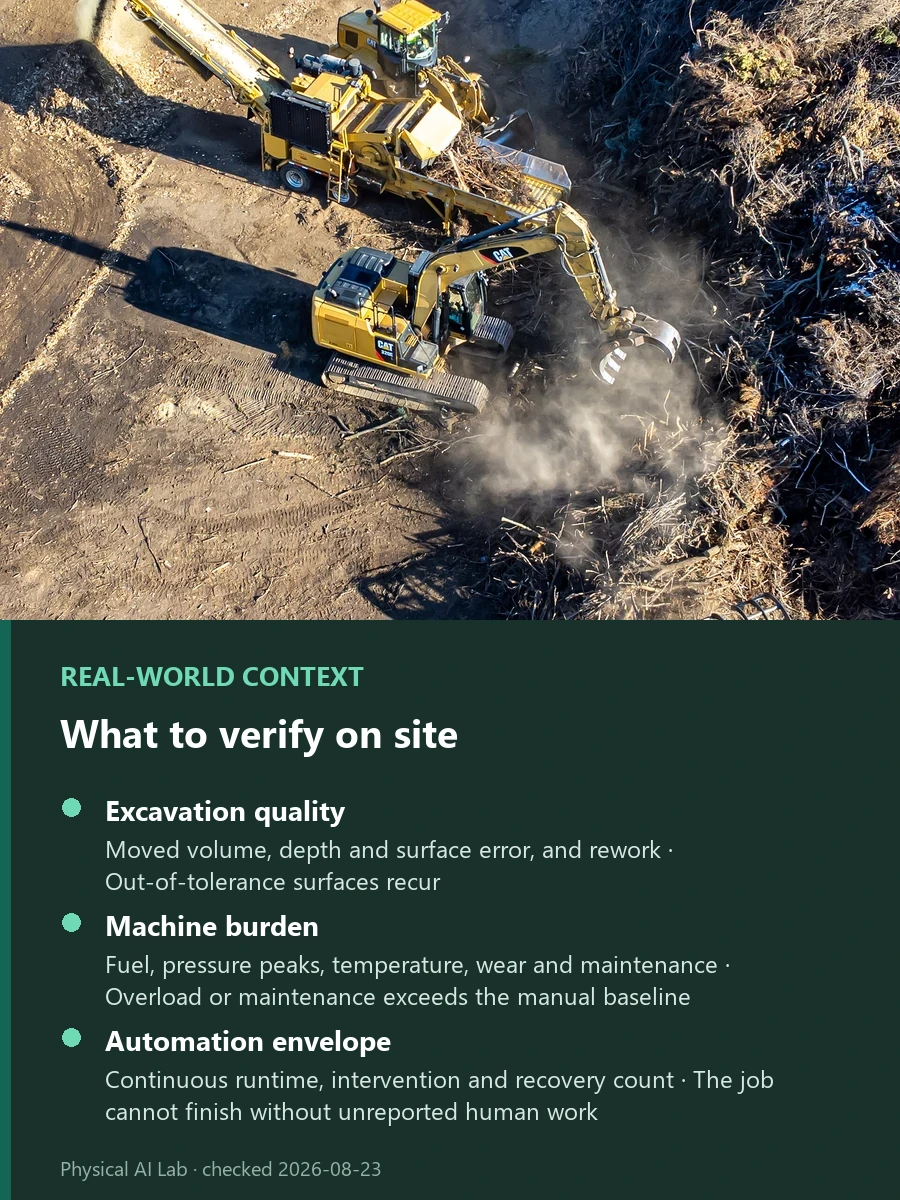
| Excavation quality | Moved volume, depth and surface error, and rework | Out-of-tolerance surfaces recur |
| Machine burden | Fuel, pressure peaks, temperature, wear and maintenance | Overload or maintenance exceeds the manual baseline |
| Automation envelope | Continuous runtime, intervention and recovery count | The job cannot finish without unreported human work |
| Site safety | Stopping distance, exclusion-zone entry and communication-loss response | Independent stop fails or a hazardous state persists |
People and buried utilities require safety outside the learned model
Excavation failures can damage equipment or injure people. Independent safety scanners, physical emergency stops, zone interlocks and hydraulic limits must stop the machine even when AI misses a person or pipe. Confirm buried-utility information through current drawings and field surveys, and exclude uncertain zones from autonomous work.
Predetermine behavior during communication loss. An abrupt stop with a raised bucket can swing the load, so each machine needs a safe pose and deceleration procedure. If one remote supervisor oversees several machines, load-test simultaneous help requests.
Operators need hands-on training for automatic-mode start and stop conditions and manual handover. If the screen and actual machine pose disagree, field observation takes priority; clear the work zone again before resetting an emergency stop. Training records should show that every shift follows the same procedure.
Do not loosen sensor thresholds simply because safety stops occur often. Investigate lighting, dust, vibration and sensor placement. Productivity and safety metrics can conflict, so an independent review should sit outside the person optimizing throughput.
Build a failure map in one bounded zone before expanding the site
Begin in one clearly bounded zone rather than an entire jobsite. Choose one of excavation, loading, grading or trenching, use one machine and two or three soil types, and establish a manual baseline. Then vary moisture, slope, rock and sensor occlusion one at a time and record where automation stops.
The physical AI company ecosystem, robot simulator comparisons and edge AI for robots help separate supply-chain, virtual-validation and on-machine compute decisions.
Contracts should define supported machines, exclusions, calibration responsibility, remote intervention, data ownership and recovery time. An investment announcement, a demo, a bounded pilot and recurring paid operation represent different evidence levels. Expand only after KPIs hold across seasons and shifts and operators can recover safely.
Frequently asked questions
Does an autonomous excavator need the soil type in advance?
Prior geotechnical information helps planning, but it cannot be the only input. The system must update its terrain model from hydraulic resistance and machine motion during every pass and stop when unexpected responses recur.
Can simulation produce a field-ready excavation policy by itself?
No. Simulation expands rare and dangerous conditions, but real soil, wear, hydraulic delay and sensor noise remain. Low-risk machine tests and a held-out field evaluation are still required.
Does autonomous digging mean an unmanned construction site?
No. People still define zones, verify buried utilities, coordinate trucks, maintain equipment, supervise remotely and handle emergencies. An automated motion is not the same as an unmanned project.
Official sources checked
- Official Gravis Robotics Series A announcement
- Official Gravis Robotics Rack page
- Official Gravis Robotics Slate page
Last checked: August 23, 2026