Automate 2026 drew more than 50,000 registrants, 1,230 exhibitors and over 50 humanoids and quadruped robots. The larger hardware presence shows that attention has moved toward physical systems, while raising the standard of evidence for production, deployment, generalization and dexterous manipulation.
What the official show-floor analysis confirms
A3's official industry analysis describes the attendance, robot count, more skeptical evaluation and commercialization challenges. Company forecasts at the show should still be separated from booked revenue or guaranteed volume production.
This article distinguishes confirmed facts from interpretation. Organizer and company figures remain bounded by their source date and scope; undisclosed prices, lead times and success rates stay unverified.
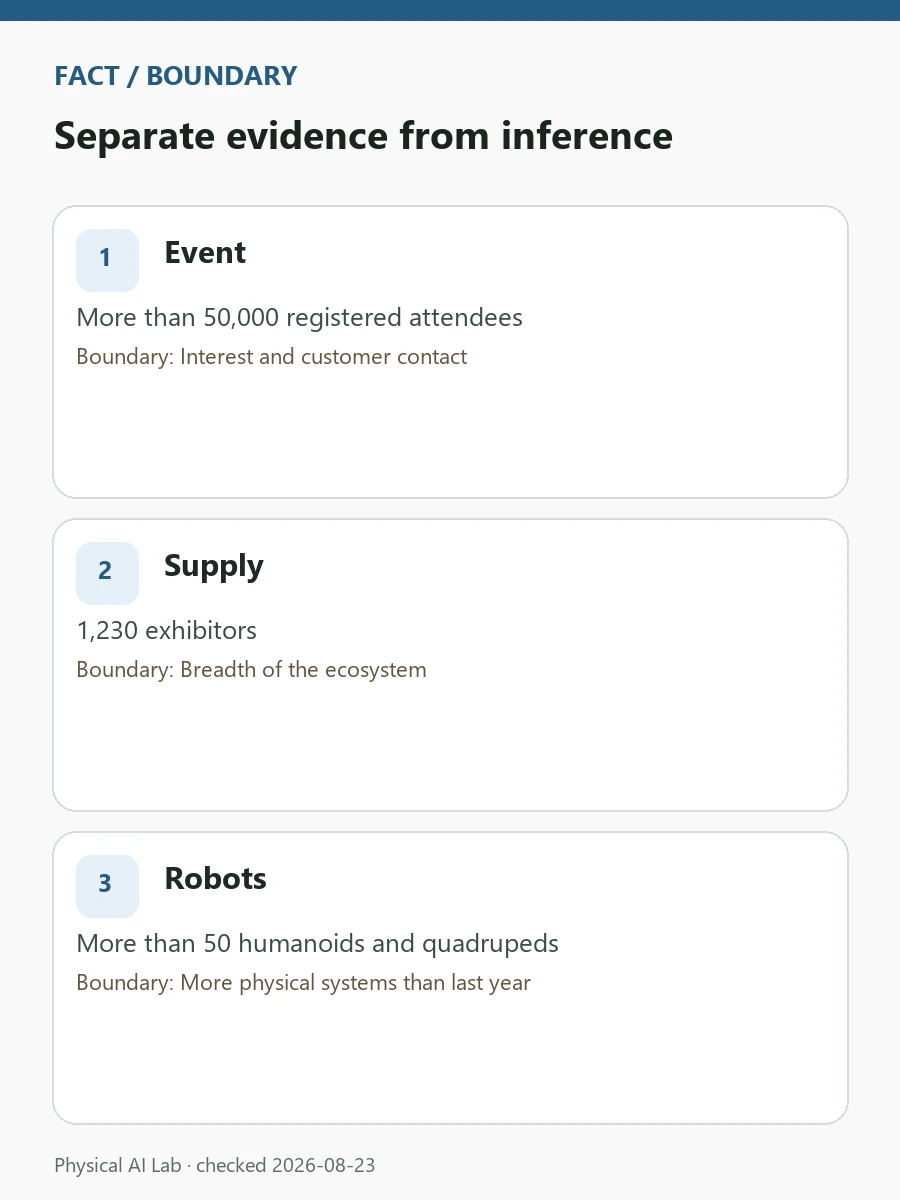
| Signal | What is confirmed | How to read it |
|---|---|---|
| Event | More than 50,000 registered attendees | Interest and customer contact |
| Supply | 1,230 exhibitors | Breadth of the ecosystem |
| Robots | More than 50 humanoids and quadrupeds | More physical systems than last year |
Paid deployments are stronger evidence than robot count
Commercial signals include how long a robot performs a customer task, whether a safety system is defined, and whether production and service can repeat. Paid deployments and renewal contracts carry more weight than the number of units displayed.
The system still needs synchronized sensors, state estimation, planning, low-level control, safety limits and recovery for repeatable physical AI work.
Ask for customers, production capacity and service response
Start with the conditions behind each failure, then record repeat count, human intervention and recovery time. Those details turn an exhibition claim into a commercial-readiness assessment.
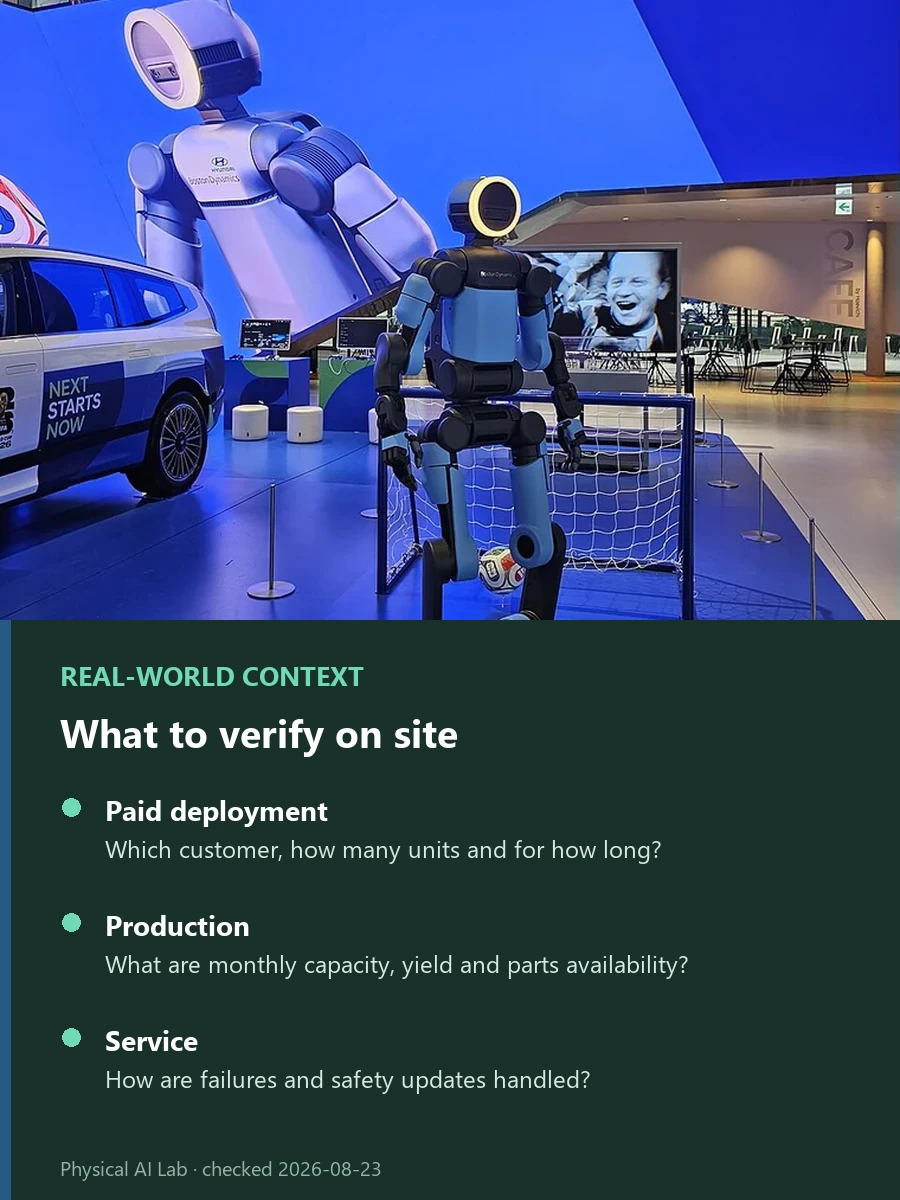
| Check | Question to ask |
|---|---|
| Paid deployment | Which customer, how many units and for how long? |
| Production | What are monthly capacity, yield and parts availability? |
| Service | How are failures and safety updates handled? |
.jpg)
Funding and valuation are not performance metrics
Capital can buy development time, but it does not automatically solve reliability, safety or customer integration. Do not substitute fundraising scale for product evidence.
The official event analysis is still an industry-association source. Customer records, independent tests and safety documentation should update the judgment when available.
Place show-floor claims inside the wider ecosystem
Map each exhibitor in the physical AI company ecosystem, compare its validation claims with the robot simulator comparison and examine its onsite compute through edge AI for robots. The commercial signals reviewed here are current to August 2026.
What the larger humanoid presence really changes
Automate 2026 brought more than 50,000 registrants, 1,230 exhibitors and over 50 humanoids and quadrupeds into one show. The important next step is repeatable customer work under disclosed production, service and safety conditions.
Frequently asked questions
What separates a commercially active Automate humanoid from an exhibition unit?
A named paid deployment should disclose the customer task, operating period, intervention burden, delivery status and service responsibility. Production forecasts and booth count do not substitute for that operating record.
Which Automate claim should a buyer verify first?
Verify a named paid deployment: the customer task, unit count, operating period, intervention rate, renewal status and service responsibility.
Why does service capacity matter as much as humanoid production?
A deployed fleet loses value when parts, diagnostics or trained technicians are unavailable. Production puts robots on site; service determines how much useful work they deliver afterward.
Official sources checked
- A3's official analysis of humanoids and Physical AI at Automate 2026
- Official Automate event site
- A3 robot safety resources
Last checked: August 23, 2026