AgiBot World Challenge 2026 combined online automated evaluation with a physical robot final in Vienna. The important step was checking long-duration task stability, physical adaptation and failure recovery on a G2 humanoid instead of stopping at the simulation ranking.
What the AgiBot challenge actually evaluated
AgiBot's official recap identifies EWMBench, Genie Sim Benchmark, R2A and world-model tracks, a physical supermarket task and the winning teams. Because it is an organizer source, the evaluation design is more informative than any unsupported claim of superiority over unrelated benchmarks.
AGIBOT’s March competition notice says the Reasoning to Action track includes online simulation and offline real-robot stages. By contrast, the World Model track has an online-only competition stage. Comparisons between online and real-robot results should therefore be limited to Reasoning to Action and not generalized to other tracks.
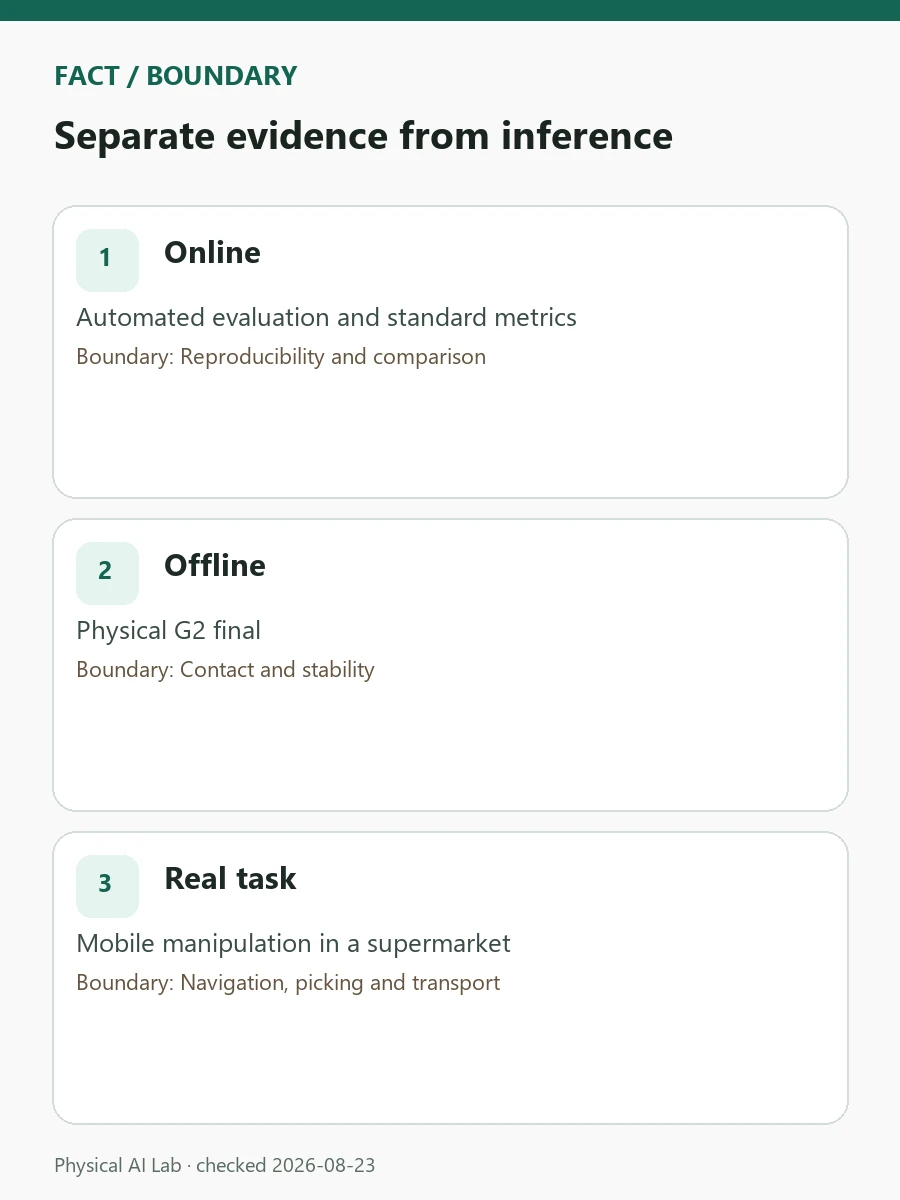
| Stage | What is confirmed | What it reveals |
|---|---|---|
| Online | Automated evaluation and standard metrics | Reproducibility and comparison |
| Offline | Physical G2 final | Contact and stability |
| Real task | Mobile manipulation in a supermarket | Navigation, picking and transport |
The ranking gap can reveal missing physics
Reproducible automated evaluation helps compare teams, while a hardware final exposes contact dynamics and sensor error. A large shift between the two rankings can point to physical variables the simulator missed or a policy's fragile assumptions.
Repeatable physical AI still requires synchronized sensors, state estimation, planning, low-level control, safety limits and recovery to function as one chain.
Compare online rank with physical endurance and generalization
Ask how many repeated tasks the robot completed, when a person intervened and how it recovered from a stop. The final should expose more than one successful hardware run.
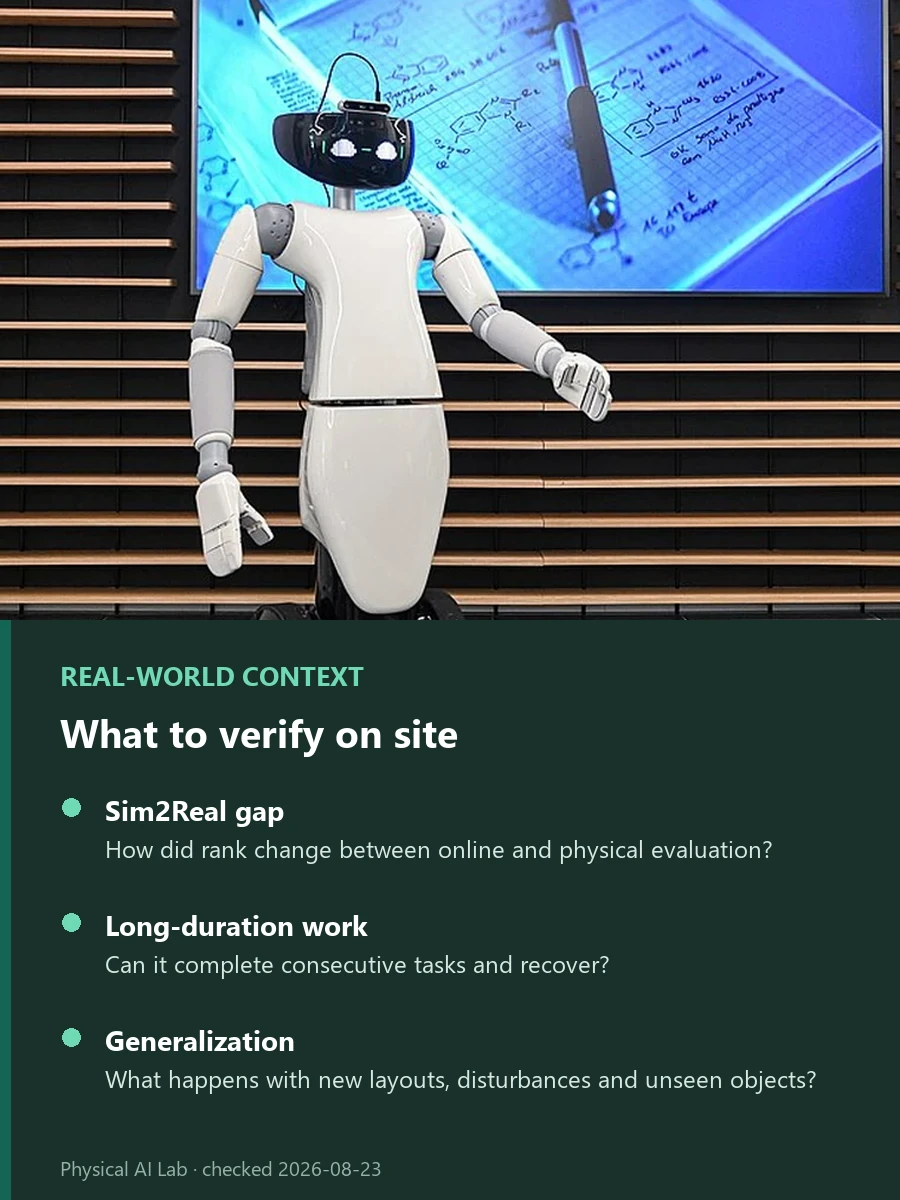
| Check | Question to ask |
|---|---|
| Sim2Real gap | How did rank change between online and physical evaluation? |
| Long-duration work | Can it complete consecutive tasks and recover? |
| Generalization | What happens with new layouts, disturbances and unseen objects? |

A benchmark score remains bounded by its distribution
New objects, a different robot, longer operation and safety certification all require separate evidence. The benchmark should not be generalized beyond the tasks and distributions it actually tested.
The official recap is the current primary source. Independent replications and customer-site data should update the assessment when available.
Background for reading the simulation-to-hardware gap
Read what physical AI means for the system boundary, the core ideas behind Sim-to-Real for the online-to-hardware gap and robot foundation models for model scope. This August 2026 article uses that context to interpret the challenge results.
Why the physical final matters
AgiBot World Challenge 2026 connected automated online evaluation with a physical final in Vienna. Its most useful evidence is the difference between reproducible simulation scores and repeatable performance on real hardware.
Frequently asked questions
What evidence is still missing after an AgiBot challenge win?
A prospective operator still needs a usable product or licensing route, repeat results on its own tasks, safety limits, integration scope and maintenance support. A competition establishes performance only inside its published evaluation.
Why can AgiBot online and hardware rankings differ?
Real hardware introduces contact, latency, sensor error, wear and environmental variation that an automated benchmark may model imperfectly.
What would make an AgiBot benchmark result reproducible?
Publish the task definition, evaluation code, model and configuration versions, random seeds, hardware setup, intervention rules and complete run logs.
Official sources checked
- Official AgiBot World Challenge 2026 recap
- AgiBot official website
- AgiBot World official open-source organization
Last checked: August 23, 2026