A robot diffusion policy generates actions by starting from a noisy action sequence and iteratively denoising it while conditioning on recent observations. The learned distribution can represent several plausible behaviors for the same scene, which is useful when demonstrations contain genuinely multimodal ways to complete a task.
The policy is not the entire robot control stack. Observation capture, normalization, inference scheduling, command conversion, interpolation, servo control, limits and protective reactions all sit around it. Its prediction horizon and the shorter portion actually executed determine how quickly the system can respond to new evidence.
Use this guide with the robot action chunking guide and robot sensor-fusion guide. Evaluate a diffusion policy on the target embodiment and task distribution rather than treating one benchmark improvement as a universal result.
Diffusion models a conditional action distribution
Behavior cloning with a single regression target can average incompatible demonstrations, producing an action that belongs to none of the demonstrated modes. A diffusion objective instead learns how to transform noise toward regions of the action-sequence distribution that agree with the observation condition. Different samples can therefore express different valid modes.
The official Diffusion Policy project describes conditional denoising in action space with receding-horizon execution. The method predicts sequences rather than isolated commands, but multimodality does not guarantee correct intent: dataset coverage and conditioning still decide which modes are available.
Training adds noise and learns the reverse direction
During training, a clean demonstrated action sequence is perturbed at sampled diffusion timesteps. A neural network receives the noisy sequence, the timestep and observation features, then learns a denoising target such as the added noise or an equivalent parameterization. The noise schedule and target definition must match the sampler used at inference.
Actions need consistent units, ordering and normalization. Joint position, Cartesian delta, rotation and gripper commands have different scales and topology. Rotations should use a representation with known discontinuities, and bounded gripper states may need separate treatment. A model can minimize loss while producing physically inconsistent commands if the action interface is ambiguous.
Inference refines a whole candidate horizon
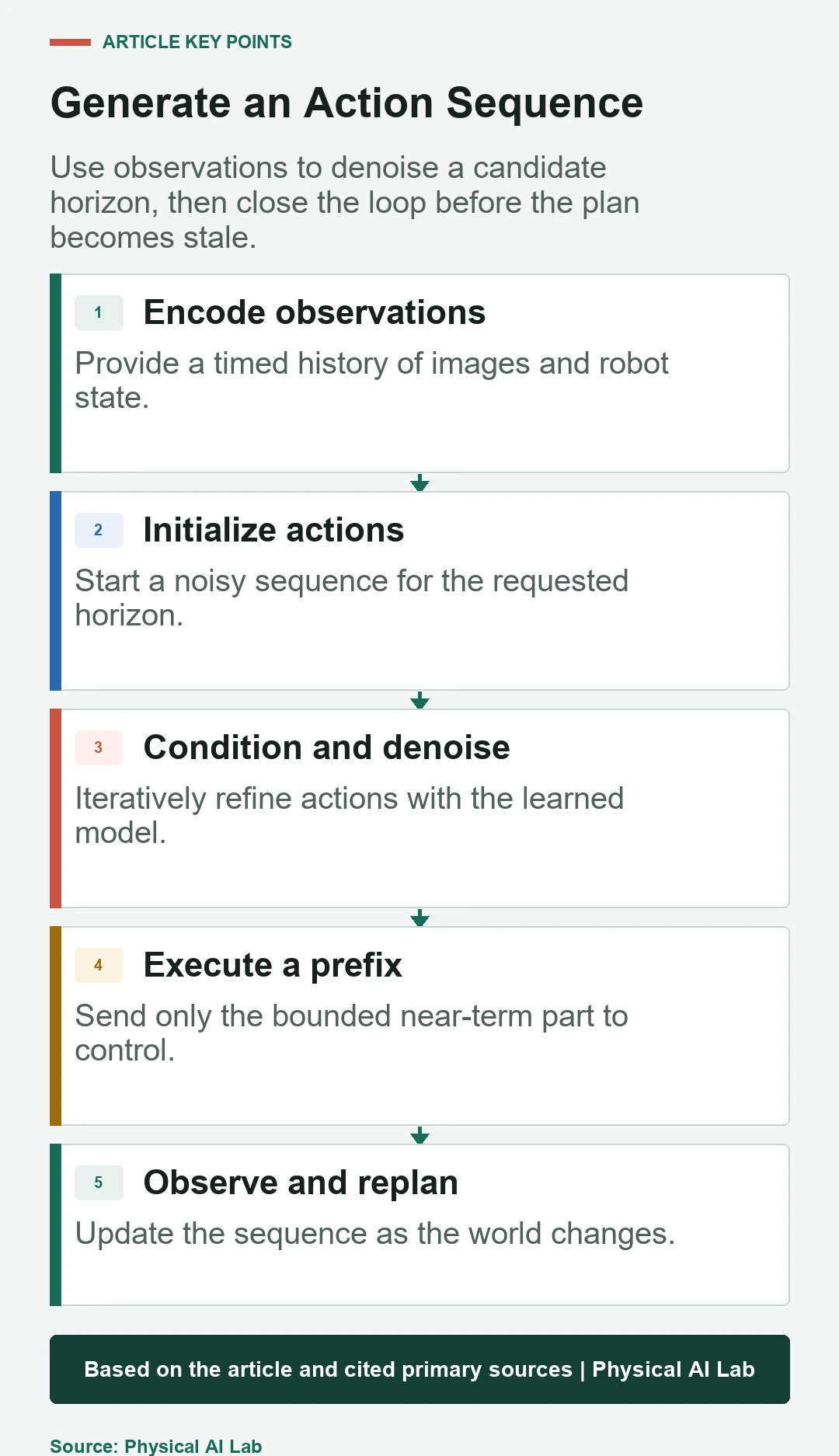
At runtime, the policy initializes an action horizon from noise and applies a finite sequence of reverse updates conditioned on observation history. The final sequence is a sample, not a deterministic optimization proof. Random seed, sampling schedule, number of steps and guidance choices affect both output and latency.
Measure end-to-end time from sensor exposure to command application. GPU kernel time alone omits image transfer, preprocessing, queueing and controller handoff. If one denoising pass is slower than the observation interval, stale frames or overlapping requests need an explicit policy rather than an unbounded callback queue.
| Horizon or rate | Meaning | Main tradeoff | Log |
|---|---|---|---|
| Observation horizon | Past states supplied | Context versus memory | Oldest data age |
| Prediction horizon | Actions generated | Coherence versus uncertainty | Sequence length |
| Execution horizon | Actions applied before refresh | Efficiency versus reactivity | Applied prefix |
| Diffusion steps | Reverse updates per sample | Quality versus latency | Sampler duration |
| Servo rate | Hardware command update | Smoothness versus bandwidth | Application timestamp |
Receding-horizon execution closes the loop
A common design executes only the first part of a predicted sequence, observes again and generates a replacement sequence. This resembles model-predictive receding-horizon control at the scheduling level, but the learned generator is not necessarily solving a dynamics-constrained optimal-control problem online.
Choose execution prefix from task speed, contact sensitivity and inference budget. Long prefixes preserve coherent motion and reduce compute demand but react slowly to disturbance. Very short prefixes replan often but can create discontinuities or expose sampling variation. Log the requested, generated and actually applied horizons separately.
Observation conditioning defines correctable errors
Images, proprioception, force or language features must be synchronized and normalized exactly as during training. Camera crop, lens, exposure, frame ordering and robot-state convention can shift the input distribution. An apparently minor resize or endpoint-frame change can invalidate a learned mapping.
Use timestamped histories rather than assuming a batch contains simultaneous evidence. If vision arrives late, current proprioception paired with an older image describes no real state. Data augmentation can improve tolerance to planned variation, but deployment tests still need representative lighting, viewpoint, occlusion and calibration shifts.
Action representation meets a lower-level controller
A policy may predict joint targets, Cartesian deltas, velocities or normalized abstract actions. The downstream controller turns those values into torques and motion under its own gains, interpolation and limits. Reproducing a policy therefore requires the action conversion and controller configuration, not only the model checkpoint.
Coordinate control details with the robot position, velocity and torque control guide and ROS 2 real-time control guide. Clamp rate, workspace and force at a layer whose behavior is deterministic and testable; do not assume training examples enforce hardware limits.
Dataset diversity is not deployment coverage
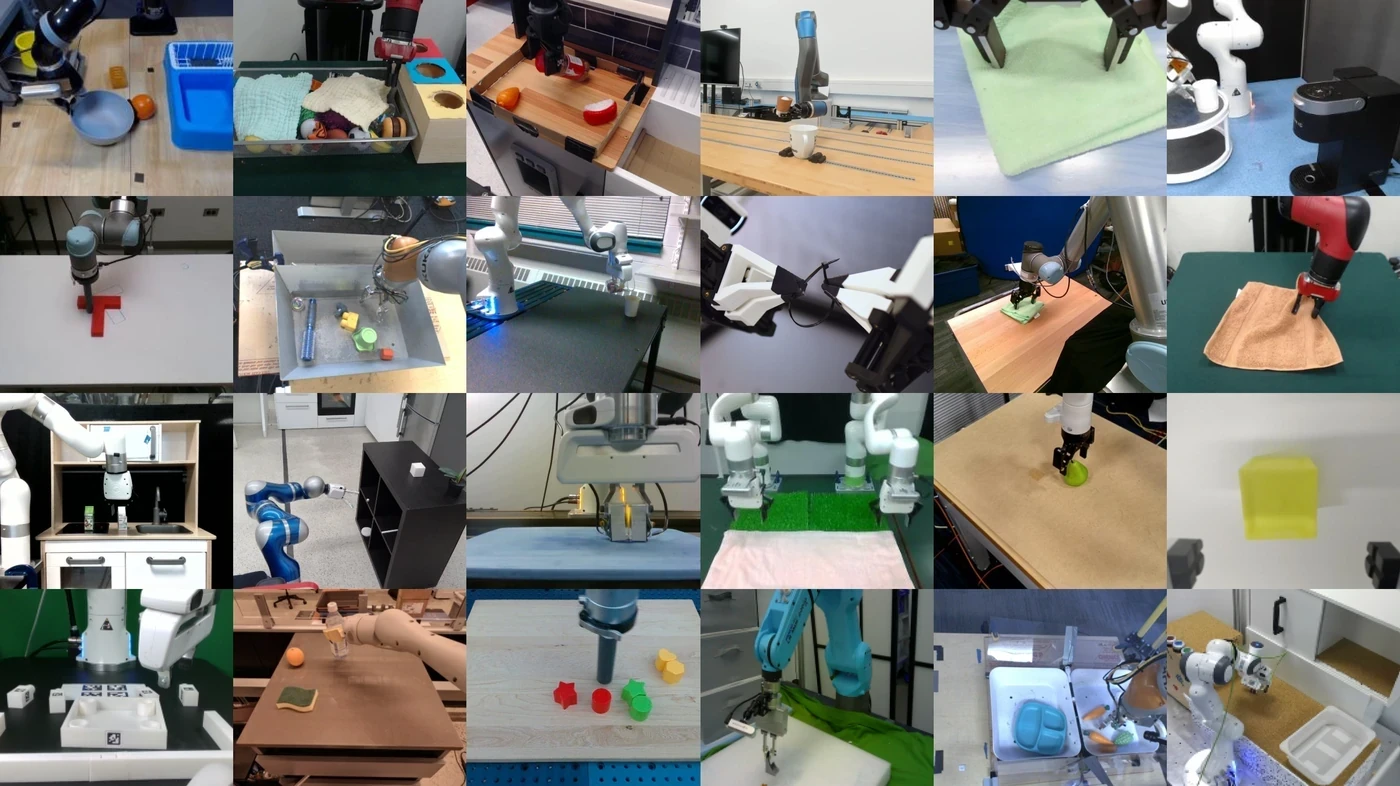
The Open X-Embodiment repository unifies open robot datasets into a common format and distinguishes software licensing from non-code material licensing. A large collection can broaden pretraining, yet its camera geometry, action spaces, task labels and embodiment mix are not automatically balanced for a new robot.
Audit per-dataset sampling, duplicates, failure examples and action conversion. Keep a deployment-specific split that contains the target gripper, objects and disturbances but is not used for model selection. Cross-embodiment pretraining is a hypothesis to test, not evidence that calibration or kinematics differences have disappeared.
| Evaluation axis | Matched test | Shifted test | Failure evidence |
|---|---|---|---|
| Objects | Held-out instances | New shapes and materials | Wrong contact |
| Viewpoint | Training-like mount | Camera displacement | Visual mislocalization |
| Language | Known phrasing | Paraphrase and distractor | Wrong subtask |
| Dynamics | Nominal payload | Mass and friction change | Overshoot or drop |
| Timing | Normal compute load | Delayed observations | Stale action |
Sampling variation needs controlled evaluation
Because inference may be stochastic, one start state can yield different sequences. Fix seeds when comparing software changes, then repeat with multiple seeds to measure operational variability. Separate policy randomness from uncontrolled object placement and sensor noise through replayable observations or instrumented fixtures.
Report trial count, success definition and confidence intervals. Do not select the most visually appealing rollout from many samples without counting the discarded attempts. If multiple candidate sequences are sampled and ranked, the ranking model and extra compute are part of the deployed system and need their own ablation.
Safety belongs outside the learned success metric
Task success does not measure collision energy, joint-limit proximity, unsafe workspace entry or human intervention. Log protective stops, contact, peak force, dropped objects and operator takeovers even when the task eventually completes. Near misses should not be hidden inside a binary success label.
Use deterministic command checks, collision monitoring and a qualified safety architecture appropriate to the application. Test corrupted images, delayed state, sampler timeout, NaN output and out-of-range actions. Define the fallback for each case before autonomous trials, including whether the robot holds, retreats or enters a safe state.
Deployment review links model evidence to hardware
The Diffusion Policy paper and official implementation are primary references for the method and reported experiments. Reproduction should pin code, checkpoint, dataset revision, sampler, image transforms, action convention and controller, because each changes the executable policy.
Start with offline action replay, continue with a guarded test fixture, and then expand object, pose, lighting and disturbance ranges. Retain videos and synchronized raw telemetry for every trial. Promote a policy only when its latency tails, failure taxonomy and protective behavior fit a written operating envelope.
- Pin observation and action conventions.
- Measure complete denoising and command latency.
- Separate prediction horizon from execution prefix.
- Repeat trials across seeds and physical shifts.
- Keep deterministic limits and protective reactions independent.
Frequently asked questions
Is a diffusion policy the same as a vision-language-action model?
No. Diffusion describes an action-generation mechanism. A VLA policy additionally uses language and vision in a particular architecture; it may or may not use diffusion.
Why predict actions as a sequence?
A sequence can preserve temporal coherence and represent a short behavior segment. The system can still execute only a prefix and replan from new observations.
Does more denoising always improve robot performance?
No. Extra steps increase latency and may show diminishing returns. The useful setting must be measured with the deployed sampler, hardware and task.
Can the policy command motors directly?
Usually a lower-level controller converts predicted joint or Cartesian targets into hardware commands. That interface and its limits are part of the system.
How should multimodal behavior be evaluated?
Repeat matched start states across seeds, count all attempts, inspect mode appropriateness and report task, safety and variability metrics rather than one rollout.
Diffusion Policy Deployment Boundary
A diffusion policy generates learned action sequences under its training distribution. It does not by itself guarantee kinematic feasibility, control stability, collision avoidance or functional safety on a physical robot.