A parachute is useful only after a failure is detected, motor hazards are controlled, deployment succeeds, descent remains within the tested envelope, and the aircraft lands where residual ground risk is acceptable. Treating the canopy as a complete BVLOS answer skips most of that chain.
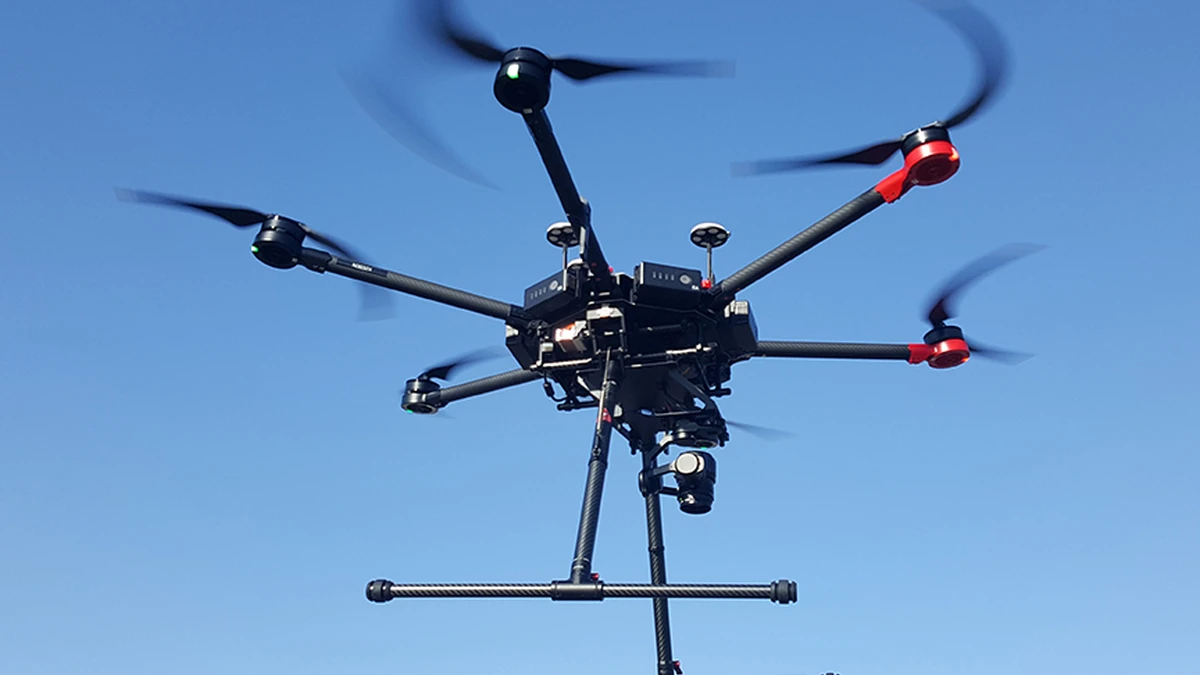

DJI’s AP100 launch release describes a rear-mounted Matrice 400 module of about 935 g and an approximate six-minute flight-time impact. It reports less than 600 ms response and less than 5 m/s descent in controlled production-model tests. Those are manufacturer condition values, not guarantees for every altitude, attitude, wind, payload, or terrain.
Draw the safety-case boundary before fitting the module
AP100 is one mitigation for a Matrice 400 operation. It does not replace command-and-control resilience, navigation containment, maintenance, airspace coordination, competent personnel, emergency response, or the authority’s review. The roughly 15.8 kg maximum takeoff mass context and six-minute endurance effect published by DJI are configuration-bound. A safety case should identify which aircraft, payload, firmware, installation, and operational volume were assessed. An installed mitigation changes residual risk; it does not erase the operation’s hazards.
Follow the observable failure from detection to descent
DJI says independent sensors and flight control plus dual capacitors allow monitoring without aircraft power or an active E-Port for up to one hour. The FTS is described as cutting motor power within 600 ms before parachute deployment, reducing the chance that rotors entangle the canopy. Motor termination and parachute deployment are separate functions; independent power also does not remove every common-cause failure in structure, installation, environment, or software assumptions. The advertised sequence needs end-to-end evidence, not isolated component timings.
| Failure or decision | Automatic layer | Human or organization layer | Residual cost |
|---|---|---|---|
| Aircraft fault | Detection and FTS trigger | Pilot confirms or commands termination | Route and impact uncertainty |
| Motor hazard | Power cut before canopy | Emergency notification | Rotor entanglement not eliminated |
| Parachute descent | Canopy limits descent | Secure landing area and recover | Wind drift and ground injury risk |
| False activation | Health logic and inhibit | Incident response and inspection | Downtime, repack, investigation |
| BVLOS application | C5/C6 evidence where applicable | Operator documents full operation | Authority may require more evidence |
Keep the remote pilot inside the intervention design
Automatic behavior still needs a remote-pilot response. Define alerts for health, arming, FTS state, deployment, link loss, and impact location. The pilot must know when to terminate manually, when continued flight creates less ground risk, how to warn people, and how to secure the landing area. Testing should include delayed or contradictory telemetry rather than assuming the operator always sees a clean event sequence. Human response remains part of a remotely operated safety architecture.
- power independence
- motor termination
- canopy deployment
- descent speed
- wind envelope
Price false deployment, repacking, and downtime
A deployment can save an aircraft while closing an operational site. Repacking or module replacement, aircraft inspection, data retrieval, regulatory reporting, recovery travel, and loss of service belong in total cost. False activation and failure to activate have different consequences. Measure both during environmental, vibration, power-loss, and maintenance tests, and assign a support owner for the aircraft, AP100, installation, and operating organization. Maintenance and recovery can dominate the cost of rare safety events.
Gate BVLOS use on the operation, not the label
DJI distinguishes a retrofit route for existing Matrice 400 aircraft associated with C5/UK5 from a factory-certified C6/UK6 combination. EASA explains that C5 is used for STS-01 and C6 for STS-02, with all scenario conditions and the authority’s declaration acknowledgement still required. The airspace and certification comparison helps keep equipment marking, standard scenario, SORA, and bespoke BVLOS authorization on separate paths. A class marking supports a pathway only when the corresponding operational conditions are met.
Questions readers ask next
Which failure paths are mitigated by parachute deployment, and which require the flight-termination system or another independent control?
The remote pilot steps in when automatic health information is contradictory, termination is required by the approved procedure, deployment changes the ground hazard, or recovery and notification begin. Exact intervention points must be written into the operation-specific emergency response plan and trained.
How can C5/C6-related evidence support a Matrice 400 application without replacing the operator’s route, ground-risk and authority review?
Responsibility is shared unless the contract says otherwise: DJI for published product support, the installer for configuration and records, the operator for maintenance and operations, and the competent authority for approval. A class marking does not transfer the operator’s safety-case responsibility to the manufacturer.
Official source trail: