A larger tank can reduce refills and still lower daily output if charging, mixing, transport, cleanup, or operating limits become the bottleneck. An agricultural-drone comparison starts with the field route and support vehicle, then works back to payload.
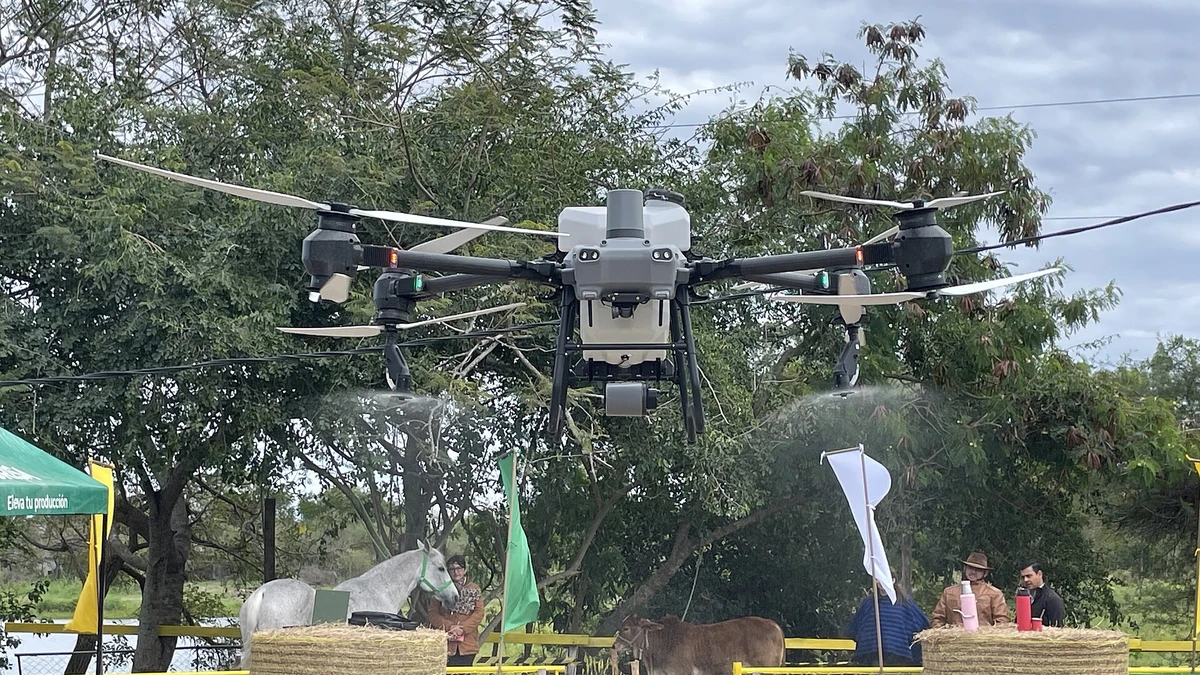

DJI’s T100 dual-battery announcement and T55 product materials publish multiple configurations rather than one universal winner. The T100’s 90 L dual-battery spraying setup and claimed up-to-50% hover-time increase under the same payload conditions are manufacturer results. They need to be tested against the T55’s field logistics and the operator’s actual mission.
Define the field, input, and turnaround cycle
Map block size, row spacing, slope, obstacles, liquid or granule, required dose, water source, battery station, and road access. A 90 L tank has little value when the aircraft must return early for energy, the mixing crew cannot refill it fast enough, or local takeoff-mass rules constrain the mission. Include ferry time and setup between fields; hectares per flight is not hectares per workday. Useful capacity belongs to a complete field cycle.
- field block size
- slope
- obstacle type
- application material
- dose rate
Represent payload and energy as configurations
DJI lists a 50 L spray tank for T55, up to 50 L/min mist flow, a 55 kg spreading load, and up to 400 kg/min spread flow. Standard T55 aircraft weight is 45 kg with DB1050 and 48.4 kg with DB1580. DB1050 is 20 Ah and 8.3 kg; DB1580 is 30 Ah and 11.7 kg, with DJI positioning the latter for longer high-altitude or low-application-rate work. Keep empty aircraft, liquid tank, spreader, lifting module, and battery configurations separate. A model name can contain several mutually exclusive configurations.
Choose by bottleneck rather than the largest number
T100’s standard lifting module is stated at 100 kg while its dual-battery lifting module is 80 kg; neither is the same as spray-tank capacity. Compare effective swath, prescribed rate, speed, refill time, charge or swap time, crew, and remaining energy. On a small fragmented farm, T55 may turn faster. On a large block with aligned support logistics, T100 may reduce nonproductive returns. The choice depends on the limiting step. The right aircraft is the one that relaxes the actual bottleneck.
Execute the route inside sensing and weather limits
T55 obstacle-avoidance specifications assume normal illumination, rich scene texture, and clean sensors. Crops, wires, mist, dust, glare, darkness, and feature-poor terrain can move the system outside that envelope. Radar and vision do not guarantee automatic safety. A route needs altitude, speed, exclusion zones, wind, GNSS quality, link margin, and manual takeover criteria. The outdoor robotics test guide supplies a field-fault checklist. Sensing has an operating envelope that crops and weather can violate.
Close the loop with refill, charging, and cleanup data
Record each sortie’s payload, actual application rate, treated area, refill minutes, battery state, swap or charge minutes, route interruption, leftover material, and cleanup. Track operator handling and support-vehicle movement. A dual-battery configuration changes endurance and turnaround, but it also changes aircraft mass, the battery inventory, charger demand, and the crew’s handling sequence. Those costs should be normalized per completed hectare. Daily productivity needs the support crew and energy system in the denominator.
| Selection constraint | T55 question | T100 question | Field measurement |
|---|---|---|---|
| Block and ferry | Does faster turnaround offset fewer liters? | Can larger loads be used before energy return? | Completed hectares per hour |
| Energy | Which DB1050/DB1580 cycle fits? | Does dual-battery inventory sustain the route? | Swap, charge, and queue time |
| Application | Are 50 L and flow limits adequate? | Can the 90 L setup use the required rate? | Actual dose and uniformity |
| Terrain sensing | Do light and texture meet conditions? | Does the route remain inside the sensor envelope? | Stops, interventions, and misses |
| Support | Can one crew mix and service it? | Does larger payload require added staff or vehicle? | Labor and logistics per hectare |
Know where the specification stops
Flow maxima depend on nozzle, particle, material, weather, and setup. Hover-time improvement belongs to DJI’s test conditions. Sales configuration and agricultural application rules differ by region. Before purchase, confirm locally available tanks, spreaders, batteries, chargers, firmware, remote controller, service, chemical requirements, flight permissions, and records. A comparison that ignores the local bill of materials can recommend an aircraft the buyer cannot configure as described.
Regional availability and rules can change the answer after the engineering comparison.
Questions readers ask next
How do refill travel, dual-battery logistics, spray or spread rate and terrain complexity change the useful capacity of each aircraft?
The system limit appears first where the field cycle is tightest: payload, energy, mixing, refill, obstacle environment, link, or regulatory mass. A one-day pilot should record every turnaround and intervention so the bottleneck is measured rather than assumed.
Official source trail: