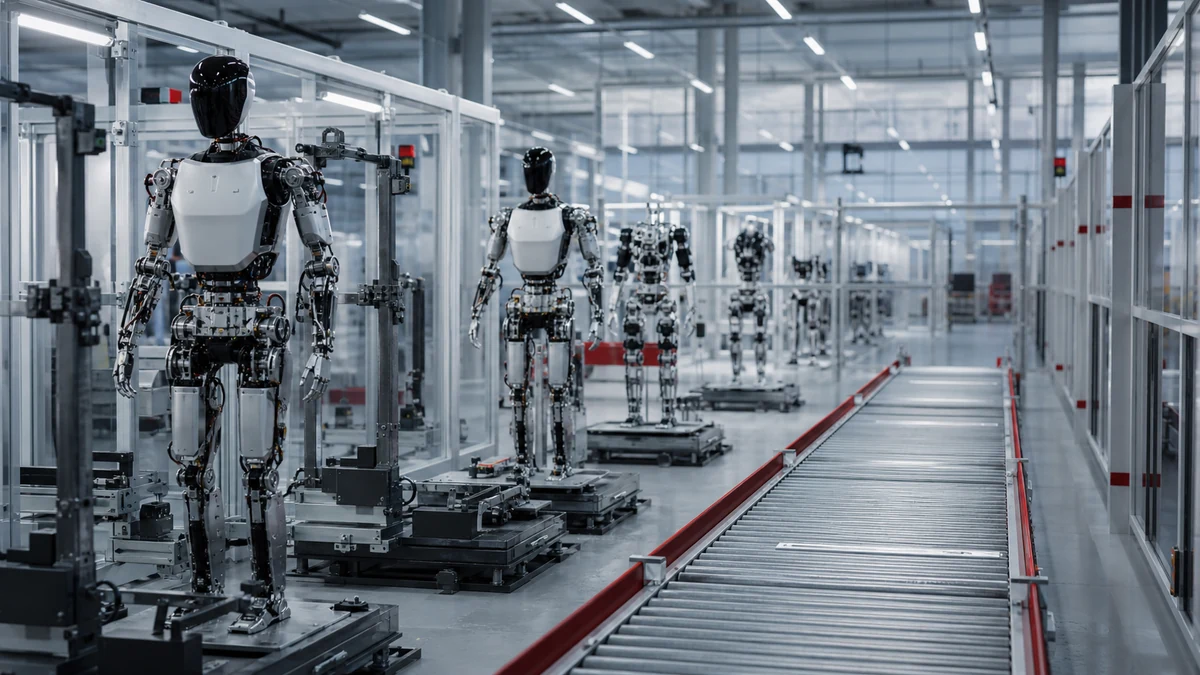
Figure said in its April 2026 BotQ production update that it had moved from one Figure 03 per day to one per hour and delivered more than 350 third-generation humanoids. The same release calls one robot per hour a successfully demonstrated cycle time. It does not report a full year of uninterrupted hourly production.
The stated capacity of up to 12,000 humanoids per year is another category: the designed ceiling of BotQ's first line. Completed units, robots assigned to Figure's internal teams, systems installed at customer sites and paid external deliveries need separate counts. The BMW work is covered in Figure 03 parts sequencing; this page tests the manufacturing claims themselves.
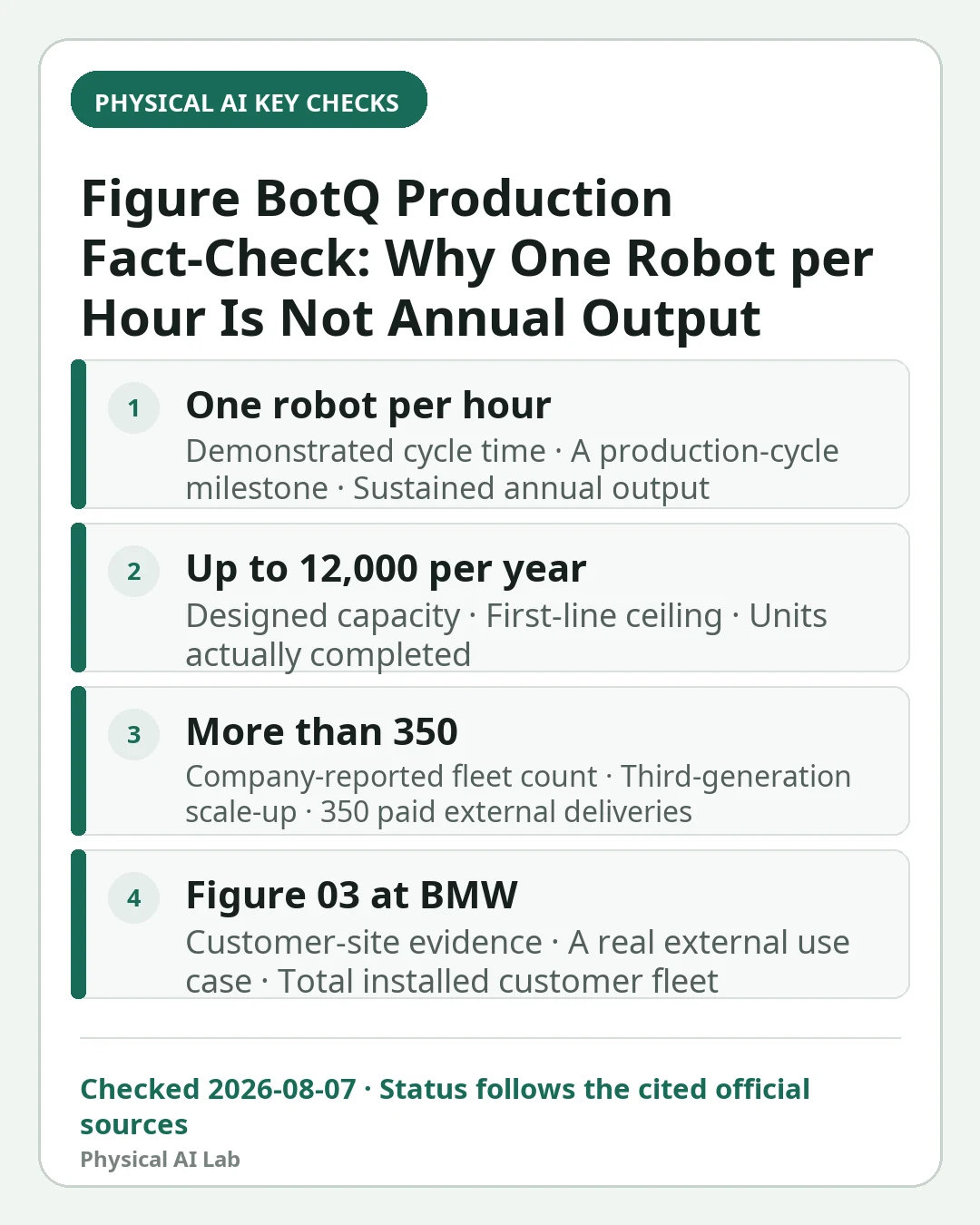
Four BotQ numbers answer four different questions
The official BotQ overview is useful only after each production claim has its unit and boundary attached. Twelve thousand per year is line capacity, one hour is a demonstrated build cycle, more than 350 is Figure's reported third-generation fleet total, and paid deliveries require customer-level evidence. Combining them into one annual sales number would add information that Figure did not publish.
The verb 'delivering' also needs context. Figure says BotQ robots are allocated to internal research and development, data collection, household-work development, commercial-use-case development and deployments beyond headquarters. An internally assigned robot is still a manufactured unit, but it is not automatically a revenue-bearing customer shipment.
| Published figure | Metric type | What it supports | What it does not establish |
|---|---|---|---|
| One robot per hour | Demonstrated cycle time | A production-cycle milestone | Sustained annual output |
| Up to 12,000 per year | Designed capacity | First-line ceiling | Units actually completed |
| More than 350 | Company-reported fleet count | Third-generation scale-up | 350 paid external deliveries |
| Figure 03 at BMW | Customer-site evidence | A real external use case | Total installed customer fleet |
A one-hour cycle cannot simply be multiplied by calendar hours
A measured cycle can assume materials, staff and equipment are ready and that no rework interrupts the station. Annual output absorbs changeovers, maintenance, supplier shortages, quality holds, engineering revisions and idle shifts. Multiplying one unit by 8,760 hours treats every one of those losses as zero.
Figure's wording is appropriately narrower: the company says it demonstrated the one-hour cycle needed for its target and will continue optimizing. The same discipline used to evaluate humanoid robot videos applies here—one successful run is evidence of capability, not a distribution of sustained results.
The 350-plus count includes internal and commercial-development allocations
Figure identifies several destinations for BotQ robots, including internal R&D groups, data collection, end-to-end housework efforts and commercial-use-case development. Those allocations serve the Helix training and reliability program. They should not be relabeled as external purchases unless a customer, date, quantity and commercial status are disclosed.
The June 2026 Figure 03 BMW announcement does establish that a production robot reached an external plant and performed a parts-sequencing workflow. It does not say how many of the 350-plus robots went to BMW or other paying customers. A verified site is not a fleet-wide delivery ledger.

Yield and inspection metrics show process control, not shipment volume
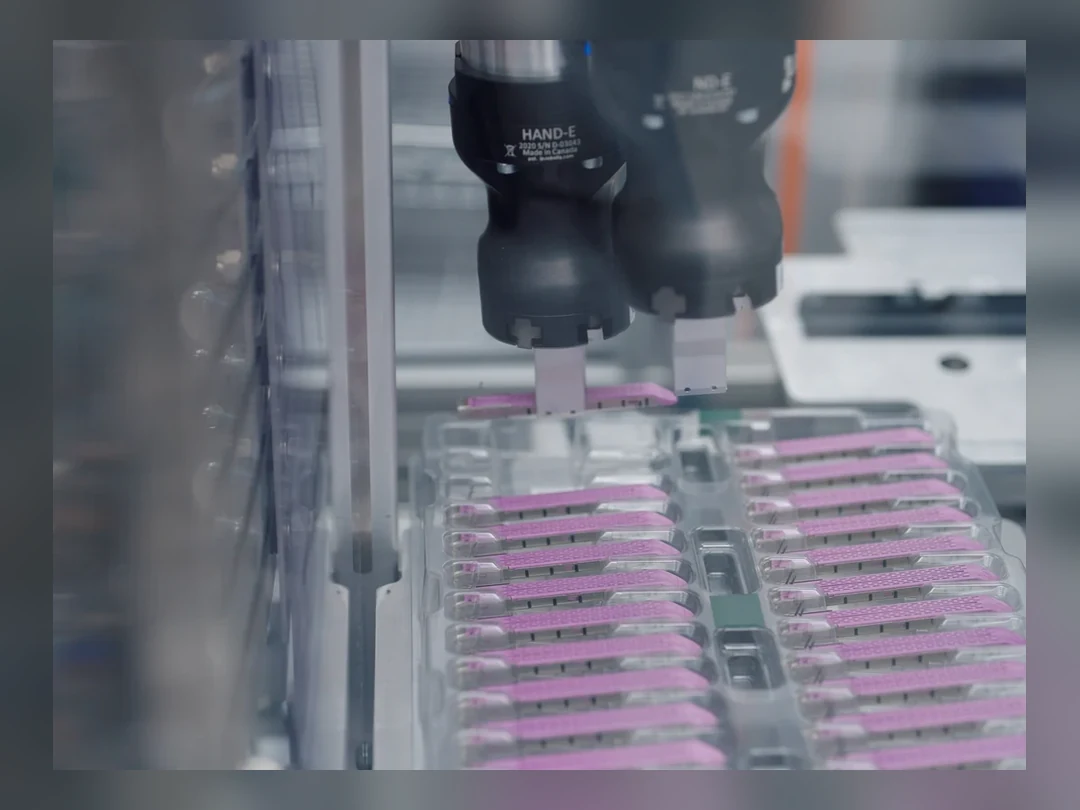
Figure reports end-of-line first-pass yield above 80%, battery-line first-pass yield of 99.3%, more than 500 battery packs and more than 9,000 actuators across over ten SKUs. It also describes more than 50 in-process inspection points and over 80 functional verification tests per robot. These are concrete signs of a maturing manufacturing system.
They still do not collapse into a robot-delivery total. Component counts can include test, spare and rejected parts, while first-pass yield differs from final yield after rework and from failure rates in service. A buyer should set task, intervention and recovery thresholds with a physical AI proof-of-concept plan before treating factory quality metrics as operational reliability.
| Quality signal | Figure-reported value | Useful reading | Missing evidence |
|---|---|---|---|
| End-of-line first-pass yield | Above 80% | Initial pass performance | Rework and final ship yield |
| Battery first-pass yield | 99.3% | Battery-line process stability | Field degradation and replacement rate |
| In-process checks | More than 50 | Traceable inspection structure | Defect distribution |
| Functional tests | More than 80 per robot | Pre-release verification breadth | Long-duration customer failure rate |
BMW proves an external use case, not the size of the customer fleet
Figure 03's arrival at BMW Plant Spartanburg confirms more than an internal lab test. The robot pulled a cart and sequenced components in Hall 52. That is relevant deployment evidence, but the release does not provide a purchase price, a fleet total or a sustained paid-production schedule.
Generation labels matter as well. Figure previously reported 1,250 hours and more than 90,000 parts for Figure 02 over an 11-month BMW program. Those figures cannot be carried forward as Figure 03 results. Model generation, site, workflow and measurement period have to match before performance numbers are compared.
The next useful disclosure is a flow of units, not a larger headline
Future updates become comparable if they show monthly completions, sustained shift output, final shipment yield, customer-site installations and paid deliveries. Dates also matter: capacity, built, allocated, shipped, installed and operating describe successive stages, not synonyms for production.
The defensible conclusion today is that BotQ has moved beyond prototype assembly and Figure has reported more than 350 third-generation robots plus a demonstrated one-hour cycle. The same public record does not prove 12,000 robots were built in a year or that every reported robot was delivered to an external paying customer.
Frequently asked questions
Is Figure continuously producing one Figure 03 every hour?
Figure says it successfully demonstrated a one-hour production cycle and is still optimizing it. It has not published a full-year record of uninterrupted hourly output.
Were all 350-plus robots sold to external customers?
That is not established. Figure lists internal R&D, data collection, home-task work and commercial-use-case development among the allocations for its fleet.
Does 12,000 per year mean BotQ already built 12,000 robots?
No. It is Figure's stated maximum annual capacity for the first-generation line, not a reported annual completion or delivery total.
Official sources checked
- Figure: Ramping Figure 03 Production
- Figure: Introducing Figure 03
- Figure: BotQ high-volume manufacturing facility
- Figure: F.03 Arrives at BMW
Last checked: August 7, 2026