A humanoid robot battery is a bottleneck because it must satisfy several competing requirements at once. It has to store enough energy for useful runtime, deliver short bursts of high power, fit inside a human-scale body, stay within thermal limits and remain safe during impacts, charging and faults. Improving one dimension can worsen another.
Runtime alone is an incomplete metric. A five-hour claim means little without the duty cycle, payload, walking speed, compute load, idle time and charging method. A robot may work continuously with shorter onboard runtime if it can dock or swap batteries without creating excessive downtime. Another may have a large pack but lose productivity to heat or slow charging.
Evaluate the battery as part of the complete robot and fleet. The relevant output is productive tasks per shift under documented conditions, including charging, intervention, safety limits and battery aging. Capacity in kilowatt-hours is an input to that calculation, not the result.
Energy and power answer different questions
Energy capacity determines how much electrical work the pack can supply over time. Power determines how quickly it can deliver that energy at a moment. Standing, walking, lifting and recovering balance can create changing loads, while compute and sensors add a more continuous baseline draw.
A pack can have adequate energy but insufficient peak power, leading to voltage sag or protective limits during demanding motion. It can also deliver high power but store too little energy for the duty cycle. Battery cells, interconnects, BMS, cables and inverters all influence the usable power envelope.
Legged locomotion creates a persistent energy cost
A wheeled platform on a smooth floor can roll efficiently. A biped repeatedly supports body weight, accelerates leg links and corrects balance. The cost depends on gait, speed, terrain, actuator efficiency, compliance and how much energy can be recovered. Standing still may also consume power depending on the mechanical design and control strategy.
This does not mean bipeds are always the wrong choice. Legs may be valuable for stairs, thresholds and human-designed workspaces. The comparison among humanoid robot types should measure task energy: electrical energy per completed transport, manipulation cycle or route, including the access benefit that the body architecture provides.
Adding battery mass can create a design spiral
A larger pack can extend stored energy, but its mass increases the load carried by legs and joints. Stronger actuators and structure may then be required, adding more mass and power demand. Packaging space competes with computers, cooling, safety structure and the range of body motion.
The optimum is not the maximum pack size. It is a system point that balances usable energy, mass distribution, center of gravity, peak power, serviceability and the planned charging operation. Swappable modules may reduce downtime but require mechanical interfaces, connectors and procedures that remain reliable over many cycles.
Peak loads and regeneration shape the electrical system
Rapid joint acceleration, lifting and fall recovery can demand high current. Deceleration can return energy toward the DC bus, but the pack and electronics must be able to accept it. When they cannot, braking resistors or control limits dissipate or avoid the excess. State of charge affects how much regenerative energy can be absorbed.
Measure power traces during representative tasks rather than quoting one average. Report the peak duration, voltage, current, cell temperature and which protective limits activated. A robot that completes a gentle demo may encounter a different electrical envelope under payload, repeated cycles or disturbance recovery.
| Battery quantity | What it describes | Missing context | Useful test |
|---|---|---|---|
| Capacity | Stored electrical energy | Usable window and task load | Wh per completed task |
| Peak power | Short high-load delivery | Duration and temperature | Worst representative motion |
| Runtime | Time under one condition | Duty cycle and idle time | Named shift profile |
| Charge rate | Energy restoration speed | Cooling and taper | Time to resume useful work |
Thermal limits turn power into operating constraints
Cells, busbars, inverters, motors and computers generate heat. A pack may meet a short test and then reduce performance after repeated cycles. Cooling consumes space and energy, while sealed enclosures complicate heat rejection. Ambient temperature changes both performance and safety margin.
A useful report includes steady-state behavior, not only the first run. Measure temperature and task time across a full duty cycle, charging period and restart. Identify whether the controller reduces speed, torque or charge current. Thermal derating can be an appropriate protection, but it changes productive capacity.
Battery safety is a layered system problem
The BMS monitors voltage, current and temperature, estimates state and opens protection paths when limits are exceeded. Mechanical enclosure, cell spacing, fusing, interconnects, ventilation and software all contribute. A humanoid also faces falls, vibration and contact near people, so the pack must be evaluated in the robot’s physical context.
Figure’s official F.03 battery development page describes a 2.3 kWh pack, five-hour claimed runtime under its stated condition and 2 kW charging, while its Figure 03 page describes protection at BMS, cell, interconnect and pack levels. Treat these as vendor specifications and verify the exact duty cycle, certification scope and current product configuration.
Charging architecture determines productive uptime
A robot can dock, use a cable, charge inductively or swap packs. Docking reduces manual labor but requires reliable localization, contact and scheduling. Fast charging shortens downtime but increases thermal and cell-aging demands. Swapping can restore service quickly while adding inventory, handling and interface complexity.
Boston Dynamics states on the Atlas product page that Atlas can navigate to a charging station and swap its own battery. Figure describes inductive charging through the feet. These different operating designs should be compared by tasks per shift, failed charge attempts, station occupancy and human service—not by runtime alone.
The entire electric body shares one energy budget
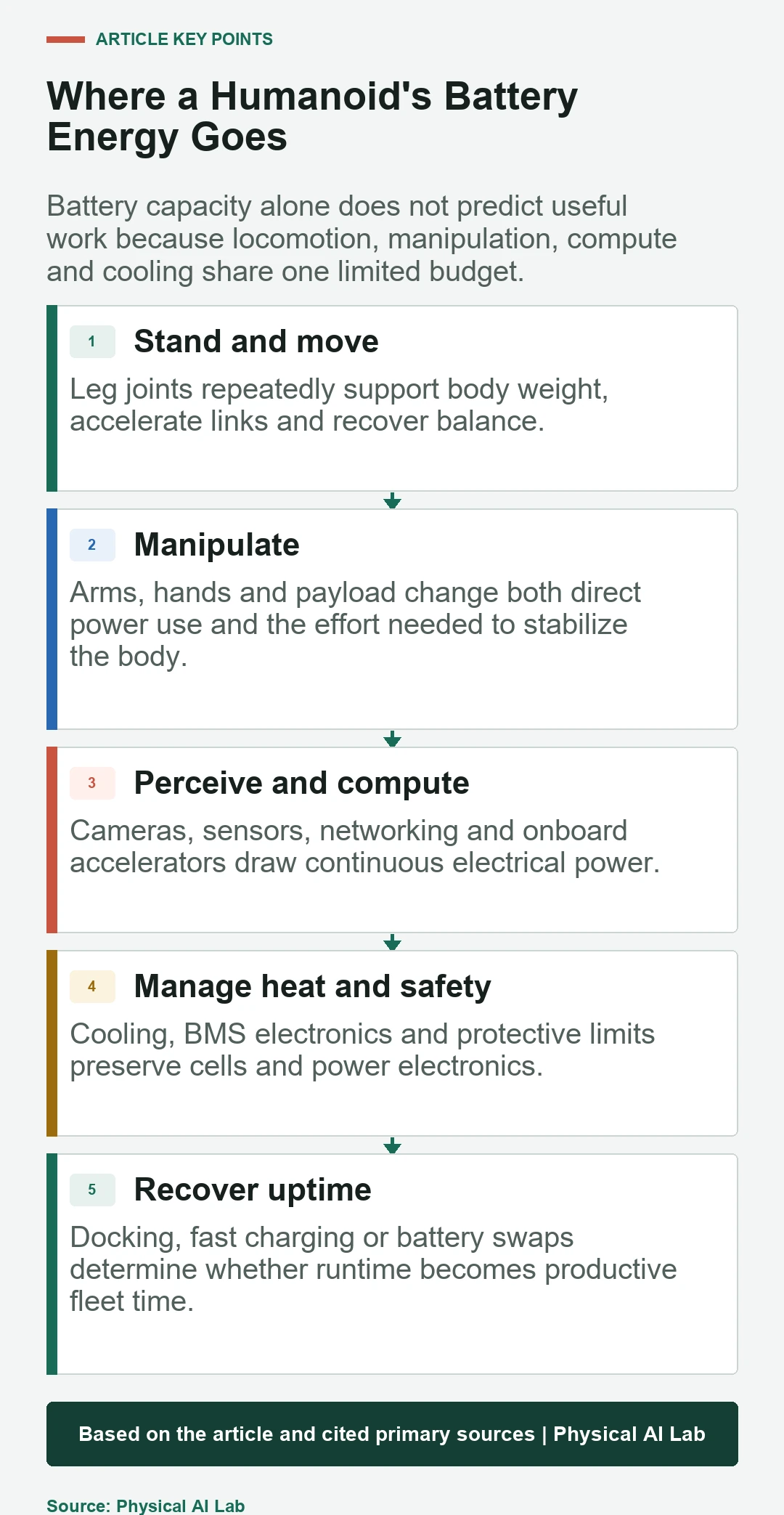
Locomotion, arms, hands, payload, sensors, networking, compute and cooling draw from the same pack. The split changes by task. A stationary manipulation task may reduce leg motion but require continuous arm force and high compute. A long walking route may make locomotion dominant.
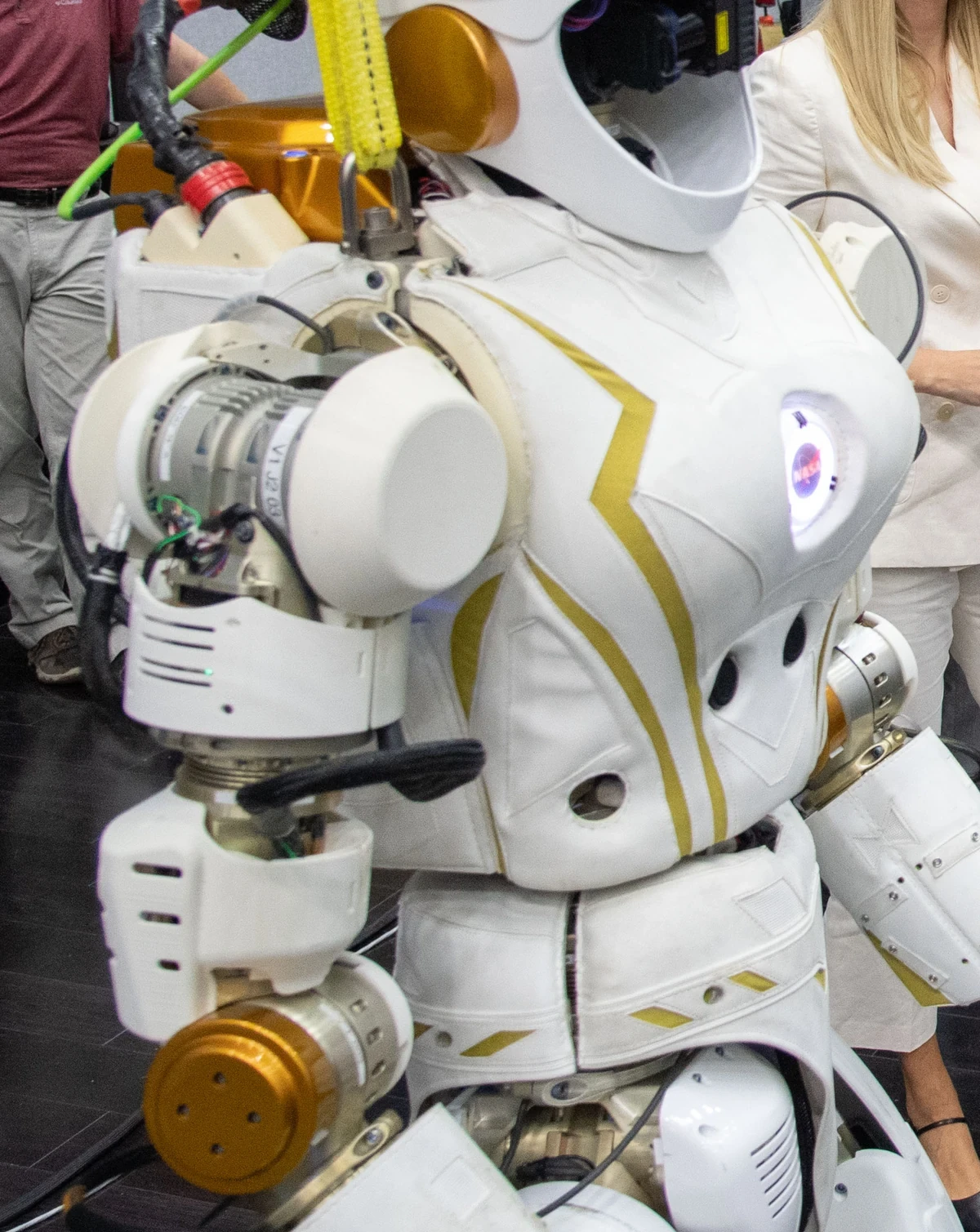
The NASA Valkyrie image shows the distributed joints and electronics of a full-body electric humanoid. It is a visual example, not a claim about a particular modern product’s energy efficiency. For any robot, instrument the DC bus and subsystems during the target workflow to identify where energy is actually spent.
Runtime claims require a named duty cycle
Ask whether runtime was measured while walking, standing, manipulating, carrying a payload or mixing those states. Record speed, environment, compute mode, battery state-of-health and the usable state-of-charge window. A peak-performance phrase is not a complete test definition unless the task profile is also provided.
Connect the battery claim to total humanoid robot operating cost. Charging stations, spare packs, electricity, cooling, battery replacement, inspection and downtime affect economics. A cheaper robot with poor duty-cycle fit can cost more per useful task.
Evaluate battery performance at task and fleet level
Build a duty-cycle test with representative walking, manipulation, payload, waiting and recovery. Log DC energy, peak power, cell and electronics temperature, protection events, task count and time spent charging. Repeat as the battery ages and across the expected ambient range.
At fleet level, measure how many robots and chargers are needed to meet throughput. Include queueing at docks, failed connections, spare-pack handling and maintenance. Productive uptime is the fraction of scheduled time completing or preparing useful tasks, not merely the time the computer remains powered.
| Fleet metric | Definition | Decision value |
|---|---|---|
| Tasks per charge | Completed representative tasks before recharge | Links energy to work |
| Charge recovery ratio | Charge time divided by productive time | Sizes docks and fleet |
| Thermal derating rate | Tasks affected by temperature limits | Reveals sustained capacity |
| Protection events | BMS or power-limit events per period | Tracks safety margin and faults |
| Energy per task | DC energy divided by completed tasks | Compares workflows and bodies |
- Require a named runtime duty cycle.
- Measure peak power and repeated-task temperature.
- Include charging, swapping and queueing in uptime.
- Verify safety layers and certification scope.
- Track energy per completed task as the battery ages.
Frequently asked questions
Why do humanoid robots use so much battery?
Legged support and balance, many electric joints, manipulation, onboard compute, sensors and cooling all share the pack. The mix depends on the task and body design.
Does longer runtime always mean a better humanoid?
No. Runtime must be tied to payload, task, speed, compute load, temperature and charging. Productive tasks per shift is usually the more useful metric.
Are battery swaps better than fast charging?
Neither is universally better. Swaps reduce service interruption but add modules and mechanisms. Fast charging simplifies inventory but can increase thermal and aging constraints.
Why not install a much larger battery?
More capacity adds mass and volume, which can increase actuator and structural requirements and consume space needed for compute, cooling and range of motion.
What should a humanoid battery specification include?
Include usable energy, duty-cycle runtime, continuous and peak power, charge time, thermal limits, protection layers, pack mass, aging assumptions and operating temperature.
Battery Claim Caution
Battery specifications, runtime claims, certifications and charging designs can change. Confirm the current product configuration and reproduce claims under a named duty cycle before procurement or safety decisions.