Outdoor physical AI faces far more variation than an indoor demo. Rain and dust, slopes and mud, shadows, GNSS degradation, weak communications and long rescue times can occur together, so failure and recovery should be designed before the normal route.
Why production reliability is the right outdoor test frame
The official Actuate 26 agenda emphasizes production-level reliability and field-data loops for outdoor and fleet robotics. A session title does not establish a product's performance, so this guide separates the published technical scope from a general field-validation plan.
Any event or company claim remains bounded by the original source's date and scope. Prices, delivery schedules and success rates that have not been published remain unverified.
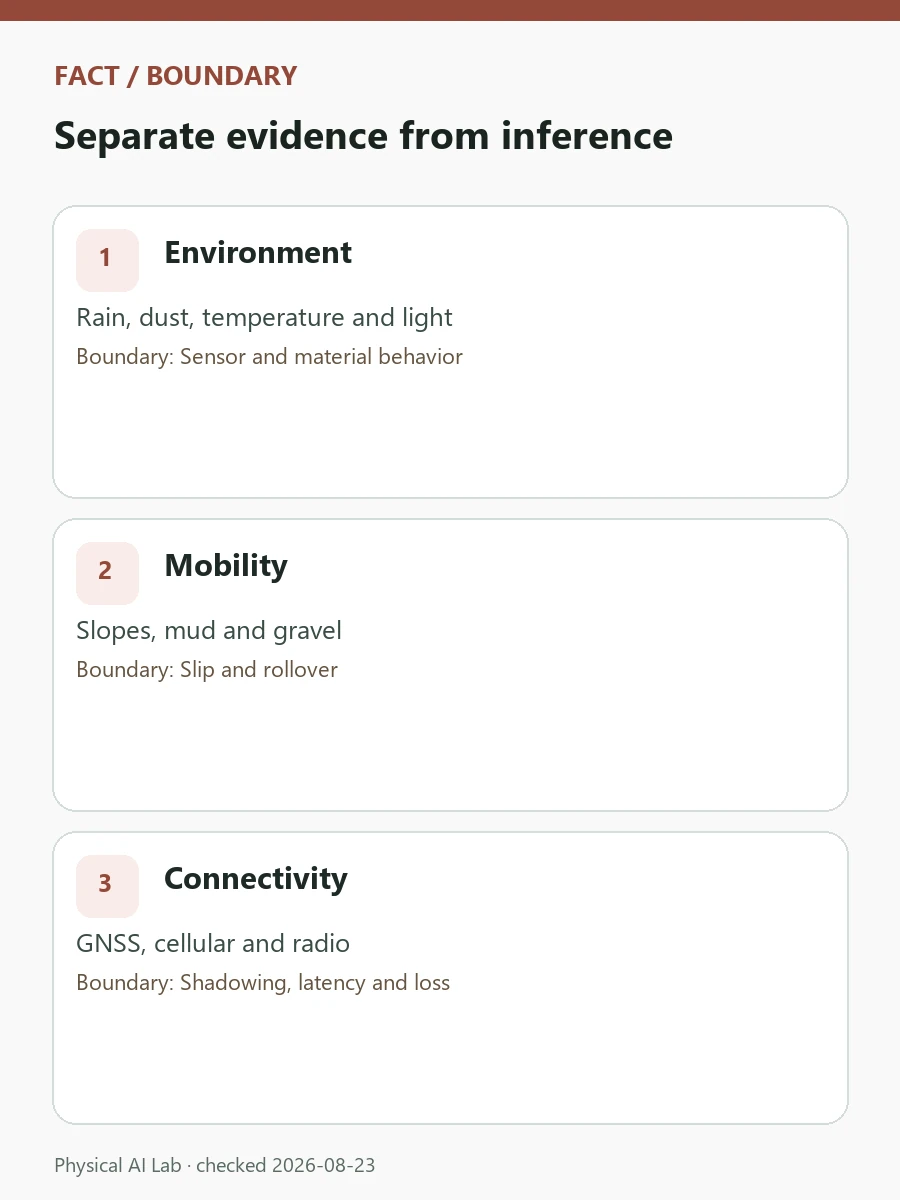
| Test layer | Variables | Typical effect |
|---|---|---|
| Environment | Rain, dust, temperature and light | Sensor and material behavior |
| Mobility | Slopes, mud and gravel | Slip and rollover |
| Connectivity | GNSS, cellular and radio | Shadowing, latency and loss |
Repeat across seasons and align every signal on one timeline
Outdoor tests should be repeated across seasons and times of day. Logging environmental sensors, map confidence, wheel or foot slip, link quality and human intervention on one timeline makes failure causes easier to isolate.
The robot's physical AI loop still has to synchronize sensors, estimate state, plan, control motion, enforce safety limits and recover from failures.
Plan fail-safe behavior, field rescue and evidence capture
Ask what happens after the robot stops in the least accessible part of the route. Repeat attempts, intervention records and time to field recovery reveal the actual operational burden.
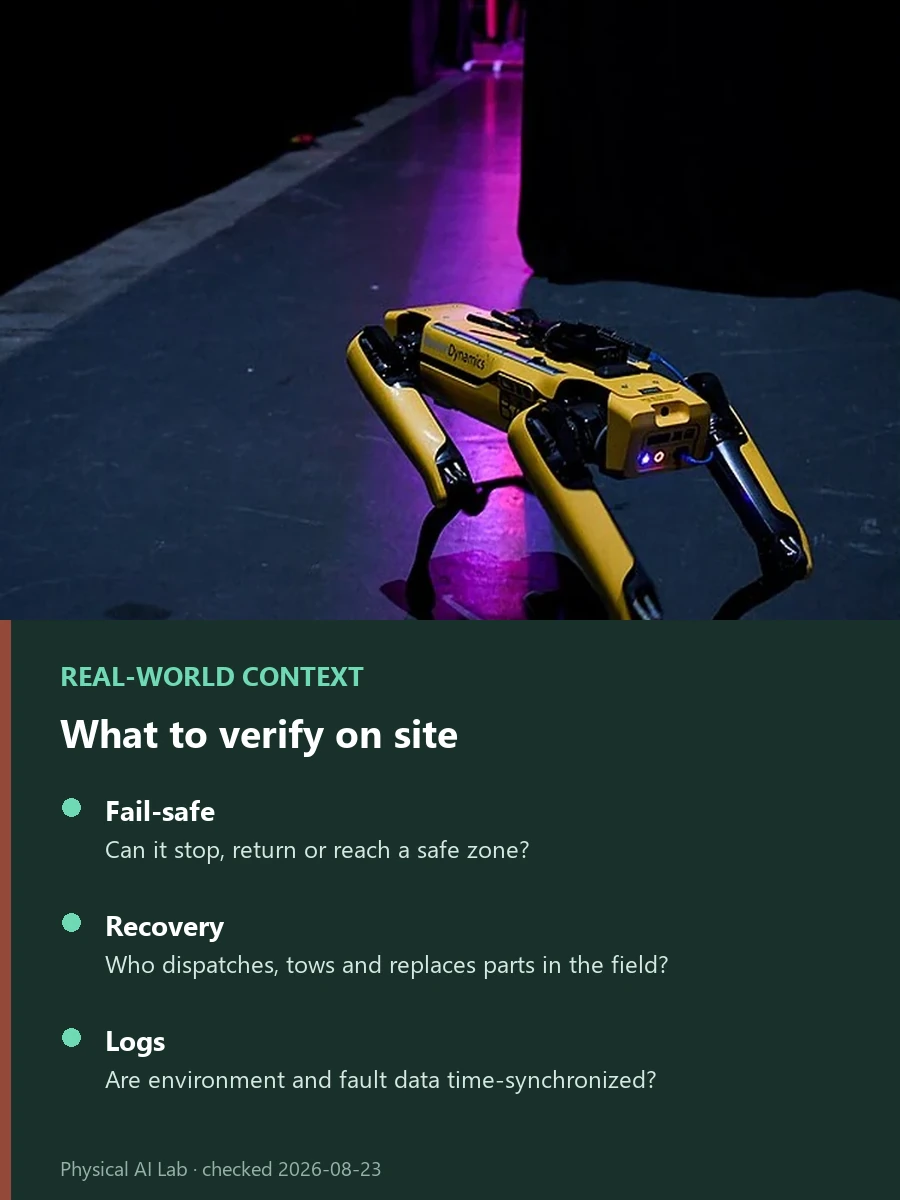
| Check | Question to ask |
|---|---|
| Fail-safe | Can it stop, return or reach a safe zone? |
| Recovery | Who dispatches, tows and replaces parts in the field? |
| Logs | Are environment and fault data time-synchronized? |

An IP rating does not cover the whole outdoor mission
Water ingress is only one risk. Lens contamination, condensation, cold-battery performance, cable wear, corrosion and retrieval after a rollover can stop the operation even when the enclosure rating is adequate.
The current sources frame production engineering rather than certify any product. Customer field data, independent tests and applicable standards should update the assessment.
Navigation and fleet concepts for outdoor testing
Use the warehouse picking robot guide to define completed work, Open-RMF multi-robot integration to plan fleet recovery and VIO versus SLAM to diagnose localization failure. These references support the outdoor validation framework assembled in August 2026.
Outdoor readiness is a recovery system, not a sunny-day route
Outdoor physical AI has to handle interacting weather, terrain, localization and communication failures. A credible test program reports repeatability, intervention and recovery under the disclosed conditions that can actually stop the mission.
Frequently asked questions
Does one dry-weather route prove an outdoor robot is ready?
No. The robot needs repeated trials across weather, light, terrain and communications states, plus a documented response to localization loss and immobilization.
Which outdoor failure should the robot handle without a link?
It should maintain stability, avoid immediate hazards, enter a safe stop or return behavior, preserve logs and reject stale commands without relying on remote help.
How should an outdoor team budget for recovery?
Include dispatch time, access equipment, towing or carrying, spare modules, cleaning, inspection and lost operating time. Recovery cost belongs in the deployment model, not in a footnote.
Official sources checked
Last checked: August 23, 2026