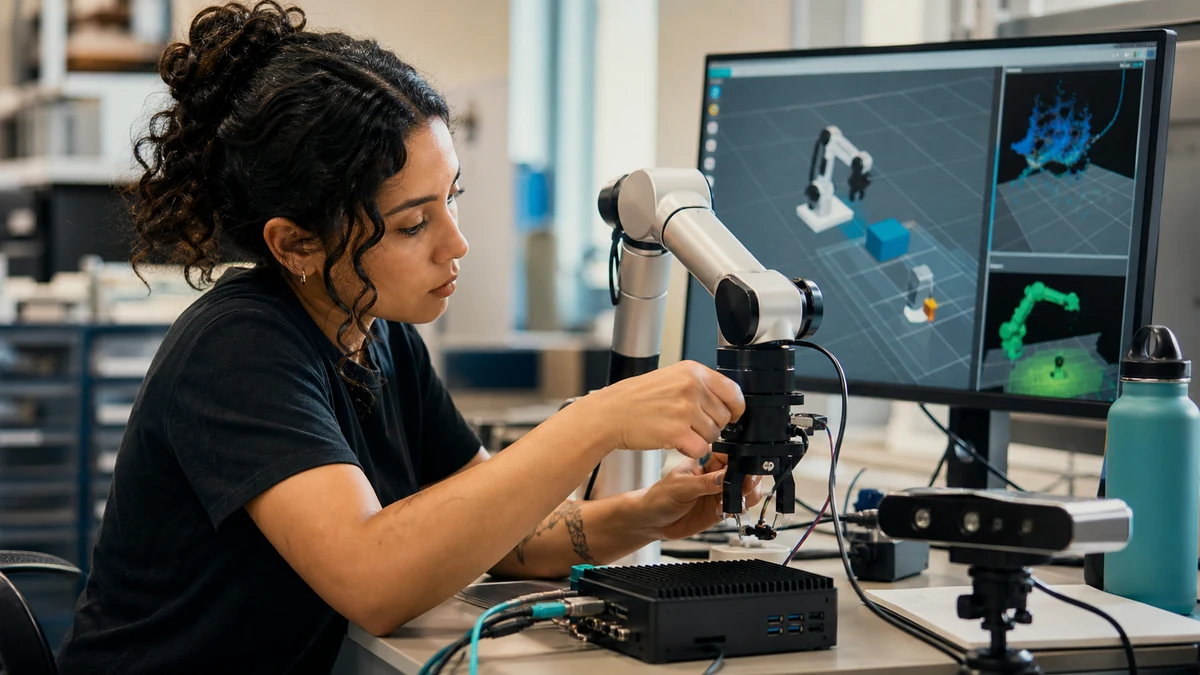
A physical AI career is not one job title. Robotics teams need controls and embedded engineers, perception and machine-learning engineers, simulation and robot-learning specialists, systems integrators, test and safety engineers, and mechanical or mechatronics engineers. Your first decision is which output you want to own.
O*NET's Robotics Engineers profile is U.S.-specific and describes tasks rather than guaranteeing a vacancy, salary or career outcome. Use it as a role map, then build evidence through the physical AI primer, VLA explainer and hands-on projects below.
Choose a role by the artifact you want to deliver
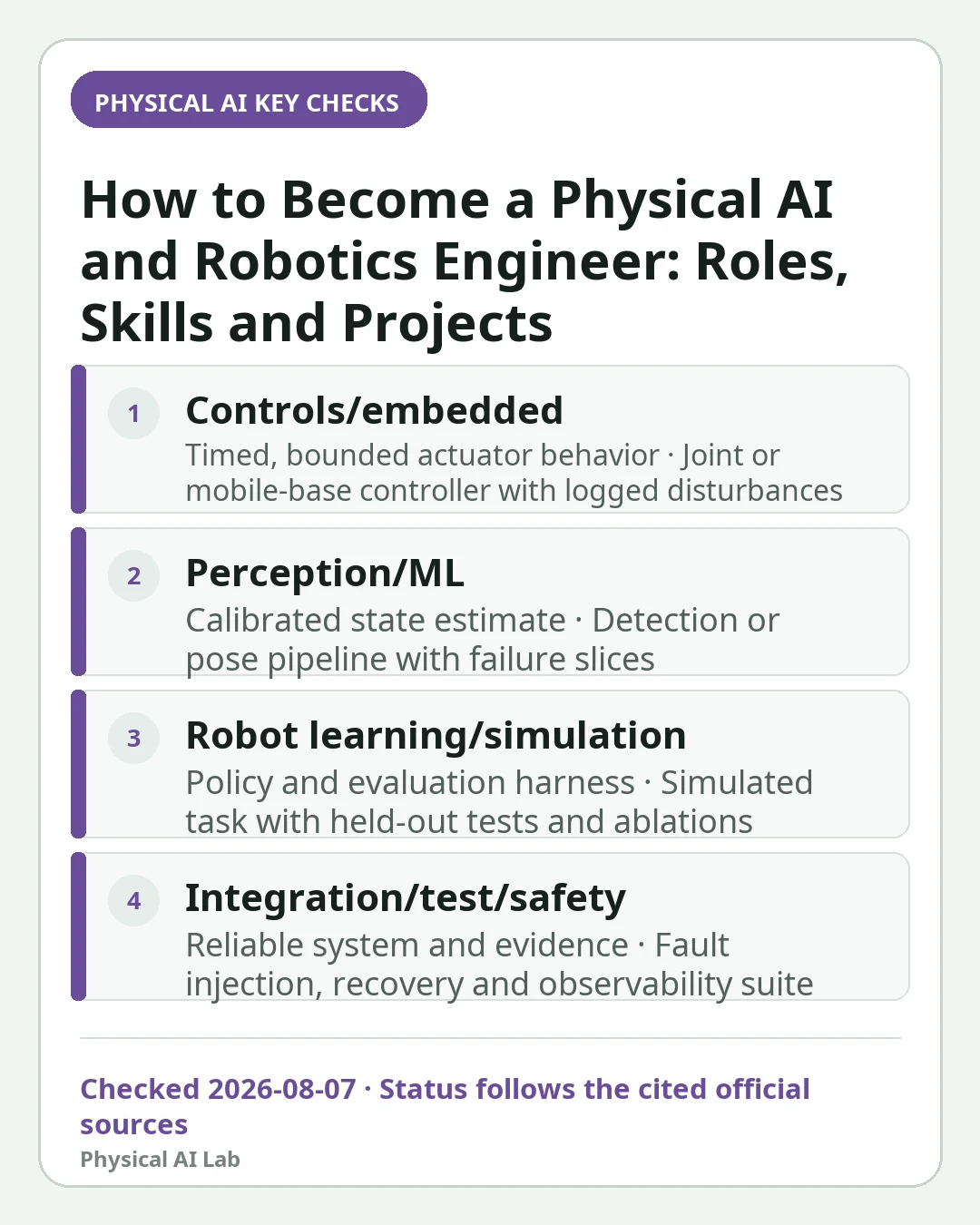
Controls engineers deliver stable motion and real-time behavior; perception engineers turn sensors into state estimates; robot-learning engineers train and evaluate policies; integration and test engineers make complete systems observable and recoverable; mechatronics engineers shape the mechanism, sensing and actuation those layers depend on.
Most roles overlap, but a portfolio becomes credible when it has a primary owner question. 'I built AI for a robot' is vague; 'I reduced pose-estimation failure under occlusion and documented the remaining error' is inspectable.
| Lane | Core output | Good first project |
|---|---|---|
| Controls/embedded | Timed, bounded actuator behavior | Joint or mobile-base controller with logged disturbances |
| Perception/ML | Calibrated state estimate | Detection or pose pipeline with failure slices |
| Robot learning/simulation | Policy and evaluation harness | Simulated task with held-out tests and ablations |
| Integration/test/safety | Reliable system and evidence | Fault injection, recovery and observability suite |
| Mechanical/mechatronics | Mechanism and validated interface | Instrumented end effector or actuator test rig |
Build a shared systems foundation first
Every lane benefits from linear algebra, probability, optimization, coordinate frames, kinematics, dynamics and feedback. In software, become comfortable with Python, one systems language such as C++, Git, Linux, testing and profiling rather than collecting framework names.
Learn ROS 2 nodes, topics, services, actions, launch, parameters, bags and robot descriptions through the official ROS 2 tutorials. Messaging is not the final product; the goal is to trace data from sensor timestamp to decision, command and observed outcome.
Add one deep specialization rather than five shallow ones
A controls path can go deeper into state estimation, model predictive control and actuator limits. Perception can focus on calibration, 3D geometry and uncertainty; robot learning can focus on reinforcement or imitation learning, datasets and policy evaluation; systems can focus on real-time behavior, networking and fault management.
Read job descriptions as evidence of recurring outputs, then compare them with O*NET tasks such as interpreting sensor data, debugging, integrating systems, testing, calibration and documentation. Do not treat a list of tools as a substitute for engineering judgment.
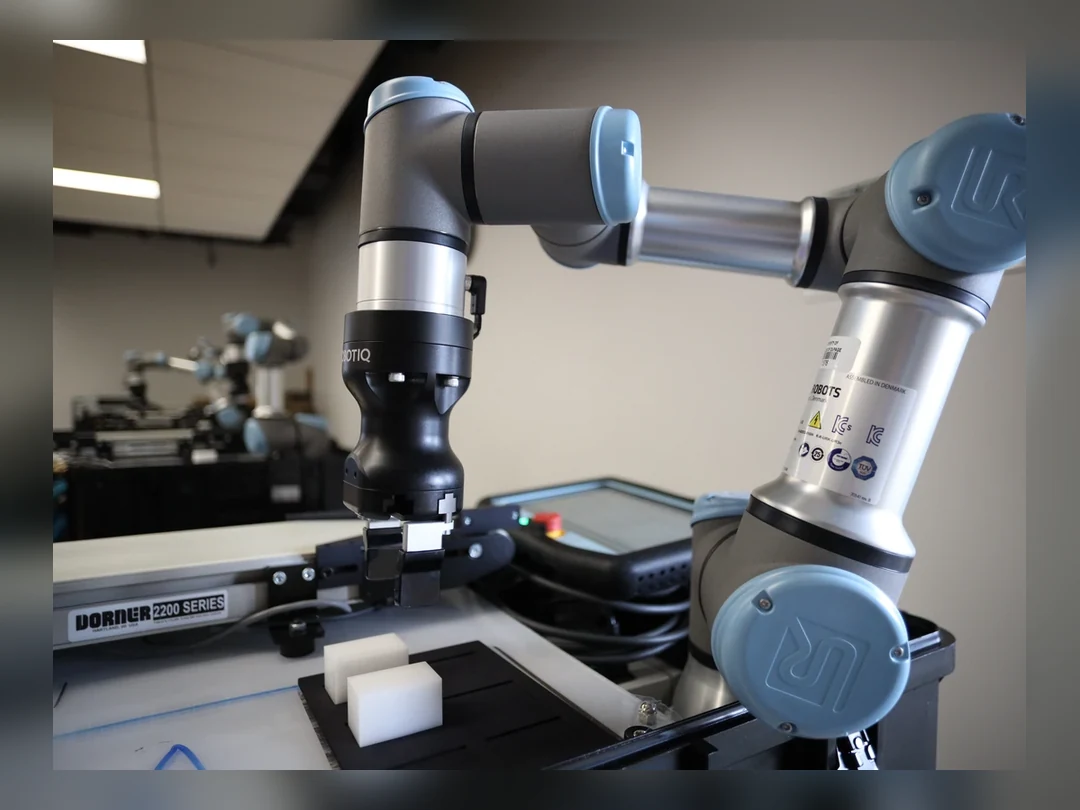

Build three projects that form an evidence chain
Project one should prove a deterministic systems loop: a ROS 2 sensor or simulator input, a documented transform, an output command, a bag file and an automated test. Project two should add uncertainty through perception or learning and a fixed evaluation set.
Project three should integrate components and deliberately inject failures—latency, missing observations, contact changes or network loss—then document detection, recovery and unsafe cases. The simulator guide helps choose a tool, but reproducibility matters more than brand.
| Portfolio evidence | Minimum content | Weak substitute |
|---|---|---|
| Reproduction | Pinned code, environment and one-command test | A video with no setup |
| Evaluation | Metrics, baseline, repeated trials and failure slices | One successful run |
| Systems reasoning | Timing, interfaces, limits and trade-offs | A long library list |
| Failure work | Known failures, logs and recovery behavior | Claiming the demo always works |
| Communication | Short architecture and experiment report | Unexplained notebook cells |
A twelve-week starter sequence
In weeks one to three, complete ROS 2 fundamentals and a small sensor-to-command loop. In weeks four to seven, implement one specialization module and define an evaluation set before tuning. In weeks eight to ten, connect it to simulation or hardware with logging and safety limits.
Use weeks eleven and twelve to reproduce from a clean machine, run failure tests, write the report and remove anything that cannot be explained. Twelve weeks is a project cadence, not a promise that a beginner will be job-ready by a fixed date.
What courses and certificates can—and cannot—show
Courses and certificates, including NVIDIA's official Isaac Lab learning resources, can structure practice, but they do not prove that a candidate can diagnose a robot under distribution shift, timing faults or contact uncertainty. Preserve code review history, experimental decisions and negative results so an evaluator can see how you reasoned.
When applying, map each portfolio artifact to the role's required output and state exactly what you implemented. Hiring demand, titles and compensation vary by country and employer; this roadmap does not predict employment or salary.
Frequently asked questions
Do I need a robotics degree to work in physical AI?
There is no single required path. Employers assess role-specific fundamentals and evidence; a relevant degree can help, but strong, reproducible systems work is still necessary.
Should I learn ROS 2 or machine learning first?
Learn enough ROS 2 and systems basics to move and inspect data, then go deep in the specialization your target role owns. Robot-learning work still needs reliable interfaces and evaluation.
Will three projects guarantee a robotics job?
No. Projects can provide inspectable evidence, but hiring depends on employer needs, geography, experience and competition. The roadmap makes skills visible; it does not promise employment.
Official sources checked
- O*NET Robotics Engineers summary
- O*NET Robotics Engineers detailed report
- O*NET Robotics Engineers update record
- ROS 2 Jazzy official tutorials
- NVIDIA Isaac Lab official learning page
Last checked: August 7, 2026