Reliable Robotics is pursuing a 2026 demonstration of remotely piloted regional cargo aircraft converted from existing general-aviation planes—not small delivery drones. The U.S. Department of Transportation selected the company and Albuquerque as one of eight FAA eIPP projects, with trial operations planned to begin in August 2026. Selection creates an opportunity to gather real-airspace data; it does not complete type certification or approve scheduled uncrewed cargo service.
This system enters existing airports, aircraft rules and controlled airspace
Reliable Robotics is not developing a small multicopter route from a warehouse to a doorstep. It adds autonomous safety and remote piloting to existing fixed-wing general-aviation aircraft for cargo between regional airports. Existing runways, airframes, maintenance and air traffic control are useful—but aircraft certification, operating rules and remote-pilot responsibility remain.
A U.S. Department of Transportation release from its Reliable Robotics visit calls the vehicles “retrofitted general aviation planes” using proprietary autonomous-safety technology, including company-built radar. The Albuquerque project will test potential regional freight service for rural communities. Potential service is not a current commercial operation.
| Category | Status confirmed in 2026 official material | Not yet proven |
|---|---|---|
| Aircraft | Regional cargo platform converted from existing general aviation | Approval for commercial uncrewed operation of an entire new aircraft type |
| Piloting | Remotely piloted regional cargo operations are the objective | No human intervention at every flight phase |
| Detection | Autonomous-safety technology including Reliable-built radar | Collision avoidance in every weather and airspace condition |
| Program | Selected for FAA eIPP with Albuquerque | Completed type certification, operating certificate and route approval |
| Schedule | Trial operations planned to begin in August 2026 | Follow-up confirmation that trials began on schedule |
eIPP is closer to a regulatory proving ground than a certificate
The FAA eIPP overview describes partnerships among state, local, tribal or territorial governments and private companies to integrate advanced air mobility, or AAM, safely into the National Airspace System. Projects announced in March 2026 create test environments across 26 states, giving the FAA data for gaps in rules and procedures.
Participation is one step in safety review. Type certification of the design, airworthiness of each aircraft, operator approval, and requirements for remote pilots and control stations remain separate. A limited eIPP route does not authorize an identical configuration on cargo routes nationwide. “Testing with the FAA” and “FAA-approved commercial product” are not interchangeable.
The August trial was scheduled; confirmation requires an operating record
The DOT said on June 17, 2026 that trial operation of the converted aircraft was expected to begin in August. As of August 23, the three official sources reviewed for this article did not establish an actual start date, flight count or route result. The accurate status is therefore “planned to start in August.”
Confirmation should combine a company update with airport and FAA operating notices, approval scope, aircraft registration and flight conditions. A first-flight video does not establish scheduled operation. Flight count, safety pilot onboard, points of remote-pilot intervention, visual conditions, weather and links determine the result's scope.
Retrofitting combines a mature airframe with new automation failure modes
A proven general-aviation platform avoids developing wings, engines and cargo structure from scratch. Adding flight computers, control-surface actuation, links, a ground station and detect-and-avoid equipment creates new failure combinations. Airworthiness history and autonomous-system software versions need one configuration-management system.
Radar detection is not enough if the track reaches flight-control logic too late. After a link loss or delay, the operating concept must choose among holding route, diverting or handing authority to a safety pilot. End-to-end latency and failure isolation across detection, decision, control and ATC communication matter more than one sensor's accuracy. See the physical AI drone architecture for a related technical stack.

Reliable's radar is one component of detect-and-avoid
Reliable-built radar, cited by DOT, is one way to detect nearby aircraft. Real operation also has to combine ADS-B, air traffic control, the aircraft's own position and speed, and link status. The system must distinguish a same-altitude conflict, noncooperative aircraft and ground clutter before issuing an avoidance command consistent with flight rules.
An earlier FAA report on Reliable Robotics detect-and-avoid testing describes satellite communications as the primary command and telemetry link, C-band CNPC for detect-and-avoid, and LTE for engineering data. That history shows technical development, but it should not be assumed to match the final 2026 eIPP configuration. Link priority, ground display and redundancy require version-specific confirmation.
Ground operations may be the bottleneck on rural cargo routes
Regional-airport cargo could supplement routes with pilot shortages or long trucking legs. Autonomous flight does not remove loading, center-of-gravity calculation, fuel, maintenance, runway snow removal, security, hazardous-material handling and destination handoff. Small airports may have limited communications, maintenance staff and alternate airports.
| Route-pilot metric | Why it matters | Warning signal |
|---|---|---|
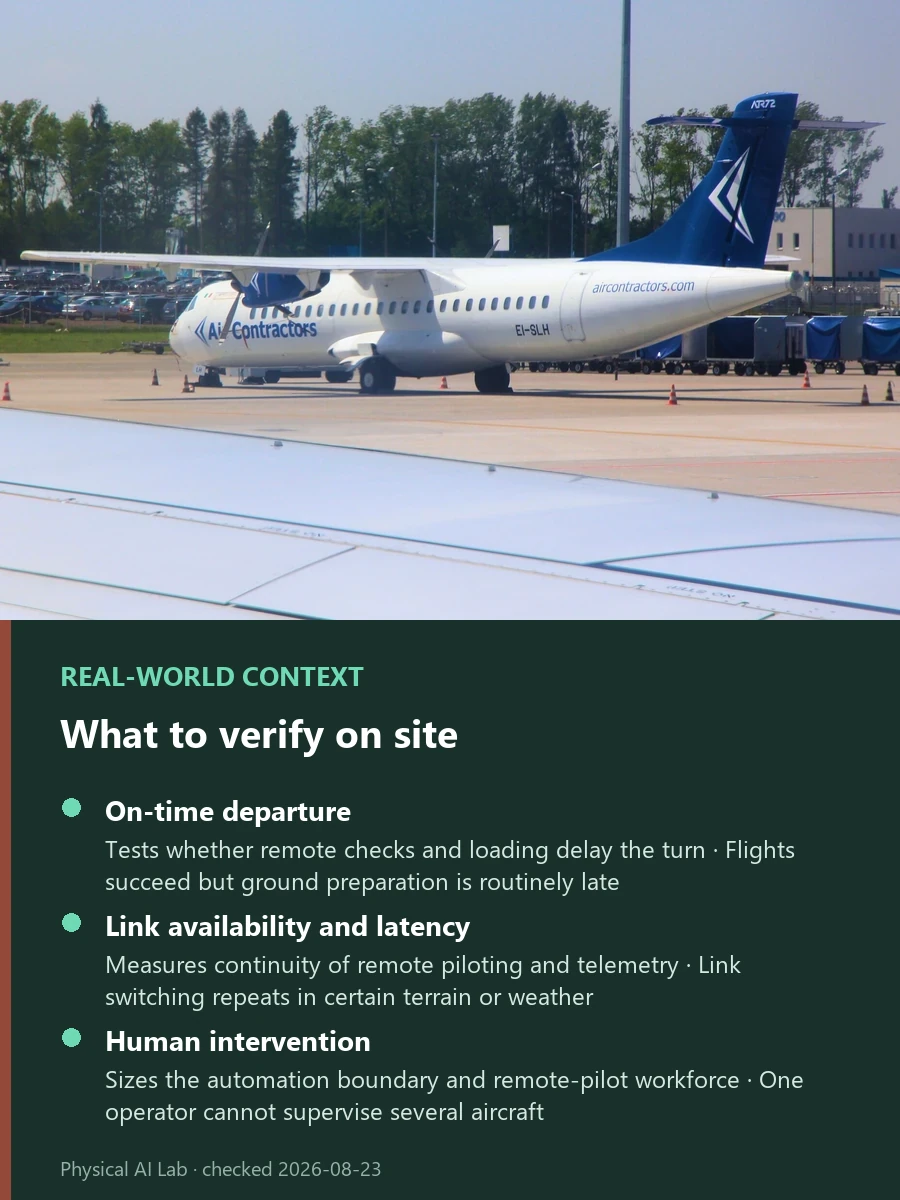
| On-time departure | Tests whether remote checks and loading delay the turn | Flights succeed but ground preparation is routinely late |
| Link availability and latency | Measures continuity of remote piloting and telemetry | Link switching repeats in certain terrain or weather |
| Human intervention | Sizes the automation boundary and remote-pilot workforce | One operator cannot supervise several aircraft |
| Time to divert | Tests recovery from weather or runway closure | Destination changes require long manual coordination |
| Total cost per flight | Includes maintenance, communications and ground handling | New infrastructure costs exceed saved cockpit labor |
Outdoor availability is set by wind, precipitation, visibility and temperature extremes rather than average weather. The outdoor physical AI test guide provides related stress criteria. The split between onboard, ground and cloud decisions shares latency and connectivity principles with edge AI for robots.
FAA approval separates design, aircraft airworthiness and operations
The FAA's 2026 eIPP selection announcement describes Albuquerque as progress in autonomous operations linked to an existing partnership. The program gathers evidence to refine regulation and policy. “Pursuing certification” and “certification complete” are different facts.
Shippers and investors should track at least four milestones: the specific approval and limitations for tests; type-design progress for the autonomous flight system; operating approval covering remote pilots and ground stations; and paid cargo service with repeat operating data. Progress on one does not complete the others.
Commercialization appears in repeat operating records, not one flight
One uncrewed or remotely piloted flight is a meaningful demonstration. Commercial service requires several aircraft to operate through maintenance cycles, remote pilots to manage abnormal cases, and ATC, insurers and shippers to accept the same procedures. Look for official disclosure of flight count, hours, weather envelope, stop reasons and safety-pilot presence.
The trial planned for August 2026 sits near the front of that path. Actual operation moves the status from plan to demonstration; a certification milestone should be recorded separately as regulatory progress. Combining all three into “autonomous cargo aircraft commercialized” would overstate the evidence.
Aircraft per remote pilot can change the route economics
Removing a person from the cockpit does not remove labor. Remote pilots, dispatch, maintenance and cargo staff remain, while communications, radar and ground-control costs are added. Whether one operator can supervise several aircraft—and how authority changes when abnormal events overlap—materially changes cost per route. The ratio is established by an approved operating concept and real intervention frequency, not a video.
Test reports should measure remote-pilot attention during takeoff and landing, link transitions, weather avoidance and diversion—not only normal cruise. If one person cannot handle simultaneous alerts from two aircraft, high nominal autonomy does not justify multi-aircraft supervision. A commercial plan should include qualified staffing by shift, training time and backup seats after a ground-station failure.
Frequently asked questions
Is the Reliable Robotics aircraft a delivery drone?
No. It is a fixed-wing regional cargo aircraft converted from existing general aviation, intended to use airports and the National Airspace System with remote piloting and autonomous safety technology.
Does FAA eIPP selection mean Reliable Robotics is certified?
No. eIPP collects data in limited real operations to develop integration procedures and rules. Type certification, operating approval and commercial route launch remain separate.
What evidence would confirm the planned August 2026 trial began?
DOT announced a planned August start. As of August 23, 2026, the official sources reviewed here did not identify the actual start date or results, so the status remains planned.
Official sources checked
- U.S. DOT release from the Reliable Robotics site visit
- Official FAA eIPP selection announcement
- Official FAA eIPP overview
Last checked: August 23, 2026