DexRobot's DexHand is the end effector that grasps an object; DexTele is the collection system that records tactile, joint, pose, video and depth data while a person teleoperates the robot. Used together, they create a repeatable loop: human demonstration → synchronized data → cleaning and training → policy execution → collection of new failures. High hand dexterity alone cannot produce a capable manipulation model if that data loop breaks.
The three DexHand models are not simply good, better and best
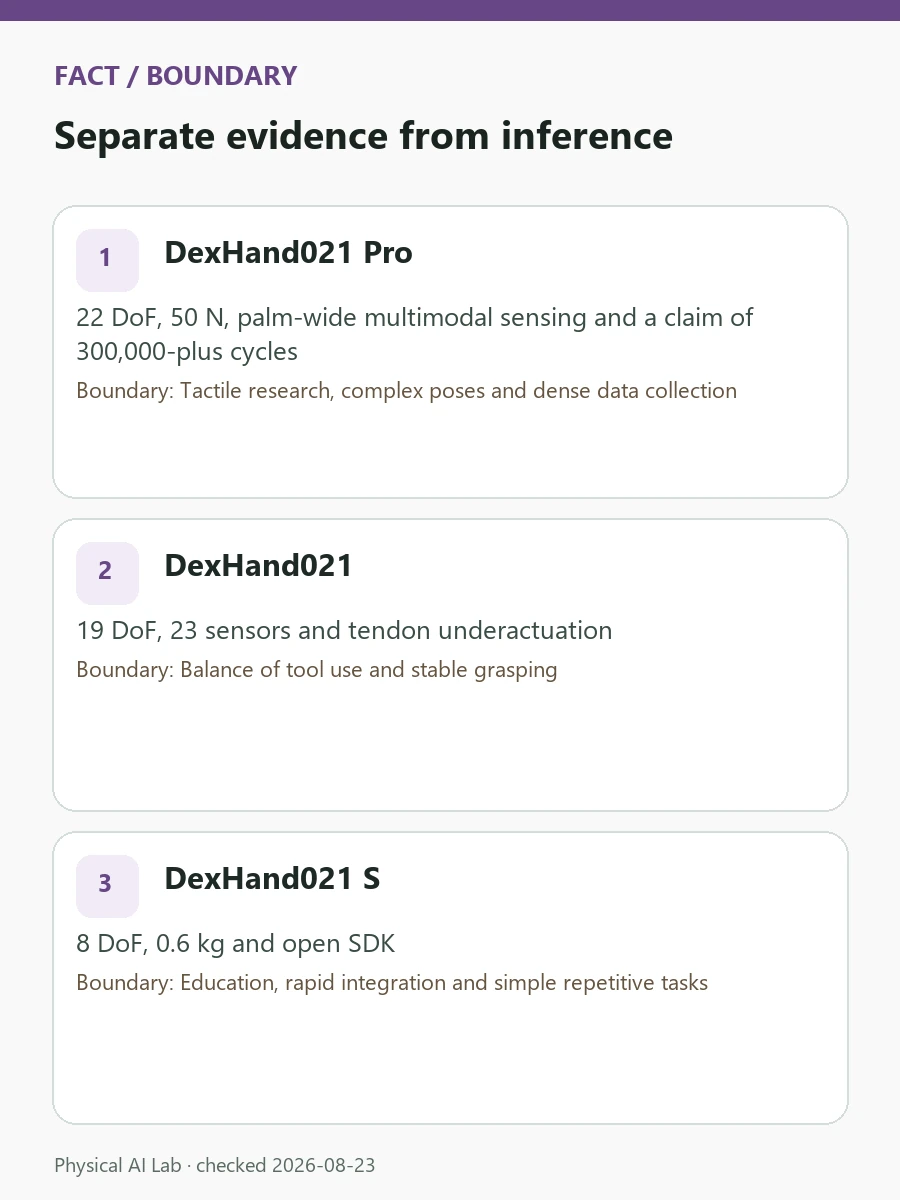
DexRobot's Automate 2026 lineup includes DexHand021 Pro, DexHand021 and DexHand021 S. According to the company's Automate 2026 release, the 021 Pro has 22 DoF, a listed 50 N load, palm-wide multimodal sensing and a claim of more than 300,000 durability cycles. The 021 has 19 DoF, 23 integrated sensors and tendon-driven underactuation. The 021 S has 8 DoF, weighs 0.6 kg and includes an open SDK.
Larger numbers do not create a universal ranking. More DoF expands finger poses but also adds control variables and calibration. DexHand021 or DexHand021 S may be the better fit for a durable repetitive grip, while DexHand021 Pro may help contact research and complex tool use. The workpiece and required data modalities should decide.
| Model | Company-disclosed configuration | Likely evaluation purpose | Boundary to verify |
|---|---|---|---|
| DexHand021 Pro | 22 DoF, 50 N, palm-wide multimodal sensing and a claim of 300,000-plus cycles | Tactile research, complex poses and dense data collection | Test pose and direction behind 50 N, sensor calibration and independent durability evidence |
| DexHand021 | 19 DoF, 23 sensors and tendon underactuation | Balance of tool use and stable grasping | Sensor types and rates, tendon replacement and tension management |
| DexHand021 S | 8 DoF, 0.6 kg and open SDK | Education, rapid integration and simple repetitive tasks | Task-level definition of the company's “80% of core functionality” claim |
50 N and 300,000 cycles do not replace object-level success rates
50 N is a force value, not the same as a 5 kg payload. Without the measurement direction, finger combination and wrist or arm limit, it cannot be converted directly into object weight. The 300,000-plus-cycle durability figure is also a company claim. Procurement should request a test report defining motion angle, speed, load, temperature and failure criteria.
Field testing should group objects by failure mode: slippery plastic bottles, thin zipper bags, deformable cartons and handled tools. After a successful grasp, record a 10-second hold, slip during transport, sticking during release and zero drift after collision. For sensor context, see robot tactile sensor types and limits.
DexTele is closer to synchronized recording infrastructure than a controller
DexRobot describes DexTele as an integrated system spanning teleoperation hardware, force-controlled humanoid arms, dexterous hands and a professional data platform. The release says customers can avoid separately building mechanics, electronics, communications, teleoperation algorithms and the data pipeline. That “no secondary development” claim applies to the vendor's standard configuration; it does not guarantee instant connection to every robot and storage system.
One manipulation episode contains several clocks: operator motion, robot joint angles, fingertip force, tactile maps, head and wrist video, depth frames, and success or failure labels must refer to the same instant. A 50 ms offset can show pre-contact video alongside an impact reading. DexTele's value therefore depends on reproducible time synchronization, frame alignment, missing-data detection and metadata—not on device count alone.
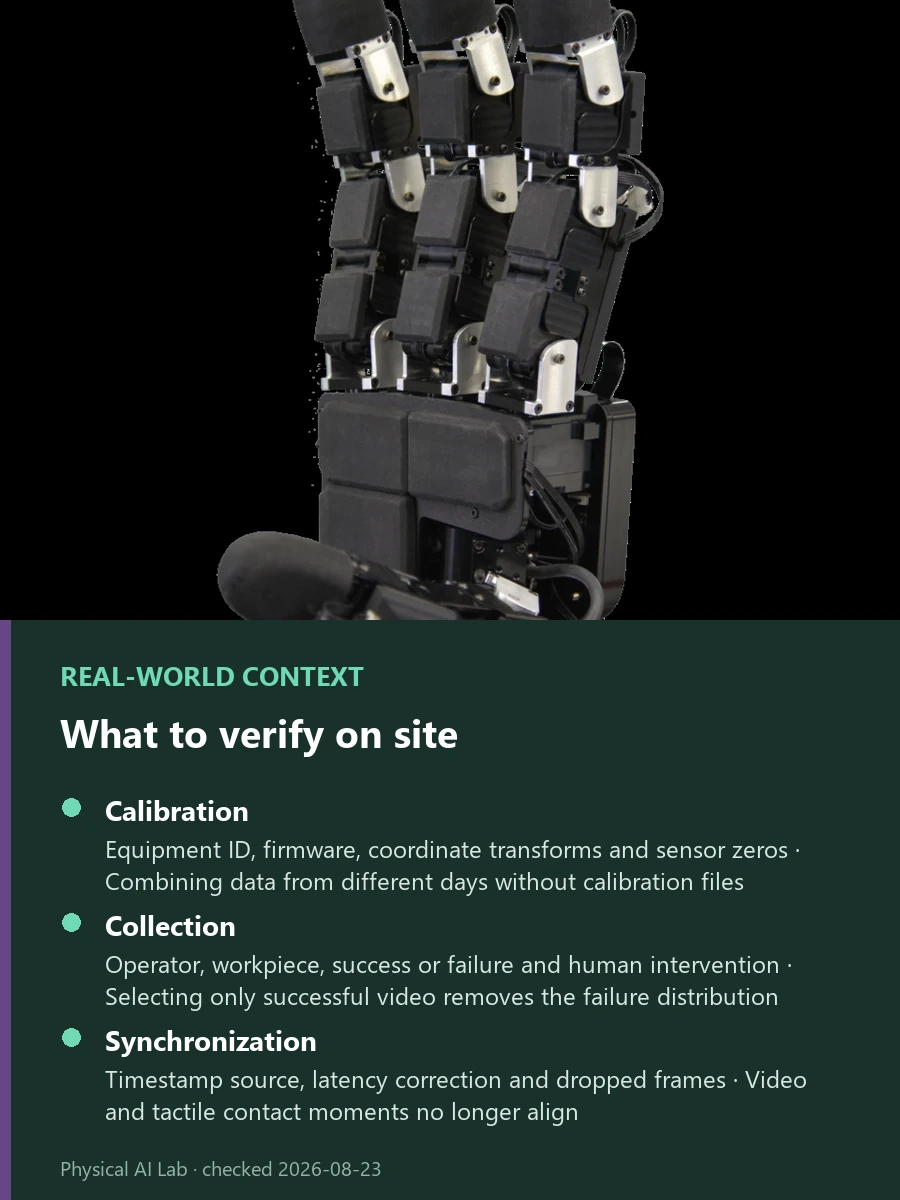

A teleoperated demonstration passes through six data stages
First, define the task beyond “pick up the cup”: initial state, allowed grasps, destination, success and stop conditions. Second, calibrate operator-to-robot coordinates and zero the hand and force sensors. Third, collect raw normal demonstrations, slips and retries. Fourth, align time and coordinates while handling privacy and irrelevant backgrounds. Fifth, split training, validation and test by place and object. Finally, run the policy and collect new failures.
One person's repetitions can teach the model that operator's habits. Mix operators with different experience and body size, then vary camera position, light and object layout. Discarding every failed episode prevents recovery learning. See how to collect teleoperation data for a deeper data-quality workflow.
| Data stage | Information to preserve | Common way quality collapses |
|---|---|---|
| Calibration | Equipment ID, firmware, coordinate transforms and sensor zeros | Combining data from different days without calibration files |
| Collection | Operator, workpiece, success or failure and human intervention | Selecting only successful video removes the failure distribution |
| Synchronization | Timestamp source, latency correction and dropped frames | Video and tactile contact moments no longer align |
| Cleaning | Exclusion reason, raw hash and label-edit history | Overwriting raw data destroys reproducibility and auditability |
| Training split | Rules separating place, object and operator | The same scene enters both training and test |
| Execution evaluation | Policy version, success, intervention and recovery time | One average hides hazardous failure modes |
Tactile, joint and visual data answer different questions
Joint data records hand and arm pose but not whether the object is slipping. Tactile and force data reveal contact, but vision and depth identify which part of which object is involved. Pose connects hand and object in space. Collecting modalities together reduces the ambiguity left by any one signal.
Storage grows quickly. Continuous high-resolution video and depth from several cameras require far more capacity and bandwidth than joint vectors. Set raw retention, compression, privacy masking, access and deletion before collection. Do not downsample ad hoc when uploads are slow; preserve an auditable raw version separately from training transforms so small contact failures remain visible.
Imitation learning is not finished when the data loader works
Human demonstrations can train an imitation policy such as ACT or another VLA-family model. The policy may still fail on unseen objects, occlusion, collision or damaged parts. Low training loss does not guarantee task success. Test at an independent site with new objects, and keep safety limits outside the learned policy.
The comparison of robot imitation and reinforcement learning explains their different roles. DexTele primarily supplies demonstrated behavior; recovery and exploration still need separate design. Conditions for immediate stop or handoff to teleoperation should also be validated separately from learning performance.
Contract data ownership before choosing the hand
The official DexRobot news page and official DexRobot website provide products and inquiry channels, but not customer-specific price, lead time or data-platform contracts. Before installing DexTele in a lab or factory, document ownership of raw data and derivative models, external transfer, remote-support access, retention and deletion.
A hardware quote should separate the hand, robot arm, teleoperation device, cameras, compute, storage, calibration tools, spare tendons and finger modules, software license, training and field support. The release's “1/5 the cost” and “80% of core functionality” are company claims. Without the comparison product, configuration and contract scope, they are not fixed budget values.
A strong pilot does not maximize collection on day one. Choose three representative tasks and audit synchronization and labels on 50–100 episodes. Check whether two people produce the same preprocessing result and whether a policy failure traces back to raw frames before scaling. A reproducible set of 1K episodes can be worth more than 100,000 episodes from a broken pipeline.
Usable yield—not total episodes—sets the true data cost
If 1K teleoperated episodes are recorded but only half survive sensor drops, calibration errors, task violations and occluded cameras, effective unit cost doubles. Track usable-episode yield with total count. Group exclusions by equipment, operator, object and time to find the first bottleneck. Repeated exclusions for one operator may indicate training; drops from one wrist camera may indicate communications or storage.
Recollection cost includes task reset, hand calibration, sensor zeroing, upload, label review and privacy—not just operator time. A label error discovered after training must trace back to raw data so prior collection spend is recoverable. If a platform exports only a proprietary format, contract exit may add conversion cost; request raw export with timestamps and coordinate transforms. Track both episodes per hour and cost per reviewed, accepted episode.
Frequently asked questions
Is DexHand021 Pro always the best DexRobot hand?
No. Its sensing may help complex tactile research, but DexHand021 or DexHand021 S can be easier to control and maintain for simple repetitive work.
Is DexTele just one robotic hand?
No. It combines teleoperation hardware, a force-controlled robot arm, a dexterous hand and a data platform for recording demonstrations and multimodal data.
Does collecting DexTele demonstrations immediately produce a finished model?
No. Time synchronization, coordinate calibration, cleaning, dataset splitting, independent evaluation and safety control still follow. Failures and human interventions should remain learning and evaluation assets.
Official sources checked
Last checked: August 23, 2026