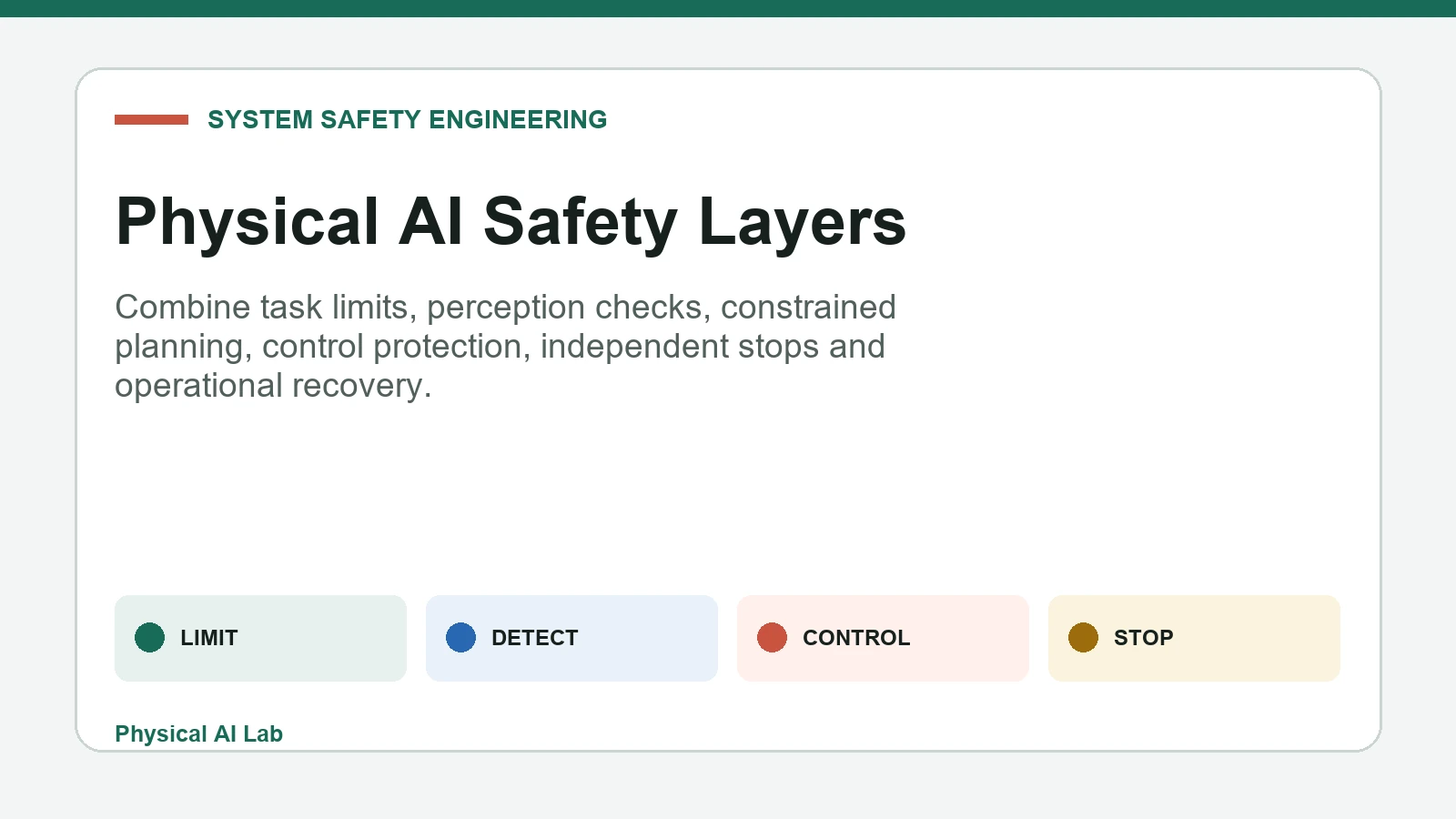
Physical AI safety is the system’s ability to keep risk within an acceptable, validated boundary when perception, models, planners, networks, actuators, people and environments interact. No average model accuracy or single emergency stop can cover every hazard.
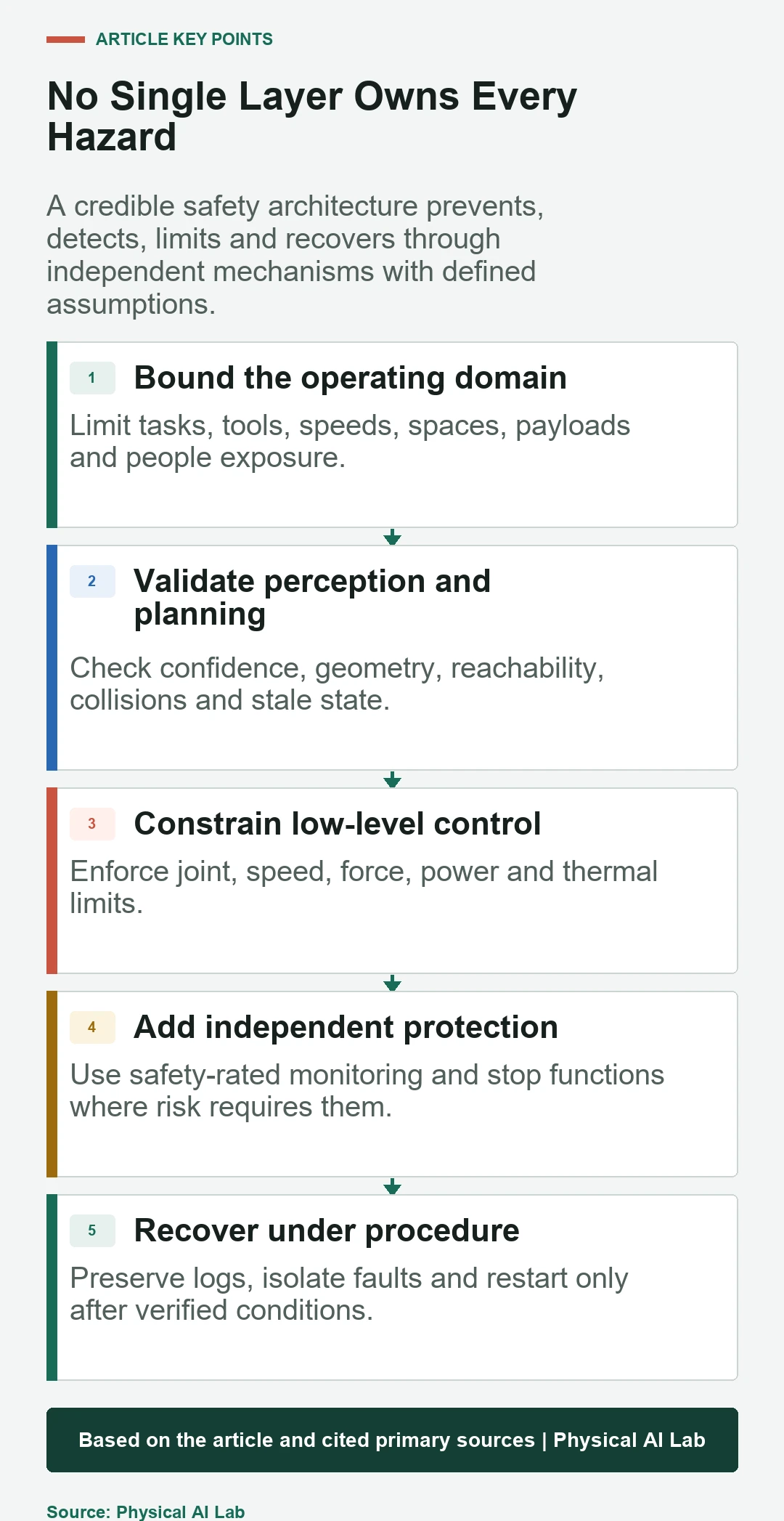
Layered safety begins by limiting the task and operating domain, then validating information, constraining motion and force, adding independent protective functions where required, and defining safe recovery. Each layer should state its assumptions and what happens when those assumptions fail.
This educational guide should be read with the force sensing guide and PoC test framework. It is not a substitute for a qualified risk assessment or applicable law and standards.
Risk assessment starts before model selection
Identify people, tasks, tools, payloads, energy sources, spaces and lifecycle phases. Consider normal operation, foreseeable misuse, setup, cleaning, maintenance, faults and recovery. A model cannot be evaluated safely without the system hazards it influences.
Reduce risk through inherently safer design before relying on detection or instructions. Record severity, exposure and avoidance assumptions, then assign controls and verification evidence. Reassess when tasks, software or sites change.
The operating domain is the first safety layer
Bound permitted objects, tools, payloads, speeds, forces, workspaces, lighting, surfaces, people access and environment. A narrower domain makes behavior and protective controls easier to validate.
Detect when the system leaves the boundary and define a safe response. Do not silently continue because the model still produces output. Expansion should require new evidence and risk review.

Perception confidence needs independent plausibility checks
Sensors can be occluded, dirty, saturated, miscalibrated or stale. Cross-check object identity, geometry, timestamps and robot state. Confidence scores should be calibrated and tied to actions such as reobserve, slow, ask for help or stop.
Diverse sensing can reduce some common failures but adds fusion assumptions. Test disagreement and missing data. Safety-rated detection functions require suitable architecture and evidence beyond a general AI perception output.
| Layer | Primary purpose | Example failure | Safe response |
|---|---|---|---|
| Operating domain | Prevent untested exposure | Unexpected person or object | Hold or stop |
| Perception validation | Reject implausible state | Occlusion or stale frame | Reobserve or slow |
| Planning constraints | Block unsafe intent | Unreachable or colliding path | Reject plan |
| Control protection | Limit physical output | Excess speed or force | Clamp or stop |
| Independent protection | Act despite AI fault | Controller or network failure | Protective stop |
Planning should treat model output as a proposal
Language and foundation models can propose goals, grasps or trajectories. Deterministic checks should validate frames, joint limits, reachability, collision, protected zones, tool orientation and allowed skills before execution.
Use bounded skill libraries and explicit preconditions. A plan that cannot be verified should not be converted into motion. Record rejections and missing context so repeated failures improve the upstream system.
Low-level control limits physical consequence
Drives and controllers enforce position, speed, acceleration, current, torque, power and temperature limits. Mechanical stops, brakes and structures add physical constraints. Limits should reflect the hazard, not only hardware survival.
Measure output at the robot and tool. Transmission friction and calibration can make motor current an uncertain force proxy. Test saturation, integrator windup, regeneration and sensor faults under representative payloads.
Independent protective functions cover control-chain failure
ISO 10218-1:2025 is listed by ISO as a safety standard for industrial robots. Applicable requirements depend on robot type, application, integration, jurisdiction and current standards.
Where risk requires it, safety-rated monitoring and stopping should remain effective when non-safety AI software, networks or computers fail. Independence, diagnostic coverage and safe-state timing need documented validation.
Human interaction requires contact and behavior evidence
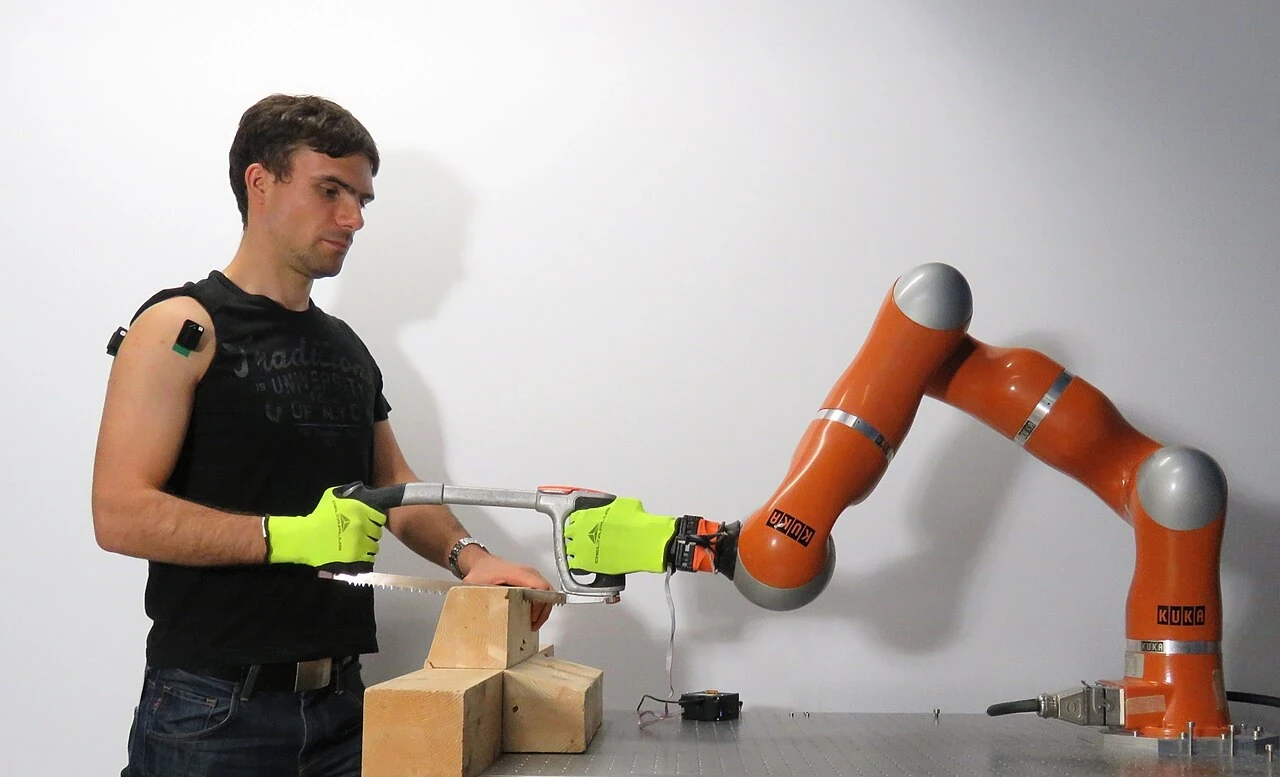
Shared spaces introduce approach, surprise, trapping, tool and ergonomic hazards. Speed and separation, power and force limiting, hand guiding or guarded operation are distinct concepts with different requirements.
Test the complete robot, end effector, payload, fixture and environment. Contact geometry and body region matter. A soft cover or compliant controller does not by itself establish acceptable collaborative operation.
| Test class | Evidence | Common blind spot | Release decision |
|---|---|---|---|
| Nominal task | Correct bounded behavior | Selected success videos | Repeat across distribution |
| Perturbation | Recovery from variation | Only clean objects | Define coverage |
| Sensor fault | Detection and response | Fault never injected | Verify timing |
| Control fault | Limits and stop | Software-only assertion | Measure physical output |
| Lifecycle | Setup, maintenance, restart | Production-only view | Validate procedures |
Cybersecurity and updates can change safety assumptions
Remote access, model downloads, configuration and over-the-air updates create paths to altered behavior. Authenticate software and commands, restrict privileges and log changes. Network loss and partial updates need bounded responses.
Regression tests should run before deployment, with staged rollout and rollback. A model update can change task selection or motion distribution even when low-level limits remain unchanged. Reassess affected hazards.
Recovery is a designed state, not a reset button
After a protective stop or AI fault, preserve pose, payload, logs and reason. Determine whether gravity, stored energy or a trapped person makes automatic restart unsafe. Assign human authority and verification steps.
Use clear operating modes, lockout procedures and restart conditions. Repeated nuisance stops should trigger engineering review, not pressure to bypass protection. Recovery metrics belong in availability planning.
Safety evidence must follow the complete lifecycle
Validate requirements, design, implementation, commissioning, production changes, maintenance and decommissioning. Use traceable tests tied to hazards and control functions. Monitor incidents, near misses and field drift.
Independent review is valuable where consequences are high. The finished argument should show what each layer prevents, detects or limits and what residual risk remains—not simply list components.
- Define hazards and a bounded operating domain.
- Validate sensing, geometry and plan assumptions.
- Enforce physical limits below AI planning.
- Use independent protection where risk requires it.
- Test faults, recovery, updates and lifecycle changes.
Frequently asked questions
Can a highly accurate robot model be considered safe?
No. Accuracy is one performance measure. Safety depends on hazards, operating limits, controls, protective functions, faults and verified residual risk.
Does an emergency stop provide all required protection?
No. It is one function. Risk may also require prevention, guarding, speed or force limits, monitoring and controlled recovery.
Should AI output directly command robot joints?
General model output should pass through validated geometry, planning, control limits and independent protective layers appropriate to the risk.
Are collaborative robots always safe around people?
No. Safety depends on the application, tool, payload, speed, force, contact geometry, environment and integration—not the robot label alone.
When should safety be reassessed?
Reassess when tasks, tools, payloads, site layout, models, software, limits or operating procedures change, and after relevant faults or incidents.
Safety Scope Note
This article is general engineering information, not certification or legal advice. Apply the current regulations and standards for the robot, application and jurisdiction with qualified safety professionals and validated hardware.