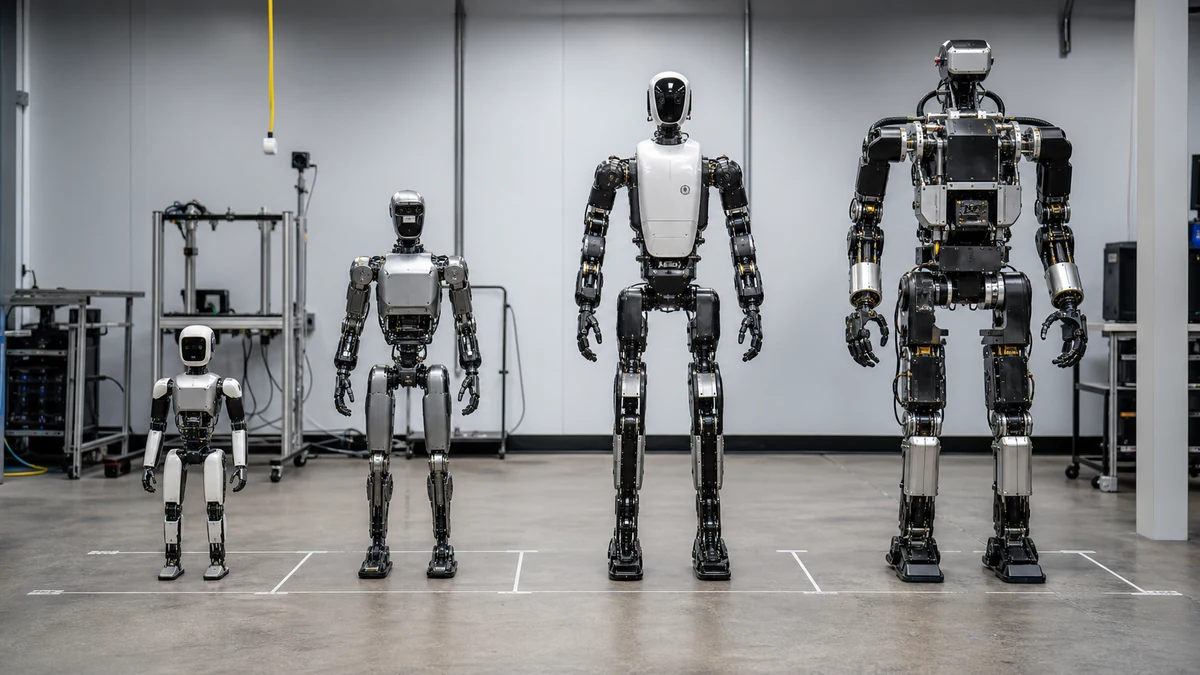
Choose R1 when compact size and a low published humanoid price matter most; compare G1 EDU when you want a roughly 35 kg research platform; look at H1/H1-2 or the H2 family when full-size dynamics and higher-output joints are required. The R1 and G1 stores explicitly exclude secondary development from the base products, while the H2 table marks it YES only for EDU. H2 Plus is a separate full-stack development configuration. Define the required size and control access before treating any model as the "best" one.
Where each Unitree humanoid fits
R1 and G1 are the smaller platforms. H1/H1-2 and H2 are closer to human scale. The suggested use in the final column is an editorial interpretation of the published specifications, not a Unitree performance guarantee.
Price status matters as much as the number. The official humanoid store collection displays $90,000 for H1 but also tells buyers to contact Unitree for the real price, so it is a quote-based reference rather than a fixed offer.
The official catalog also lists R1-D from $4,290 and H2 Plus as a separate development configuration. R1-D is an application platform rather than another R1 AIR/R1/EDU trim, so it is not mixed into the R1 specification row below. The Unitree price and buying guide keeps the full purchase-path detail separate from this model-selection comparison.
| Family | Height and weight | Official price status | Secondary development | Start here when |
|---|---|---|---|---|
| R1 Air / R1 / R1 EDU | 123 cm; about 27–29 kg | $4,900 / $5,900 / EDU quote | EDU only | Space and initial budget are limited |
| G1 / G1 EDU | 132 cm; about 35 kg or more | $13,500 / EDU quote | EDU only | You need a compact research platform for control and manipulation |
| H1 / H1-2 | H1 about 180 cm, 47 kg / H1-2 about 178 cm, 70 kg | H1 shows $90,000 but requires real-price contact / H1-2 unpublished | Confirm per configuration | Full-size dynamics and higher-output research matter |
| H2 / H2 EDU / H2 Plus | 182 cm; about 70 kg | H2 $29,900 / H2 EDU quote / H2 Plus store display $100,000 with sales contact | H2 EDU and H2 Plus supported; base H2 not marked | You need a full-size H2 or a full-stack development configuration |
R1 lowers the price and space needed to get started
The R1 family stands 123 cm tall and weighs about 27–29 kg with its battery. Unitree lists 20 degrees of freedom for R1 Air, 26 for R1 and 26–40 for R1 EDU. Published battery life is about one hour across the family. Those numbers make R1 easier to place in a smaller lab than a 70 kg full-size platform.
R1 Air and the base R1 are marked as not supporting secondary development. If the project requires custom control or sensor access, the low headline price is not the right comparison. Ask for an R1 EDU quote that specifies joint configuration, hand options, compute and SDK access.
G1 sits between compact hardware and research expansion
G1 is 132 cm tall and weighs about 35 kg with the battery. The base model has 23 degrees of freedom; G1 EDU is listed at 23–43. Unitree publishes about two hours of battery life and lists a depth camera plus 3D LiDAR on both configurations, with additional compute and hand options available for EDU.
The base G1 has a published price of $13,500, but its specification table does not grant secondary development. A team doing robot learning, joint control, sensor fusion or manipulation should compare the actual G1 EDU configuration, not the base-model price alone.

H1/H1-2 and the H2 family are full-size, but not interchangeable
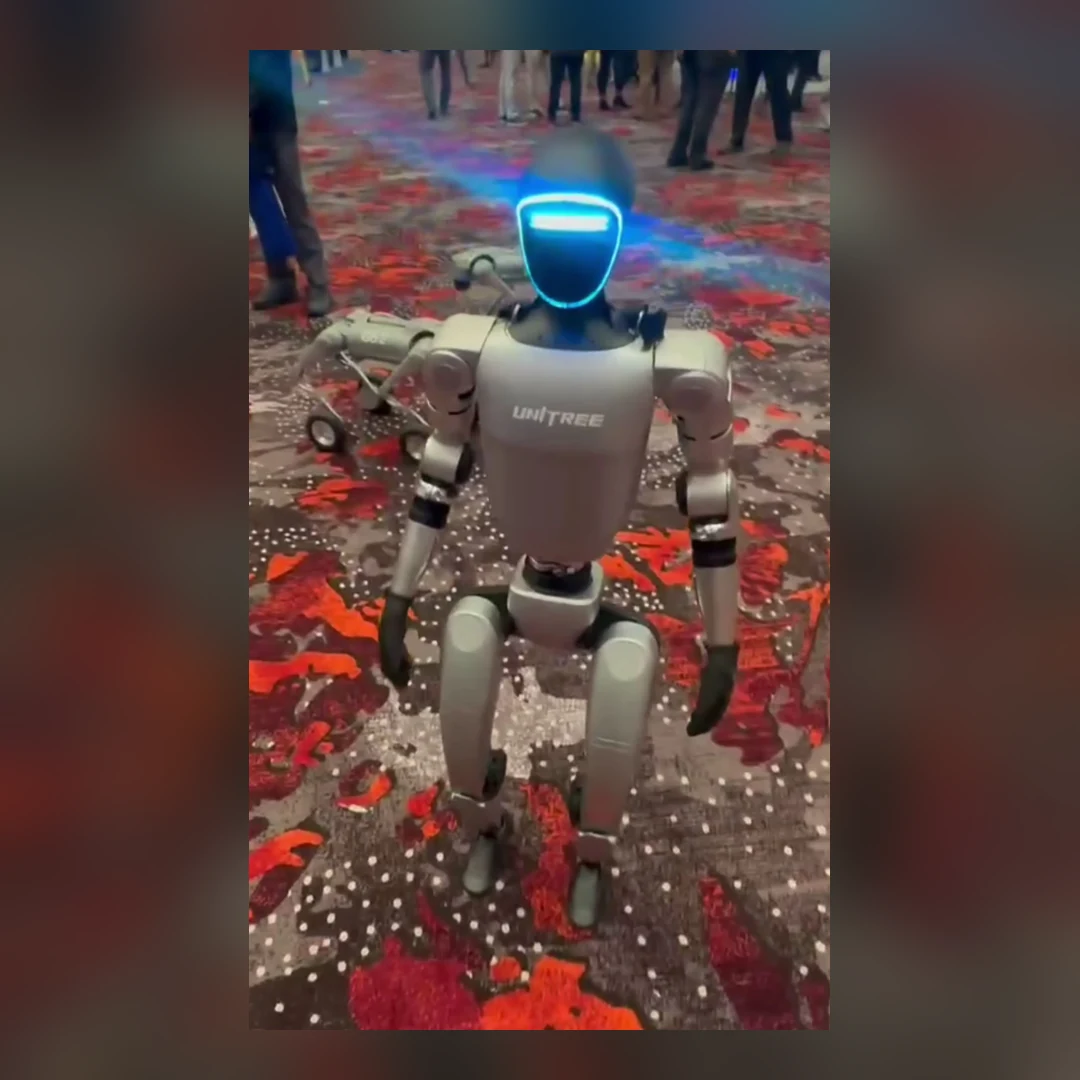
H1 is about 180 cm tall and 47 kg. Unitree lists a 3.3 m/s moving speed and a replaceable 864 Wh battery. H1-2 is about 178 cm and 70 kg, with 27 degrees of freedom and a different arm and load specification. Because Unitree presents both on the same current product page, H1-2 should not be treated as a mere rename.
H2 is about 182 cm and 70 kg, with 31 degrees of freedom and roughly three hours of published battery life. The base H2 is listed at $29,900, while H2 EDU is quote-only and marked for secondary development. H2 Plus is a separate full-stack configuration built around Jetson Thor, multiple cameras, 22 active hand DoF, 75 total body-and-hand DoF and secondary development. The store collection displays $100,000, while the purchase path still goes through sales. Compare H1/H1-2, H2 and H2 Plus by exact SKU rather than treating H2 as a simple linear successor.
Three questions will narrow the shortlist
First, decide the largest machine your facility can operate with a real safety perimeter. Second, separate a packaged motion demo from a project that needs custom control, sensing or learning. Third, model a full working day: battery swaps, charging, spares, supervision and downtime matter more than a single runtime figure.
Specifications can change with configuration and software updates. Before buying, obtain a written quote for the exact SKU, degrees of freedom, hands, sensors, compute, SDK, warranty, shipping and tax. Humanoids produce substantial force, so safe separation and an emergency-stop procedure belong in the selection criteria. Last checked August 6, 2026.
| Decision question | Shortlist implication |
|---|---|
| Are space and entry price the main constraints? | Start with the R1 family |
| Do you need a balanced platform for control, sensing and manipulation research? | Confirm a specific G1 EDU configuration |
| Do you need human-scale reach and higher-output joints? | Compare H1/H1-2 and H2 EDU under the same quote requirements |
| Will you run custom code or access low-level interfaces? | Choose EDU or another configuration with development access confirmed in writing |
Guides for the next buying or deployment decision
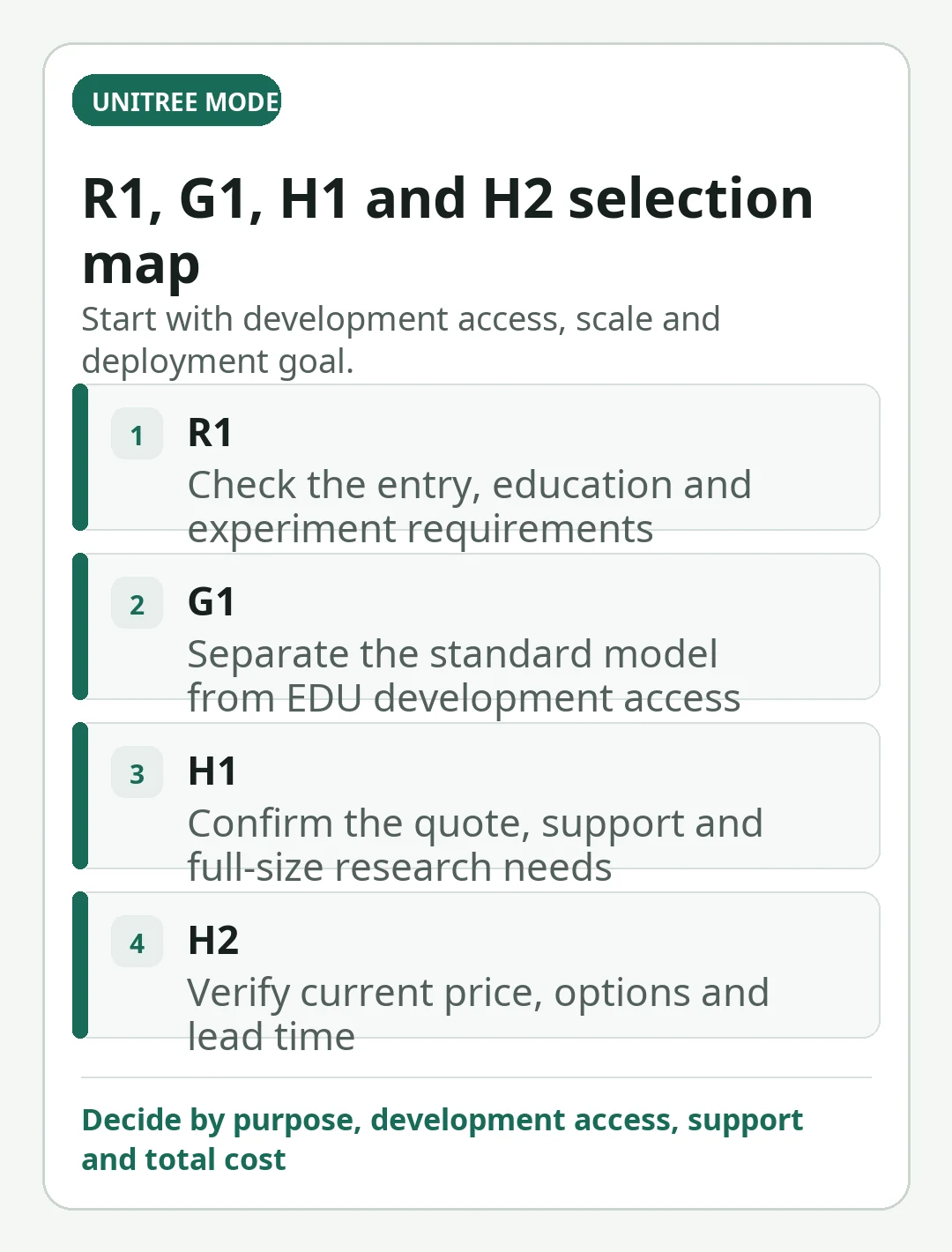
After narrowing the model range, check price and market access with Unitree robot price and buying guide, types of humanoid robots, and Unitree, Optimus and Atlas buying-stage comparison. Together they add budget, claim-verification and present-access context.
Frequently asked questions
Is R1 the best first humanoid for an individual buyer?
R1 is easier to approach on price and size, but the base versions are not marked for secondary development. Decide whether you want packaged features or custom development; for the latter, compare R1 EDU with G1 EDU before choosing.
Can I use the base G1 for robot AI research?
Unitree's official table marks secondary development as unsupported on the base G1. If you need to deploy a model or custom controller, request the G1 EDU SDK, sensor, joint-interface and compute details in writing.
Is H2 automatically a higher-end replacement for H1?
No simple hierarchy is stated. H1/H1-2, H2 and H2 Plus are separate choices with different size, weight, joints, mobility, compute and development configurations. Compare the exact task and configuration-specific quote rather than the model number alone.
Official sources checked
- Unitree R1 official product page
- Unitree G1 official product page
- Unitree H1/H1-2 official product page
- Unitree H2 official product page
- Unitree official humanoid store collection
- Unitree H2 Plus official product page
- Unitree R1-D official store page
Last checked: August 6, 2026