Virtual commissioning tests production control behavior against a virtual representation before or during physical startup. A digital twin is a maintained virtual representation connected to a physical asset or intended asset for one or more lifecycle decisions. The concepts overlap, but their scope and ownership often differ.
The distinction is not whether a model is three-dimensional. It is the decision being supported, the production logic connected, the fidelity required, the evidence used for validation and whether the model remains synchronized after commissioning.
Use this guide with the Physical AI proof-of-concept framework and sim-to-real failure guide. Model credibility must be tied to a stated use case, configuration and uncertainty.
Virtual commissioning is a focused validation activity
Virtual commissioning substitutes a virtual plant for some physical equipment so production controllers, PLC logic, robot sequences and interfaces can be tested earlier. It aims to find integration errors before they consume scarce on-site time.
A useful setup runs representative production logic, not only an animation. It reproduces sensor and actuator signals, states, timing, faults and reset behavior at the fidelity needed by the test. The physical system still requires final commissioning and acceptance.
A digital twin supports decisions across a lifecycle
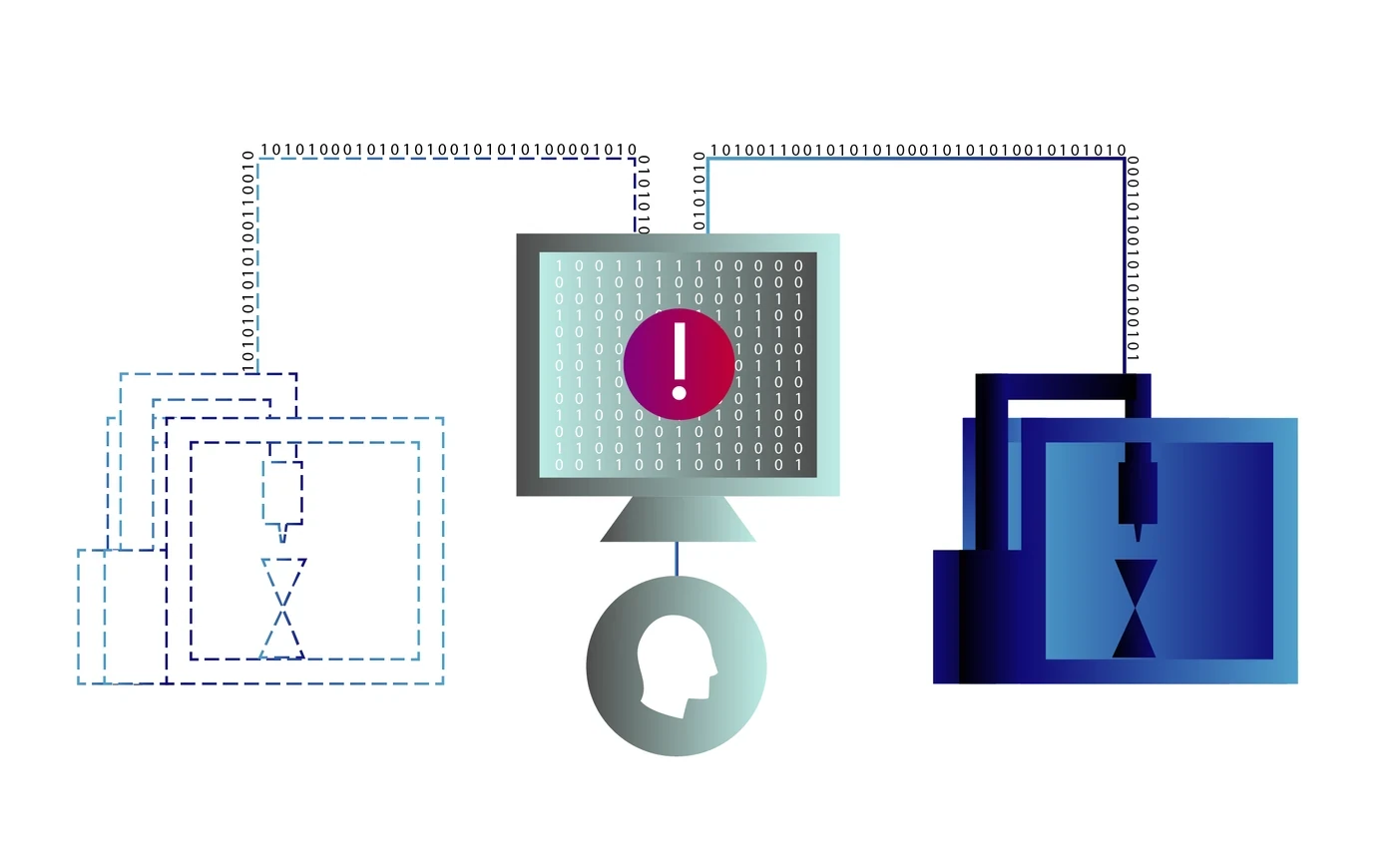
NIST describes manufacturing digital twins as synchronized virtual models that can represent, diagnose, predict and optimize operations. Its robot-system study connects design, commissioning and operational reconfiguration rather than limiting the model to startup.
A twin can support condition monitoring, what-if analysis, maintenance or scheduling, but no single model must serve every purpose. Each use case needs defined inputs, update rates, uncertainty and validation. Calling a dashboard a twin does not establish predictive credibility.
The lifecycle question determines which approach comes first
If the immediate risk is untested control logic before equipment arrives, begin with virtual commissioning. If the problem is ongoing health, reconfiguration or production optimization, define a digital-twin use case and the data needed to maintain it.
The same models may evolve from design through commissioning into operation. Reuse is valuable only when configuration, assumptions and ownership survive the transition. A geometry model without signal semantics or maintenance procedures may be expensive to keep trustworthy.
| Question | Virtual commissioning | Digital twin | Required evidence |
|---|---|---|---|
| When used | Before or during startup | Across selected lifecycle stages | Configuration dates |
| Primary purpose | Test control and integration | Support ongoing decisions | Decision definition |
| Typical connection | Real controller to virtual plant | Physical data to maintained model | Interface and timing |
| Validation focus | Sequence and fault behavior | Prediction or diagnosis credibility | Measured comparison |
| End condition | Acceptance and handover | Continuous maintenance or retirement | Named owner |
Model fidelity should follow the failure being tested
Geometric fidelity matters for reach, collision and cycle time. Signal fidelity matters for PLC logic and interlocks. Dynamic fidelity matters when forces, compliance, transport or temperature affect the decision. More detail is not automatically more credible.
Write a model-adequacy statement for every test. Identify omitted physics and acceptable error. Validate important outputs against measurement or trusted references. A simpler calibrated model can be more useful than a photorealistic model with unknown timing and behavior.
Software-in-the-loop and hardware-in-the-loop expose different risks
Software-in-the-loop can execute virtual controllers quickly and supports broad regression tests. Hardware-in-the-loop connects real controller hardware, networks or I/O, exposing scan times, drivers, protocol behavior and hardware configuration.
Choose the least expensive level that can reveal the target failure, then escalate. Neither label guarantees coverage. Record which components were real, emulated or omitted and ensure faults can be injected without endangering equipment.
A signal dictionary prevents semantic mismatch
Virtual devices and real code must agree on tag names, units, ranges, update direction, default values, quality, timing and fault behavior. A matching name with a different state meaning can let a test pass while the real line fails.
Version the interface contract and map it to higher-level information models where appropriate. The OPC UA Robotics guide explains how shared semantics can support vertical integration, although deterministic motion control remains a separate concern.
Failure and recovery sequences deserve first-class tests
Nominal production order is rarely the hardest part of commissioning. Test delayed sensors, inconsistent states, blocked stations, rejected handoffs, network loss, emergency or protective stops, power restoration and partially completed work.
Each test needs initial state, stimulus, expected transitions, timing tolerance and a safe end state. Verify alarms and operator guidance as well as controller behavior. Recovery should not create duplicate work, unexpected motion or hidden inventory errors.
| Test family | Injected condition | Expected evidence | Common omission |
|---|---|---|---|
| Sequence | Missing or late part | Controlled wait or reject | Only nominal flow |
| Network | Delay or disconnect | Bounded stop and recovery | Instant reconnect |
| Safety | Protective event | Defined safe state | No restart test |
| State | Conflicting signal | Alarm and inhibit | Silent coercion |
| Recovery | Mid-cycle restart | Known work and inventory | Manual cleanup ignored |
On-site commissioning is the calibration step, not a failure
Virtual results reduce uncertainty but cannot eliminate installation tolerances, cable errors, real friction, sensor placement, network load or human procedure. Plan physical commissioning to reconcile those differences and update the model where justified.
Compare the same cycle, signal and timing definitions. Capture discrepancies with root cause and disposition. Do not tune the model until every real result appears to match; preserve residual uncertainty so later users understand the twin’s valid operating range.
Operational twins need explicit ownership and governance
Assign owners for asset configuration, interfaces, data quality, model updates, validation and access. A twin that is not updated after controller, tooling or recipe changes can become more dangerous than having no twin because its outputs appear authoritative.
Use configuration identifiers, change review, validity status and retirement criteria. Cybersecurity applies to data paths and control connections. Limit write capability, authenticate endpoints and separate analytical access from safety-critical control authority.
A practical workflow connects purpose to maintained evidence
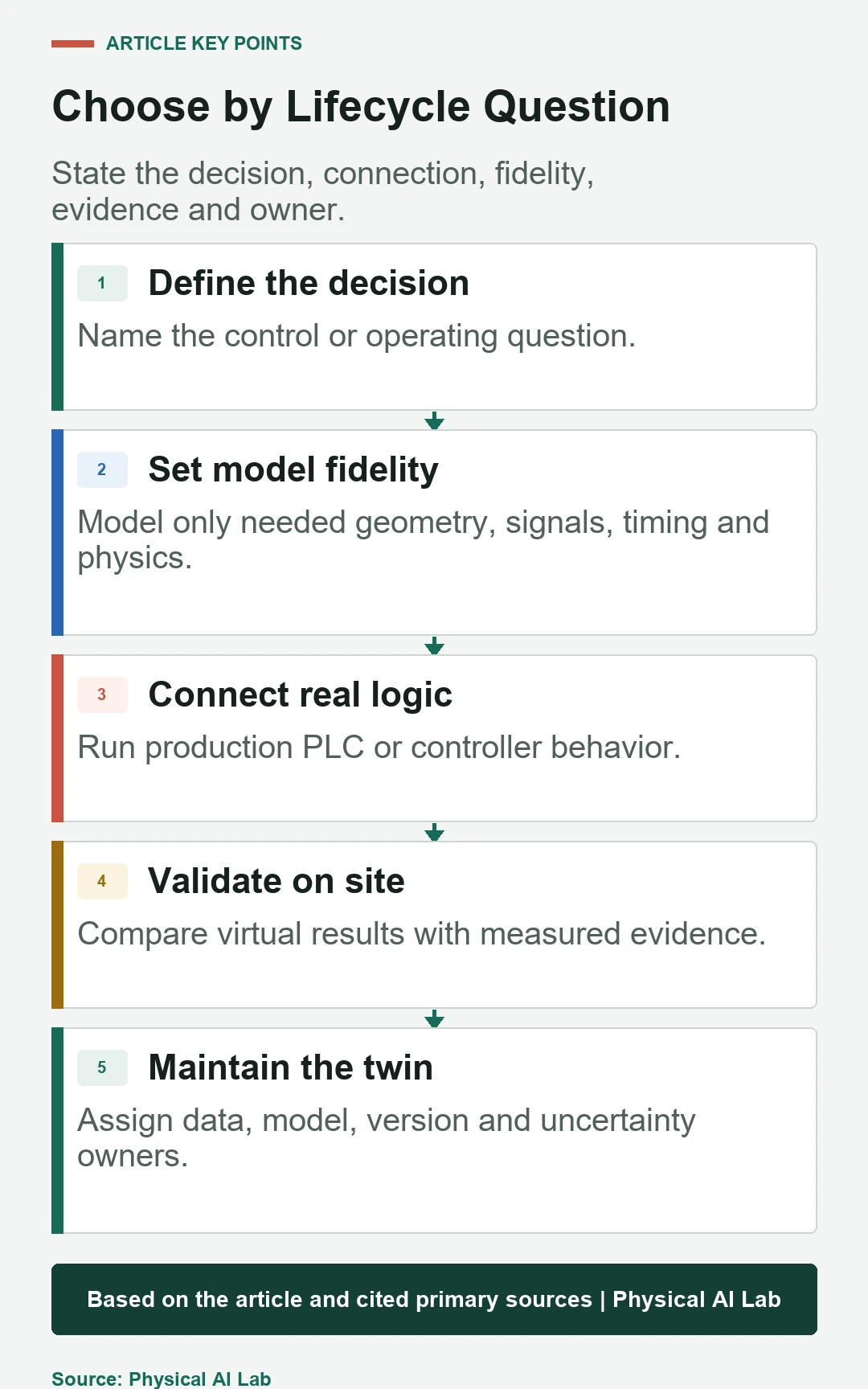
Begin with the decision and failure cost, define the system boundary, select fidelity, create interface contracts, run staged tests, reconcile on-site measurements and hand over ownership. Every result should be reproducible against a model and controller version.
Expand from virtual commissioning into an operational twin only when the ongoing use case justifies synchronization and maintenance. The name is less important than a credible chain from requirement to model, measurement, uncertainty and action.
- State one decision and its acceptance evidence.
- Model the signals and physics that can change it.
- Connect representative production logic.
- Test nominal, fault and recovery sequences.
- Assign lifecycle ownership before handover.
Frequently asked questions
Is every 3D robot simulation virtual commissioning?
No. Virtual commissioning normally tests representative control and integration behavior against a virtual plant, not merely robot motion or layout.
Does virtual commissioning remove the need for on-site commissioning?
No. Physical commissioning verifies installation-specific mechanics, sensors, networks, safety functions and procedures, and calibrates the virtual evidence.
Must a digital twin update in real time?
The required synchronization depends on its use case. Monitoring may need frequent updates, while planning or maintenance analysis may tolerate slower validated data.
Is hardware-in-the-loop always better than software-in-the-loop?
No. It exposes different timing and hardware risks but costs more. Use the level needed to reveal the target failure.
How is model fidelity accepted?
Define tolerances for decision-relevant outputs, compare them with measured or trusted references and document residual uncertainty and scope.
Model Credibility Note
Virtual commissioning and digital-twin labels do not certify model accuracy. Validate every use case against configuration-controlled evidence, quantified tolerances and the real system before relying on safety, production or maintenance decisions.