The published program for the 2nd World Humanoid Robot Games in Beijing in August 2026 described competitive and scenario tasks, including a fully autonomous 100m and work in factories, hotels and model homes. The announced design helps compare autonomy and field constraints, but it contains no verified results or completion rates.
What is new in the event program
Beijing's official guide confirms 32 events spanning athletics, soccer, dance, household work, firefighting and retail assistance. It also identifies a fully autonomous 100m, clothes folding, cooking, firefighting and tests in real environments.
This article separates confirmed facts from interpretation. Event and company figures are used only within the date and scope of the original sources; unpublished prices, lead times and success rates remain unknown.
| Program area | Confirmed tasks | What they test |
|---|---|---|
| Competition | Athletics, soccer and dance | Mobility, balance and coordination |
| Scenarios | Household work, firefighting and retail | Manipulation, planning and safety |
| Environment | Factories, hotels and model homes | Variables closer to real deployment |
Competition rules improve comparison—but narrow the problem
Giving multiple teams the same task makes comparison easier. Yet a system optimized for a competition rulebook is not the same as one handling loosely structured customer work, so generalization outside the rules needs a separate test.
Repeatable physical AI still requires sensor time synchronization, state estimation, planning, low-level control, safety limits and failure recovery to function as one chain.
Read the result sheet for completion, intervention and recovery
Ask how many attempts were made, when people restarted or remotely assisted the robot, and what happened after a failure. Those details matter more than a polished winning clip.
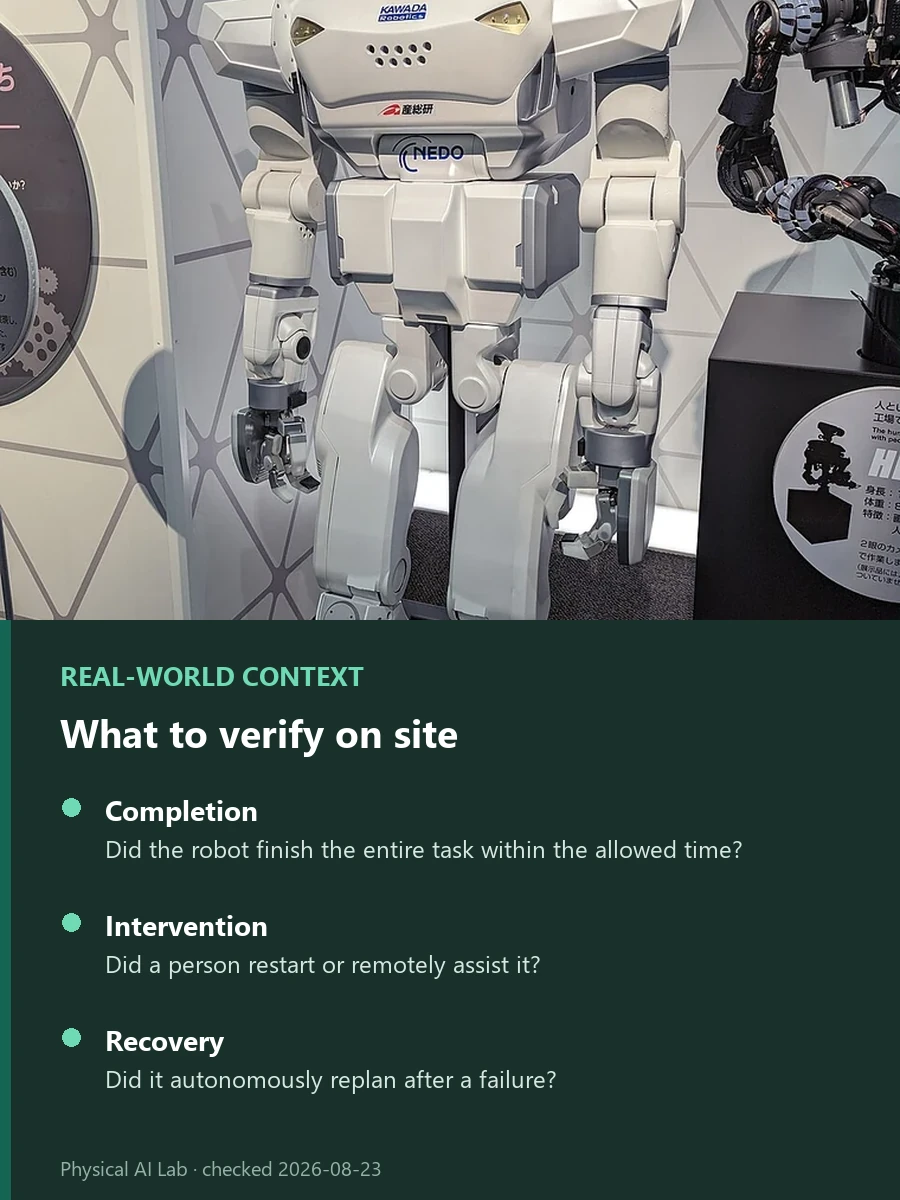
| Metric | Question to ask |
|---|---|
| Completion | Did the robot finish the entire task within the allowed time? |
| Intervention | Did a person restart or remotely assist it? |
| Recovery | Did it autonomously replan after a failure? |

A ranking alone does not establish commercial readiness
The published result needs completion rate, retries, human intervention, hardware replacement and any remote operation permitted by the rules. Without that context, a single rank cannot establish that the robot is deployable.
Official event material is the current primary evidence. Customer-site records, independent tests and regulatory documents should change the assessment when they become available.
Background for reading humanoid competition results
Start with what physical AI means, then use the core ideas behind Sim-to-Real and robot foundation models to distinguish a competition policy from a field system. This guide evaluates the games with information available in August 2026.
Why the real-environment tasks matter most
The published program said the 2nd World Humanoid Robot Games would bring competitive and scenario events together in Beijing in August 2026. The strongest post-event evidence would be comparable records from autonomous and real-environment tasks, not the spectacle or the size of an announcement.
Frequently asked questions
Which World Humanoid Robot Games result is most useful to a potential operator?
A complete run with the rules, resets, remote assistance, retries and recovery record disclosed is more useful than rank alone. It shows how the result was produced and what would have to change at a customer site.
Which metrics matter more than a humanoid's rank?
Look at human-intervention rate, mean recovery time, continuous operating time and failure conditions alongside task completion. Those four measures show how the robot reached its result.
How can teams compare results across humanoid events?
Use completion, intervention, recovery, retries, hardware changes and rule-permitted remote assistance alongside rank. A result without that context is not a deployment benchmark.
Official sources checked
- Beijing municipal government's official guide to the 2nd World Humanoid Robot Games
- Beijing municipal government's official WRC 2026 event guide
- Beijing municipal government's World Humanoid Robot Games operations update
Last checked: August 23, 2026