Pre-event WRC 2026 material described brain-computer interface competitions involving brain-controlled humanoids, quadruped robots and unmanned vehicles. A realistic reading is that limited intentions become high-level robot commands; the program listing does not show that a demonstration or record attempt was completed.
What the organizers have announced about the BCI events
Official material confirms BCI competitions, hands-on experiences and record attempts. Signal-acquisition methods, number of commands, accuracy and user training time can still differ by entry.
Figures from the BCI event and participating organizations remain bounded by the date and scope of their source material. Prices, lead times and operating success rates that have not been published remain unverified.
| Pipeline stage | What happens | What can limit it |
|---|---|---|
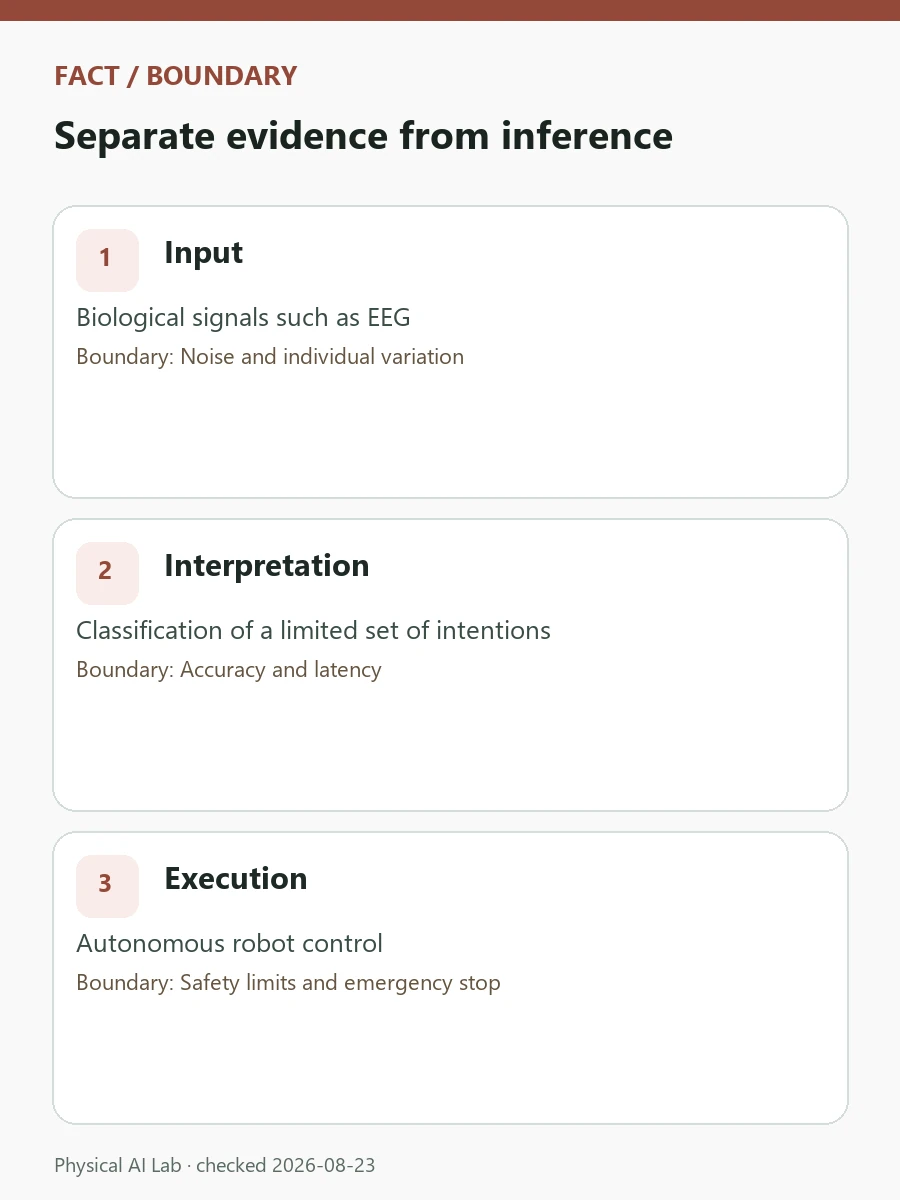
| Input | Biological signals such as EEG | Noise and individual variation |
| Interpretation | Classification of a limited set of intentions | Accuracy and latency |
| Execution | Autonomous robot control | Safety limits and emergency stop |
The brain signal is only the beginning of the control loop
A BCI pipeline includes signal acquisition, noise removal, feature extraction, intention classification, robot command generation and safety supervision. Evaluate false-command rate and time to command alongside classification accuracy.
The robot then still needs synchronized sensors, state estimation, planning, low-level control, safety limits and recovery to repeat the task. BCI does not replace the physical AI stack.
Ask how the interface performs across users and over time
Request repeat counts, intervention records and recovery time after a stop, not just the best successful attempt. A practical interface must remain usable as the session continues.
| Check | Question to ask |
|---|---|
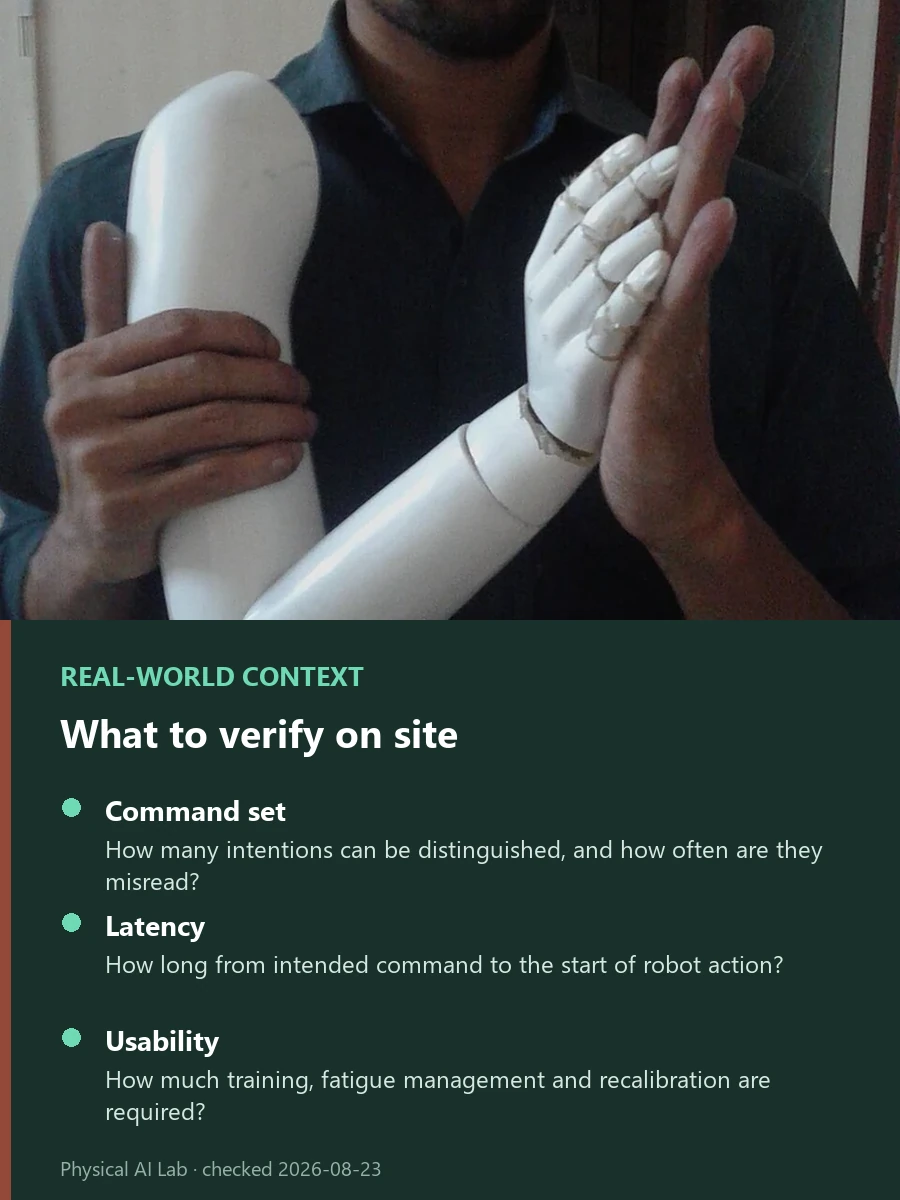
| Command set | How many intentions can be distinguished, and how often are they misread? |
| Latency | How long from intended command to the start of robot action? |
| Usability | How much training, fatigue management and recalibration are required? |

A short BCI demo does not establish everyday usability
Fatigue, electrode movement, muscle and eye-motion artifacts, and differences among users can change performance during longer sessions. A brief success should not be generalized to daily use.
The current evidence comes from event and company communication. Customer-site data, independent testing and regulatory documentation should update the assessment when available.
Where BCI fits in the physical AI stack
Use what physical AI means to separate intent input from robot autonomy, the core ideas behind Sim-to-Real to question transfer and robot foundation models to locate the policy layer. The BCI evidence assessed here is current to August 2026.
The accurate way to describe a brain-controlled robot
The pre-event program announced WRC 2026 BCI competitions involving brain-controlled humanoids, quadruped robots and unmanned vehicles. Treat them as limited intention interfaces coupled to autonomous robot control, and look for repeatable results and disclosed operating conditions rather than a claim of unrestricted thought control.
Frequently asked questions
What evidence would carry a BCI competition result into assistive or industrial use?
Test multiple users over longer sessions and report calibration time, false commands, latency, fatigue and safe cancellation. The robot must also show how it handles ambiguous or lost input without creating an unsafe action.
Which BCI performance metrics matter most?
Measure false commands and latency alongside task success, human-intervention rate, mean recovery time and continuous operating time. Those four operating measures help separate an interface demo from sustained use.
Can the same BCI command set work for every user?
Not automatically. Signal quality, training time, fatigue, electrode placement and physiology vary, so calibration and false-command limits must be tested per user and over longer sessions.
Official sources checked
- Beijing municipal government's official WRC 2026 event guide
- Invest Beijing's WRC 2026 industry overview
- World Robot Conference official service platform
Last checked: August 23, 2026