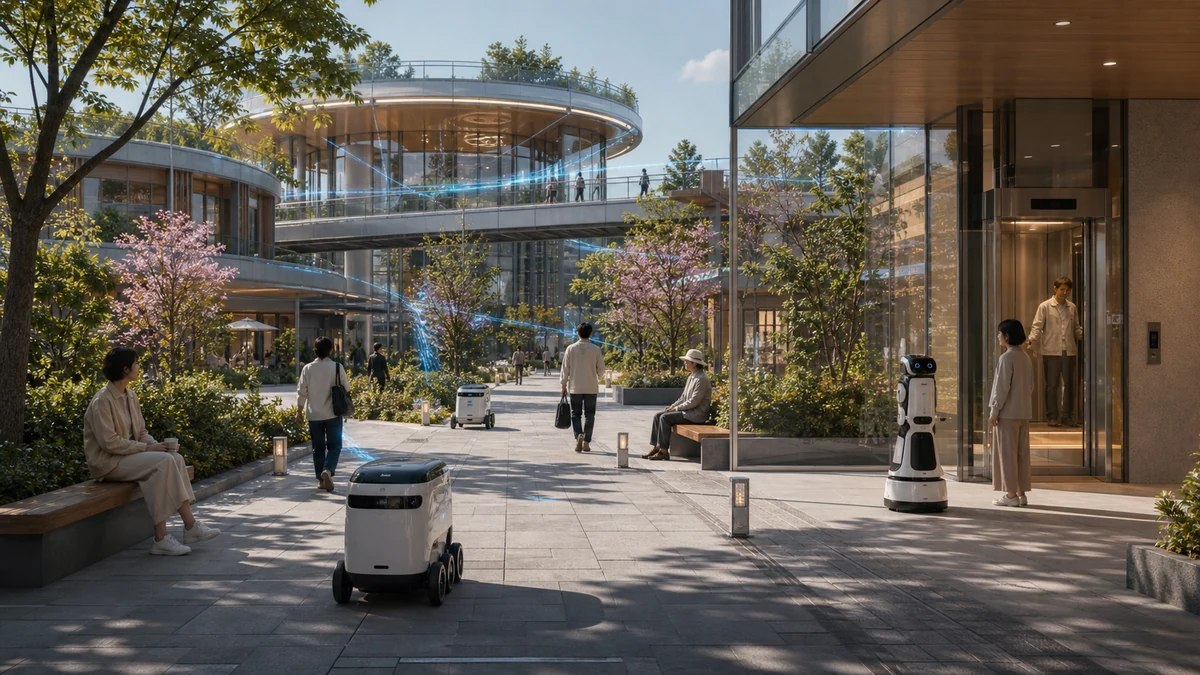
The Woven City Robot Platform is a development and integration environment for robotics services, not a robot sold as a single product. The official KAKEZAN 2026 account says it combines simulation software, varied test hardware, links to infrastructure such as automatic doors and elevators, and a total robotics system supporting goods movement and daily life.
Its distinctive idea is to test the robot together with the building, shared data and operating workflow. That makes Woven City more useful than an isolated lab for finding interface failures. It does not mean that every demonstrated service is continuously available to every resident or visitor, or that the platform is a finished commercial city operating system.
Four layers turn the platform into more than a robot lab
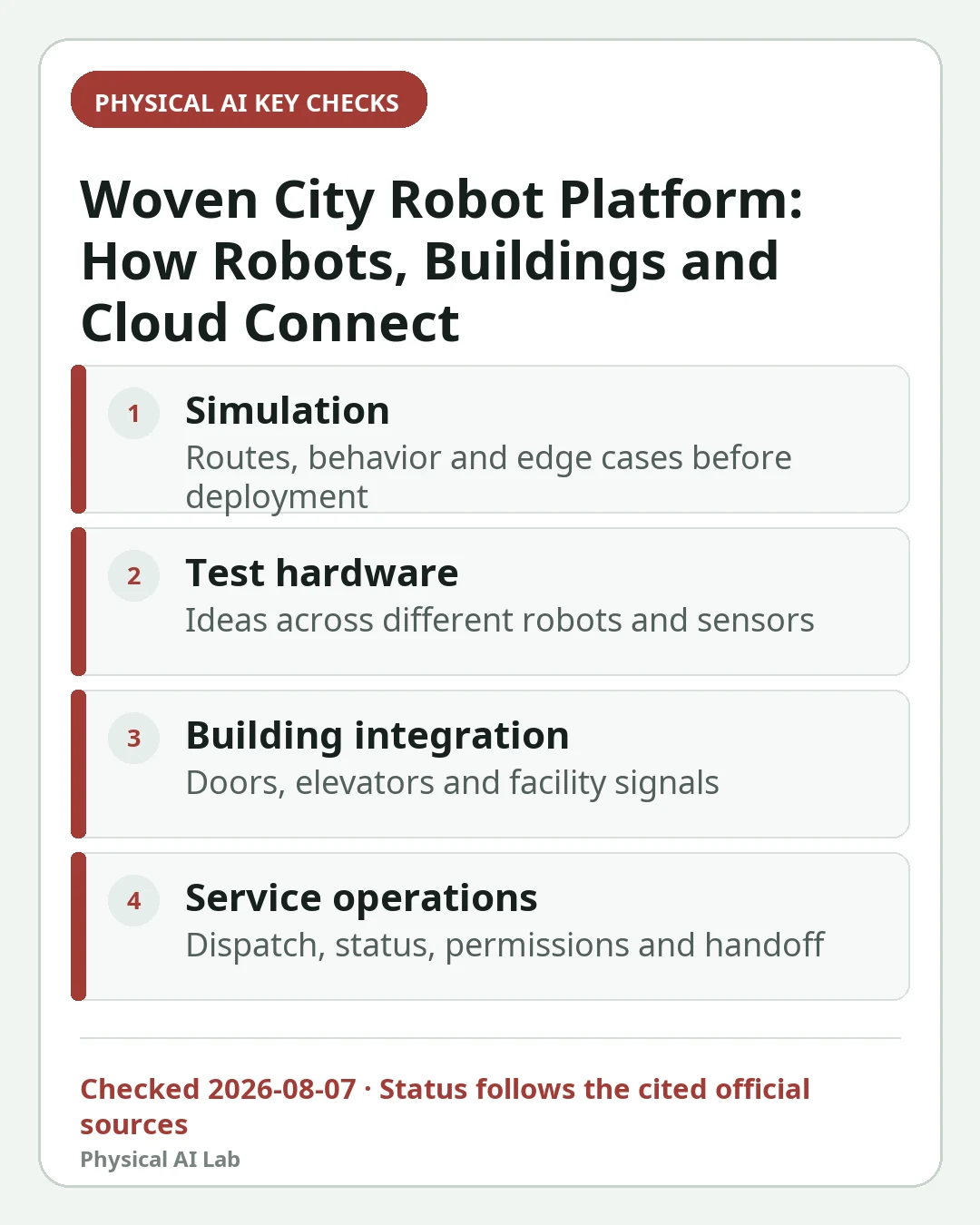
The first layer is simulation, where routes, behaviors and exceptions can be tested before physical deployment. The second is a set of hardware on which different ideas can be tried. The third connects robots to doors, elevators and facility systems. The fourth coordinates the service that moves goods or assists daily activity.
A service can fail even when the robot moves correctly. A delivery unit may reach a lobby but lack elevator permission, receive a stale door state or lose its handoff record. The platform is meant to shorten the cycle for discovering and correcting those cross-system faults.
| Platform layer | What it tests |
|---|---|
| Simulation | Routes, behavior and edge cases before deployment |
| Test hardware | Ideas across different robots and sensors |
| Building integration | Doors, elevators and facility signals |
| Service operations | Dispatch, status, permissions and handoff |
The building and cloud become part of the robot service
A robot does not have to rediscover every fact with onboard sensors. A building can report door or elevator state, while an operations layer assigns a destination and priority. The robot handles local perception and motion; shared services coordinate jobs and context across devices.
The Woven by Toyota technology overview describes a common cloud and AI foundation for cross-company work. KAKEZAN 2026 also introduced the Infra Hub, intended to absorb differences in data formats and control systems so people, facilities, vehicles and robots can cooperate. That should not be read as unrestricted data pooling; purpose, access and privacy remain design constraints.
| Component | Practical role |
|---|---|
| Robot | Local sensing, motion and physical interaction |
| Building systems | Door, elevator and space-state signals |
| Infra Hub | Translation across data and control systems |
| Operations service | Job assignment, permissions and recovery |
A living test course provides realism and a strict scope boundary
Toyota's CES 2025 Woven City presentation described completion of phase one, resident move-in plans and the city as a living laboratory. Woven City officially launched in September 2025, and 2026 activities added the Inventor Garage and further demonstrations.
Residents create real traffic, timing and social constraints that a closed laboratory cannot fully reproduce. The same fact also limits the evidence: the site has controlled access, selected participants and a bounded physical area. Performance there should not be generalized to an open metropolitan deployment without new evidence.
.jpg)
One delivery job reveals the interfaces that must cooperate
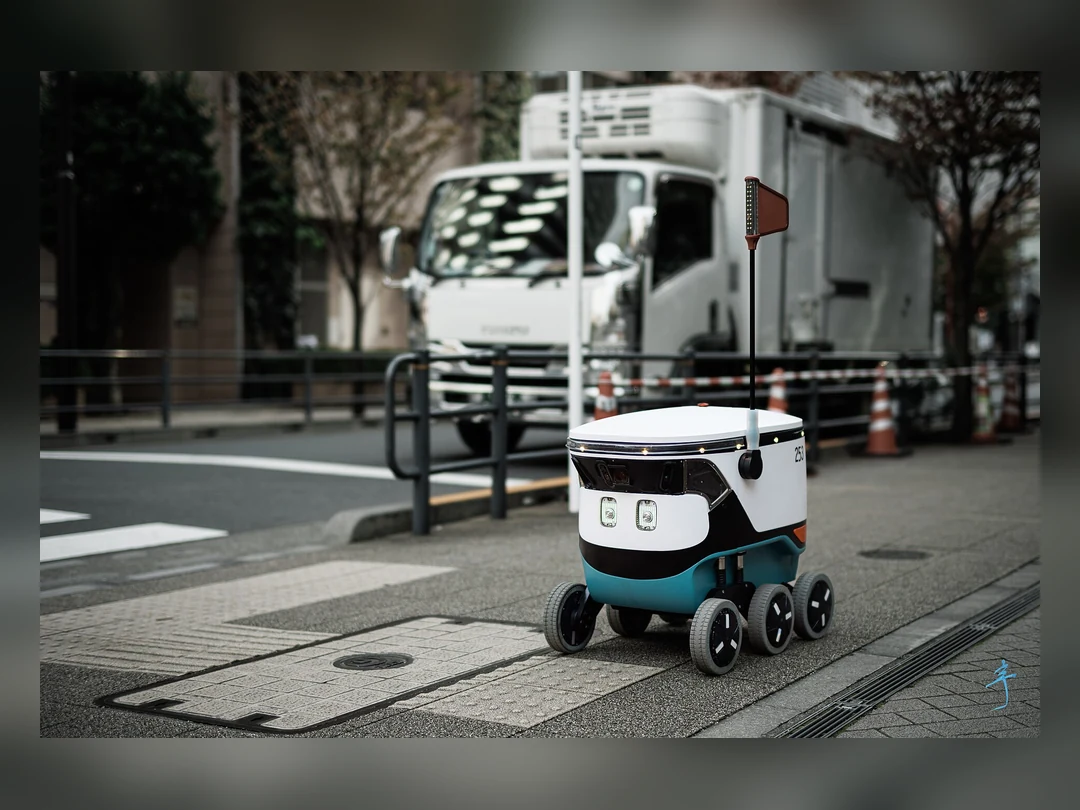
A delivery request may involve intake, loading, robot selection, route planning, door and elevator passage, recipient authentication and failed-delivery recovery. Robot Platform testing can cover that entire chain rather than only a navigation benchmark.
When a corridor is blocked or an elevator is out of service, an operating layer must replan, change priorities or transfer the job to another robot. Low battery can trigger charging or reassignment. These cases show why interface contracts and recovery logic often matter as much as the intelligence on the mobile unit.
Useful evidence is operational, not a highlight reel
A serious assessment should ask for request completion rate, human interventions, mean recovery time, door and elevator failures, peak-hour performance and simultaneous-job capacity. A multi-vendor claim also raises questions about interface standards, identity, permissions and whether one fault can propagate into another service.
Privacy is a separate decision track. Woven City presents its Data Fabric as a way for people to grant or deny access according to purpose, data type, conditions and requester. That is a design direction, not proof that every individual robot application has completed every privacy assessment.
| Evidence area | Metric or document to request |
|---|---|
| Task performance | Completion, duration, retries and intervention |
| Infrastructure integration | Door and elevator failures and recovery |
| Scale | Concurrent jobs, congestion and charging allocation |
| Trust | Access control, logs, deletion and human override |
Related engineering guides explain the surrounding decisions
Pre-deployment validation is clearer in virtual commissioning versus digital twins. Fleet decisions connect to multi-robot task allocation, while AMR versus AGV selection explains why a mobility platform still needs a suitable vehicle type.
As of August 7, 2026, the official record supports an integrated environment intended to accelerate robotics experiments. Availability, operating building, participant access and commercial status must still be checked service by service. The phrase robot platform should not erase that boundary.
Frequently asked questions
Is Woven City Robot Platform an operating system?
It is better understood as a broader development and integration environment combining simulation, hardware, infrastructure interfaces and service operations, rather than one operating system.
Are all Woven City robot services commercially available?
No. The site is a real living testbed, but individual services can be in development, demonstration or limited operation with different access rules.
Can the robots operate without the cloud?
Local capability depends on each robot. The platform highlights shared infrastructure and cloud coordination, while offline behavior must be verified in each service specification.
Official sources checked
- Woven by Toyota KAKEZAN 2026
- Toyota Woven City phase-one update
- Woven by Toyota corporate technology overview
- Toyota CES 2025 Woven City presentation
2026-08-07