A human-shaped robot hand concentrates several hard problems into a small, impact-prone package. More fingers and joints can increase the set of possible grasps, but every joint adds sensing, actuation, calibration and control variables. The hand must then survive contact with objects whose shape, stiffness, friction and location are only partly known.
Human appearance is not the objective. A useful hand completes defined tasks repeatedly, detects slip and contact, applies safe force and can be maintained at an acceptable cost. A two- or three-finger gripper may outperform a five-finger hand when the object set is narrow, because simplicity can improve reliability and make force control easier to validate.
The correct comparison therefore starts with tasks and evidence. Ask which objects were tested, how grasps were initialized, how many trials succeeded, which sensors were active and what failed. Finger count, degrees of freedom and a polished demonstration are incomplete proxies for manipulation capability.
Human-like shape does not create human-like function
The human hand combines bone, tendon, compliant skin, dense touch, temperature and pain sensing with a nervous system trained through lifelong interaction. A robot hand may reproduce the outline while using rigid links, remote motors, tendons, gears and a much smaller set of sensors. Similar shape can hide a very different contact system.
Task evidence should describe grasp range, payload, speed, precision and recovery rather than relying on resemblance. A hand that can pick a soft bag may not insert a connector, turn a key or manipulate a tool. Each task places different demands on fingertip geometry, force, compliance and sensing.
Compact actuation creates a design tradeoff
Motors and reducers must produce useful fingertip force without making the hand too large or heavy. Placing motors in the palm or fingers shortens transmission paths but consumes space and adds heat. Remote actuation through tendons reduces distal mass but introduces routing, elasticity, friction and maintenance problems.
Underactuated hands couple several joints to fewer motors, allowing shape adaptation with simpler hardware. Fully actuated hands offer more independent control but increase cost, wiring and failure modes. Neither is universally superior; the best architecture depends on the grasp set, required in-hand motion and allowed maintenance.
Touch must estimate contact before vision loses it
The camera often cannot see the contact surface once fingers close around an object. Tactile sensing can estimate touch location, normal force, shear force and slip. Wrist force sensing captures the net load but may not reveal which finger is losing contact. Motor current provides an indirect estimate that includes friction and transmission effects.
Figure states that Figure 03 uses softer fingertips, palm cameras and fingertip tactile sensors intended to improve contact area and slip awareness. These are relevant design features. Their practical value should still be assessed through repeated tasks, object variation, sensor durability and failure disclosure.
Dexterous control is a high-dimensional contact problem
The controller must choose joint motion while contact points appear, disappear and slide. Small errors in object pose or friction can change the outcome. A grasp planner may propose a hand pose, but reaching it without collision and closing the fingers with safe force remain separate problems.
Learned policies can map observations to actions, and a vision-language-action model can add task instructions. The physical loop still needs fast feedback, calibration, limits and recovery. High-level reasoning cannot compensate for an unmeasured slip or a damaged tendon after contact occurs.
| Capability | Required information | Failure if missing | Evidence |
|---|---|---|---|
| Stable grasp | Contact and force distribution | Slip or crush | Payload and slip trials |
| In-hand motion | Object pose and rolling contact | Object leaves the hand | Defined reorientation benchmark |
| Tool use | Tool geometry and reaction force | Misalignment or unsafe contact | Repeated task cycles |
| Recovery | Error and available support | Drop or uncontrolled retry | Failure-recovery rate |
Durability competes with sensitivity
A sensitive fingertip can be exposed to abrasion, impact, oil, dust and sharp edges. Flexible sensor layers and cables experience repeated deformation. Protective coverings can improve survival but reduce spatial resolution or change friction. Calibration can drift as surfaces wear.
A product hand needs replaceable wear parts, fault detection and a service procedure. Report cycles to failure, sensor drift, impact limits and replacement time. A hand that performs a complex grasp in the laboratory may still be uneconomic if frequent cable or fingertip maintenance interrupts a production workflow.
Simpler grippers can be the more capable system
Parallel-jaw, adaptive two-finger and three-finger grippers cover many industrial tasks. They can provide predictable contact geometry, strong grasp force and easier cleaning. Custom fingers or fixtures can further improve reliability when the object family is known.
A dexterous hand becomes valuable when one end effector must handle diverse objects, use human tools or reorient items without putting them down. That flexibility has to outweigh added mass, cost and maintenance. Compare total workflow performance rather than ranking hands by finger count.
Performance metrics should connect traits to tasks
NIST’s robotic hand performance work describes tests for finger strength, grasp strength, slip resistance, touch sensitivity, force tracking and manipulation. These measures help explain why a hand succeeds or fails without reducing capability to one headline number.
Trait measurements should be paired with representative task tests. High grasp strength may not help with fragile objects. Fine force tracking may not compensate for a narrow opening. A selection process maps each task requirement to measurable hand behavior and records the operating range where the result holds.
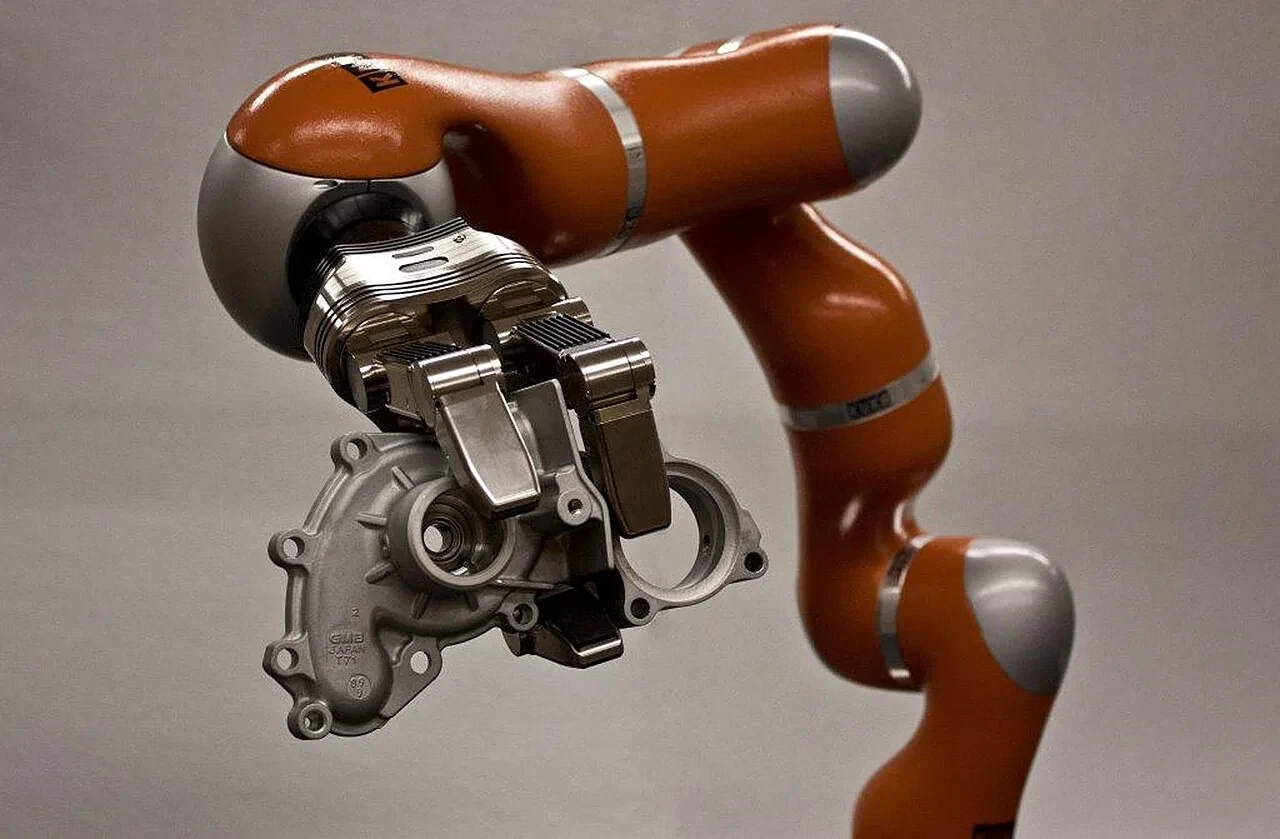
Hand claims need complete configurations
Product pages may show several hand options, sensors or compute packages. Verify which configuration was used in the demonstration and which is included in a quoted system. Payload, speed and runtime can change with the end effector, tool and control software.
The hardware price is only one component of humanoid robot cost. Integration, spare fingertips, cables, calibration, software, safety validation and downtime determine the total cost of the manipulation function. Ask for service intervals and replacement access before comparing prices.
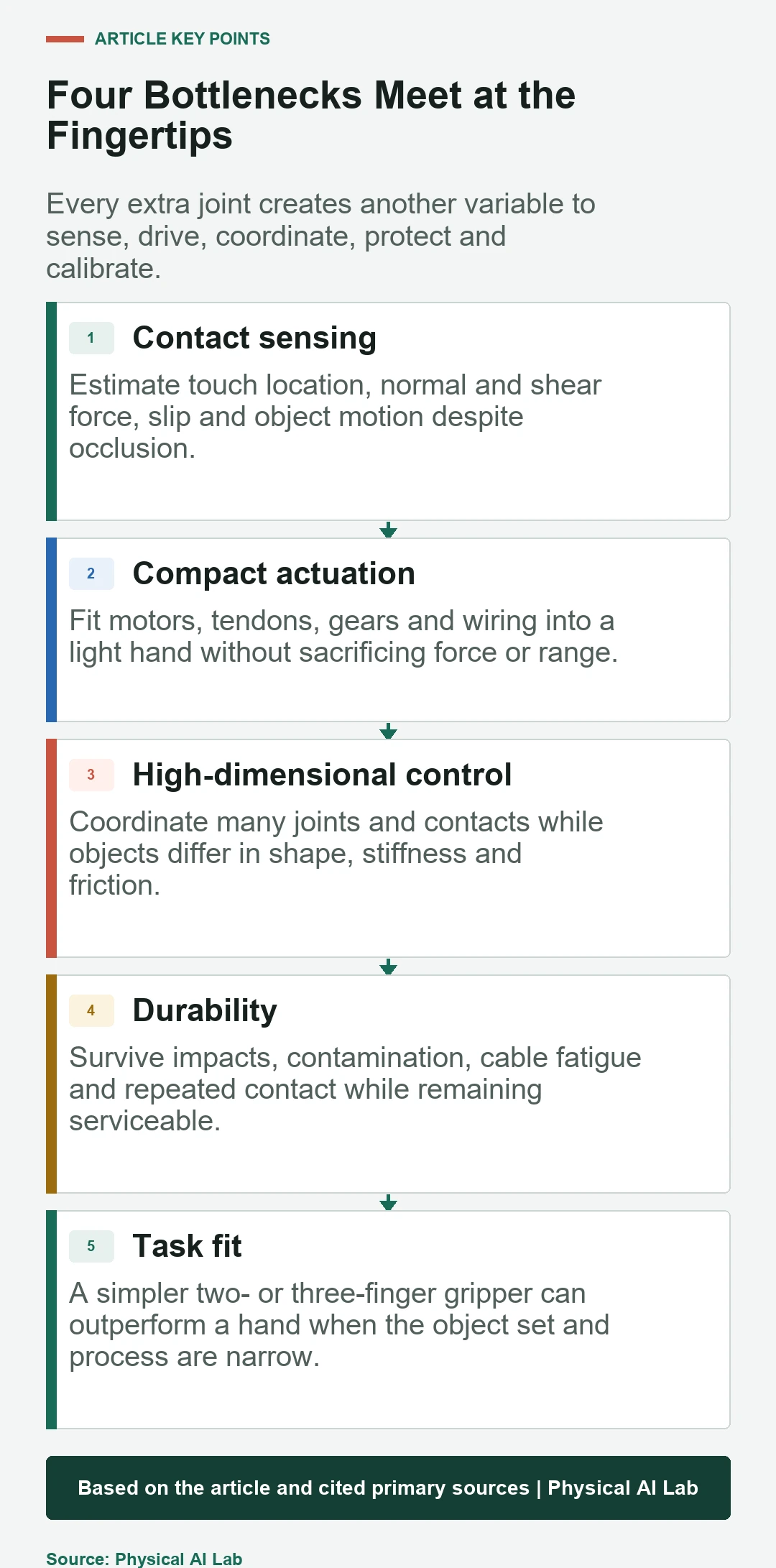
Five bottlenecks meet at the fingertips
Contact sensing, compact actuation, high-dimensional control, durability and task fit cannot be optimized independently. A lighter mechanism may reduce available force. A more compliant finger may improve contact but complicate position estimation. Added sensors increase observability while adding wiring and calibration.
Use the card as a review map. For each hand, write the target tasks and trace how the design addresses every bottleneck. Missing information becomes an evaluation request instead of an assumption based on appearance.
Choose a robot hand from the task backward
Define object dimensions, mass, fragility, surface, placement uncertainty, required cycle time and tool interactions. Then decide whether the hand needs reorientation, variable grasp types, tactile feedback and quick tool change. A bounded object set often justifies a simpler gripper.
Run repeated trials with representative variation and publish failures. Include grasp acquisition, transport, placement, recovery and post-test inspection. The hand should be selected as part of the arm, perception and control system because isolated bench performance does not guarantee task performance on the robot.
| Task condition | Likely priority | Candidate design | Verification |
|---|---|---|---|
| Known rigid parts | Repeatability and force | Parallel or adaptive gripper | Cycle and drop rate |
| Mixed household objects | Contact adaptation | Multi-finger hand with touch | Object-set coverage |
| Human tool use | Pose and reaction control | Dexterous or specialized tool hand | End-to-end tool task |
| Dirty or wet process | Sealing and cleanability | Protected simple gripper | Contamination and maintenance test |
- Specify the object and task distribution.
- Measure force, slip, touch and manipulation separately.
- Include cables, fingertips and calibration in maintenance cost.
- Compare simpler grippers against the same workflow.
- Require repeated task and recovery evidence.
Frequently asked questions
Does a humanoid robot need five fingers?
No. Five fingers can expand grasp and tool-use options, but a simpler gripper may be lighter, stronger, more reliable and easier to maintain for a defined task.
Why are tactile sensors important in robot hands?
They provide contact and slip information when cameras cannot see the grasp surface, helping the controller regulate force and detect a failing hold.
Why are dexterous robot hands expensive?
They combine many precision joints, compact actuators, transmissions, sensors, wiring, controllers and durable coverings, then require calibration, integration and maintenance.
Can AI software make any robot hand dexterous?
No. Software can improve planning and control within the hardware’s sensing, force, speed, range, latency and durability limits. Missing contact information remains a physical constraint.
How should two robot hands be compared?
Use the same representative objects and tasks, and report success, cycle time, slip, damage, intervention, recovery, maintenance and the exact hand configuration.
Hand Capability Note
Robot hand specifications, configurations and demonstrated capabilities can change. Confirm the current hardware, sensors, software and task-level evidence before comparing products or planning a deployment.