Version update: Google’s Gemini API changelog listed August 31, 2026 as the shutdown date for gemini-robotics-er-1.6-preview. Its successor, Gemini Robotics ER 2, is now in public preview. See the ER 2 pricing and API guide for the new model IDs, costs and migration scope. The original article below remains as a historical explanation of ER 1.6.
Gemini Robotics-ER 1.6 is an embodied-reasoning model intended to connect visual and language understanding with spatial outputs useful to robotics. It can reason about objects, regions, trajectories and plans, but it is not a replacement for calibrated perception, motion planning, low-level control or safety systems.
The engineering question is how a probabilistic model output crosses into a deterministic robot stack. Coordinates need frames and scale, plans need reachability and collision checks, and actions need limits, feedback and recovery when the scene or model assumption is wrong.
This guide complements Physical AI control loops and the GR00T model guide. Product access, capabilities, limits and API behavior may change, so check current primary documentation.
ER emphasizes embodied reasoning rather than low-level actuation
Google DeepMind’s model card describes Gemini Robotics-ER 1.6 as a vision-language model with spatial and embodied reasoning capabilities. It can support perception and planning questions for robot applications.
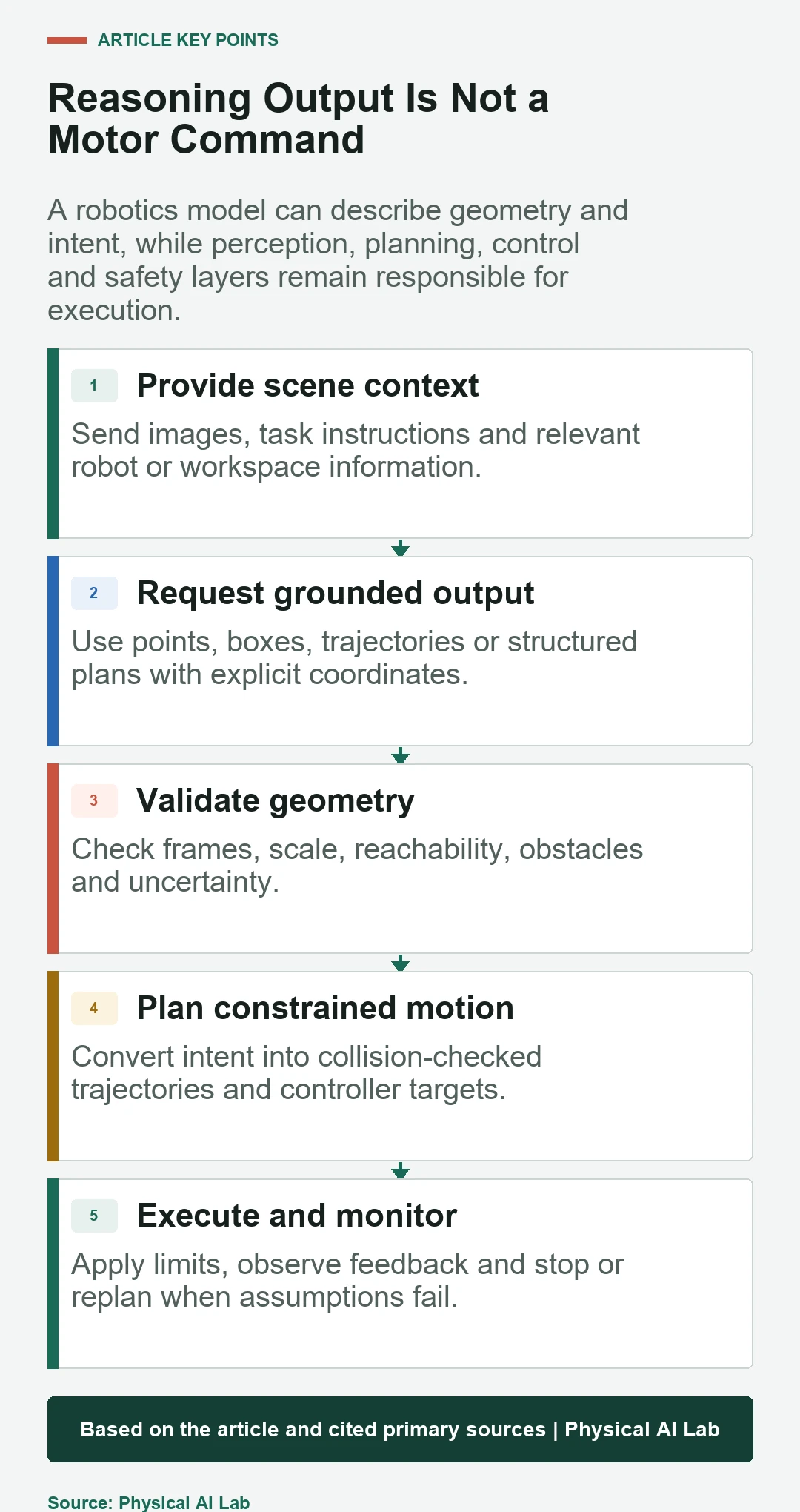
Its outputs remain proposals or structured information. A robot system must decide how to validate, transform and execute them. Do not describe a point, box or trajectory as a motor command.
Inputs should expose the task and coordinate assumptions
Images, video frames, language instructions and relevant context define the model’s view. Camera intrinsics, pose, crop, timestamp and scene changes can affect how output maps to physical space.
Record exact prompts, model identifier, API settings and input preprocessing. If robot state or tool geometry is not provided, the model cannot be assumed to know it. Version every schema that downstream software consumes.
Grounded points and boxes need a coordinate contract
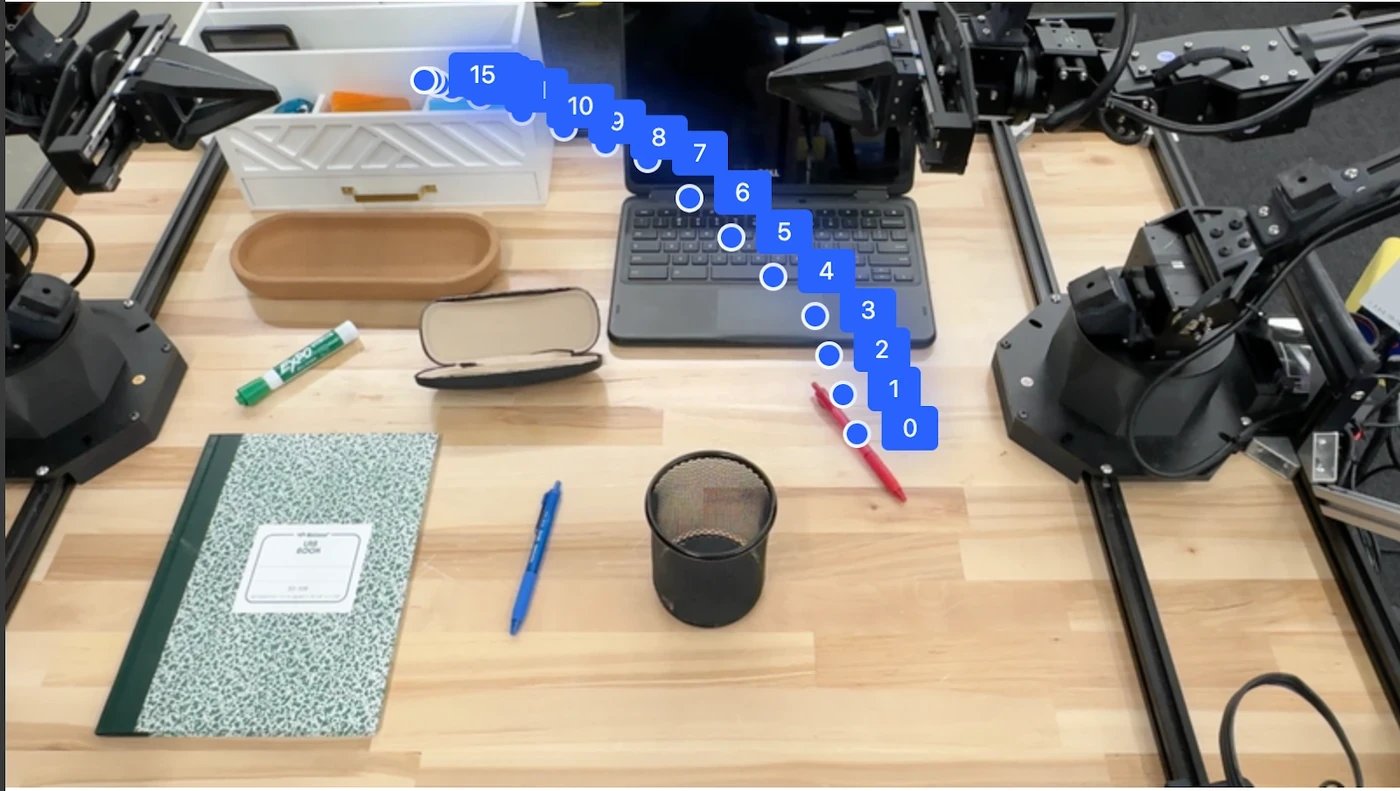
A model can identify image points, regions or object locations. Downstream code must know whether coordinates are pixels, normalized values, camera-frame positions or another convention. Image resizing and orientation must be consistent.
Validate coordinates against known markers and objects. Reject out-of-bounds, ambiguous or low-confidence outputs. A visually plausible overlay can still be metrically wrong for grasping.
| Output | Useful for | Required conversion | Critical check |
|---|---|---|---|
| Point or box | Object grounding | Image coordinate mapping | Bounds and identity |
| Depth or geometry | Spatial relation | Camera calibration and scale | Metric error |
| Trajectory sketch | Intent or path hint | Time and robot frames | Collision and reachability |
| Task plan | Action sequence | Skill and state mapping | Preconditions and recovery |
Spatial reasoning must be reconciled with calibrated geometry
Robot planning uses camera models, transforms, kinematics and environment geometry. A model’s semantic understanding can select an object or relation, while calibrated perception supplies metric pose and uncertainty.
Fuse sources explicitly rather than silently replacing geometry with model estimates. Timestamp every transform and observation. Dynamic scenes require confirmation before execution because people or objects may move after inference.
Official examples illustrate the interface boundary
Official robotics documentation shows how model outputs can describe scene elements and trajectories. These examples help define possible API interactions, not a guarantee of success across arbitrary robots, cameras and tasks.
Reproduce examples with pinned inputs, then test held-out objects, lighting, clutter and viewpoints. Measure both valid outputs and abstention or failure behavior. Demonstrations should be converted into repeatable tests.
Plans should map to a constrained skill library
A language-level plan such as pick, place or open should resolve to skills with defined parameters, preconditions, limits and success checks. Free-form text should not pass directly to unrestricted robot motion.
The executive layer can request clarification, reobserve or stop when a parameter is missing. Skills should report verified outcomes and failure codes so the model or planner does not assume completion.
Motion planning and control remain separate safety boundaries
Grounded targets enter inverse kinematics, collision checking, trajectory generation and low-level control. Joint limits, speed, force, workspace and protected zones are enforced independently of model suggestions.
Monitor execution with perception and robot feedback. Replan only within bounded rules; otherwise stop safely. Safety-rated functions should remain outside a general model unless specifically validated in an appropriate architecture.
| Failure | Detection | Immediate response | Engineering evidence |
|---|---|---|---|
| Wrong object | Identity verification | Do not execute | Confusion matrix and trials |
| Frame mismatch | Geometry sanity check | Reject output | Calibration test |
| Unreachable target | Kinematics check | Request alternative | Reachability coverage |
| Collision path | Planner check | Block trajectory | Scenario suite |
| Scene changed | Fresh observation | Stop or replan | Latency and dynamic tests |
Evaluation needs task denominators and failure taxonomy
Count valid trials, not only successful examples. Separate object grounding, spatial accuracy, plan validity, motion feasibility, execution success and recovery. A final task failure can begin at any layer.
Use held-out scenes and repeated trials with controlled variation. Report intervention, latency, invalid-output and abstention rates. Compare against a simpler perception or scripted baseline for the same workflow.
Latency, cost and privacy affect deployment
Cloud API calls introduce network delay, availability and data-governance questions. Local preprocessing and caching can help but should not create stale state. The system needs timeouts and a defined behavior when service is unavailable.
Measure end-to-end decision time and task value, not model latency alone. Review data retention, access control and regional requirements for images from workplaces or people. Current service terms should be checked before deployment.
A progressive integration path reduces hardware risk
Start with recorded images and offline scoring, then use shadow mode, simulation and a guarded robot setup. Require deterministic validation at every boundary before expanding tasks or speed.
Maintain prompts, schemas, calibration, tests and logs as versioned artifacts. The model is useful when it improves verified task outcomes beyond a baseline while the robot retains bounded control and safe recovery.
- Pin model, prompt and output schema.
- Define coordinates, frames and scale.
- Validate geometry, reachability and collision.
- Execute only through bounded skills and controls.
- Measure failures, latency, intervention and recovery.
Frequently asked questions
What is Gemini Robotics-ER 1.6?
It is an embodied-reasoning vision-language model intended to provide spatially grounded understanding useful in robotics applications.
Does Gemini Robotics-ER directly control motors?
Not by itself. Its outputs should pass through geometry validation, planning, low-level control and independent safety limits.
What grounded outputs can a robotics model provide?
Depending on the current API, examples can include points, regions, spatial relations, trajectories or structured task plans.
How should ER output be evaluated?
Measure grounding accuracy, coordinate validity, plan feasibility, task success, latency, interventions and failure recovery on held-out repeated trials.
Can it replace a robot safety system?
No. Safety functions require hazard-based architecture and validated protective mechanisms independent of general probabilistic model output.
Model and API Version Note
Model availability, access, API schemas and capabilities can change. Verify the current official model card and documentation, pin versions, and keep geometry, control and safety validation outside untrusted model output.