NVIDIA Isaac GR00T N1.7 is a generally available (GA) vision-language-action release with commercial licensing, pretrained weights, reference code, fine-tuning, inference and evaluation paths. GR00T N2 is a separately previewed successor based on DreamZero research, not a released N1.7 update.
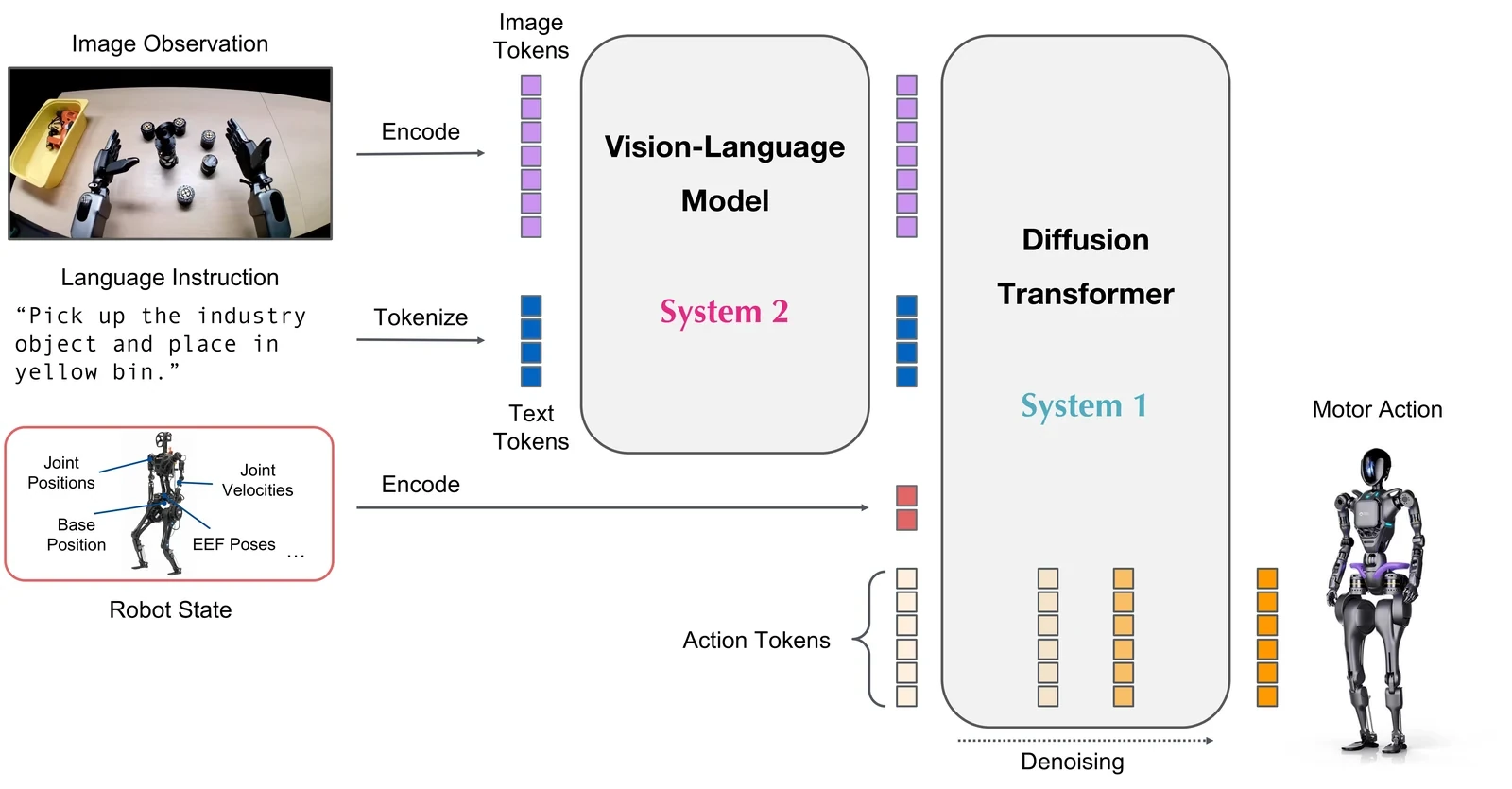
The base checkpoint is approximately three billion parameters. It combines a vision-language backbone with a diffusion transformer action head. Images, language and robot state are converted into continuous actions. The model spans multiple embodiments, but a robot must use the correct modality configuration, action representation and normalization.
GR00T should be understood within the broader robot foundation model and VLA landscape. Downloading a checkpoint is the beginning of an engineering process, not proof that a new robot will perform a task safely or reliably. For release status and scope, use the GR00T N2 versus N1.7 comparison.
GR00T N1.7 is GA; N2 is not yet released
The official Isaac-GR00T repository now identifies N1.7 as generally available (GA). The older n1.7-release tag documents its early-access phase; GA status alone does not validate a particular robot deployment. Teams should pin the commit, checkpoint and dependencies used for every result because documentation and interfaces can change.
N1.7 can be useful for research, prototyping and comparison. Deployment decisions should account for support status, license, security review, model updates and reproducibility. A benchmark performed on one checkpoint should not be silently attributed to every later or earlier version.
The architecture joins understanding and continuous action
A vision-language backbone processes images and instructions, while robot state supplies embodiment context. A diffusion transformer iteratively denoises continuous action outputs. This design differs from a VLM that ends with text; the output must map into the robot’s action space and timing.
Architecture diagrams show information flow, not task reliability. Performance depends on training distribution, camera views, state fields, action definition, controller, latency and physical robot. The official diagram should be read with the data and Policy API documentation.
Embodiment tags define the data interface
GR00T uses embodiment tags to select modality configuration for state, action and video keys. A tag identifies how concatenated arrays are split and normalized. Using the wrong tag can produce syntactically valid inference with semantically wrong commands.
For a new robot, document joint order, units, tool frame, action horizon, gripper convention and cameras. Test conversion with simple known motions before training. The interface should be versioned with the robot description and calibration.
The data format extends a LeRobot workflow
The repository describes a LeRobot v2-style dataset with metadata, episode and task records, parquet state-action data, video and a GR00T-specific modality file. Complete episodes align visual observations, robot state, actions and language at each timestep.
Data quality principles from the robot action data guide still apply. Check timestamps, calibration, success labels, failure coverage and operator intervention. Converting files does not repair a demonstration whose action and image are misaligned.
| Dataset element | Purpose | Critical check | Failure effect |
|---|---|---|---|
| Videos | Visual observations | Camera keys and timing | Wrong scene context |
| State | Robot configuration | Order, units and normalization | Incorrect embodiment state |
| Actions | Target motion or command | Frame and horizon | Unsafe or meaningless output |
| Tasks | Language goal | Episode alignment | Instruction mismatch |
| Modality metadata | Field interpretation | Tag and schema version | Silent mapping error |
Base inference and fine-tuning answer different questions
Zero-shot inference can test supported pretrained embodiments and reveal interface behavior. A new task, camera arrangement or robot generally needs adaptation. Fine-tuning uses demonstrations and modality configuration to specialize the model while retaining pretrained representations.
Create train, validation and held-out test splits by scene, object and trajectory where possible. Tune on training data, choose checkpoints with validation evidence and reserve physical trials that are not recycled into every iteration. Otherwise the team can overfit a small demonstration set.
Hardware requirements differ for training and inference
NVIDIA’s current hardware recommendation separates fine-tuning from low-latency inference and publishes tested platform frequencies. Those results depend on model settings, camera count, denoising steps and runtime.
Benchmark end-to-end robot latency, not only model frequency. Include camera capture, preprocessing, network or process transfer, policy inference, action chunk handling and controller execution. Thermal, memory and concurrent workloads can change sustained performance.
| Stage | Measure | Why it matters | Acceptance evidence |
|---|---|---|---|
| Data loading | Episode integrity and throughput | Prevents training corruption | Schema audit |
| Fine-tuning | Loss and validation task metrics | Selects an adapted checkpoint | Held-out data |
| Inference | End-to-end rate and jitter | Sets usable control timing | Production hardware log |
| Simulation | Task and failure coverage | Screens unsafe policies | Repeatable benchmark |
| Hardware | Success, intervention and safety | Tests actual deployment | Controlled robot trials |
Evaluation must progress from open loop to hardware
Open-loop evaluation compares predicted actions against a recorded dataset, which is useful for regression but cannot reveal compounding errors. Simulation adds closed-loop response while retaining a model gap. Real hardware exposes sensors, contact, timing and safety constraints.
Define tasks, initial conditions, object set and success before trials. Report first-attempt success, retries, completion time, intervention and failure categories. Compare the adapted model with a simpler baseline and the prior checkpoint under the same protocol.
The Policy API sits above the robot controller
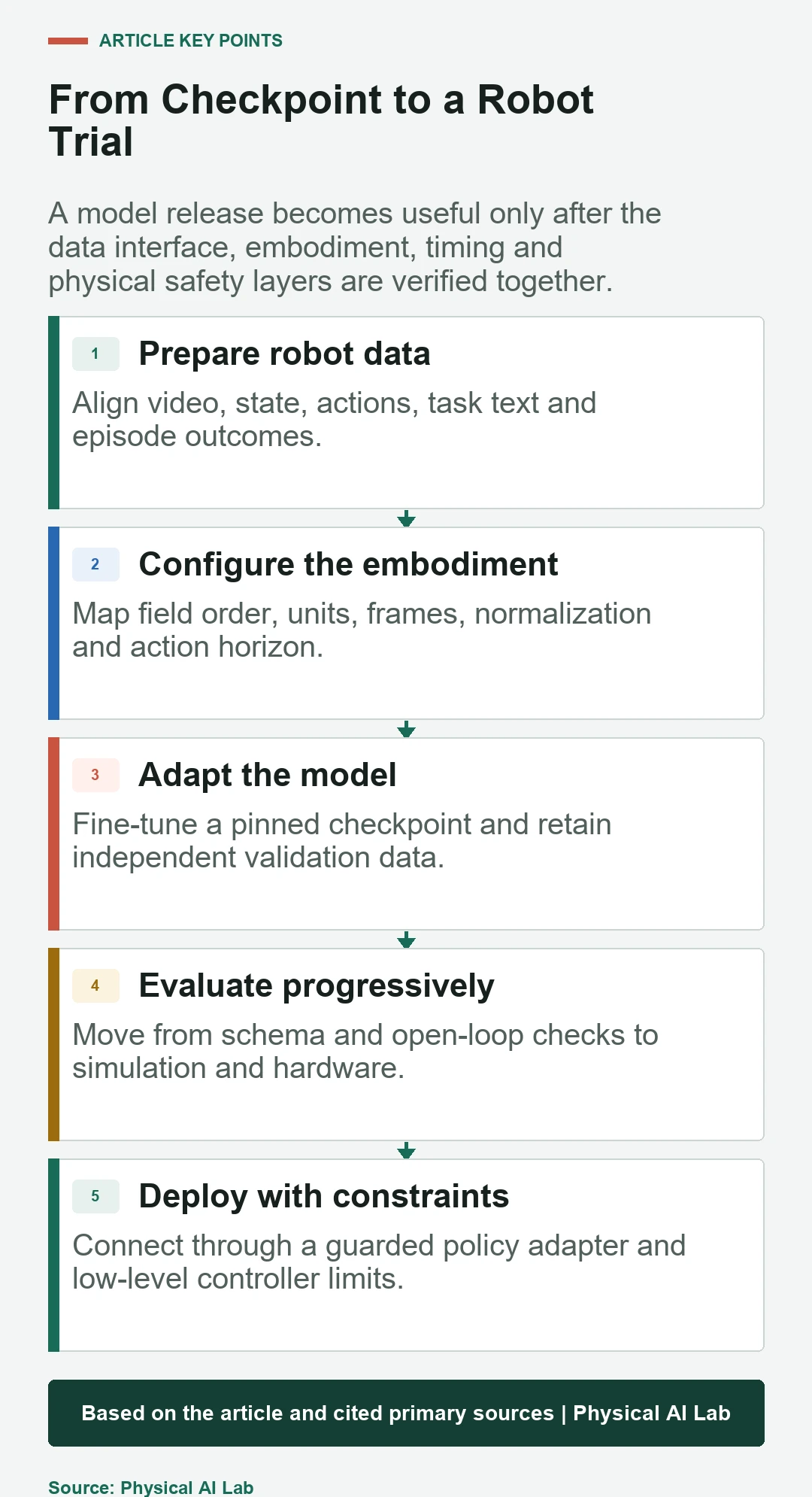
A policy output should not bypass kinematic, dynamic and safety constraints. The deployment adapter maps action chunks to targets, monitors timing and handles stale or invalid outputs. The low-level controller tracks commands within joint, torque, speed and workspace limits.
An edge AI architecture can keep inference near the robot, while remote training and fleet analytics remain centralized. Decide what the robot does if policy inference misses a deadline, a camera fails or network assistance disappears.
Model improvement should be attributed carefully
A new release may change the backbone, training data, code, checkpoints and runtime. An observed gain can also come from better data conversion, augmentation or controller tuning. Keep an experiment matrix that changes one major factor at a time.
Use the repository’s stated benchmarks and limitations as context, then reproduce the target embodiment. Comparable headline results do not establish equal behavior in a different camera, gripper, action frame or environment.
A guarded adoption plan reduces risk
Begin with the official demo data and supported environment to verify installation. Convert a small robot dataset and inspect every modality. Fine-tune a baseline, evaluate open loop, run simulation and then use a constrained physical workspace with emergency procedures.
Preserve checkpoints, code commits, configs, datasets and robot calibration. Expand task variation only after failure handling is stable. Do not treat GA status as a substitute for the support and validation required before connecting the model to production-critical systems.
- Pin the repository commit and checkpoint.
- Audit the embodiment tag and modality schema.
- Validate synchronized demonstrations before training.
- Measure end-to-end inference on target hardware.
- Progress from open loop to simulation and guarded robot trials.
Frequently asked questions
What is GR00T N1.7?
It is NVIDIA’s generally available open vision-language-action model and reference workflow for generalist robot manipulation across multiple embodiments.
Is GR00T N1.7 production-ready?
The official repository now labels N1.7 generally available (GA). Production use still requires independent validation and risk review.
Can GR00T control any robot zero shot?
No. Pretrained embodiment support is specific, and new robots generally require correct modality configuration, data conversion and adaptation. Hardware constraints and safety remain external.
What data does GR00T use?
The workflow uses language tasks, videos, robot state and actions organized as complete episodes with modality metadata that explains each embodiment’s fields.
How should GR00T be evaluated?
Use schema checks and open-loop regression first, then closed-loop simulation and controlled hardware trials with task success, timing, interventions and failure categories.
Release and Model Note
GR00T N1.7 is now marked generally available (GA). Verify the current official repository, checkpoint terms, hardware guide and support status before reproducing results or planning deployment.