A QDD (quasi-direct-drive) actuator combines a torque-dense motor with relatively low-ratio gearing. Compared with high-ratio joints, it trades some torque multiplication for lower reflected inertia, better backdrivability and more responsive force control.
QDD is not one fixed ratio or product category. The useful range depends on the robot, motor, transmission, current capability, thermal path, feedback and controller. A lower ratio requires more motor torque for the same output torque. Electrical demand also depends on speed, motor sizing and losses; ratio alone does not determine it.
Read this with the frameless motor guide and reducer comparison. The complete joint should be validated at output under the intended dynamic and contact tasks. The robot actuator structure guide shows where motor, reducer, encoder, brake and thermal path fit in the full joint.
What QDD means—and where the ratio boundary sits
Direct drive connects motor to output with essentially no reduction. High-ratio joints multiply torque strongly but also reflect motor inertia and transmission friction. QDD selects a lower ratio to trade torque multiplication for transparency and bandwidth.
There is no universal boundary. Define output torque, speed, contact, impact, mass and energy requirements, then compare ratios using one motor and system model. Labels should follow measured behavior rather than marketing categories.
A torque-dense motor carries more of the output burden
Low reduction means the motor must generate more torque for the same joint output. Large-radius frameless motors and suitable windings can provide torque, but copper loss and package volume increase. Continuous output is constrained by the thermal path.
Select bus voltage, torque constant, current, speed and cooling together. Peak current may produce impressive short motion while overheating in repeated locomotion or manipulation. Duty-cycle evidence should include drive and battery limits.
Low ratio improves backdrivability and force observability
With less reflected motor inertia and transmission friction, external forces can move the joint more readily. This can improve impact response, contact control and torque estimation from motor current. Bearings and belt or gear friction still remain.
Backdrivability should be measured across position, speed, load and temperature. A joint that feels transparent when unpowered may behave differently under closed-loop control, cable forces or a warm transmission.
| Architecture | Torque multiplication | Transparency | Primary burden |
|---|---|---|---|
| Direct drive | None | Highest potential | Large motor and current |
| Quasi-direct drive | Low to moderate | High potential | Motor, drive and cooling |
| High-ratio geared | High | Lower potential | Friction, inertia and compliance |
| Series elastic | Architecture-dependent | Designed compliance | Deflection and bandwidth |
Transmission choice still matters at low ratio
Planetary, belt, cable and other stages can create the selected ratio. Each adds backlash, compliance, efficiency, alignment and wear behavior. A belt can support remote packaging but needs tension and inspection; gears can be compact but add mesh effects.
For a concrete routing trade-off, the open-versus-crossed belt geometry experiment shows how greater wrap also creates a crossing in the shared plane. It is a geometric construction, not a test of transmitted torque, slip or belt life.
Include output bearings and housing in mass and stiffness. The lowest ratio is not automatically the lightest system because motor and drive size may grow. Optimize the complete actuator against the robot task.
The open actuator example reveals the integration stack
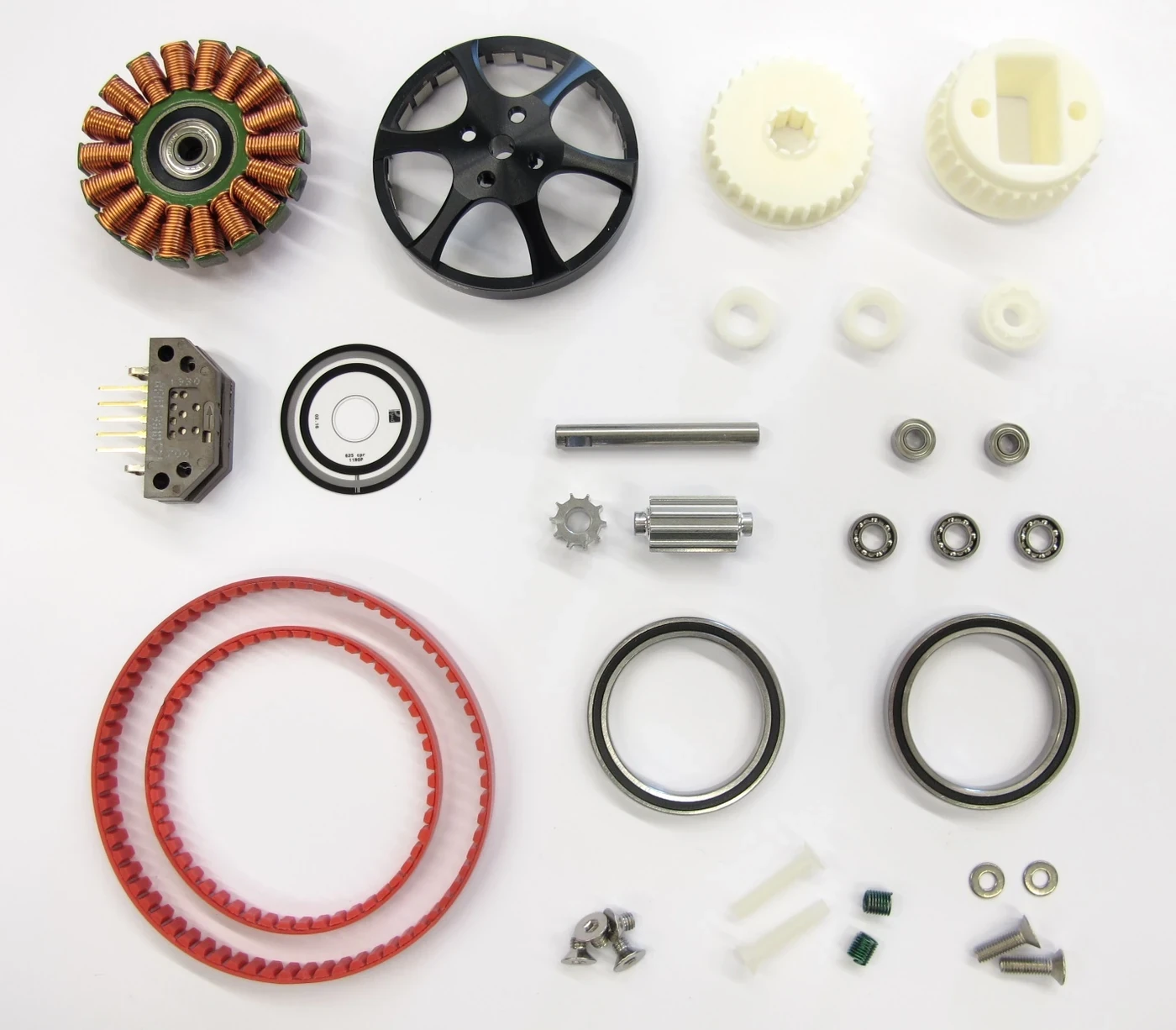
The Open Dynamic Robot Initiative actuator hardware exposes motor, belt transmission, encoders, shafts, bearings and structure. It is a useful educational reference for torque-controlled low-ratio design.
It is not a universal QDD blueprint. Commercial humanoid, quadruped and arm joints use different ratios, gear types, cooling and packaging. Evaluate architecture, license and evidence separately from the general concept.
Current-based torque estimation needs calibration
Motor current relates to motor torque through a torque constant, then transmission ratio maps it toward output torque. Friction, cogging, belt tension, gearbox loss and temperature create error. Drive current measurement and commutation accuracy also matter.
Calibrate against an output torque reference over directions, speeds and temperatures. A direct torque sensor can improve measurement, while current estimation remains useful for fast control and diagnostics. State which signal supports safety decisions.
Control bandwidth depends on mechanics, sensing and delay
A QDD joint can support fast torque control when motor current, encoders, structure and software are well designed. Structural resonance, flexible transmission, quantization, network delay and filters limit the stable bandwidth.
Identify the assembled plant and tune current, torque, velocity and position loops hierarchically. Validate contact transitions and impacts, not only free-space tracking. Saturation and anti-windup behavior should be explicit.
| Validation | Measure | Risk exposed | Design response |
|---|---|---|---|
| Torque-current map | Output torque versus current | Friction and calibration | Estimator compensation |
| Backdrive sweep | External torque versus speed | Drag and cogging | Ratio and mechanics |
| Frequency response | Gain and phase | Resonance and delay | Controller bandwidth |
| Thermal duty cycle | Temperature and derating | Continuous limit | Cooling and trajectory |
| Impact trial | Peak load and recovery | Structural or control fault | Limits and protection |
Electrical power and heat can dominate the design
Producing joint torque at low ratio can require high phase current. Copper loss rises with current squared, and drive conduction loss and battery voltage sag follow. Regenerative motion can return energy and raise the DC bus.
Map electrical input, mechanical output and heat across representative trajectories. Size conductors, connectors, drives, battery and cooling for simultaneous multi-joint operation. Per-joint bench success may not survive whole-robot power demand.
Impact tolerance is not the same as softness
Low reflected inertia and backdrivability can reduce some collision severity, but the actuator remains capable of large force under active control. Structural stops, bearings, gears and motor magnets still have overload limits.
Define torque and speed limits, collision detection, safe-stop behavior and post-impact inspection. Evaluate the complete robot contact geometry and controller. An actuator architecture alone does not establish collaborative safety.
A QDD decision should end in joint-level evidence
Compare candidate ratios using output torque-speed envelopes, complete mass, efficiency, thermal rise, torque fidelity, backdrivability, control bandwidth, impacts and life. Include manufacturing variation and service requirements.
Prototype the intended motor, transmission, drive, feedback and housing. Run task trajectories and fault injection on multiple units. QDD is valuable when its measured transparency and dynamics justify the electrical and thermal burden.
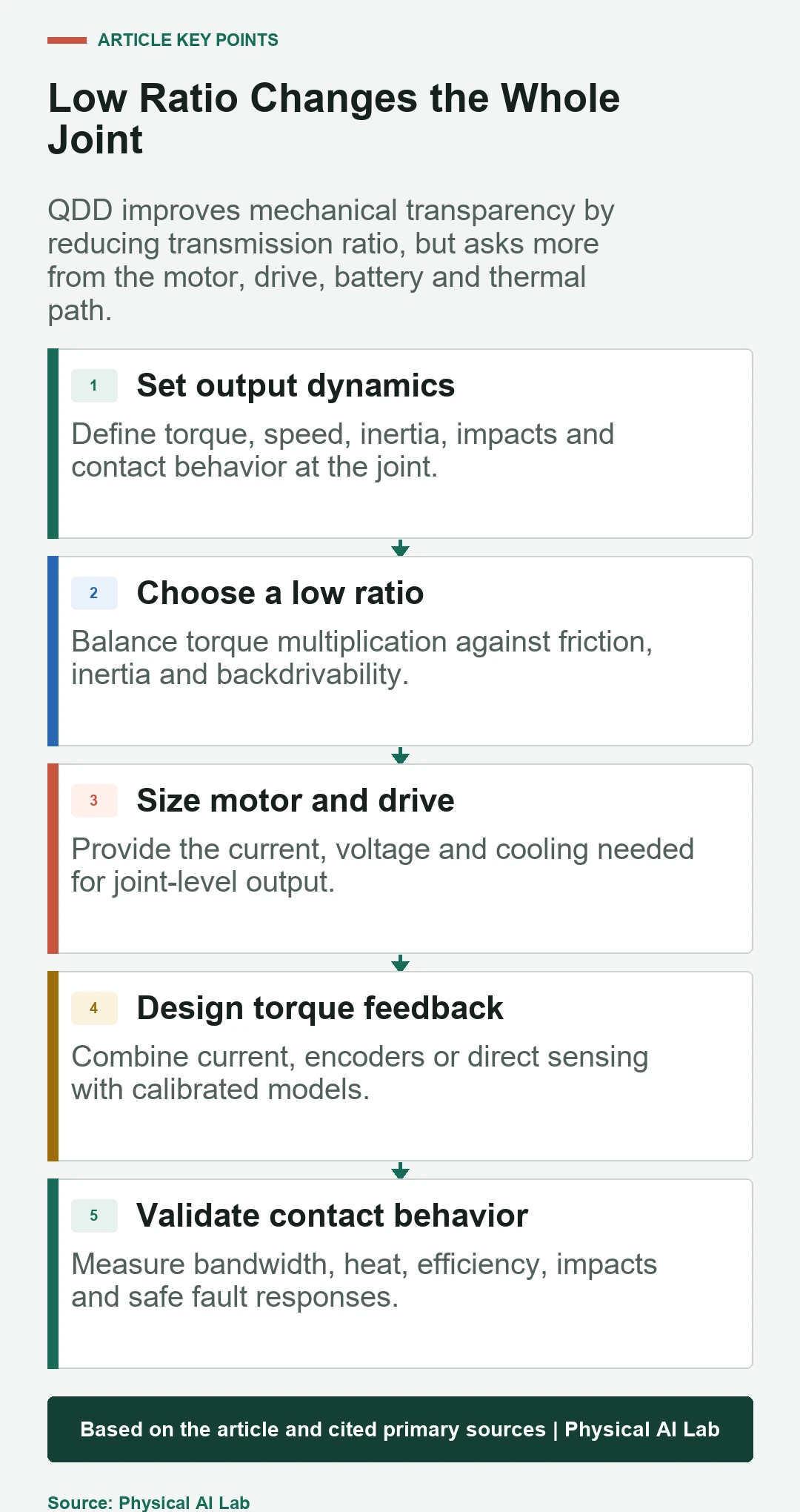
- Define task-level output and contact behavior.
- Optimize motor and ratio together.
- Calibrate output torque across conditions.
- Measure power, heat and regeneration.
- Validate bandwidth, impacts, life and faults.
Frequently asked questions
What does quasi-direct drive mean?
It generally means a torque-dense motor combined with a relatively low transmission ratio, between direct drive and conventional high-ratio gearing.
What is the best QDD gear ratio?
There is no universal value. The ratio follows required torque, speed, transparency, motor size, current, heat and task dynamics.
Why are QDD joints backdrivable?
Lower ratio can reduce reflected inertia and transmission friction, allowing external torque to move the output more readily.
Can QDD estimate torque from motor current?
Yes, but friction, transmission loss, motor calibration and temperature create error. Joint-level calibration or direct sensing improves confidence.
Are QDD actuators safer?
They can improve transparency and contact response, but safety depends on the complete robot, control, limits, hazards and validated protective functions.
QDD Architecture Note
QDD is an architectural continuum rather than a standardized ratio class. Verify component ratings and measure the assembled joint under representative power, thermal, contact, impact and fault conditions.