A Physical AI proof of concept should answer a decision, not merely produce a robot video. It tests whether a defined workflow can deliver measurable value under known conditions with acceptable safety, intervention, integration and cost.
A good PoC is narrower than deployment but more rigorous than a demonstration. It states the baseline, task boundary, success denominator, variation, failure taxonomy and pass or stop thresholds before trials begin. This prevents selective examples from replacing evidence.
Use this guide with the robot video evaluation checklist and Physical AI ecosystem map. Site-specific risk, privacy and safety review remains necessary.
Begin with the decision the PoC must support
State whether the next decision is to stop, redesign, expand testing or fund a limited deployment. Name the decision owner, date, budget and evidence required. A PoC without a decision can continue indefinitely.
Write a hypothesis that connects capability to workflow outcome. For example, the robot will complete a defined task family at a specified rate, with bounded intervention and no unacceptable safety event, compared with the current process.
Define the workflow boundary and baseline
Map inputs, objects, people, systems, task start, task end and exception handling. Identify what remains manual. A robot may complete motion while operators prepare every object or recover every failure.
Measure the current process using the same output definition planned for the PoC. Include throughput, labor touch time, defects, delay, damage, safety and variability. Without a baseline, improvement claims have no denominator.
Turn success into observable metrics
NIST publishes robot test-method work that emphasizes repeatable measurement. A PoC should define task success, quality, time, intervention and failure categories before execution.
Use verified completed outcomes rather than robot motion alone. Report both numerator and denominator, and distinguish autonomy from supervised or teleoperated operation. Define whether setup, reset and recovery time are included.
| Metric | Definition | Denominator | Operational question |
|---|---|---|---|
| Task success | Verified acceptable output | All attempted tasks | Can it perform? |
| Intervention rate | Human help events | Tasks or operating hours | How autonomous? |
| Cycle time | Start to verified finish | Successful and failed cycles | How productive? |
| Coverage | Eligible tasks handled | Required task distribution | How broad? |
| Recovery time | Time to resume | Failure events | How supportable? |
Control the test before adding variability
Create a test protocol for objects, poses, lighting, surfaces, clutter, network, reset and operator actions. Use calibrated measurement and synchronized logs. Repeat enough trials to expose variance rather than stopping after first success.
Start with a controlled task cell to debug measurement and basic capability. Control is not the final operating claim; it establishes a reproducible reference before stress conditions are introduced.
Stage gates keep evidence proportional to risk
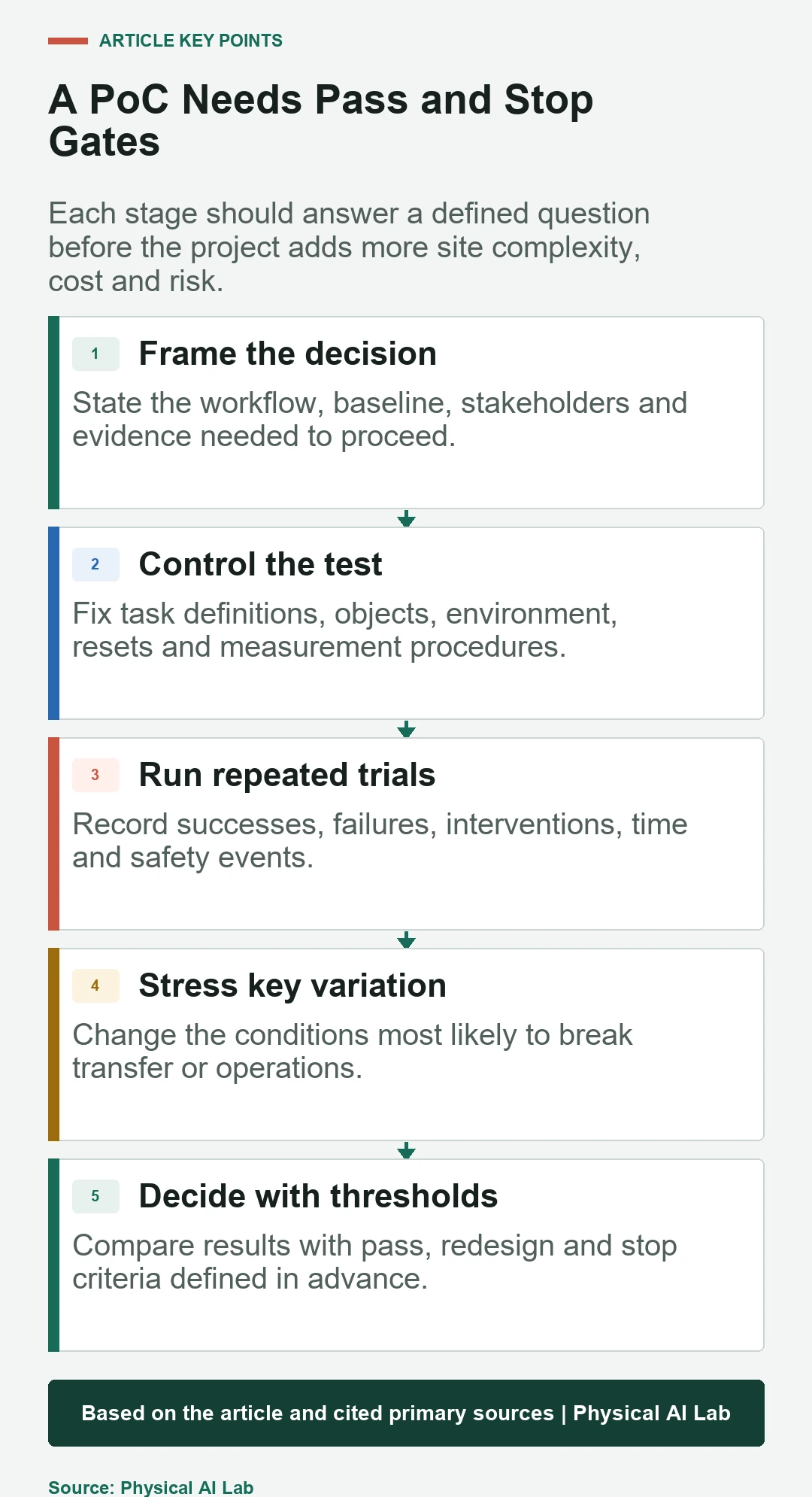
Use gates for offline data, bench tests, supervised robot trials, limited site operation and expansion. Each gate has prerequisites, tests, acceptance thresholds and a stop path. Risk and cost rise only after earlier questions are answered.
A failed gate can trigger redesign rather than automatic cancellation. Record which assumption failed and what evidence would justify another trial. Avoid moving thresholds after seeing results unless the decision is explicitly reframed.
Variation should reflect the real task distribution
List the conditions that change in production: object identity, deformation, lighting, clutter, worker behavior, station state, network and upstream quality. Sample them deliberately and preserve held-out cases.
Do not claim generalization from variations the team selected after model tuning. Track out-of-distribution events and define whether the system abstains, asks for help or attempts recovery.
Failures and interventions are primary PoC outputs
Create a taxonomy separating perception, planning, grasp, motion, control, hardware, integration, environment and human-process failures. Record root cause after evidence review instead of assigning every miss to the AI model.
Interventions should include remote assistance, physical reset, object preparation, software restart and safety response. Their frequency, duration and skill requirement determine support cost and scalable autonomy.
| Gate result | Meaning | Required action | Do not do |
|---|---|---|---|
| Pass | Thresholds met with evidence | Advance bounded scope | Claim universal readiness |
| Conditional | Value exists with known gaps | Redesign and retest | Hide exclusions |
| Fail technical | Capability below threshold | Investigate root cause | Move threshold silently |
| Fail operational | Workflow value absent | Change process or stop | Optimize demo only |
| Stop safety | Unacceptable hazard or control | Contain and reassess | Continue live trials |
Integration tests should include surrounding systems
Connect identity, orders, inventory, safety PLCs, fleet software, user interfaces and reporting as required by the workflow. Simulated interfaces can begin a PoC, but integration gaps should remain explicit.
Test stale data, duplicates, network loss, clock error and conflicting commands. Verify idempotency and reconciliation so a retry does not move the wrong object or update inventory twice.
Cost evidence must include human and infrastructure load
Track engineering setup, integration, fixtures, compute, network, maintenance, consumables, training and human supervision. A monthly robot price or model API fee is only one component.
Estimate cost per verified outcome at observed coverage and intervention. Include expected downtime and support response. Sensitivity analysis should show which assumptions determine the business case.
The final report should make the next decision obvious
Publish protocol, scope, baseline, trial counts, conditions, failures, interventions, safety events, costs and limitations. Separate measured facts from projections. Preserve raw logs and configuration for audit and reproduction.
The recommendation should be pass, redesign or stop with reasons and owners. If advancing, define the next bounded scope, new risks and evidence gaps. A transparent negative PoC can save more value than a polished ambiguous demo.
- Frame a concrete decision and hypothesis.
- Measure the baseline and full workflow.
- Predefine metrics, conditions and thresholds.
- Record failures, interventions and total cost.
- Use stage gates with explicit pass, redesign and stop outcomes.
Frequently asked questions
How long should a Physical AI PoC run?
Long enough to collect repeated evidence across the intended task variation and operating periods. Duration follows the decision and failure modes, not a universal calendar.
What is the most important PoC metric?
Verified workflow output with task coverage, intervention, time, quality, safety and cost. No single model or motion metric is sufficient.
How many successful robot trials are enough?
The number depends on required confidence and variability. Always report the denominator and conditions, and include failures rather than a highlight reel.
Should a PoC include system integration?
It should include enough surrounding systems to test the decision. Simulated interfaces can be used early, but untested integration must remain an explicit risk.
What happens when a PoC fails?
Classify whether the gap is technical, operational, safety-related or economic, then stop or run a specifically redesigned test with new evidence criteria.
PoC Decision Note
A PoC is site- and workflow-specific evidence, not general product certification. Define hazards, privacy and operational controls with qualified stakeholders before live robot testing.