OPC UA Robotics is a companion specification that gives robot systems a common information model for vertical integration. It helps higher-level software interpret identity, status, modes, axes and powertrain structure without inventing a different semantic contract for every vendor.
It does not make all robot capabilities identical and is not a replacement for deterministic motion control, safety functions or application commissioning. Interoperability still depends on selected nodes, optional features, units, quality, security and tested consumer behavior.
Use it alongside the VDA 5050 Version 3 guide and virtual commissioning and digital twin guide. Define the integration use case before deploying an OPC UA server.
The current public Part 1 release is Version 1.02
As checked July 29, 2026, the OPC Foundation lists OPC 40010-1 Version 1.02, published September 8, 2025, as the current release of OPC UA for Robotics Part 1: Vertical Integration. Pin this version in procurement and test records.
Do not write only “supports OPC UA Robotics.” Record namespace URI, model version, server product version, profiles, security policies and optional nodes. Consumers need a compatibility matrix because two conforming products may implement different subsets or vendor extensions.
The information model targets complete motion-device systems
The model describes robotic systems and related motion devices in a form that can be browsed and consumed by vertical applications. It organizes shared information rather than prescribing the robot’s internal controller architecture.
Define the system boundary: controller, manipulators, axes, drives, tools and associated components. Asset identifiers must remain stable enough for MES, maintenance and analytics to join observations with the correct physical equipment and configuration.
Identity and classification create the integration anchor
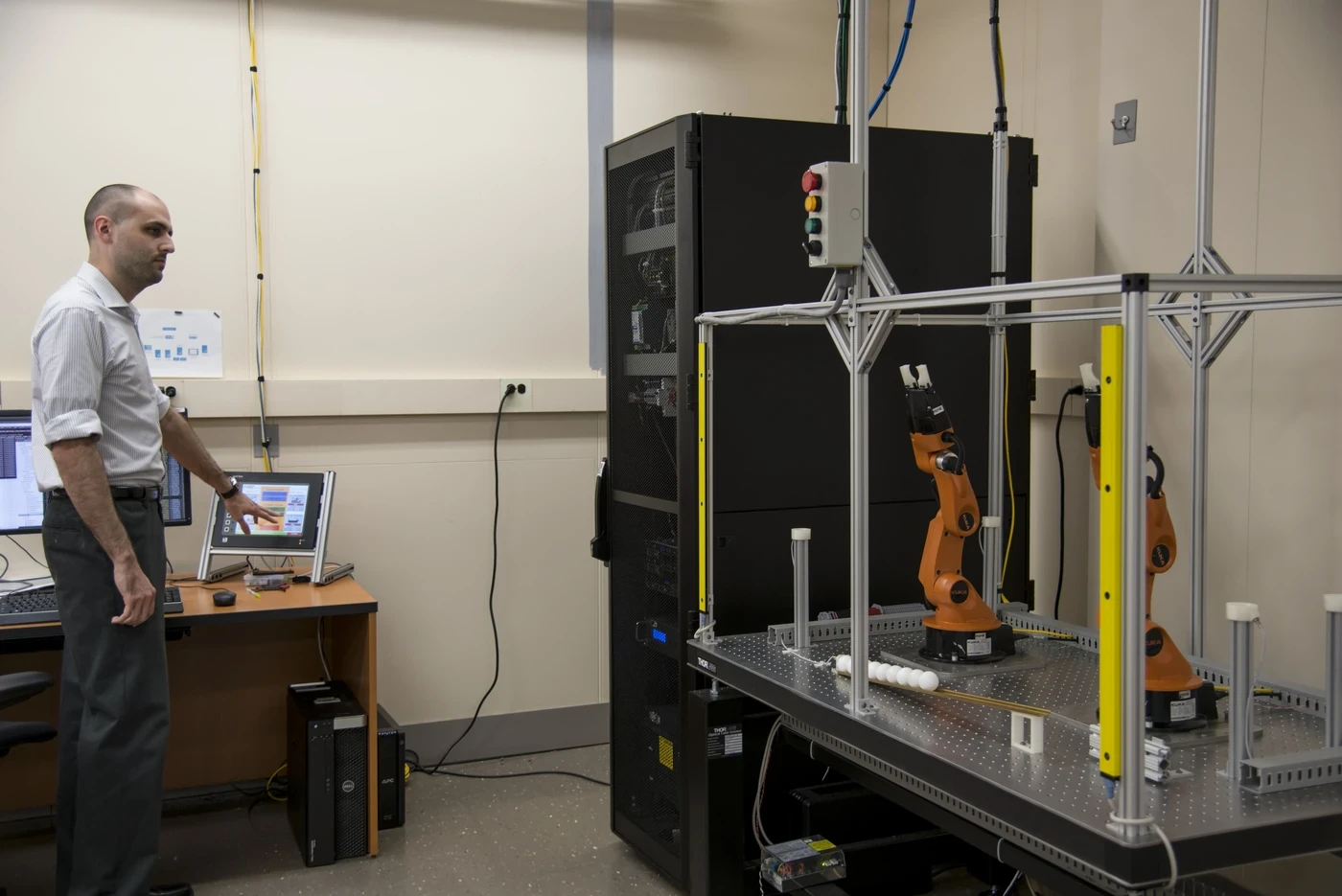
Manufacturer, model, serial number, product code and asset hierarchy let higher-level systems distinguish robots that otherwise expose similar tags. Classification helps applications interpret different kinematic structures without assuming every device is a six-axis articulated arm.
Map enterprise asset IDs to the OPC UA objects and keep replacements explicit. Reusing an identifier for different hardware corrupts maintenance history and digital-twin associations. Record firmware, controller and companion-specification versions with the asset state.
| Information group | Consumer use | Required agreement | Failure if ambiguous |
|---|---|---|---|
| Identity | Asset registry | Stable identifiers | Wrong maintenance record |
| Operating state | Production monitoring | State meanings | False availability |
| Axes and powertrains | Diagnostics | Structure and units | Misread component |
| Mode and status | Workflow control | Transitions and quality | Unsafe assumption |
| Vendor extension | Special capability | Namespace contract | Consumer lock-in |
Operating state must retain meaning and quality
A dashboard needs more than a Boolean running tag. Consumers should distinguish operating mode, motion-device status, errors, warnings and data quality with timestamps that support the intended decision.
Document state transitions and unavailable values. A stale good-looking value can be worse than an explicit bad-quality state. Test startup, reconnect, controller reboot and maintenance modes so consumers do not infer production availability from incomplete data.
Axes and powertrains provide maintenance context
The Robotics model can expose structures that connect motion devices to axes and powertrains. This allows maintenance or analytics applications to relate condition information to a component instead of treating the whole robot as one anonymous signal source.
Vendor implementations may differ in granularity and optional coverage. Verify units, coordinate interpretation and component identifiers. A common node name does not guarantee equivalent sensor placement, sampling or diagnostic accuracy.
OPC UA for Machinery can extend the factory hierarchy
Part 1 includes informative guidance for use with OPC UA for Machinery building blocks. This can place robot information within a broader machine, component and asset organization used by manufacturing systems.
Choose the smallest consistent hierarchy that supports users. Duplicating the same asset under competing models creates reconciliation work. Maintain namespace versions and references so upgrades can be tested without silently changing browse paths or meanings.
OPC UA Robotics and VDA 5050 solve different problems
OPC UA Robotics focuses on an information model for robot-system vertical integration. VDA 5050 defines communication between a master control and mobile robots for orders, state and related fleet coordination. One is not a newer version of the other.
They can coexist: a fleet interface may dispatch mobile-robot work while OPC UA exposes assets and operating information to MES or maintenance. Define authority clearly so multiple systems do not issue conflicting commands.
| Dimension | OPC UA Robotics | VDA 5050 | Integration decision |
|---|---|---|---|
| Primary role | Vertical information model | Fleet order and state interface | Separate consumers |
| Typical assets | Robot and motion system | Mobile robots and master control | Map identities |
| Control purpose | Not hard real-time motion | Task coordination | Keep local control |
| Data structure | OPC UA nodes and types | Defined message topics and schemas | Version both |
| Shared concern | Semantics and status | Order-state consistency | Test failure handling |
Hard real-time motion control remains outside the main purpose
Part 1 is designed for vertical integration, not for replacing the robot’s deterministic servo loop. Networked methods and variables should not be treated as safety-rated or time-critical control merely because they are available through OPC UA.
Keep motion and safety authority in qualified architectures. If a higher-level system requests actions, define validation, permissions, rate limits, acknowledgement, timeout and recovery. Measure end-to-end latency for the actual workflow rather than assuming protocol capability.
Security begins with the trust boundary
Decide which networks, applications and roles may browse, subscribe or invoke methods. Use managed certificates, endpoint policies, user or application identity and least privilege. Plan renewal and revocation rather than treating initial certificate installation as completion.
Segment industrial networks and log security-relevant events. Vendor remote access, engineering tools and data export can bypass the intended boundary. Test expired credentials, untrusted clients and failed authorization without disrupting production.
Implementation should end with consumer-level tests
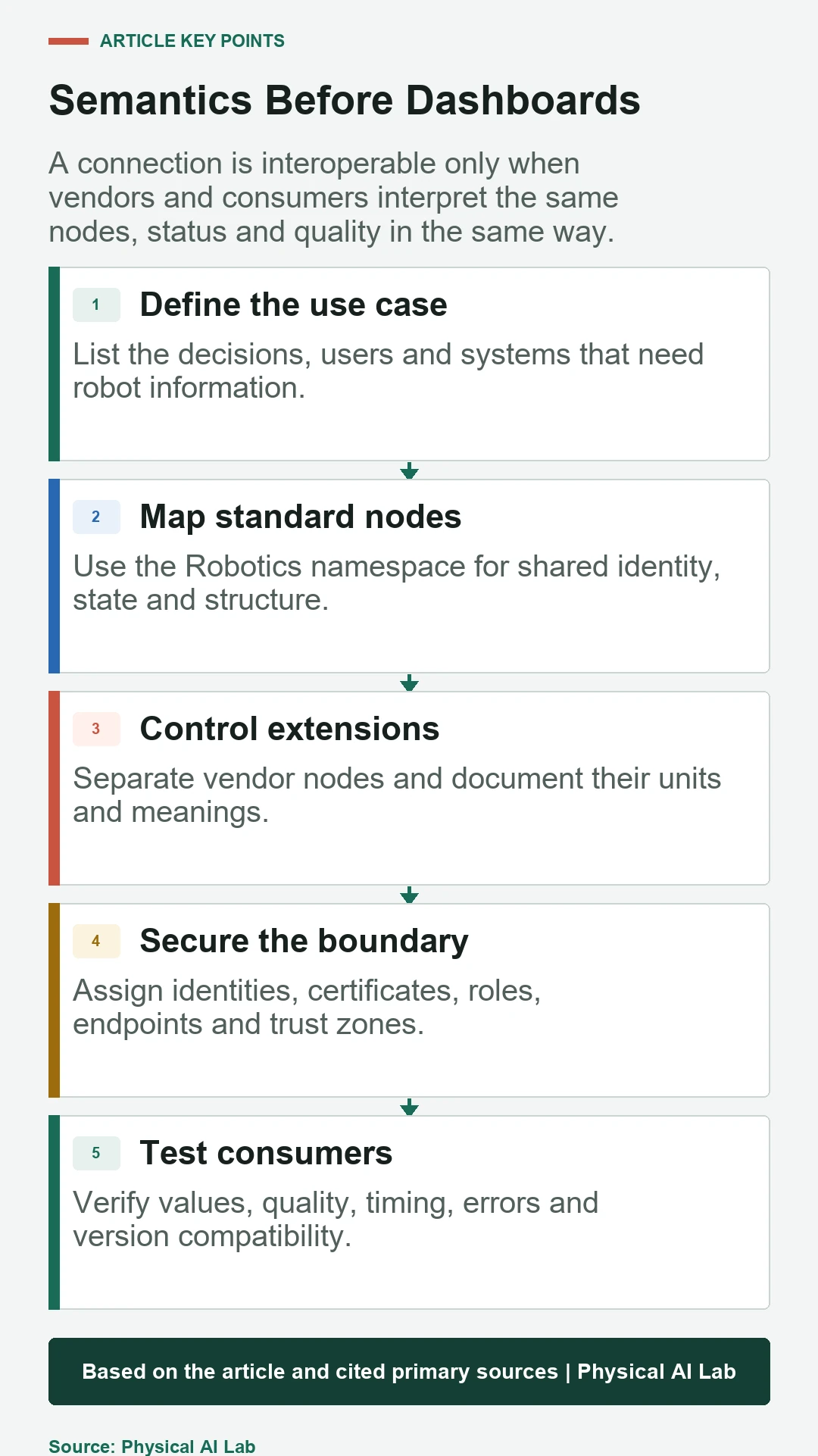
Start from use cases, list required information, map standard nodes, document extensions, configure security and test each consumer. Verify values, units, quality, timestamps, transitions, errors and behavior after reconnect or upgrade.
Conformance to a profile is useful but does not prove application interoperability. Maintain a captured address-space description and regression suite. When suppliers change firmware or namespace versions, compare the contract before returning the data to production use.
- Pin the Robotics model and namespace version.
- Define the asset and information boundary.
- Document optional nodes and vendor extensions.
- Secure endpoints by role and trust zone.
- Test every consumer through faults and upgrades.
Frequently asked questions
Can OPC UA Robotics directly control robot motion?
Its primary Part 1 purpose is vertical information integration, not deterministic servo motion or safety-rated control.
Do all robots expose the same nodes?
No. The standard defines common semantics, but optional coverage, vendor extensions and component granularity can differ.
What is the current OPC UA Robotics Part 1 version?
The OPC Foundation listed Version 1.02, published September 8, 2025, as current when checked July 29, 2026.
Can OPC UA Robotics be used with VDA 5050?
Yes. They address different layers and can coexist if asset identities, authority, versions and failure behavior are explicitly mapped.
Does an OPC UA server complete a digital twin?
No. A digital twin also needs a defined decision, validated model, governed data, synchronization and lifecycle ownership.
Specification Version Note
This article was checked against OPC 40010-1 Version 1.02 on July 29, 2026. Specifications, profiles and vendor implementations can change; pin the exact version and verify the required nodes, security and consumer behavior.