VDA 5050 3.0.0 is a communication interface for order and state exchange between master control and mobile robots. It adds zones and planned-path sharing for freely navigating robots; it does not standardize navigation algorithms or certify functional safety.
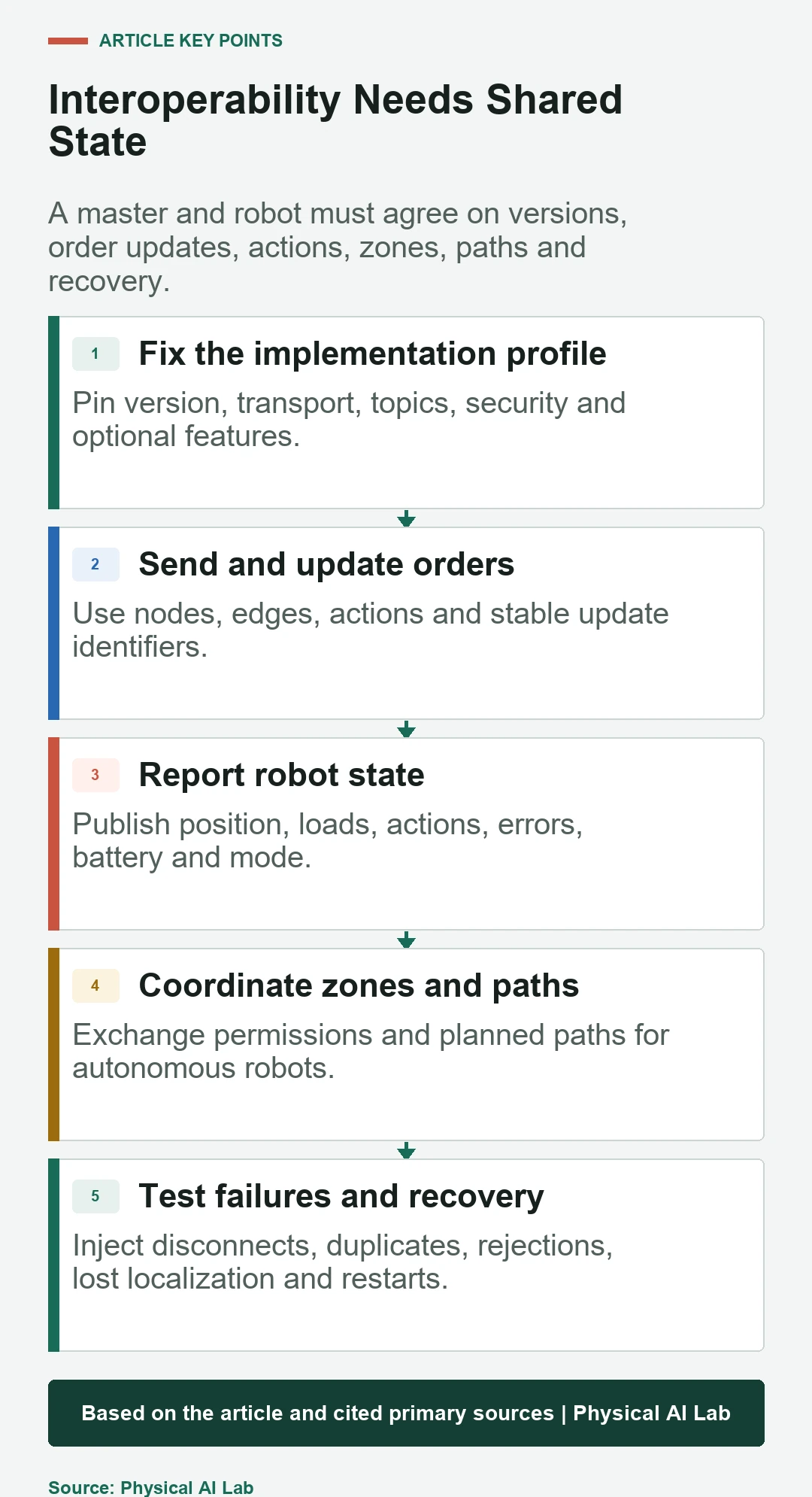
The specification is a toolkit, not a plug-and-play guarantee. A project must agree on version, transport, optional features, map and coordinate conventions, action meanings, security, error handling and recovery. Interoperability is proven only through cross-vendor testing.
This guide extends the logistics AI architecture and robot edge computing guide. Always use the current official VDA document and repository as the implementation authority. Compare protocol scope in the VDA 5050 versus ISO 21423 guide, and use the Open-RMF fleet adapter guide for broader orchestration and facility integration.
What changed in VDA 5050 3.0
The official VDA 5050 page identifies Version 3.0.0, March 2026, as current and states that older versions are no longer recommended or developed. Pin the exact document and schemas used by the project.
Do not assume compatibility across major versions. Maintain a capability and migration matrix for master control, vehicle adapters and simulators. Mixed-version operation needs an explicit gateway or tested profile.
The master control and robot keep different responsibilities
The master control creates and updates transport orders, coordinates shared resources and observes fleet state. The robot executes feasible movement and actions using its onboard controls. Version 3 supports projects with different levels of vehicle autonomy.
Define who owns route planning, traffic permission, obstacle handling, charging and recovery. The interface cannot resolve an ambiguous responsibility boundary. Document how human operators override or release each side.
Orders combine nodes, edges and actions
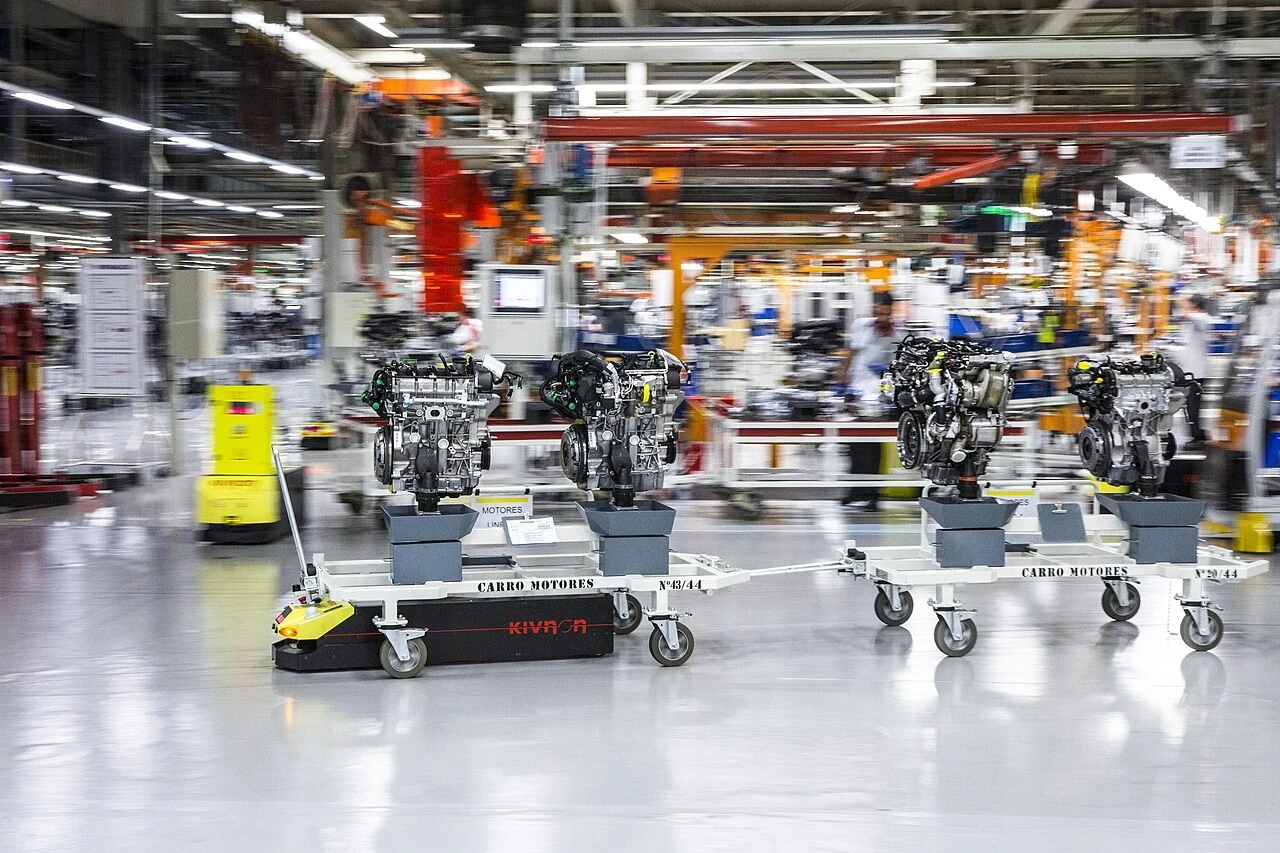
Orders describe a graph sequence of nodes and edges with actions attached at appropriate locations. Identifiers and update rules let the master extend or replace the executable horizon while preserving an agreed base.
Validate order identity, sequence, horizon, action parameters and route feasibility. Reject unsupported or inconsistent content explicitly. A received MQTT message is not evidence that a physical transport task is safe or complete.
| Interface area | Purpose | Implementation agreement | Failure test |
|---|---|---|---|
| Order | Assign route and work | IDs, horizon and updates | Duplicate or stale order |
| State | Report robot execution | Frequency and semantics | Missing or delayed state |
| Actions | Request device behavior | Parameters and blocking type | Unsupported action |
| Maps and zones | Share spatial rules | Frames, versions and permissions | Wrong map or zone |
| Factsheet | Describe capabilities | Supported features | Capability mismatch |
State messages provide the operational truth
Robot state can report order progress, node and edge status, position, loads, actions, errors, battery and operating mode. Consumers should distinguish unknown, stale and valid values rather than replacing missing data with a default.
Measure state age and clock behavior. Persist enough history to reconstruct incidents. The master should not issue unsafe follow-up work when the robot’s location or load identity is uncertain.
Version 3 introduces zones for freely navigating robots
The official VDA release announcement describes zones with movement rules such as restricted areas, one-way routes or places requiring master-control authorization. The robot can plan detailed routes between waypoints under those constraints.
Agree on zone geometry, coordinate system, priority, validity and conflict resolution. Test boundary precision and updates while robots are moving. Zones supplement project controls; they are not safety-rated protective fields by default.

Path sharing preserves fleet-level traffic influence
Freely navigating robots can share planned paths so the master control can coordinate traffic while detailed planning remains onboard. The shared path should include timing and interpretation suitable for conflict detection.
Plans can change when obstacles or local conditions appear. Define update rate, reservation policy, uncertainty and stale-path behavior. Traffic management should fail conservatively when path information is missing.
Actions, maps and request-response broaden the interface
Version 3 includes defined areas for actions, maps, zones, connection, state, visualization, path sharing, request-response and factsheets. Projects select a usable subset through an implementation profile.
Document every supported action and parameter, including blocking behavior, timeout, cancel and result. Avoid vendor-specific strings without a namespace and governance process. Test unknown fields and forward compatibility.
| Test scenario | Expected behavior | Evidence | Operational risk |
|---|---|---|---|
| Network disconnect | Bounded hold and reconnect | Connection timeline | Lost control |
| Duplicate message | Idempotent handling | State and command log | Repeated action |
| Rejected order | Clear error and no execution | Reason code | Silent task loss |
| Robot restart | State reconciliation | Recovery trace | Ghost load or route |
| Map mismatch | Refuse unsafe plan | Version check | Wrong location |
Transport and security remain project responsibilities
The interface uses a transport and topic structure, but deployment security requires identity, authentication, authorization, certificate handling, network segmentation, logging and update control. Define who can publish each topic.
Test credential expiry, broker loss, replay and unauthorized commands. Apply current organizational and regulatory cybersecurity requirements. A conforming message schema does not prove a secure system.
Conformance and interoperability are different tests
Schema validation checks message form. Behavioral conformance checks sequence and semantics. Interoperability checks whether different master controls and robots complete scenarios consistently. Site acceptance adds network, traffic and equipment conditions.
Build an automated scenario suite and capture topic logs. Include edge cases, optional features and recovery. Repeat after firmware or adapter updates, not only during initial integration.
Safety remains outside the communication guarantee
VDA 5050 coordinates orders and state; it does not replace onboard safety functions, risk assessment or site traffic protection. The robot must remain safe when the master, broker, network or messages fail.
Separate operational authorization from safety-rated permission. Validate stop distances, protective fields, manual modes and recovery independently. The successful interface is one that remains predictable under faults and supports safe operations.
- Pin Version 3.0.0 and a project profile.
- Assign route, traffic and recovery responsibilities.
- Validate orders, state, zones and path updates.
- Test network, duplicate, restart and map failures.
- Keep safety and cybersecurity assurance explicit.
Frequently asked questions
What is VDA 5050 Version 3.0?
It is the March 2026 interface recommendation for communication between a fleet master control and mobile robots, including line-guided and freely navigating systems.
What changed for freely navigating robots?
Version 3 adds a zone concept and planned-path sharing so onboard route planning can coexist with master-control traffic influence.
Does VDA 5050 make all AGVs and AMRs interoperable?
No. Vendors must support compatible versions, features, semantics and project profiles, then prove behavior through testing.
Does VDA 5050 control robot safety?
No. It exchanges operational orders and state. Robot and site safety require separate validated functions and risk controls.
Where is the current VDA 5050 specification?
Use the official VDA topic and publication pages or the VDA5050 GitHub repository, and pin the exact version used by the project.
Specification Version Note
Checked against official VDA information on July 29, 2026: Version 3.0.0, March 2026, is current. Recheck the official VDA page and repository before implementation because schemas, corrections and guidance can change.