Action chunking predicts several future actions at once, but prediction length alone does not determine how quickly a robot can react. What matters is how many actions are executed before a new observation is used, and how old and new predictions are combined. A small synthetic CPU test below separates those effects: frequent queries changed a blended command immediately, yet did not immediately reverse its direction.
Action Chunking with Transformers, or ACT, is a specific imitation-learning method introduced with ALOHA. ACT uses a conditional variational autoencoder and transformer components to predict action sequences from images and robot state. Action chunking is the broader design pattern; not every chunking policy uses ACT, a CVAE or the same temporal ensemble.
Use this guide with the diffusion policy guide and robot joint-control guide. Treat the predicted chunk, the portion applied to hardware and the next observation time as separate, measurable quantities.
Action chunks reduce the effective decision horizon
A task lasting thousands of servo cycles can require fewer high-level choices when each policy query predicts a short trajectory segment. The actions within a segment share context, which can reduce jitter from independent one-step predictions and help represent coordinated bimanual or contact-rich motion.
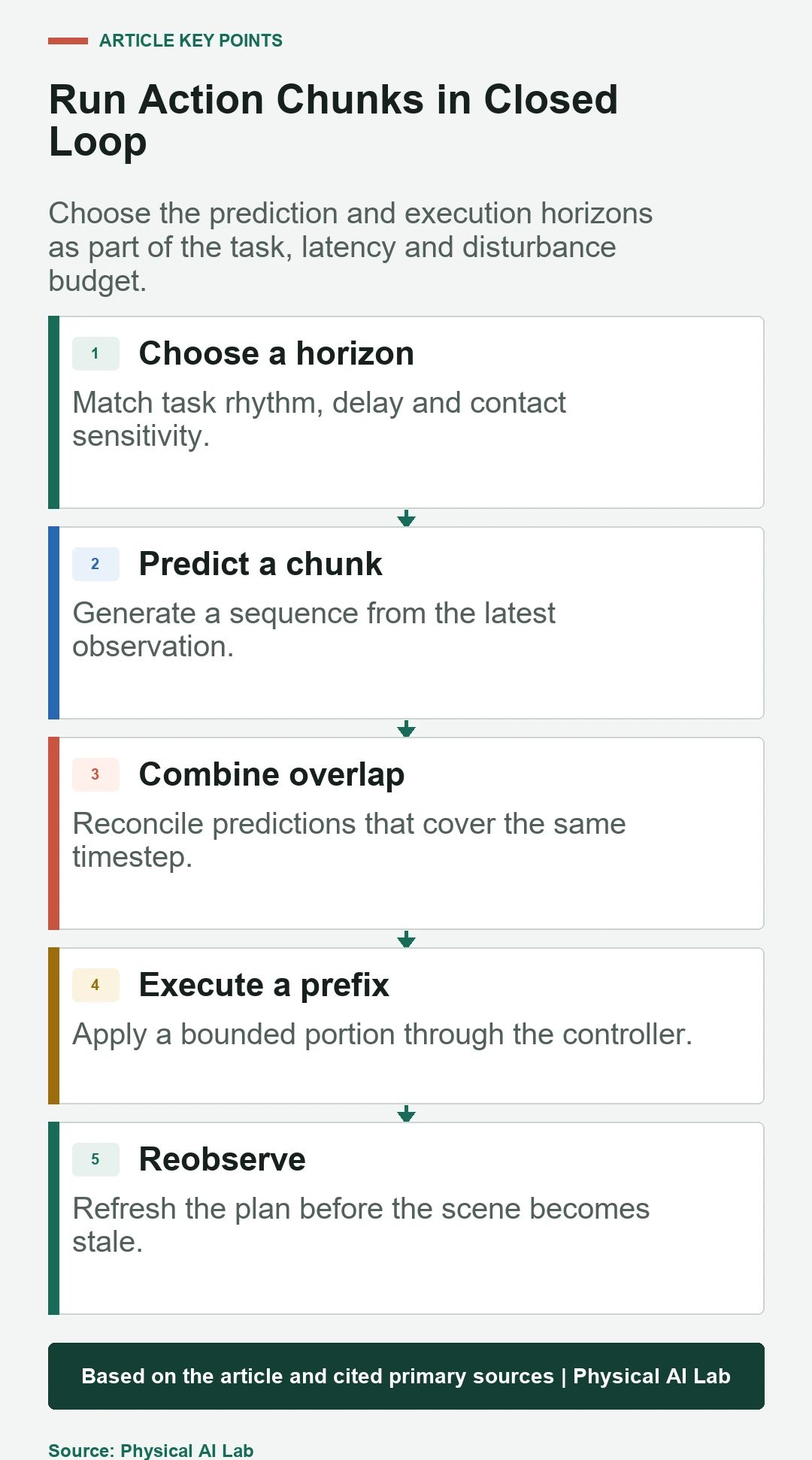
The reduction is not free. Errors within an executed chunk can accumulate before the next observation. Chunking therefore shifts part of the problem from per-step prediction to horizon selection and closed-loop scheduling. A long prediction can be useful as context without requiring the robot to execute it open loop.
ACT is one concrete chunking architecture
The official ALOHA project introduces ACT to predict actions in chunks for fine-grained bimanual manipulation. Its policy combines visual and proprioceptive inputs with a transformer-based conditional variational autoencoder, using a latent variable during training to represent demonstration variation.
At deployment, ACT commonly uses the deterministic prior mean rather than requesting a demonstrated style label. Architecture, camera encoders, latent handling and action normalization are implementation details that must be pinned. The reported ALOHA tasks and data efficiency are evidence for that setup, not a general success guarantee for every robot.
Prediction, execution and query horizons differ
Chunk length is how many future actions the model predicts. Execution horizon is how many are sent before the system replaces them, and query interval is when another prediction begins. Some implementations query every control step and combine overlap; others execute a prefix to reduce inference load.
State each horizon in both steps and seconds. The same 100-step chunk means one second at 100 Hz and ten seconds at 10 Hz. Also report inference delay and whether new predictions are aligned to their observation time or to the time when computation finishes.
| Quantity | Definition | Too short | Too long |
|---|---|---|---|
| Prediction chunk | Future actions generated | Weak temporal context | Uncertain far future |
| Execution prefix | Actions applied before replacement | Compute and jitter burden | Slow disturbance response |
| Query interval | Time between policy requests | Queue contention | Stale plans |
| Observation history | Past evidence supplied | Ambiguous motion | Memory and old context |
| Servo period | Hardware target update | Coarse control | Timing demand |
A small CPU test: frequent queries can still produce a late reversal
Does a longer chunk delay a new observation, or does the execution schedule do that? On 4 October 2026, we ran an AI-assisted, standalone NumPy scheduling test on Windows 11 with Python 3.12.14 and NumPy 2.3.5. It used synthetic scalar commands, not an ACT model or a robot. The pinned ACT evaluation code supplied two reference rules: its non-ensemble default queries once per predicted chunk, while temporal ensembling queries every step and uses oldest-first exponential weights with k = 0.01. The model below isolates these scheduling choices; it does not reproduce ACT inference.
The simulated command clock was 10 Hz. Before tick 3, the observed command was −1; at tick 3 (0.3 seconds), it switched to +1 before any query scheduled for that tick. Our mock predictor simply repeated the current observed value across H future slots. Inference took zero simulated time. Each run lasted 16 ticks. Q is the interval between queries; using Q smaller than H without ensembling is an alternative prefix-replacement schedule, not the original ACT default.
| Predicted slots H | Query interval Q | How commands are selected | First change after the signal switch | First positive command |
|---|---|---|---|---|
| 4 | 4 | Latest chunk, full execution | 100 ms | 100 ms |
| 8 | 8 | Latest chunk, full execution | 500 ms | 500 ms |
| 8 | 2 | Replace after two slots | 100 ms | 100 ms |
| 8 | 1 | Replace every slot | 0 ms | 0 ms |
| 8 | 1 | Blend all overlapping chunks | 0 ms | 300 ms |
These are delays on the simulated clock, not measured hardware latencies. Keeping eight predicted slots but replacing after two gave the same command trace as four slots with the same two-step replacement interval. In this test, the execution schedule determined when the new observation reached the command; reducing prediction length was not necessary to obtain that change.
The ensemble result exposes a different delay. At tick 3, the new +1 prediction joined three older −1 predictions. Their normalized oldest-first weights produced approximately −0.5075. The command changed immediately, but its sign remained negative until tick 6. Thus “uses a new observation every step” and “has reversed the applied command” were different events. Averaging helped soften the jump in this artificial trace while retaining old predictions; the test does not establish which choice would complete a real manipulation task better.
To repeat the comparison, run the following in Python with NumPy. Each printed delay is measured from tick 3; the five rows follow the table order. The test deliberately uses nonzero ±1 predictions and tracks occupied chunks explicitly, so it does not test the original implementation’s zero-entry filtering or tensor/device behavior.
import numpy as np

for H, Q, blend in [(4,4,False), (8,8,False),
                    (8,2,False), (8,1,False), (8,1,True)]:
    chunks, output = [], []
    for t in range(16):
        signal = -1.0 if t < 3 else 1.0
        if t % Q == 0:
            chunks.append((t, signal))
        active = [v for start, v in chunks if t-start < H]
        if blend:
            w = np.exp(-0.01 * np.arange(len(active)))
            command = np.dot(active, w / w.sum())
        else:
            command = chunks[-1][1]
        output.append(command)
    changed = next(t for t in range(3,16) if output[t] > -1+1e-12)
    positive = next(t for t in range(3,16) if output[t] > 0)
    print(H, Q, blend, (changed-3)*100, (positive-3)*100)
Use this distinction when instrumenting a real deployment: log the observation’s capture time, the first command it influences and the first command that meets the intended response criterion. Here that criterion was only a positive scalar. Actual response also depends on inference and communication delay, the learned policy, action representation and controller dynamics, all absent from this test. A zero-delay row is not a promise of instantaneous robot response.
Temporal ensembling combines overlapping predictions
In the ACT paper, frequent queries produce multiple predictions for the same future timestep. In the original ACT formulation, temporal ensembling combines those overlapping estimates with exponentially decaying weights that give the oldest prediction the greatest weight. This can smooth changes between chunks while incorporating newer observations.
Averaging actions is not always neutral. Cartesian rotations, discrete gripper states and multimodal alternatives need representations where interpolation is meaningful. Two individually valid strategies can average into an invalid middle. Log the contributing predictions and weights so smoothing failures can be distinguished from model errors.
Chunk length follows task dynamics and contact
Free-space reaching may tolerate a longer prefix than insertion, grasp closure or tool contact. Choose horizon from expected disturbance time, camera rate, inference tail and lower-level controller bandwidth. Use shorter refresh near phase transitions or allow a task state machine to change the policy schedule.
Sweep chunk and prefix independently on held-out trials. Measure completion, intervention, command discontinuity and reaction to moved objects. A horizon that scores well in static demonstrations may fail when contact timing varies, because the policy continues a memorized segment after the physical event has shifted.
Demonstrations need temporal alignment and diversity
Teleoperation logs couple human intent, camera frames, robot state and commanded action. Latency between these streams can teach the policy to react late. Preserve original timestamps, estimate teleoperation delay and define whether action labels represent desired or applied robot states. Remove only corrupt samples under a documented rule.
Collect variation in object pose, approach, correction and recovery, not only clean nominal successes. A learner cannot infer how to recover from states absent from demonstrations. Balance repeated tasks and operators so the largest session does not dominate, and keep contiguous episodes together when splitting training and evaluation data.
The lower-level controller shapes every chunk
Predicted joint targets pass through interpolation, gain, torque and motion limits. If the training robot used a different controller rate or impedance, the same numerical chunk can produce a different physical path. Preserve controller configuration and measured application timestamps with the model artifact.
Coordinate limits and tracking checks with the robot joint gain-tuning guide and collision-detection guide. A chunk is a learned reference sequence, not a certified motion primitive. The servo layer must reject impossible or stale commands predictably.
| Failure mode | Observable symptom | Isolation test | Mitigation |
|---|---|---|---|
| Stale observation | Correct action too late | Add controlled delay | Shorter prefix or scheduling |
| Chunk boundary jump | Command discontinuity | Plot overlapping targets | Ensemble or transition rule |
| Controller mismatch | Tracking and contact change | Replay same targets | Match interface and gains |
| Mode averaging | Invalid middle action | Inspect contributors | Structured output or selection |
| Missing recovery data | Compounding drift | Perturb mid-task state | Add corrective demonstrations |
Closed-loop disturbance tests expose stale behavior
Move an object after the policy has generated a chunk, vary grasp timing, add a small compliant deflection or temporarily occlude a camera. Measure how many milliseconds and how much robot travel occur before the applied action changes. This is more informative than saying the system replans frequently.
Test inference overruns and dropped observations. Decide whether to finish the current prefix, hold the last bounded target or stop. Queueing old chunks is usually dangerous because each was conditioned on an obsolete state. Use sequence identifiers to prove which observation produced each applied command.
Evaluation needs progress and a failure taxonomy
Binary task success hides whether the policy reached, grasped, lifted or failed during placement. Define observable milestones and classify perception, wrong-object, trajectory, contact, slip, timeout and protective-stop failures. Count human interventions as outcomes even if the operator rescues the trial.
Report trial counts and confidence intervals for matched and shifted conditions. Repeat the same initial fixtures across policy versions and randomize run order to reduce warm-up or operator bias. Video is useful for review, but synchronized command, state and event logs are needed to measure delay and boundary behavior.
Reproduction pins the complete execution contract
The ALOHA repository provides hardware support associated with the project; the ACT evaluation implementation linked above defines the scheduling rules examined here. A valid reproduction still records repository revision, dataset, camera transforms, policy rate, chunk size, temporal-ensemble settings, action units and the robot controller.
Promote a configuration through offline replay, guarded hardware trials and progressively shifted tests. Keep a fixed regression set of task starts and disturbances. If a new chunk size improves average completion but increases collision or intervention tails, the change has not produced a generally better deployment.
- Distinguish action chunking from the ACT architecture.
- Record prediction, execution and query horizons.
- Align demonstrations with physical timestamps.
- Test overlap, stale observations and inference overruns.
- Report milestones, interventions and uncertainty.
Frequently asked questions
Is ACT the same as all action-chunking policies?
No. ACT is a particular CVAE-and-transformer imitation-learning method. Other architectures can also predict and execute action chunks.
Should the robot execute the whole predicted chunk?
Not necessarily. Many systems query again before the chunk ends or combine overlapping predictions. The safe choice depends on latency, task dynamics and disturbances.
What does temporal ensembling do?
It combines multiple predictions that target the same timestep. In the original ACT formulation, the oldest prediction receives the greatest weight. It can smooth updates but can also average incompatible modes.
How is action chunking different from trajectory planning?
A learned chunk predicts actions from data. A motion planner usually searches within explicit kinematic or collision models. Either may supply references to a controller, but their guarantees differ.
What is the most important deployment log?
Keep observation capture, inference start and finish, predicted sequence, applied command and robot state on one time base. That log exposes staleness and boundary errors.
Action Chunking Control Boundary
Action chunks are learned command sequences tied to a robot interface, controller and data distribution. Validate timing, feasibility, contact behavior and protective reactions on the complete physical system.