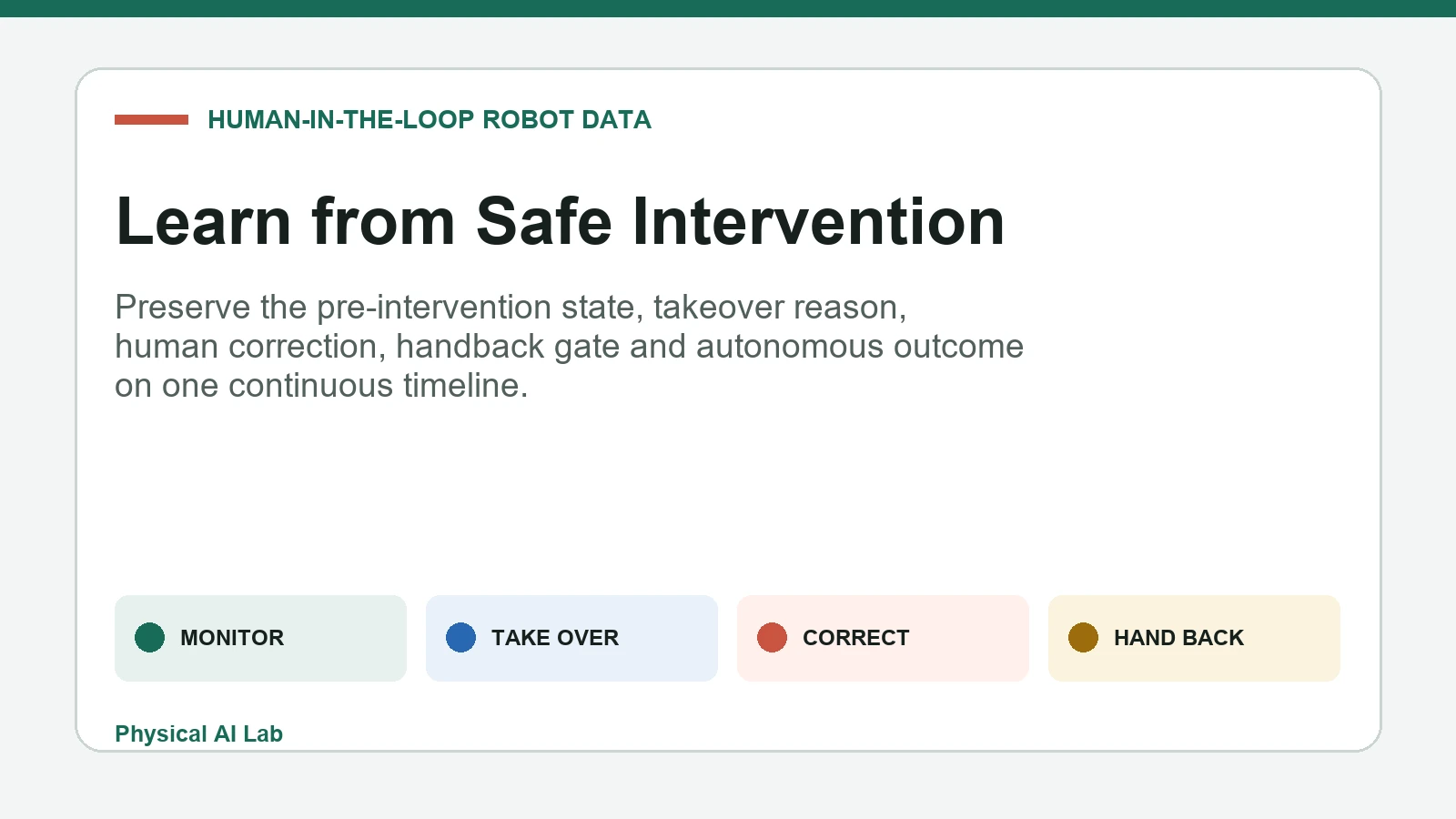
Human-in-the-loop intervention data comes from autonomous rollouts in which a person monitors behavior, takes control near a difficult or unsafe state, corrects the trajectory and may hand control back. It differs from an offline teleoperation demonstration that is human-controlled from the start.
Its value lies in policy-induced states and recovery context. The record must include observations before takeover, control authority, human action, intervention reason, handback decision and subsequent autonomous outcome on one continuous timeline.
Use this guide with the teleoperation data guide and robot evaluation guide. Keep occupational and machine safety controls independent from the learning loop.
Separate intervention from full demonstration
A demonstration samples states chosen by the human operator. Intervention samples states visited by the policy before the operator decides help is needed. These distributions support different learning questions and should carry different labels.
Preserve autonomous actions before and after the correction. Removing them turns the event into an isolated human clip and loses evidence about what caused the takeover and whether handback succeeded.

.jpg)
Define control authority as a state machine
Useful states include autonomous, warning, takeover requested, human controlled, handback requested, autonomous confirmed and emergency stop. A button edge alone cannot show whether the robot accepted the request or which command reached the actuator.
Log arbitration output and actuator command, not only policy and operator proposals. Define priority when network loss, deadman switch or safety controller conflicts with the requested mode.
| Phase | Required record | Main question | Failure risk |
|---|---|---|---|
| Autonomous | Policy observation and action | What led to trouble? | Missing precursor |
| Takeover | Request and effective-control time | How late was authority transfer? | Latency |
| Correction | Human action and intent | What recovery was attempted? | Ambiguous label |
| Handback | Gate and state confidence | Can policy manage now? | Immediate relapse |
| Outcome | Task, safety and intervention result | Did recovery work? | Cherry picking |
Preserve pre-intervention context
Buffer several seconds or a task-relevant horizon before takeover so the dataset includes precursor cues, policy actions and progress loss. The correct window depends on task dynamics and action horizon, not a fixed frame count.
Store synchronized video, robot state, command, force, mode and event times. A human decision may rely on evidence that the model input does not currently contain.
Measure decision and system takeover latency
Separate time for the operator to perceive and decide from interface, network, arbitration and controller latency. The physical robot can travel significantly during either interval, changing the state the human actually receives.
Record request, acknowledgement, first effective human command and measurable response. Train on the real post-latency state rather than assuming correction began at button press.
Record intervention reason and recovery intent
The action sequence alone rarely explains whether the operator prevented collision, corrected alignment, improved grasp or responded to uncertainty. Use a controlled reason taxonomy plus optional notes and confidence.
Reasons support filtering and evaluation, but keep them separate from verified root cause. An operator’s judgment can be incomplete or inconsistent across shifts.
Learn from interventions without copying all behavior
The Sirius project uses intervention signals to reweight samples in a human-in-the-loop deployment framework. The result is a specific research method with reported tasks and hardware, not a general rule that every intervention frame deserves maximum weight.
Compare behavior cloning, intervention weighting and other updates under matched data. Human corrections can be delayed, suboptimal or constrained by the teleoperation interface.
Keep online reinforcement learning scope explicit
The HIL-SERL project combines demonstrations, a binary reward classifier, online reinforcement learning and human interventions. Its project page describes reducing interventions as policies improve across reported manipulation tasks.
Do not collapse reward examples, demonstration buffers, interventions and autonomous experience into one unlabeled dataset. Their roles and selection biases differ.
Gate handback from a policy-manageable state
Handback should occur after the robot is stable, collision-free and within a state distribution the policy can handle. Releasing control when the operator stops moving can return autonomy during unresolved contact or poor alignment.
Require acknowledgement and monitor the first autonomous horizon. Permit immediate retakeover without losing the transition history.
Sample interventions without erasing normal behavior
Intervention windows are rare and valuable, so oversampling is common. Excess weighting can make the policy imitate recovery motions during normal states or overfit one operator’s habits.
Use the dataset mixture guide to preserve normal autonomous, successful recovery and hard-negative examples. Report effective exposure by phase.
Evaluate more than intervention count
Fewer interventions can mean higher autonomy, but also a more tolerant operator, missed hazards or a task that ended early. Report autonomous success, unsafe events, workload, decision latency, correction duration, relapse and task quality.
Run fixed-policy independent evaluation without hidden assistance. Separate the collector’s safety support from the policy’s measured autonomous capability.
Review complete episodes with mode overlays
Replay video, state, policy action, human action, effective command and authority state together. Inspect boundary alignment, dropped packets and cases where the operator intended takeover but the robot stopped for another reason.
Sample non-intervention episodes and false takeovers as well as celebrated recoveries. Maintain privacy and workforce governance for operator data.
| Metric | Measures | Needed denominator | Misleading shortcut |
|---|---|---|---|
| Intervention rate | Operator workload | All eligible rollouts | Raw count |
| Takeover latency | Control transfer | Request events | Button timestamp only |
| Correction success | Immediate recovery | Completed interventions | Pretty clips |
| Relapse rate | Handback quality | Autonomous returns | First safe frame |
| Autonomous success | Policy capability | Fixed-protocol trials | Assisted completion |
Release with an intervention-data contract
Document authority states, trigger policy, latency, observation buffer, action channels, reason taxonomy, handback gate, safety controls, sampler and evaluation protocol. Link every training example to its original continuous rollout.
Close validation with the following checklist.
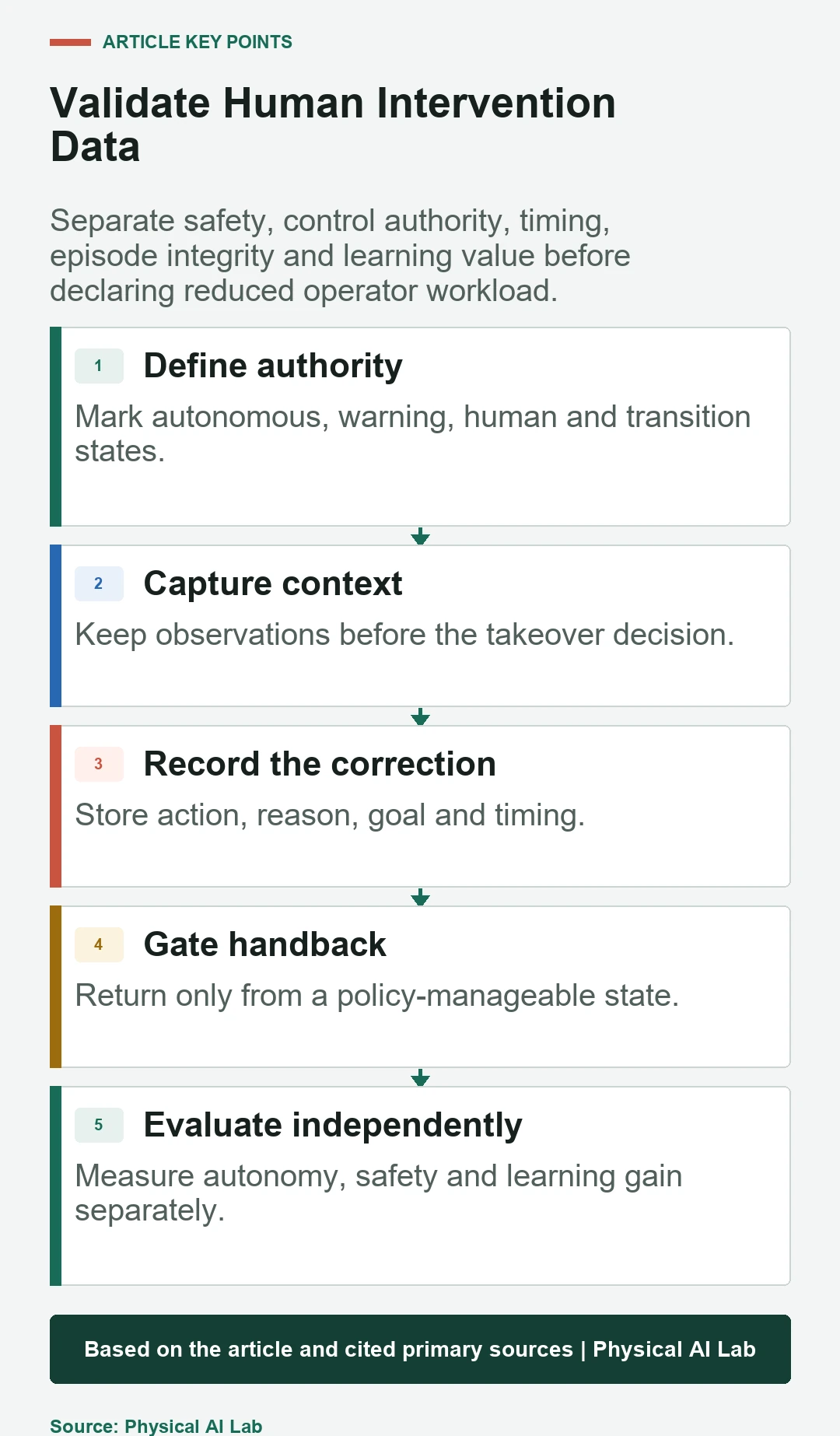
- Record autonomous context before takeover.
- Measure effective control transfer and physical response.
- Store correction reason, goal and outcome.
- Gate handback from a policy-manageable state.
- Evaluate autonomy, safety and learning gain separately.
Frequently asked questions
Is intervention data the same as teleoperation demonstration data?
No. It is collected during autonomous execution around states where a human decides the policy needs correction.
Can only the few intervention seconds be saved?
No. Preserve precursor, takeover, correction, handback and subsequent outcome on one synchronized episode timeline.
Does a lower intervention count prove improvement?
No. Pair it with fixed-protocol autonomy, safety, workload and missed-event metrics.
Should every human action be treated as ground truth?
No. Human corrections can be delayed, interface-limited or suboptimal and need contextual labels and evaluation.
When should control return to the policy?
Only after an explicit gate confirms a stable state the policy can manage and the handback is acknowledged.
Control-Authority and Autonomous-Handback Boundary
Intervention data is a control-authority trace as well as a training sample. Preserve the state that caused takeover and the evidence that autonomous handback was safe.