Robot VLA fine-tuning adapts a pretrained vision-language-action model to new scenes, instructions, objects, embodiments or control conventions. The right trainable scope depends on where the distribution changes, not on a general preference for the smallest or largest update.
Head-only training, adapters, LoRA and full fine-tuning trade memory, compute, optimization risk and representational freedom. Parameter efficiency can make experiments cheaper, but it does not guarantee better target performance, preserved base capabilities or a complete deployment artifact.
Start with the robot foundation-model guide and pair adaptation with the robot VLA evaluation guide. Compare methods under matched data, steps and selection rules.
Locate the distribution shift before training
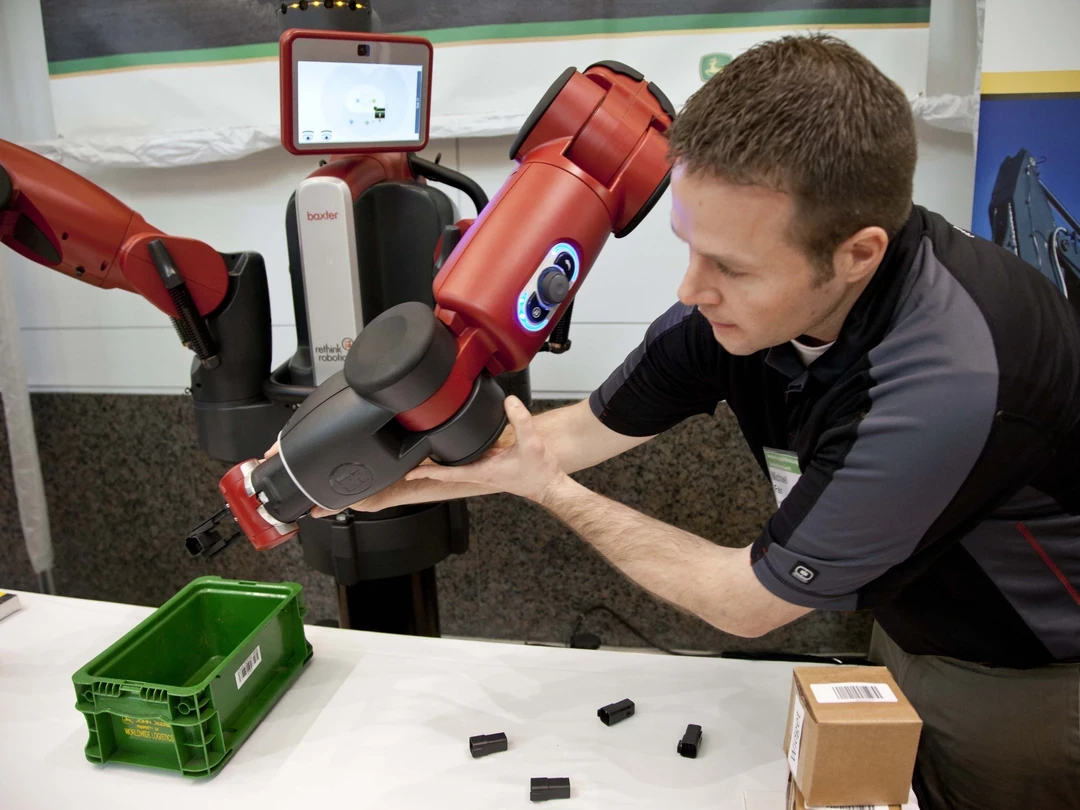
Separate changes in visual appearance, camera geometry, language, task semantics, embodiment, action space, dynamics and control rate. A new background may need modest visual adaptation, while a new action convention can require a redesigned head and normalization contract.
Build a shift matrix with evidence from target examples and base-model failures. Avoid choosing LoRA rank or full training before confirming which interface is actually incompatible.
.jpg)
Compare trainable scopes by what they can change
Head-only training preserves the backbone and changes the action mapping. Adapters or LoRA add a small trainable path inside selected modules. Full fine-tuning can update all weights but consumes more memory and can more easily overwrite broad capabilities.
List trainable tensors and counts from the actual configuration. Labels such as parameter efficient are too vague when one recipe updates attention projections and another also changes visual or action modules.
| Strategy | Trainable scope | Useful when | Primary risk |
|---|---|---|---|
| Head only | Action output modules | Representation transfers | Shift is upstream |
| Adapters | Inserted small modules | Modular task adaptation | Placement limits capacity |
| LoRA | Low-rank weight updates | Memory-constrained tuning | Rank or targets too narrow |
| Partial unfreeze | Selected backbone blocks | Localized representation shift | Unstable layer choice |
| Full fine-tune | Most or all weights | Broad severe shift | Cost and forgetting |
Understand what LoRA changes
LoRA trains low-rank updates to selected weight matrices while keeping base weights fixed. Rank, scaling, dropout and targeted modules determine capacity and must be reported. A tiny trainable percentage does not mean the runtime or storage dependency is only the adapter.
The Hugging Face PEFT LoRA guide documents common configuration concepts. Robot VLA results still depend on action heads, data mixtures, normalization and evaluation beyond the language-model adapter.
Decide whether the action head must change
A pretrained action head may assume a particular dimension count, robot mask, range, binning scheme, chunk horizon or controller frame. Reusing it across an incompatible embodiment can produce syntactically valid outputs with the wrong physical meaning.
Pin the base action contract and compare it with the target. Reinitialize, expand or replace the head only with an explicit migration and evaluation plan.
Control data quality before adding parameters
Fine-tuning magnifies narrow demonstrations, inconsistent instructions and action-label errors. Clean episode boundaries, success labels, intervention states and time alignment before attributing failures to insufficient model capacity.
Use the robot dataset-mixture guide to balance target and retention data. More repeated target examples do not create independent coverage.
Run matched adaptation comparisons
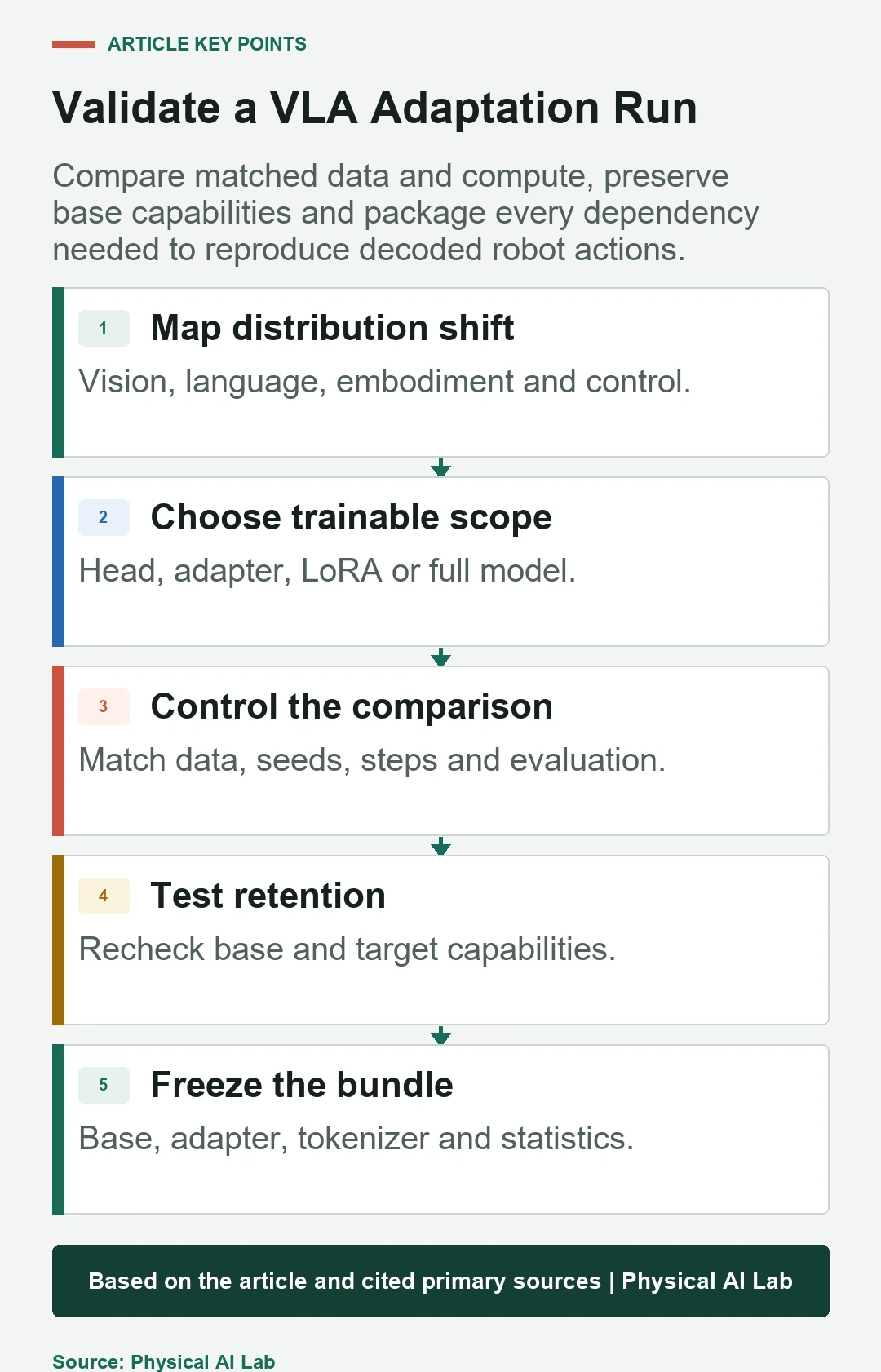
Compare head-only, LoRA, adapters and fuller updates using the same train and validation episodes, batch definition, optimizer budget, augmentation, seeds and checkpoint-selection rule. Report wall time, accelerator memory, trainable and total parameters as separate quantities.
A method receiving more examples or a different action decoder is not an isolated parameter-efficiency comparison. Preserve unsuccessful runs and instability rather than selecting only the most favorable seed.
Use public VLA evidence within scope
The Octo project studies a generalist robot policy and adaptation across its reported datasets and embodiments. The OpenVLA paper and official OpenVLA repository provide model, fine-tuning and implementation context for their supported releases.
These results guide hypotheses but do not establish the best recipe for a private task. Confirm repository version, model checkpoint, action statistics and hardware assumptions before reproduction.
Distinguish OFT recipe changes from LoRA alone
The OpenVLA-OFT project reports an optimized fine-tuning recipe with architectural and training choices evaluated in its stated benchmarks. Treat the result as a bundle of choices rather than evidence that any one adapter setting causes the full improvement.
When reproducing, ablate action representation, head, objective, data and optimization separately where feasible. Report differences from the upstream checkpoint and code revision.
Test retention and negative transfer
Target success can rise while instruction grounding, visual robustness or previously supported tasks regress. Maintain a frozen retention suite sampled from capabilities that the deployment still requires, alongside target-domain and safety evaluations.
Report per-task deltas and worst regressions rather than one combined mean. If base data is mixed into adaptation, version its exposure and ensure evaluation episodes remain independent.
Validate optimizer and numerical behavior
Track gradient norms, loss by action dimension, adapter weight norms, learning-rate schedule and overflow or NaN events. Low-rank updates can still destabilize downstream action decoding or overfit a small demonstration set.
Use multiple seeds for decisions near the acceptance threshold. Keep an untouched test set and avoid repeatedly selecting rank, modules or epochs from its outcomes.
Measure deployment cost and hardware behavior
An adapter may reduce training memory yet leave base-model inference cost unchanged. Measure merged and unmerged runtime, loading time, accelerator memory, first-action and tail latency, control deadline misses and exact decoded action behavior on the deployment stack.
Run protected hardware trials across target, retention and failure-recovery scenarios. Offline action accuracy is supporting evidence, not a substitute for closed-loop outcomes.
| Review layer | Measure | Warning | Response |
|---|---|---|---|
| Shift | Failure by modality | Cause unclear | Collect diagnostics |
| Training | Memory and stability | Unfair compute | Match budget |
| Target | Task and action metrics | Narrow gain | Broaden trials |
| Retention | Per-capability delta | Forgetting | Mix data or reduce scope |
| Runtime | Latency and decoded actions | Bundle mismatch | Repackage |
Package base and adaptation as one release
Store base-model identifier and checksum, adapter configuration and weights, tokenizer, image processor, action head, normalization statistics, dataset lineage, code revision, merge procedure and evaluation report. Test loading from a clean environment.
Close release review with the following checks.
- Identify the actual distribution shift.
- Document every trainable module and parameter count.
- Compare methods under matched data and compute.
- Test target performance and retained capabilities.
- Package base, adapter, tokenizer, action contract and checksums together.
Frequently asked questions
Is LoRA always better for robot VLA fine-tuning?
No. It lowers trainable-parameter cost, but sufficient adaptation and retention depend on the shift, targets, rank and data.
When is head-only training reasonable?
When upstream representations transfer and the main incompatibility is the action mapping or target-specific output layer.
Should I merge LoRA weights before deployment?
Either form can work, but benchmark the exact packaged form and preserve the base checksum and merge procedure.
How do I detect catastrophic forgetting?
Use a frozen retention suite and report per-capability changes alongside target gains under the same checkpoint rule.
Is the adapter file enough to reproduce the policy?
No. The base, processor, tokenizer, action head, normalization, controller contract and code revision are also required.
Adaptation-Scope and Deployment Boundary
Choose VLA adaptation scope from measured distribution shift. Parameter-efficient training is an engineering option, not evidence of sufficient adaptation, retained capability or safe deployment.