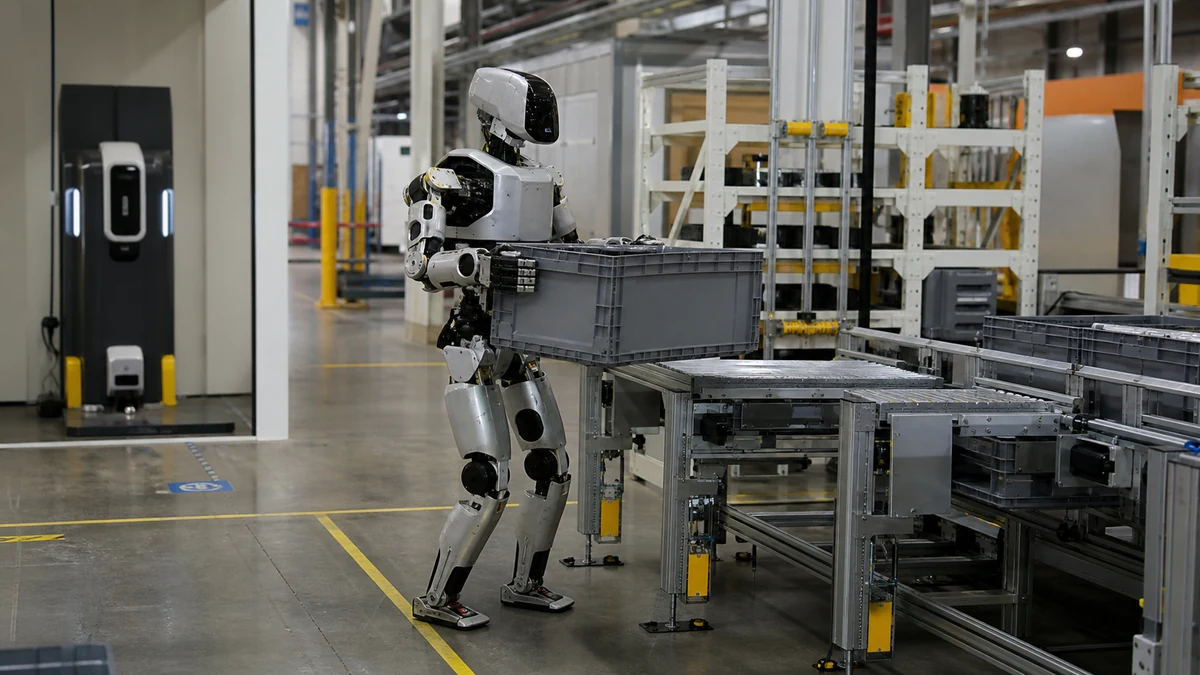
As of August 6, 2026, Boston Dynamics does not publish a numerical list price for Atlas or offer a consumer checkout path. Its product page invites qualified organizations to discuss an application, while the company said in January that all 2026 deployments were committed to Hyundai's RMAC and Google DeepMind. Atlas is a product-version industrial humanoid, but it is not an off-the-shelf robot available at a public price.
Atlas is sold through an enterprise discussion, not a public price list
The official Atlas page offers a ‘Start the Conversation’ route rather than a price card or shopping cart. Boston Dynamics describes a process of planning the application, evaluating the workflow with its team, training application-specific skills and integrating the robot. No public price does not mean free or unavailable, but it also does not justify using a third-party estimate as a current quote.
In its January 5 product announcement, the company said all Atlas deployments for 2026 were already fully committed. An organization can still make contact, but the contact form is not evidence of unallocated 2026 inventory.
| Buying question | What Boston Dynamics publishes | Practical reading |
|---|---|---|
| Public list price | No numerical price | Request a deployment quote rather than estimating the robot alone |
| Online purchase | No checkout or shopping cart | The commercial path begins with an enterprise discussion |
| 2026 deployments | Fully committed in the January announcement | A new inquiry does not establish 2026 delivery |
| Initial customer group | A select number of early adopters | This is not a consumer retail channel |
| Additional customers | Planned for early 2027 | A company plan is not a guaranteed order-opening date |
Buying Atlas means designing a deployment, not ordering a standalone machine
The published journey runs from use-case planning to workflow evaluation, on-the-job skill training and integration. Atlas targets material-handling work such as part sequencing, machine tending and order building. The public specification also lists barcode and RFID workflow integrations, while Orbit is intended to connect Atlas with MES and WMS systems. A deployment budget may therefore include batteries and charging, cell changes, safety validation, software integration, training and support—not only the robot body.
Before contacting sales, a site should document object mass and geometry, task rate, travel paths, shared human space, power, and the required MES or WMS exchange. Matching a specification number does not prove that the full workflow is ready for unattended operation.
The published specifications for the product-version Atlas
Boston Dynamics' Atlas specification sheet gives unusually detailed figures for the product-version robot. These are manufacturer specifications, not independent site-performance tests or guaranteed throughput for every application.
Payload and battery figures come with distinct conditions. Instant, sustained and one-handed capacity are separate ratings, and heavy-lifting battery life is lower than the headline battery figure.
| Category | Published specification | Condition or meaning |
|---|---|---|
| Size | 1.9 m tall; 90 kg | Designed around human-scale industrial workstations |
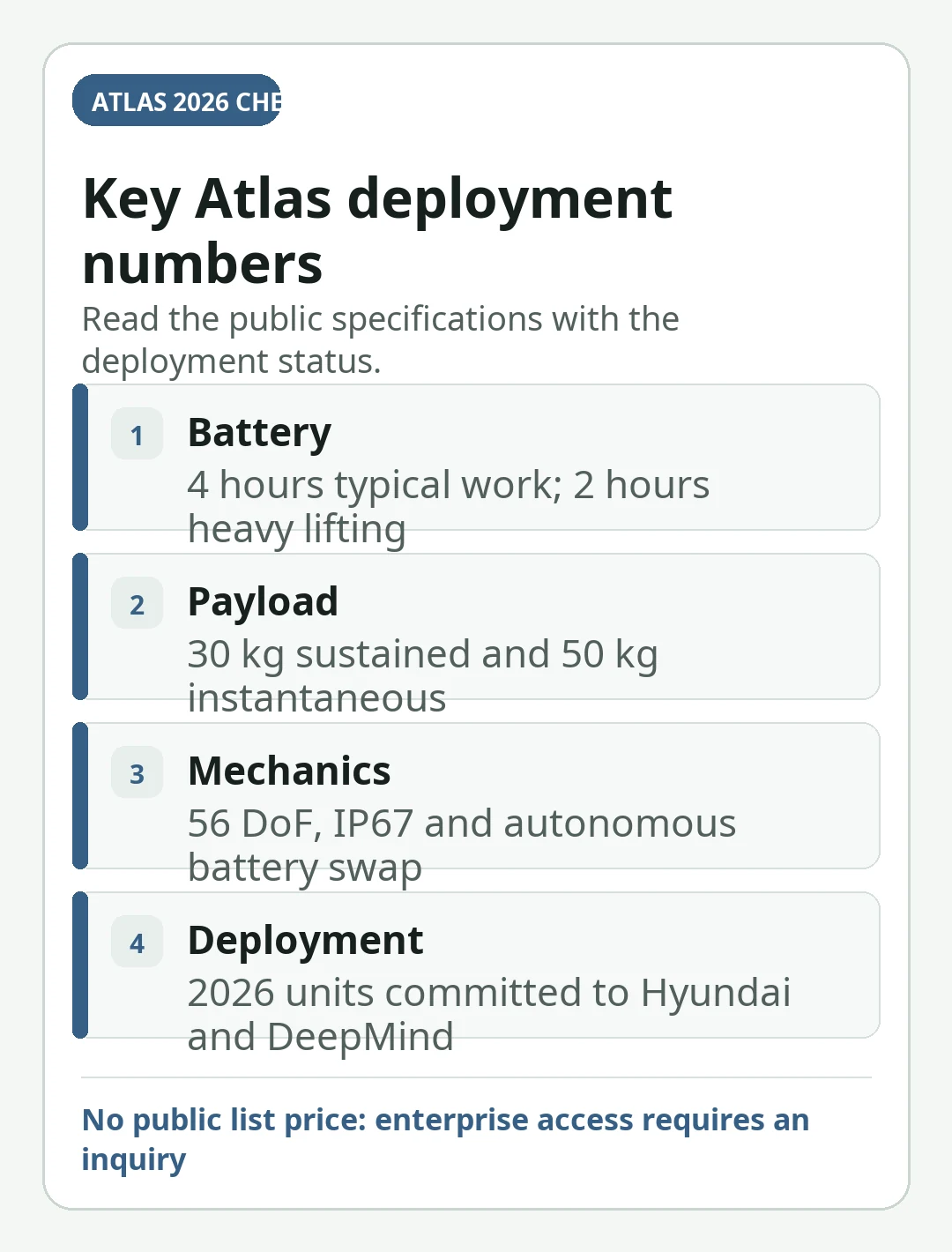
| Motion | 56 DoF; 2.3 m reach; continuous range of motion | Does not imply maximum load in every pose |
| Capacity | 50 kg instant; 30 kg sustained; 20 kg one-handed | Do not substitute the instant rating for continuous work |
| Battery | 4 hours; 2 hours with heavy lifting | Duty cycle changes with task intensity |
| Battery operations | 3-minute autonomous swap; 1.5-hour charge | Continuous work requires spare-battery and charger planning |
| Sensing and environment | Tactile fingers and palm, 360° camera, IP67, -20 to 40°C | Environmental ratings do not approve an application by themselves |
| Operating modes | Autonomous, VR teleoperated and tablet control | Evidence and supervision should be checked for each mode |
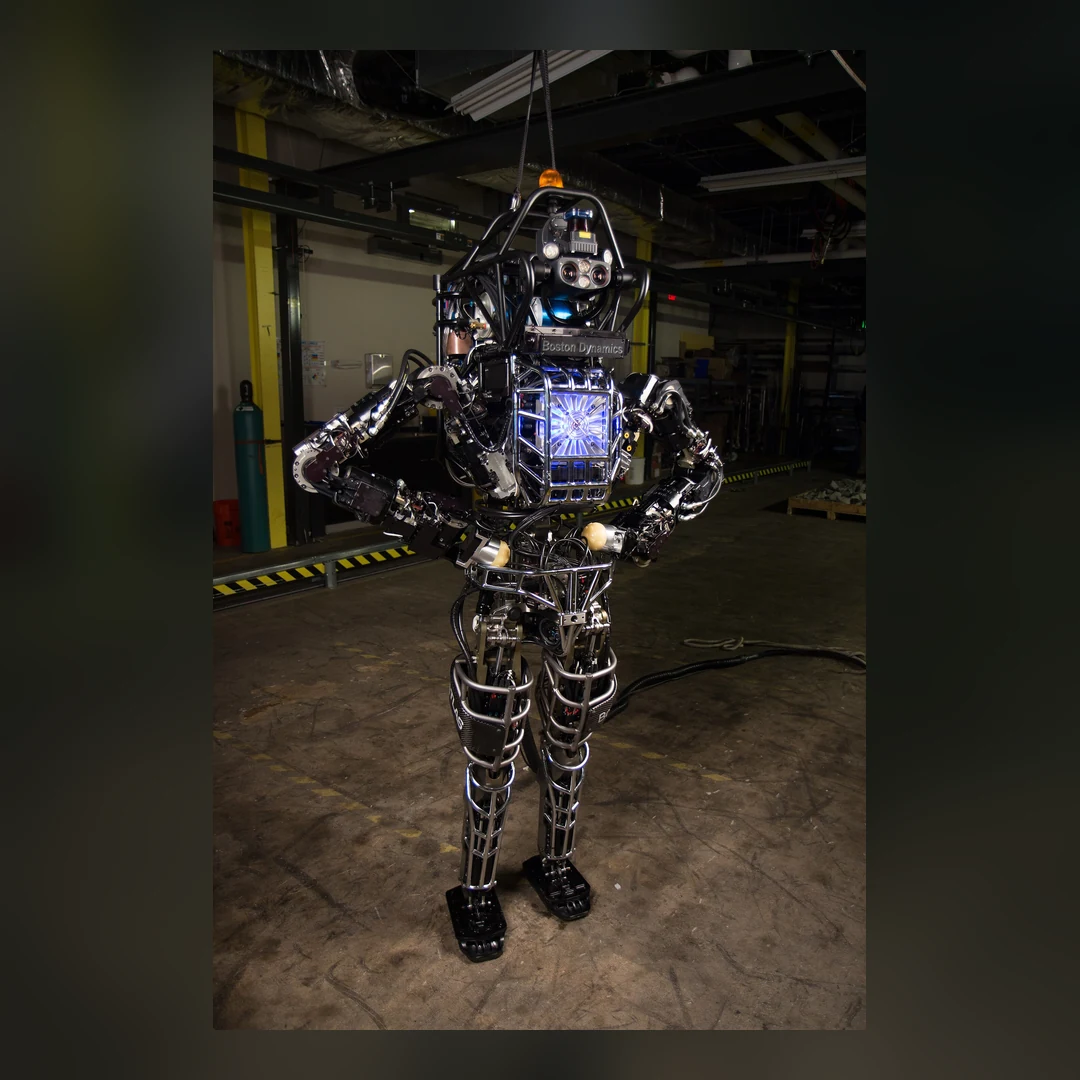

The four-hour battery and 50 kg lift need their conditions attached
The product page's four-hour battery figure and the specification sheet's two hours for heavy lifting describe different duty cycles. Boston Dynamics says Atlas can navigate to a charging station and complete an autonomous battery swap in about three minutes. A continuous-operation design still needs enough spare batteries to cover the stated 1.5-hour charge time.
The 50 kg figure is an instant capacity; sustained capacity is 30 kg and one-handed capacity is 20 kg. A field assessment must also test grip surface, center of mass, travel distance, repetition and human interaction. The spec sheet is a screening tool, not a substitute for application validation.
Hyundai and Google DeepMind have different roles in the 2026 deployment story
The January launch said production of the product version would begin immediately at Boston Dynamics' Boston headquarters and that fleets were scheduled for Hyundai's Robotics Metaplant Application Center (RMAC) and Google DeepMind. The current product page also says Atlas has entered a Hyundai customer facility for field testing on real-world sequencing tasks. That supports a Hyundai industrial trial; it does not establish that a large-scale rollout across all Hyundai factories is complete.
Google DeepMind is both a scheduled 2026 deployment recipient and the AI partner named in the announcement. The sources support a fleet-shipment plan and foundation-model collaboration. They do not yet provide a public measure of production results, task throughput or commercial operating scale at DeepMind.
Atlas is commercially real, but ‘available’ needs qualification
Atlas is no longer only a hydraulic research prototype: Boston Dynamics announced a product version and said manufacturing would begin immediately, while customer deployment work is under way. Yet there is no public list price or consumer order channel, and the announced 2026 allocation was committed. The most accurate description is an enterprise humanoid being commercialized through selected early-adopter deployments and application-specific quotations.
This status can change when Boston Dynamics publishes pricing, new 2027 customers, delivery confirmations or field results. A procurement team should reopen the product page, specification sheet and latest deployment announcement on the same day it requests a quote. The sources here were last checked on August 6, 2026.
Guides for the next buying or deployment decision
To translate Atlas specifications into deployment requirements, use Unitree, Optimus and Atlas buying-stage comparison, warehouse picking robot deployment, and humanoid battery runtime. Together they add budget, claim-verification and present-access context.
Frequently asked questions
What is the official price of Boston Dynamics Atlas?
Boston Dynamics had not published a numerical list price as of August 6, 2026. Atlas follows an enterprise evaluation and quotation process, so an online estimate should not be presented as the official price.
Can an individual order Atlas?
The public route is an application discussion for qualified organizations, not consumer checkout. Boston Dynamics says it is starting with selected early adopters, and its January announcement said the 2026 deployments were fully committed.
Have all Atlas units already arrived at Hyundai and Google DeepMind?
The announcement scheduled 2026 fleets for both organizations. The product page describes Hyundai field testing, but the sources do not state that every planned shipment to both recipients has been completed.
Official sources checked
- Boston Dynamics Atlas product page
- Boston Dynamics Atlas specification sheet
- Boston Dynamics Atlas product launch, January 5, 2026
Last checked: August 6, 2026