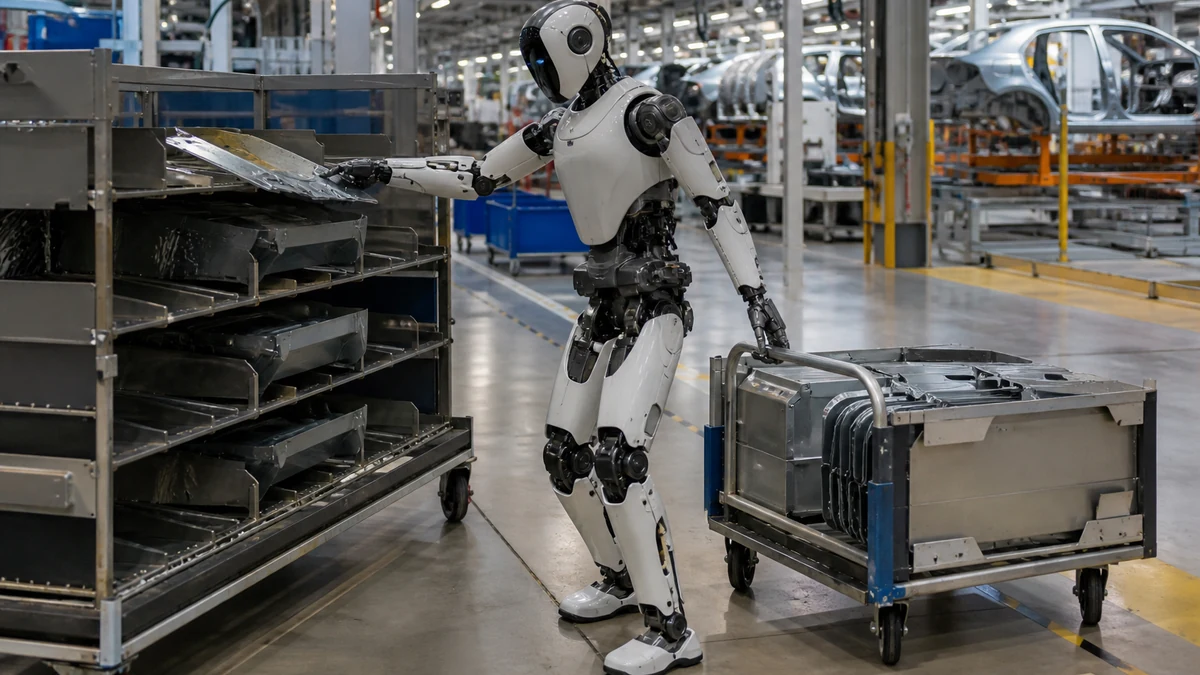
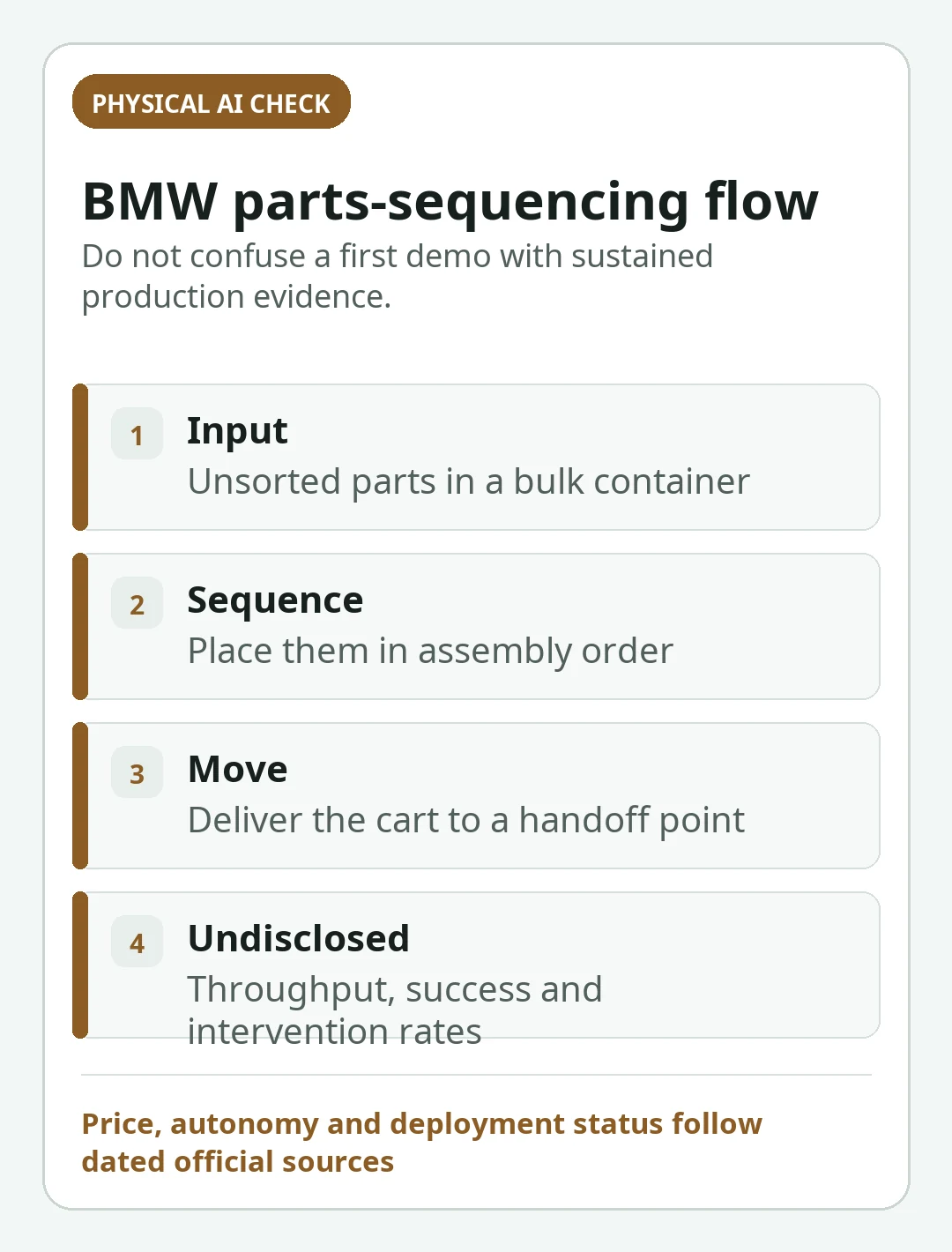
Figure 03's BMW job is parts sequencing, not the sheet-metal loading task previously performed by Figure 02. At Plant Spartanburg's Hall 52, the robot picks sheet-metal components that arrive out of sequence, places them on a trolley in the order needed for vehicle assembly and prepares that trolley for a tugger train or Smart Transport Robot to carry onward. BMW announced the project on June 25, 2026; Figure published its first logistics-workflow demonstration on June 30.
Figure says its Helix 02 pixels-to-actions system coordinates whole-body movement and adapts when parts, carts and fixtures are not in exactly the same pose. BMW's announcement confirms the Figure 03 project and workflow, but does not name Helix 02 or disclose autonomous operating share. Neither source publishes Figure 03 cycle time, hourly throughput, intervention rate, uptime, failure recovery or sustained production results. The evidence supports a project and demonstrated workflow, not yet a claim of complete autonomous production deployment.
The workflow turns an unordered parts supply into assembly order
BMW's official Figure 03 project announcement places the work in Hall 52 at BMW Group Plant Spartanburg in South Carolina. Hall 52 combines assembly and logistics work for BMW X3 variants and is also identified in BMW's future iX5 production plans. The project's value comes from connecting inbound components to the order in which the assembly process needs them.
The input is unsequenced sheet-metal parts. Figure 03 picks the correct component and places it in a defined trolley position according to vehicle sequence. Once the trolley is complete, a tugger train or Smart Transport Robot can move it toward assembly. Figure's F.03 at BMW account also shows the robot handling thin parts and moving a heavy steel cart on casters as parts of the logistics scene.
Sequencing is more than picking an object from a bin. The right part must reach the right trolley slot for the right vehicle at the right time, and the downstream material-flow system must accept the handoff.
| Workflow stage | What happens | Interface that must be verified |
|---|---|---|
| Receive | Sheet-metal components arrive without assembly sequence | Part identity, presentation, orientation and container state |
| Select | Figure 03 chooses the part required by the sequence | Production order, part ID and next-slot instruction |
| Pick | The robot grasps a thin metal component | Perception, grasp, edge handling and double-pick detection |
| Place | The component is put in its assigned trolley position | Slot identity, pose tolerance and placement confirmation |
| Complete | The trolley is filled to the required sequence | Missing, wrong and duplicate part checks |
| Transfer | A tugger train or Smart Transport Robot carries the trolley onward | Handoff signal, cart condition, route and schedule |
| Consume | Assembly receives parts just in sequence | Vehicle build order and line-side confirmation |
Sequencing is a different BMW task from Figure 02 sheet-metal loading
Figure 02's earlier Spartanburg assignment involved loading sheet-metal parts into fixtures on the BMW X3 body shop process. The new Figure 03 project sits in intralogistics and assembly preparation: it rebuilds part order on a trolley before transport. Both involve sheet metal, but their success conditions, interfaces and failure costs differ.
A loading task can be judged by correct fixture placement and process availability. Sequencing adds vehicle order, trolley-slot correctness and handoff timing. A robot may grasp every part successfully and still fail the workflow by placing one variant in the wrong sequence. That is why the project should not inherit Figure 02's output numbers as if the task had remained unchanged.
The broader warehouse picking system guide helps map perception, manipulation, conveyance and verification. BMW's use case is an automotive just-in-sequence flow rather than a generic e-commerce order, so the part-order connection is the central metric.
| Dimension | Earlier Figure 02 BMW work | Figure 03 sequencing project |
|---|---|---|
| Primary job | Load sheet-metal parts into production fixtures | Arrange unsequenced parts on a trolley in assembly order |
| Operational area | Body-shop production support | Hall 52 intralogistics and assembly preparation |
| Critical correctness | Right part in the fixture | Right part, right trolley slot and right vehicle sequence |
| Downstream handoff | Manufacturing process fixture | Tugger train or Smart Transport Robot and line-side supply |
| Published history | BMW and Figure reported cumulative production-support figures | Project launch and first workflow demonstration |
| Safe inference | Prior evidence that a Figure robot worked in BMW production | Not a performance baseline for the new sequencing task |
Helix 02 is Figure's explanation for adapting to changing poses
Figure says Helix 02 is a pixels-to-actions vision-language-action system for whole-body control. In the BMW demonstration, Figure attributes coordinated reaching, grasping, body positioning and cart movement to that architecture. Its claim is that high-frequency visual-action control can correct for small changes in part, rack and trolley position instead of relying on one hard-coded pose.
This matters in sequencing because thin panels can shift, stacks can settle and wheeled carts can stop with rotation or offset. A robot that only replays a fixed joint path may miss a grasp or collide after a small scene change. A visual policy can, in principle, adjust the approach from the latest image and body state.
BMW's June 25 announcement confirms the Figure 03 project and material-flow job but does not identify Helix 02, publish its control frequency or state that the whole workflow is autonomous. Helix 02 is Figure's technical attribution. For the architecture detail and the limits of its published evidence, use the Helix 02 guide rather than repeating model-wide training claims here.

Thin sheet metal and rolling steel carts create two distinct control problems
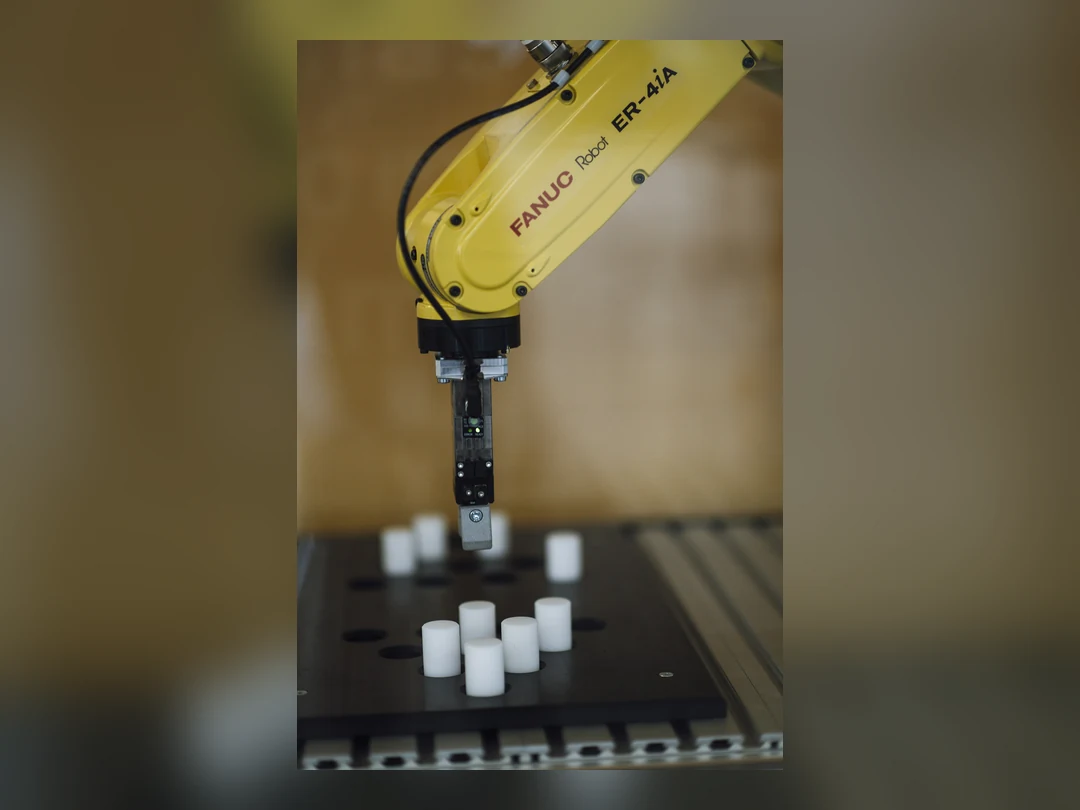
Picking a thin sheet-metal component demands reliable edge or surface localization, a grasp that avoids separating the wrong layer, and confirmation that exactly one correct part moved. Parts can reflect light, occlude each other or flex. Public video can show a successful pick, but it does not provide the distribution of scratches, drops, double picks or wrong-part selections.
Moving a heavy cart is a locomotion-and-force task. Casters can swivel, resist initial motion and redirect a cart when the push point changes. The robot must coordinate contact force, stance and path while keeping the trolley and surrounding people within safe limits. Figure says the workflow combines manipulation and cart handling; it does not publish cart mass, force limits, route length or recovery behavior.
This is where whole-body control matters, but a model name is not a safety case. The robot whole-body control guide explains coordination across contacts and joints. The deployed cell still needs task-specific limits, protective functions, traffic rules and human recovery procedures.
| Failure mode | Why sequencing is exposed | Evidence a production review needs |
|---|---|---|
| Wrong part | Similar panels or variants may share a presentation area | Identity check before pick and before trolley release |
| Double pick | Thin stacked components can move together | Layer detection, weight or vision confirmation and reject path |
| Poor grasp | Edges, glare and small pose changes affect contact | Drop, slip and retry rates across the real part mix |
| Wrong slot | A successful grasp can still corrupt vehicle sequence | Trolley map, placement verification and sequence reconciliation |
| Cart drift | Caster orientation changes the path after force is applied | Route deviation, force limits and obstacle response |
| Human intervention | A bad part or blocked trolley may need recovery | Stop, handover, reset and safe restart procedure |
| System mismatch | Robot success may not update material-flow state | MES or logistics acknowledgement and exception audit |
Figure 02's production totals are context, not Figure 03 results
BMW's 2026 production update says Figure 02 supported BMW production in Spartanburg for ten months in ten-hour shifts, contributing to more than 30,000 BMW X3 vehicles, handling more than 90,000 components, logging about 1,250 hours and walking roughly 1.2 million steps. Those are BMW-published historical figures for the earlier task.
Figure's own production account describes an eleven-month deployment. The ten- versus eleven-month wording likely reflects different scope definitions, but the public sources do not reconcile them. Preserve both attributions instead of averaging them or selecting the larger figure.
None of those values is a Figure 03 sequencing metric. They establish that BMW and Figure have previous operating experience and that Figure 02 supported real production. Figure 03 needs its own denominator: scheduled time, sequence orders, component mix, interventions, wrong placements, recoveries and downstream line effects.
Project launch and full production deployment are different milestones
BMW says it launched the Figure 03 sequencing project, and Figure calls the June 30 material its first logistics workflow at BMW. Those statements support on-site work and a defined task. They do not disclose whether the robot was in an engineering trial, limited production support, continuous shift operation or a wider fleet rollout on the check date.
A production-complete claim would need sustained results: cycle-time distribution, correctly sequenced parts per hour, intervention-free runs, availability, maintenance, recovery and proof that the workflow meets line demand. A short demonstration can reveal the task and integration concept while omitting the rare events that determine industrial reliability.
The humanoid video evaluation checklist is useful here. Count cuts, identify resets and ask what happened outside the shown interval, but do not call the footage staged merely because it is edited. The right conclusion is that the published clip demonstrates the workflow under shown conditions and the companies confirm the project; quantitative production acceptance remains undisclosed.
| Milestone | Evidence available | Status on August 6, 2026 |
|---|---|---|
| Task defined | BMW describes unsequenced parts, trolley order and transport handoff | Confirmed |
| Figure 03 at Spartanburg | BMW and Figure announcements | Confirmed |
| Workflow demonstrated | Figure's first logistics-workflow publication | Confirmed under shown conditions |
| Helix 02 controls the demo | Figure's technical account | Company claim; BMW does not independently name it |
| Continuous production rate achieved | No cycle-time or throughput table | Unknown |
| Fully autonomous shift operation | No control-mode or intervention disclosure | Unknown |
| Large fleet deployment complete | No quantity or rollout schedule | Unknown |
The next useful evidence is a sequencing scorecard, not another highlight reel
A sequencing scorecard should start with orders and parts: total requested, correctly identified, successfully picked, placed in the correct slot, released with complete verification and delivered before the line deadline. Report wrong-part, double-pick, drop, damage and wrong-slot events separately. One aggregate success percentage can conceal the error that matters most to assembly.
Add operations: median and tail cycle time, intervention count and duration, autonomous recovery, robot availability, maintenance, cart-transfer failures and the number of shifts represented. Link every result to hardware, Helix policy and task versions. The robot data factory guide explains why versioned failure and intervention data matter when a deployed policy is retrained.
Until those figures are public, describe the project narrowly. Figure 03 is performing and demonstrating a BMW Hall 52 sequencing workflow that combines thin-part manipulation, ordered trolley loading and cart handling. Figure says Helix 02 supplies visual whole-body adaptation. BMW and Figure have not yet published enough data to claim stable shift-level autonomy, production throughput or a completed large-scale deployment.
Frequently asked questions
What exactly does Figure 03 do at BMW Spartanburg?
It picks sheet-metal parts that arrive out of assembly sequence, places them into defined trolley positions in the required vehicle order and prepares the trolley for a tugger train or Smart Transport Robot to move toward assembly.
Is Figure 03 already running fully autonomously in BMW production?
BMW and Figure confirm the project and a demonstrated workflow, but they do not publish autonomous operating share, remote supervision, interventions, cycle time, uptime or sustained shift results. A full autonomous production deployment is therefore not established.
Does BMW confirm that Helix 02 controls Figure 03?
Figure attributes the demonstrated whole-body visual adaptation to Helix 02. BMW's project announcement confirms the task and robot but does not name Helix 02 or disclose the control architecture, so the technical attribution remains Figure's company claim.
Official sources checked
- BMW Group: Figure 03 project in Spartanburg
- Figure: F.03 Arrives at BMW
- Figure: Introducing Helix 02
- BMW Group: Figure 02 production results
- Figure: Figure 02 at BMW
Last checked: August 6, 2026