Helix 02 is Figure’s announced whole-body humanoid AI system for continuous locomotion and manipulation. Figure describes a hierarchy in which System 2 interprets scenes and goals, System 1 maps onboard sensing to full-body joint targets, and System 0 executes fast balance and contact control.
The release is significant as a company demonstration, not independent proof of general humanoid autonomy. Published videos and architecture details establish what Figure says occurred under shown conditions. They do not disclose complete failure rates, intervention policy, training distribution, safety architecture or third-party replication.
Use this guide with the humanoid video evaluation checklist and robot foundation model guide. Treat current specifications and metrics as dated company claims unless independently verified.
Helix 02 extends Figure's model to the full body
Figure’s January 27, 2026 Helix 02 release says the system extends learned control from upper-body manipulation to walking, balance, arms, hands and fingers in one hierarchy. The company presents a continuous four-minute kitchen task with no resets or human intervention.
That result should be read as a defined demonstration. Ask how tasks were selected, how many trials preceded the published run, what counted as intervention, and how failures and recovery were measured across the broader distribution.
System 2 represents slow semantic reasoning
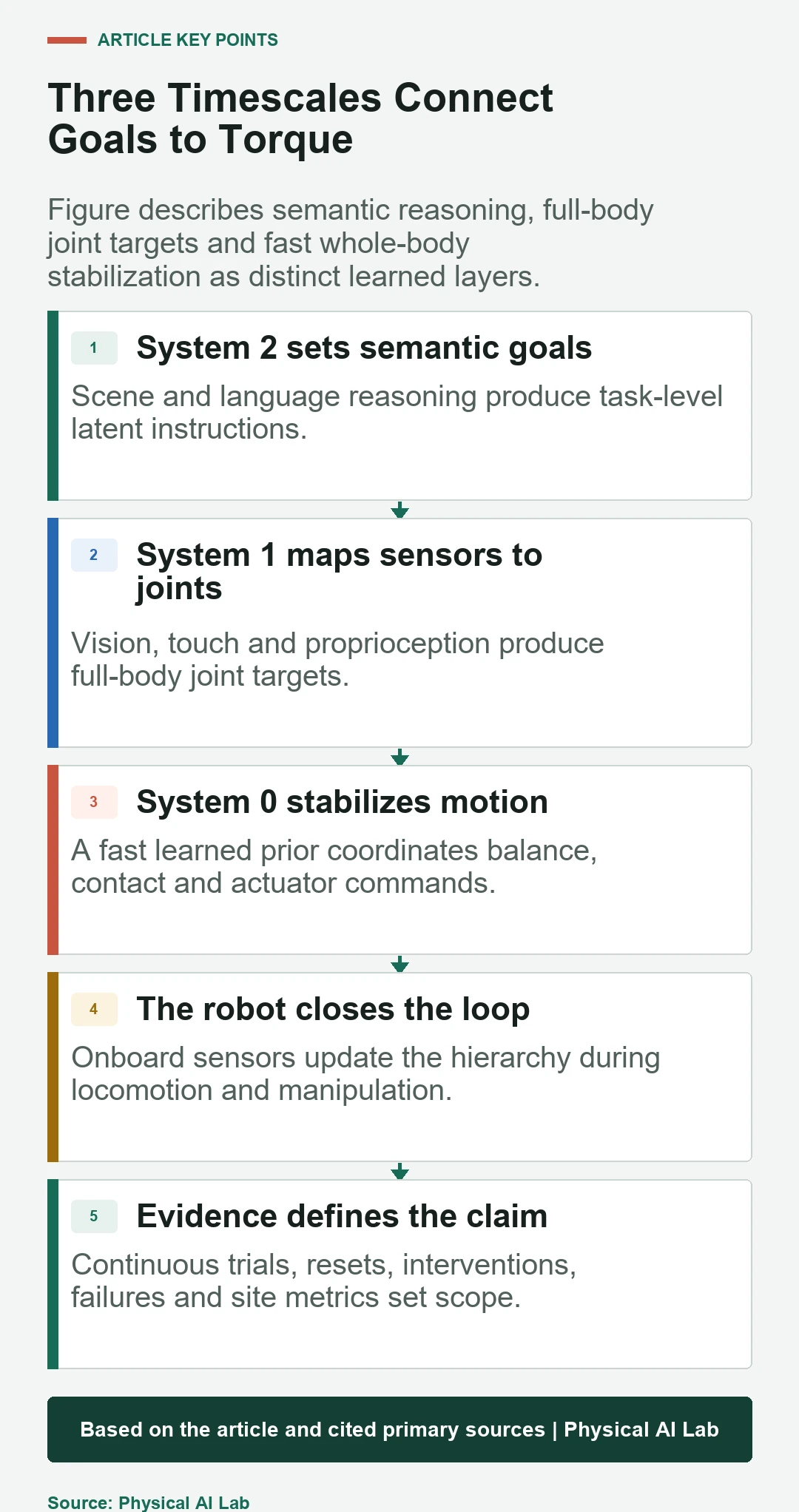
Figure describes S2 as the scene and language layer that produces semantic latent goals such as walking to an appliance or carrying objects. It does not need to specify every footstep or joint trajectory.
This separation lets task intent operate at a slower timescale. Evidence questions include instruction coverage, task-state memory, ambiguity handling and what happens when the scene changes or a requested object is missing.

System 1 maps onboard sensors to full-body targets
Figure says S1 receives head and palm cameras, fingertip tactile sensing and full-body proprioception, then outputs joint targets for the complete robot. Palm vision and touch are presented as useful when head-camera views are occluded.
Sensor dependence creates calibration, synchronization and fault questions. Ask whether performance changes with lighting, tactile drift, contamination, object novelty or missing modalities. A unified policy still operates through physical sensors and actuators.
| Layer | Published role | Published timescale | Evidence question |
|---|---|---|---|
| S2 | Scene, language and semantic goals | Slower reasoning | Task coverage and memory |
| S1 | Sensors to full-body joint targets | Figure states 200 Hz | Generalization and latency |
| S0 | Balance, contact and actuator commands | Figure states 1 kHz | Stability and transfer |
| Robot hardware | Vision, touch, proprioception and actuators | Physical loop | Calibration, limits and reliability |
System 0 provides a learned whole-body motion prior
Figure says S0 is a 10-million-parameter network trained to track retargeted human motion while maintaining stability. The company reports more than 1,000 hours of human motion and simulation training across over 200,000 parallel environments.
These numbers describe training scale as reported by Figure. They do not directly establish task reliability, force limits or safety. Human-like motion can be useful for coordination while still requiring robot-specific dynamics and protection.
The hierarchy spans goals, joint targets and torque
S2, S1 and S0 operate at different timescales so semantic planning does not need to run at actuator frequency. Figure describes the layers as tightly integrated from pixels to torque rather than hand-engineered locomotion and manipulation state machines.
A learned hierarchy can reduce explicit handoffs, but its internal coupling can complicate diagnosis. Engineers need logs that trace a failure from goal and perception through joint targets, contacts, actuator response and recovery.
The kitchen demonstration tests long-horizon loco-manipulation
Figure reports a sequence of 61 locomotion and manipulation actions across four minutes, including dish handling, walking and use of different body parts. The company describes the run as autonomous and without resets.
Useful follow-up evidence would include repeated trial counts, object breakage, intervention taxonomy, time distribution and alternative kitchens or object sets. One continuous run demonstrates integration but not fleet-level reliability.
Dexterity claims depend on touch and in-hand vision
Figure shows bottle-cap removal, pill handling, syringe movement and selection of small metal pieces. These tasks require contact regulation, occlusion handling and multi-finger coordination according to the company description.
Evaluate the exact object distribution, force accuracy, damage and success denominator. Medical-looking objects in a demonstration do not establish medical-device capability, clinical suitability or safety certification.
| Claim type | Published evidence | What it supports | What remains unknown |
|---|---|---|---|
| Continuous autonomy | Four-minute shown task | Integrated behavior can occur | Repeat rate and failures |
| Whole-body policy | S0-S1-S2 description | Architecture claim | Independent replication |
| Touch-enabled dexterity | Selected small-object tasks | Sensor-policy capability | Coverage and calibration drift |
| Simulation transfer | Reported S0 training | Development method | Reality-gap limits |
| Factory use | Company deployment updates | Operational direction | Complete customer metrics |
Newer deployment updates add context, not universal proof
Figure’s June 30, 2026 BMW update says Figure 03 with Helix 02 performs a manufacturing-logistics workflow involving part manipulation and cart movement. This is newer evidence than the January release.
The update remains a first-party company report. Distinguish shown workflow capability, reported prior production contribution and independently audited operational performance. Date every claim because robot generations and policies change quickly.
Safety and reliability are separate from model architecture
Whole-body pixels-to-actions control does not disclose the independent protective layers, force limits, stop functions or hazard analysis used in operation. These are essential for people, tools, breakable objects and dynamic walking.
Ask how sensor faults, network loss, falls, joint limits and unexpected contact are contained. A high-frequency learned controller can improve stability while still needing safety-rated functions outside the model.
The right evaluation separates architecture from evidence
Record which facts come from Figure, which are visible in continuous video and which are independently reproduced. Compare tasks using success denominators, intervention, speed, object variation, failures, uptime and service—not only motion quality.
Helix 02 is meaningful as a disclosed whole-body learning architecture and series of company demonstrations. Its broader significance should be updated as repeatable customer and third-party evidence becomes available.
- Date and attribute every company claim.
- Separate S2 goals, S1 targets and S0 control.
- Inspect continuous videos for resets and intervention.
- Request denominators, failures and task variation.
- Treat safety and fleet reliability as separate evidence layers.
Frequently asked questions
What is Figure Helix 02?
It is Figure’s announced learned control hierarchy for whole-body humanoid locomotion and manipulation using semantic, visuomotor and fast stabilization layers.
What do S0, S1 and S2 mean?
Figure describes S2 as semantic reasoning, S1 as onboard-sensor-to-full-body joint targets, and S0 as fast balance, contact and actuator control.
Is the four-minute kitchen video independently verified?
It is a first-party Figure demonstration. The public release states it was autonomous with no resets or intervention, but independent replication and full trial statistics are not public.
Does Helix 02 use tactile sensing?
Figure says Figure 03 fingertip tactile sensors and palm cameras feed S1 for contact-aware and occlusion-heavy manipulation.
Does Helix 02 prove general-purpose humanoid autonomy?
No. It provides evidence for the shown tasks and reported architecture. General reliability requires broader repeated, customer and independent evidence.
Company Claim and Evidence Note
Helix 02 details and metrics in this article are attributed to Figure's January and June 2026 publications and were checked July 29, 2026. They are company claims unless stated otherwise; product, deployment and evidence may change.