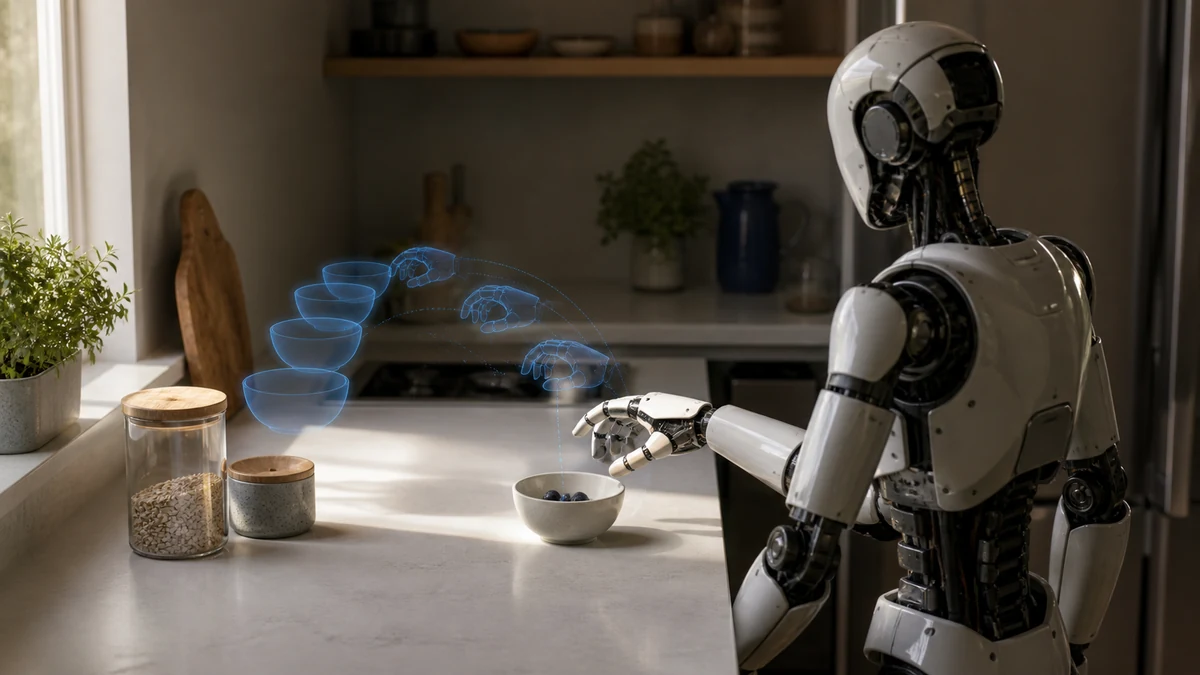
1X's official World Model research article describes a two-stage path for controlling NEO: a text-conditioned world model imagines a short future video, then an inverse dynamics model estimates the action sequence needed to move between those frames. NEO executes that trajectory on the physical robot; the generated pixels are not themselves motor commands.
This is a research policy integrated into NEO, not evidence that every household task is already autonomous. 1X reports failures in depth, geometry and contact and says longer tasks will need faster inference, closed-loop replanning and memory. Start with our world-model primer if you need the broader concept.
The pipeline moves from prompt to pixels to actuators
At inference, the system receives NEO's starting camera frame and a text instruction. The world-model backbone rolls out the intended future, after which the inverse dynamics model extracts a trajectory that the robot can execute.
That separation answers a common misconception: the model does not simply play a generated video and hope the robot follows it. The action bridge must convert visual change into embodiment-specific movement while respecting the robot's kinematics.
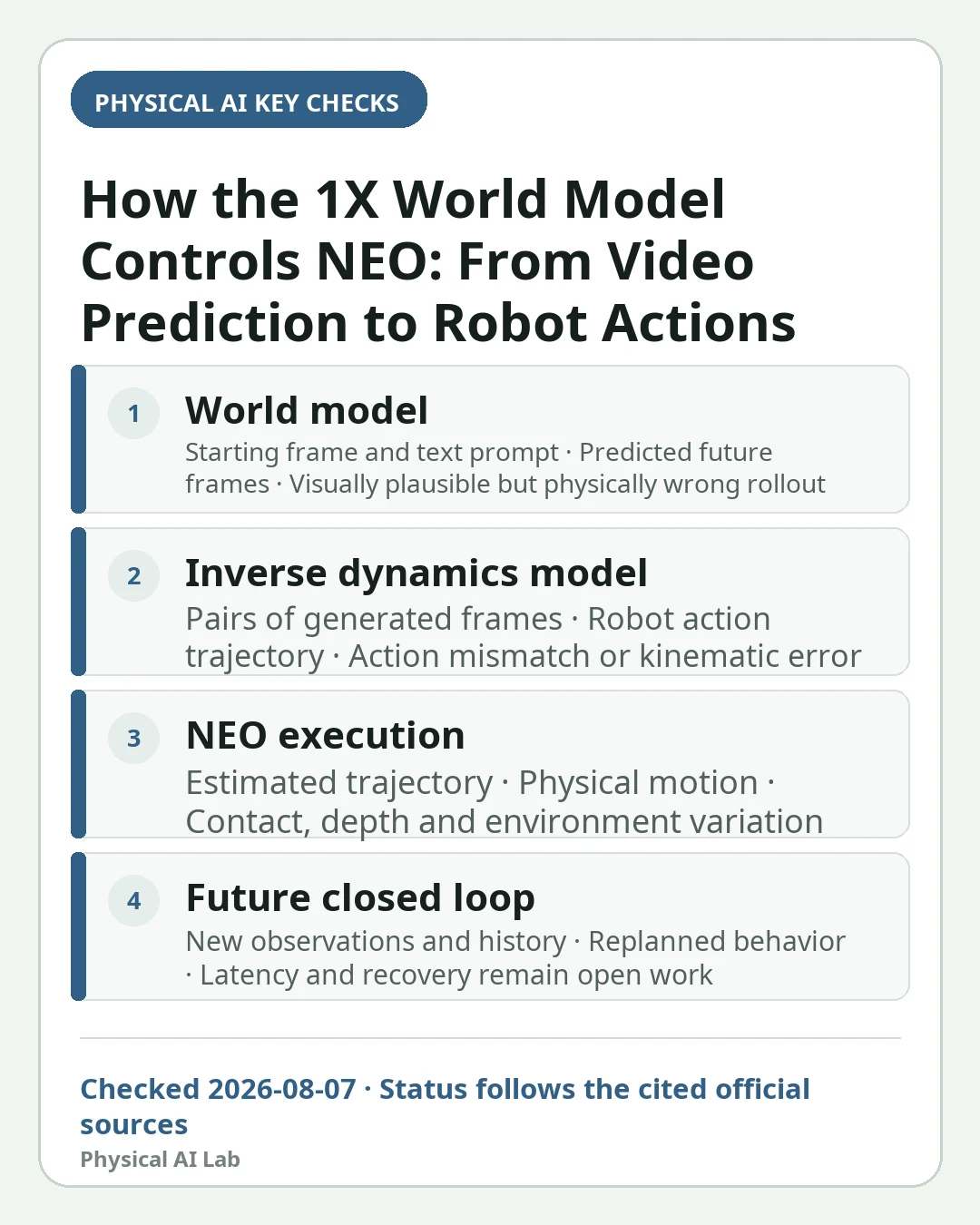
| Stage | Input | Output | Main risk |
|---|---|---|---|
| World model | Starting frame and text prompt | Predicted future frames | Visually plausible but physically wrong rollout |
| Inverse dynamics model | Pairs of generated frames | Robot action trajectory | Action mismatch or kinematic error |
| NEO execution | Estimated trajectory | Physical motion | Contact, depth and environment variation |
| Future closed loop | New observations and history | Replanned behavior | Latency and recovery remain open work |
Video pretraining supplies priors, then NEO data grounds them
The 1X World Model technical paper says the backbone begins from a 14-billion-parameter generative video model. It is mid-trained on 900 hours of egocentric human video and then fine-tuned on 70 hours of robot data to adapt its view and motion to NEO.
The inverse dynamics model uses 400 hours of unfiltered robot motion data, including random play. These figures explain the training recipe disclosed by 1X; they do not prove that the model has seen every object, room or contact condition it may encounter.
Predicted success and physical success must be measured separately
A generated rollout can show a clean grasp while the real robot undershoots, overshoots or loses contact. 1X explicitly notes optimism in generated completions and remaining weaknesses from monocular pretraining, including depth and 3D grounding.
For that reason, evaluation should preserve three records: the proposed future, the extracted action and the actual camera result. The see-think-act loop helps locate a failure without attributing every error to the world model.
| Evidence | What it can show | What it cannot show alone |
|---|---|---|
| Generated rollout | Intended visual outcome | Real contact success |
| Side-by-side demo | Qualitative alignment in selected trials | Fleet-wide success rate |
| 30-run task test | Repeatability in the disclosed setup | Performance in every home |
| Nonzero unseen-task success | A path for learning from experience | General household autonomy |

The current latency narrows the kind of task it can handle
1X reports that the backbone currently takes 11 seconds on multiple GPUs to generate five seconds of real-time video, while the inverse dynamics step takes another second. That cadence is easier to tolerate in deliberate manipulation than in fast, reactive contact.
The company identifies faster inference, memory and closed-loop replanning as future work for tasks longer than five seconds. A single successful open-loop clip should therefore not be expanded into a claim about uninterrupted chores or rapid recovery around people.
A useful audit keeps human intervention visible
Ask whether the prompt was chosen after several failed attempts, whether multiple rollouts were sampled and who selected the one to execute. 1X's evaluation article reports parallel sampling and explains that selection can be manual or automated, so sampling policy belongs in the result record.
Also separate autonomous execution from task setup, resets and safety intervention. Our teleoperation detection guide provides a compatible checklist, although the 1XWM article describes model execution rather than proving the absence of all off-camera assistance.
Use the model as a testable policy, not a universal claim
A serious evaluation would select representative objects, hold out rooms and prompts, run repeated trials and record completion, intervention, latency and failure type. Generated-video quality is useful as an intermediate diagnostic, but the final metric must come from physical execution.
The disclosed work shows a concrete route from web and human video knowledge to NEO actions. Its value lies in that mechanism and measured generalization signals, not in the much broader future aspiration that a robot might eventually master any task in any home.
Frequently asked questions
Does 1XWM send video frames directly to NEO's motors?
No. The world model generates future frames, and a separately trained inverse dynamics model estimates the action trajectory needed to move between them.
Is the generated future always physically correct?
No. 1X reports errors involving object consistency, depth, geometry and contact. A plausible generated video must still be validated by repeated physical execution.
Does this prove NEO can do any household task autonomously?
No. The publication shows research results on disclosed tasks and identifies latency, longer-horizon replanning and recovery as areas for further work.
Official sources checked
- 1XWM from video to action research article
- 1X World Model evaluation article
- 1X World Model technical paper
- 1X artificial intelligence overview
Last checked: August 7, 2026