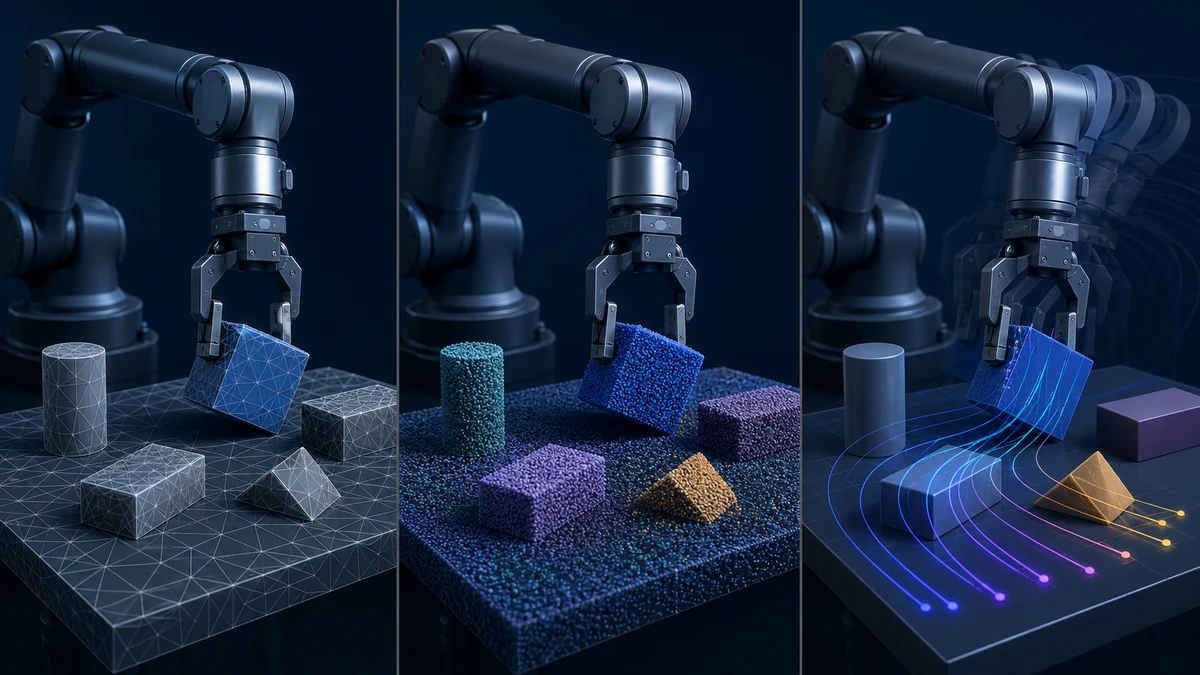
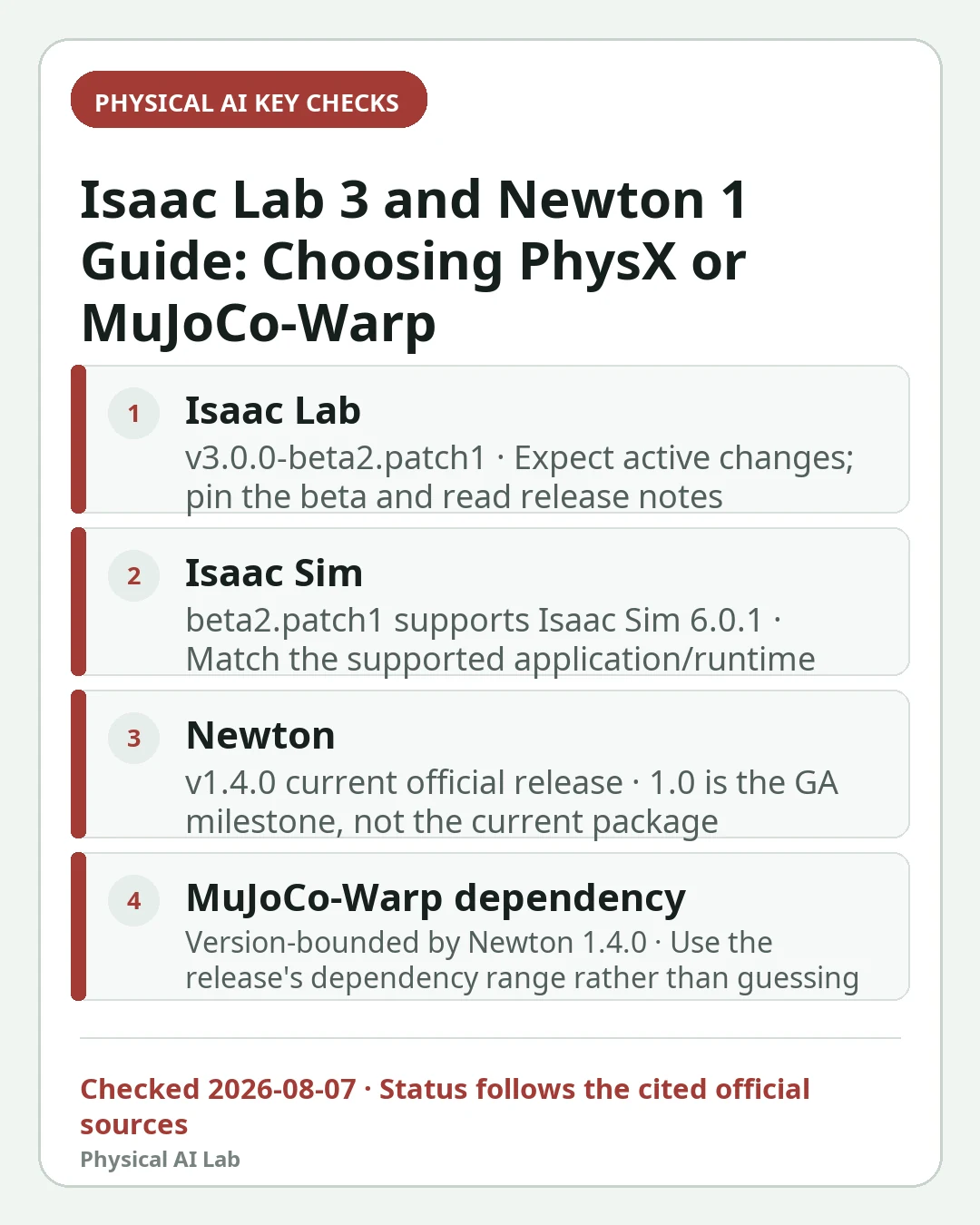
Version check on October 13, 2026: the Isaac Lab release is v3.0.0-EA, built for Isaac Sim 6.1 and Python 3.12. Its project-managed Newton stack is 1.5.2, while the standalone Newton release is 1.6.1. Keep those tracks separate: a newer independent package is not evidence that it belongs in the Lab-supported stack.
Start from the task's supported physics and renderer presets. Isaac Sim integrations may favor its PhysX path, while Newton/MuJoCo-Warp offers a kit-less option for supported learning tasks; other kit-less PhysX choices also exist. Check the actual task combinations before comparing them. The simulator comparison guide provides the wider landscape.
Start by naming the two release tracks correctly
The 3.0.0-EA release is Early Access. Its release notes target General Availability toward the end of October 2026; that target is not a completed GA milestone. Pin the tag and supported dependencies when making a comparison.
Newton 1.0 reached general availability in March 2026. The standalone repository now lists 1.6.1. That independent release should not replace Lab EA's project-managed 1.5.2 override without a separate compatibility check.
| Track | Status checked October 13, 2026 | Planning consequence |
|---|---|---|
| Isaac Lab | v3.0.0-EA | Early Access; GA is a target, not complete |
| Isaac Sim / Python | 6.1 / 3.12 built-for stack | Match the EA tag's runtime requirements |
| Newton in Lab EA | 1.5.2 project-managed override | Keep the declared Lab stack pinned |
| Standalone Newton | 1.6.1 official release | Latest standalone is not Lab compatibility proof |
| MuJoCo / MuJoCo-Warp in EA | Project uv overrides: ~=3.11.0 | Keep dependency-management path explicit |
Choose the supported backend and default for the task
The package name isaaclab_physx is distinct from the launcher selector physics=isaacsim_physx. In the current backend documentation, concrete defaults and supported physics, renderer and visualization combinations depend on the task. Inspect that task's --help; do not assume every environment has the same default or supports every combination.
For an existing Isaac Sim scene, PhysX can be the first baseline. If Newton is being evaluated, use a preset explicitly supported by the current release and record unsupported combinations. Neither backend automatically makes contacts, materials, actuators or timing match a real robot.
Newton brings MuJoCo-Warp and kit-less execution
The `isaaclab_newton` backend is powered by Newton and MuJoCo-Warp. Isaac Lab describes kit-less operation and multiple solver paths, which can be attractive for high-throughput GPU training or teams already working with MuJoCo model semantics.
Task presets, sensors, renderers and visualization combinations still differ across backends in the Early Access line. Check that the selected environment has a Newton preset and that its sensors, constraints, contacts and reset behavior are supported before treating throughput results as equivalent.
Run one environment twice with a controlled record
Use the pinned release's launcher and task help rather than an old command. The 3.0 migration guide changes quaternion order from WXYZ to XYZW and uses ProxyArray data with explicit .torch or .warp access. Check those interfaces, then record the release, task, presets, seed, timestep, device and runtime. No installation or migration command was executed for this update.
First run a small headless smoke test, then increase parallel environments while watching stability and memory. The comparison is valid only if the observation, action, reward, reset and evaluation definitions remain identical.
| Record | Why it matters | Pass condition |
|---|---|---|
| Release and commit | Commands and defaults change | Another user can fetch the same code |
| Task and backend config | Not every task supports both backends | Both runs use explicit supported presets |
| Physics parameters | Contact and integration affect learning | Differences are documented, not hidden |
| Seed and evaluation set | Training variance can dominate | Repeated results include uncertainty |
| Throughput and task metrics | Fast simulation can still learn poorly | Speed and policy quality are reported together |
Do not compare frames per second alone
Measure environment steps per second, GPU memory, wall-clock training time, numerical instability and held-out task success. Also inspect contact behavior and learned gait or manipulation quality, because a faster backend can converge to a policy that exploits a different approximation.
The domain randomization guide helps vary uncertain parameters, while the sim-to-real failure guide explains why randomization cannot repair an incorrect interface, missing latency or wrong actuator model.
Keep the hardware gate separate
A policy that succeeds in either backend is a simulation result. Before hardware, verify units, joint ordering, limits, control rate, communication delay, observation timing, action scaling, emergency stop and a low-energy test sequence.
Export the exact policy and normalization statistics used in evaluation, then use a staged test with conservative limits and supervision. Backend agreement can increase confidence, but it cannot certify real-world safety or performance.
Frequently asked questions
Is Isaac Lab 3 stable and generally available?
As checked October 13, 2026, Isaac Lab 3.0.0-EA is Early Access, built for Isaac Sim 6.1 and Python 3.12. The release targets GA toward the end of October; it does not report GA as complete.
Is Newton 1.0 still the current Newton release?
No. Standalone Newton is 1.6.1 on the check date, while the project-managed Isaac Lab EA stack uses 1.5.2. Newton 1.0 remains a historical GA milestone.
Should every Isaac Lab project switch to MuJoCo-Warp?
No. Use Newton/MuJoCo-Warp only when the task supports the selected physics, renderer and observation configurations. A backend choice does not establish equivalent task behavior or real-world performance.
Official sources checked
- NVIDIA Newton 1.0 general-availability overview
- NVIDIA Isaac Lab official releases
- Newton official releases
- Isaac Lab 3.0 task-specific backends and presets
- NVIDIA Isaac Lab product and learning page
Version, backend and migration references checked October 13, 2026. The earlier August 7 snapshot was Lab beta2.patch1 / Sim 6.0.1 / standalone Newton 1.4.0. General comparison guidance retains its original scope.