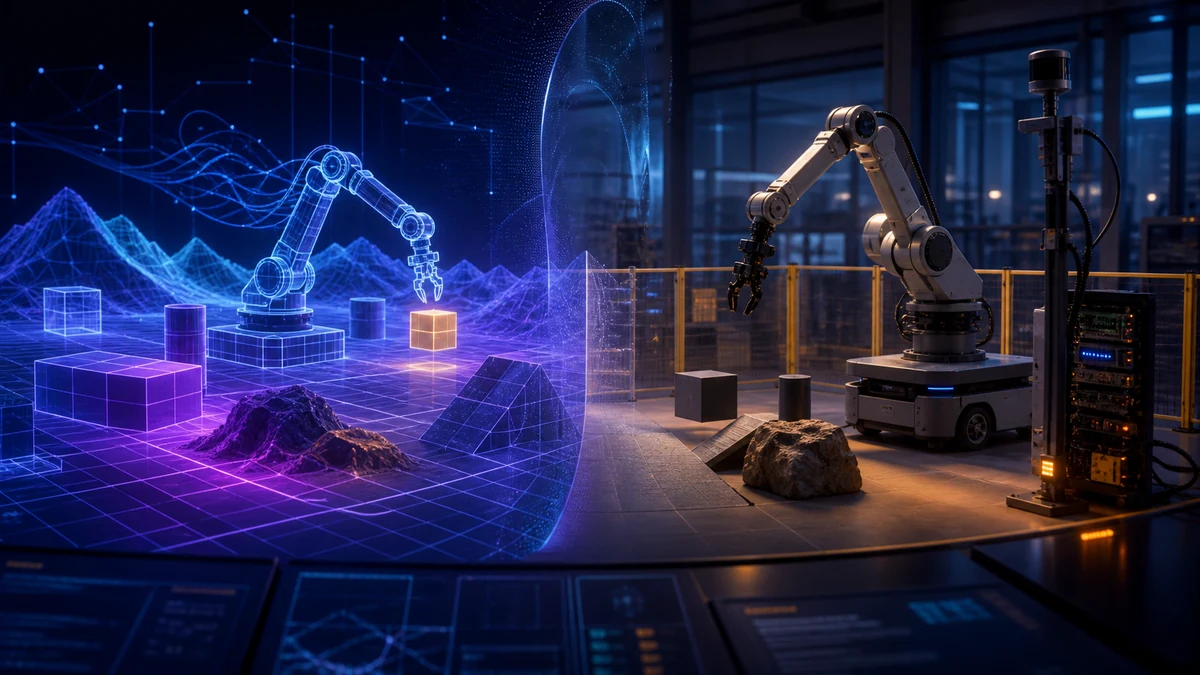
No. Google Genie 3 does not, by itself, send joint, gripper or wheel commands to a physical robot. Google DeepMind's Genie 3 announcement describes a general-purpose world model that turns a prompt into an environment a user or agent can navigate in real time. Predicting the next view of a generated world is a different output from producing safe numerical actions for real hardware.
Genie 3 can still matter to robotics because generated environments may broaden agent training and expose failure cases. The missing bridge is crucial: an embodied agent must observe the environment, choose an action, translate it for a particular robot and remain inside independent safety limits. Our guides to world models for physical AI, VLA systems and robot foundation models explain those layers separately.
Genie 3 predicts an interactive world, not a robot's motor command
The official Genie 3 model page says the model creates photorealistic environments from simple text descriptions and lets people explore them in real time. It generates the scene ahead in response to navigation and other inputs while recalling portions of the earlier trajectory. Its visible product is a changing virtual world, not a stream of target joint angles, velocities, torques or gripper forces.
That output distinction determines what the model can prove. A character walking through a generated room shows that the environment responds to an input. It does not show a policy reading a real camera, localizing an arm, compensating for backlash and sending commands through a robot driver. A physical deployment also needs sensing, calibration, low-level control, collision monitoring and a safe-stop path that remains available when an AI model is wrong.
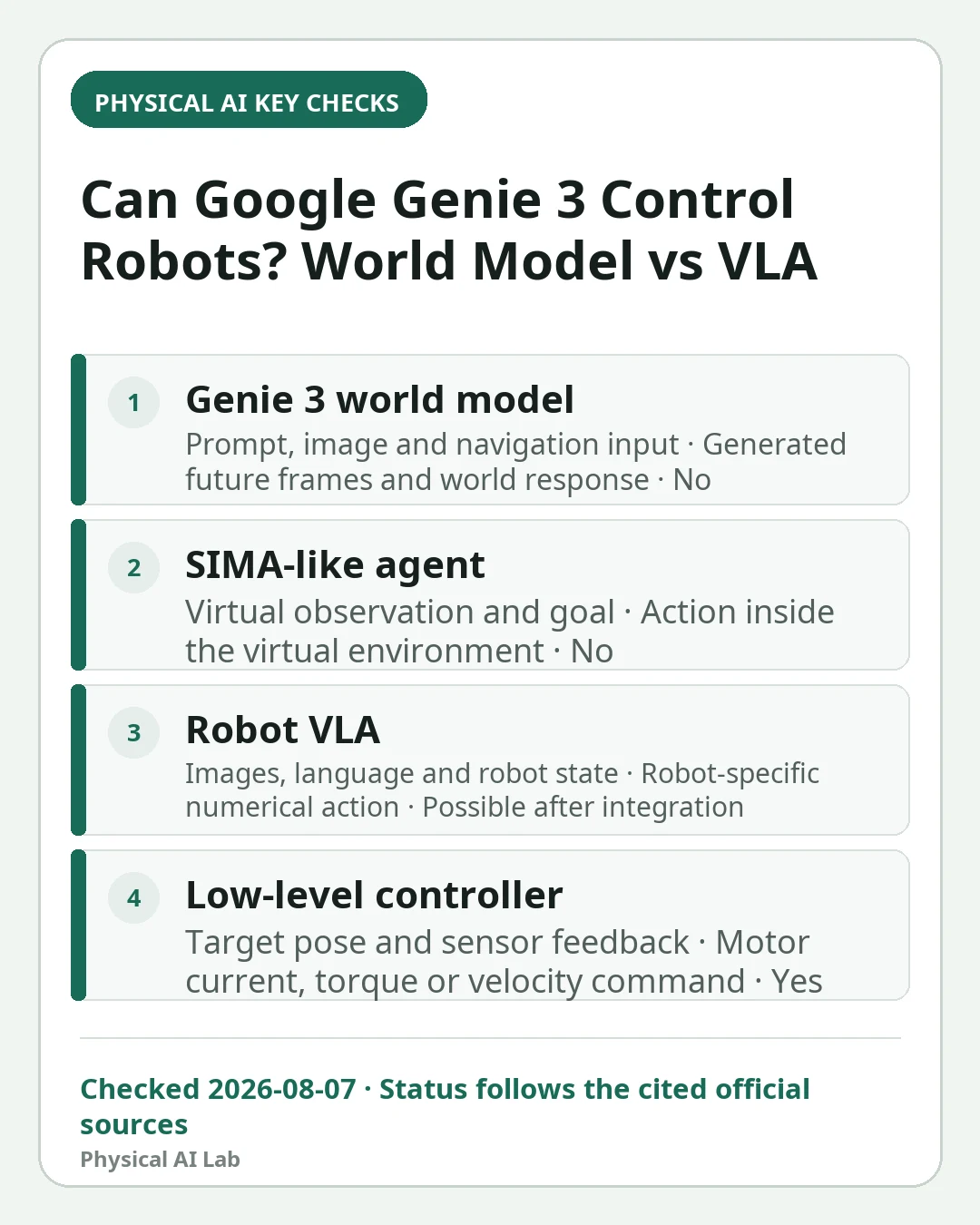
| Layer | Typical input | Typical output | Direct physical control |
|---|---|---|---|
| Genie 3 world model | Prompt, image and navigation input | Generated future frames and world response | No |
| SIMA-like agent | Virtual observation and goal | Action inside the virtual environment | No |
| Robot VLA | Images, language and robot state | Robot-specific numerical action | Possible after integration |
| Low-level controller | Target pose and sensor feedback | Motor current, torque or velocity command | Yes |
The 24 fps and 720p figures are simulation-display results
In the August 2025 research release, Google reported that Genie 3 could generate navigable environments at 24 frames per second and 720p resolution while remaining largely consistent for a few minutes. Those figures describe the generated visual experience under Google's research-demo conditions. They are not a servo rate, a worst-case control latency or a certified response time for machinery operating around people.
Google also lists limitations that matter when judging robotics claims. The action space is restricted, interactions among multiple independent agents remain difficult, real locations are not reproduced perfectly, legible text is unreliable unless supplied in the description, and continuous interaction is measured in minutes rather than working shifts. A convincing visual world is therefore useful experimental material, not evidence of hour-long physical reliability.
The SIMA example keeps the environment model and the acting agent separate
Google's embodied-agent example pairs Genie 3 with SIMA. SIMA receives a goal and tries to carry it out inside the generated environment; Genie 3 is not told that goal and instead simulates what happens as the agent acts. This is an important architectural clue. One model advances the world, while another selects behavior. The demonstration does not say that Genie 3 itself plans the task or controls a physical body.
Such a setup can still be valuable. Researchers can vary terrain, object placement or unexpected events, then observe where an agent becomes confused. They can collect more diverse trials without risking hardware on every episode. Yet the result remains a virtual evaluation until the same policy is tested against camera noise, friction, payload changes, network delay, actuator limits and recovery procedures on a real machine.
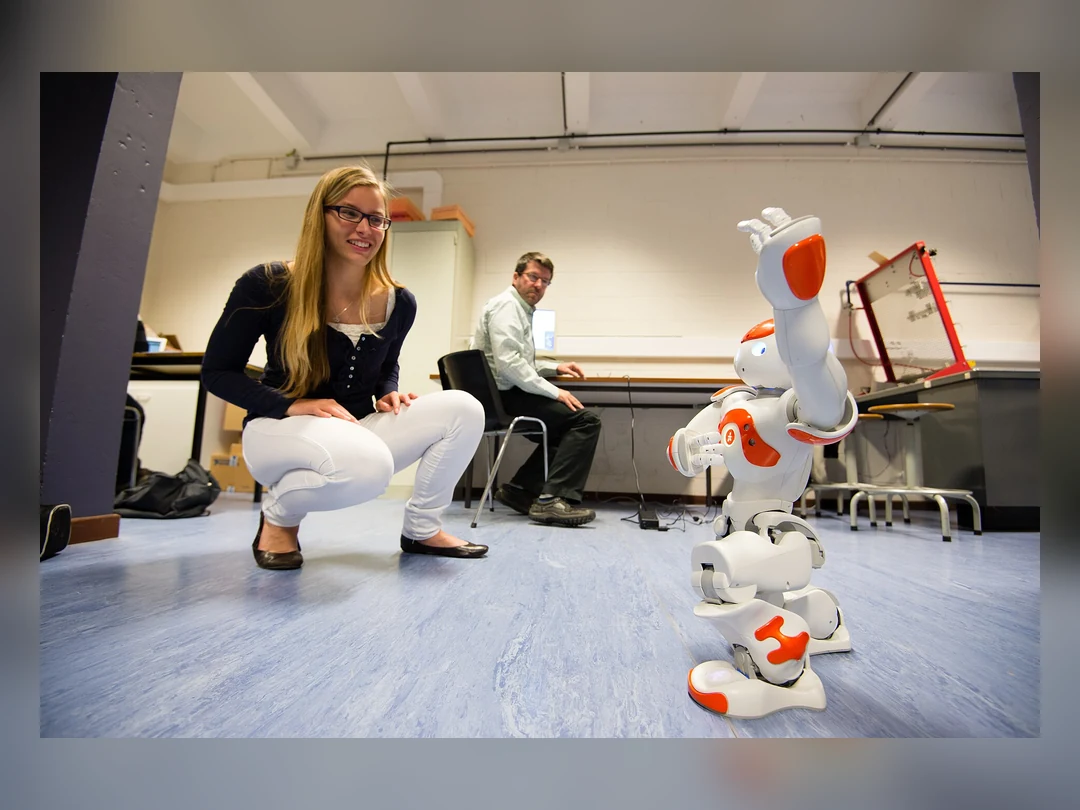

A VLA crosses from perception and language into robot action
The comparison is explicit on the Gemini Robotics page, where Google describes a vision-language-action model that transforms visual information and instructions into motor commands. A deployable VLA must represent the action space of the target embodiment and consume relevant robot state. Genie 3 instead models how a generated environment changes, so the two systems have different outputs and responsibilities.
Even a VLA is not a complete safety system. Its proposed action must pass through robot-specific kinematics, trajectory generation, joint limits and low-level feedback control. Independent interlocks must handle a person entering the workspace, a sensor failing or communication arriving too late. Connecting a world model to a VLA could support research, but the connection does not certify either the policy or the machine.
| Claim to check | What the official material supports | Verdict |
|---|---|---|
| Genie 3 outputs commands to real motors | It generates interactive virtual worlds | Not supported |
| Genie 3 may help train or evaluate agents | Google demonstrates SIMA in generated environments | Research use supported |
| 24 fps is a robot control-loop rate | It is the generated world's frame rate | Incorrect comparison |
| A world model and a VLA are interchangeable | They model different outputs and duties | Keep them separate |
Project Genie access is not access to a robot-control API
The Project Genie launch post presents a Google Labs research prototype for sketching, exploring and remixing interactive worlds. Text and images help define an environment and character, and navigation causes the path ahead to be generated. Nothing in that workflow is an official joint-control SDK, a supported robot driver or permission to operate connected machinery.
Google's May 2026 expansion notice says access began expanding globally to eligible Google AI Ultra subscribers aged 18 or older, with Street View grounding for places in the United States. Availability can still depend on account and territory, and the prototype remains experimental. A user being able to open Project Genie therefore says nothing about whether a specific robot is supported.
A credible robot experiment needs a measured bridge to reality
A useful evaluation would freeze a Genie 3 scenario set, define goals and failure labels, and test the same agent repeatedly rather than selecting the best clip. Researchers should record completion, collisions, invalid actions, recovery and latency. They should then compare those results with a conventional simulator and a bounded real-robot test. Without that bridge, environmental variety can be demonstrated but transfer cannot be quantified.
The practical conclusion is narrow. Genie 3 can be treated as a candidate environment generator for embodied-agent research, not as a physical robot controller. Any future integration should be judged by its supported embodiments, action interface, calibration process, independent safety layer and repeatable real-world results. Until Google or a robot vendor documents those pieces, statements that Genie 3 directly controls robots overstate the official evidence.
Frequently asked questions
Can I connect a robot camera to Genie 3 and make the robot move?
Not from the documented Genie 3 capability alone. A physical robot needs a policy that turns observations into robot-specific actions, plus drivers, feedback control and independent safety constraints.
What is the simplest difference between Genie 3 and a VLA?
Genie 3 predicts and renders how a virtual world changes. A robot VLA maps visual input, language and robot state to an action the target embodiment can execute.
Who can use Project Genie as of August 7, 2026?
Google says it is rolling out to eligible Google AI Ultra subscribers aged 18 or older around the world. Account and regional availability should still be checked on the official product page.
Official sources checked
- Google DeepMind: Genie 3 announcement
- Google DeepMind: Genie 3 model page
- Google: Project Genie launch
- Google: Project Genie global expansion
- Google DeepMind: Gemini Robotics
2026-08-07