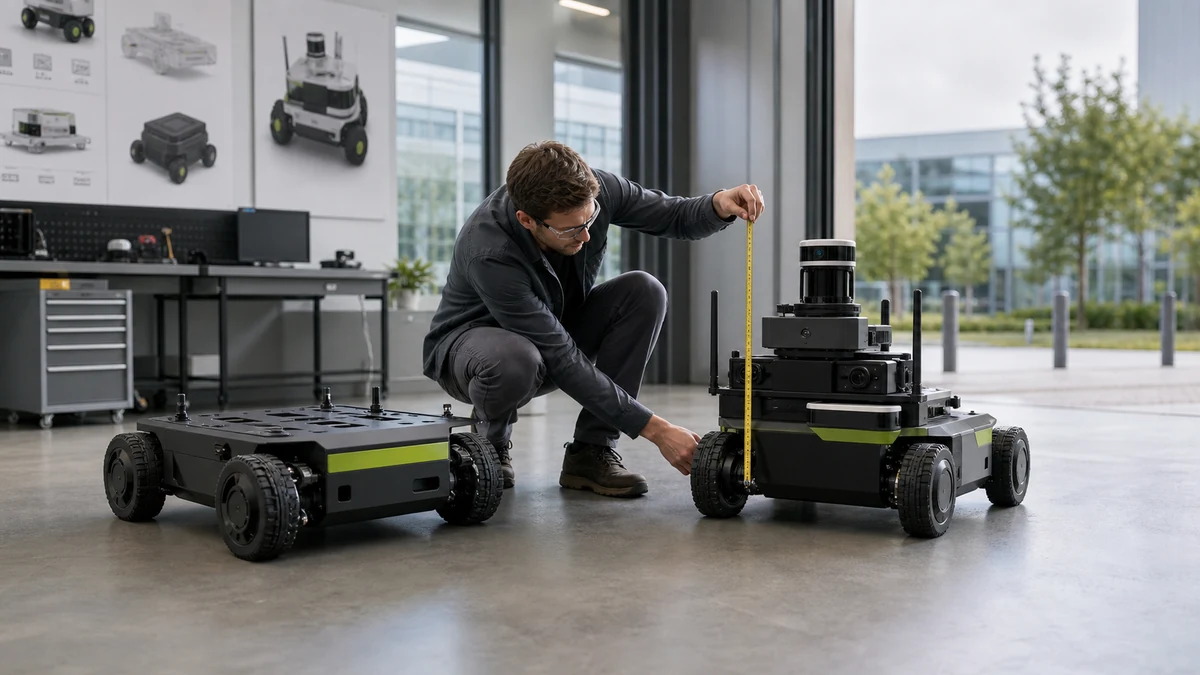
Choose MobED Pro when the project needs an integrated autonomous mobility base; choose Basic when your team plans to own the perception, compute and upper-module stack. Hyundai Motor Group's iREX 2025 announcement scheduled sales and mass production for the first half of 2026, but that dated target is not proof of current stock, a completed delivery or a guaranteed lead time.
The official MobED product page provides product information and a sales contact, but it does not display a public list price or a live checkout path. This guide therefore treats availability as inquiry-based and focuses on the engineering choice. If the navigation terminology is unfamiliar, start with the AMR versus AGV guide.
The short decision: integrated autonomy or integration freedom
Pro packages the sensors and interfaces required for an autonomous mobile base. Hyundai's manual identifies two LiDARs, eight radars, three cameras and GNSS on Pro, together with video streaming and charging-station support. That makes it the faster starting point for a team whose differentiating work is an application or payload rather than the navigation stack.
Basic removes the default autonomous-driving package, weighs less and has a higher stated payload ceiling. It can be attractive for research rigs, custom sensors or a proprietary controller, but the buyer inherits more systems engineering. The robot sensor guide explains why field of view, timing and failure coverage matter as much as the sensor count.
| Item | MobED Pro | MobED Basic | Selection consequence |
|---|---|---|---|
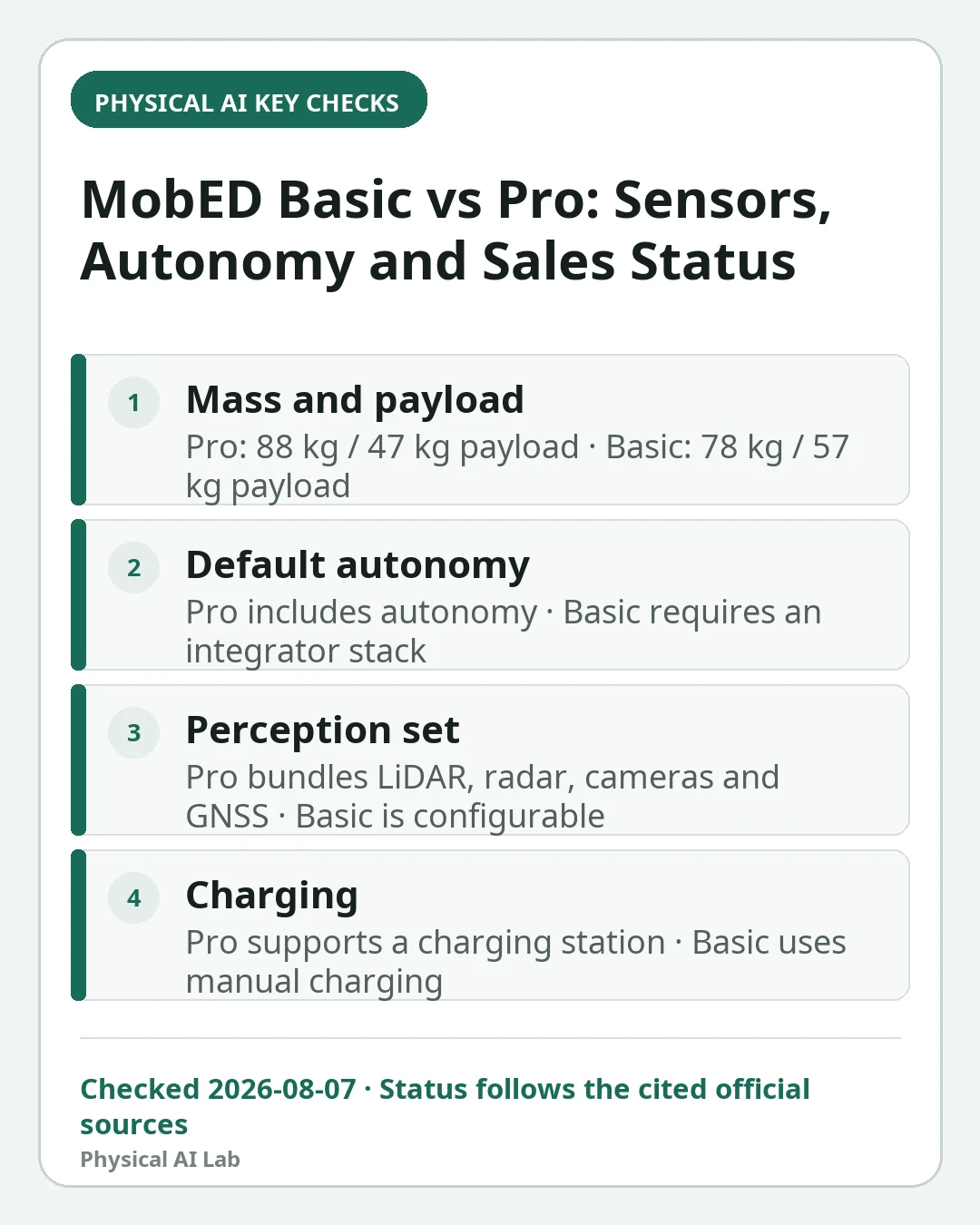
| Mass and payload | Up to 88 kg; payload up to 47 kg | Up to 78 kg; payload up to 57 kg | Basic preserves more allowance for an upper module |
| Default autonomy | Included | Not included | Buy an integrated stack or build your own |
| Perception set | LiDAR, radar, cameras and GNSS | Configured by the integrator | Ownership of coverage and calibration changes |
| Charging | Charging-station support | Manual charging | Unattended operation is easier to design around Pro |
| Interfaces | Ethernet and streaming support | RS422-centered interface | Confirm the upper computer and telemetry path |
Shared specifications still need operating conditions
Both variants are listed with a top speed of 10 km/h, IP54 protection and operation on slopes of up to plus or minus ten degrees. Hyundai also describes roughly 100 to 200 mm curb conditions. Those numbers are useful screening data, not a promise that every curb geometry, approach angle, surface and payload can be crossed at the headline value.
The common 1.47 kWh battery is specified for more than four hours from 90 to 10 percent charge and no more than two and a half hours from 10 to 90 percent under the stated test basis. Payload, speed, slope, sensor use, upper-computer power and temperature will shift the field result, so a pilot should measure an energy curve rather than copy one duration into an operating plan.
Where Pro reduces development work
Pro is suited to teams building inspection, guidance, delivery or media applications on top of a mobile platform. Integrated perception can shorten the path to mapping and obstacle tests, but installed sensors do not establish safe unattended operation in a particular facility. The team still needs to validate stopping distance, blind zones, localization loss and recovery around people.
Ethernet and streaming can simplify a supervisory application and remote diagnostics. They should not turn a best-effort network into the only safety channel. Decide which inference runs on the vehicle, which data is merely monitored and which stop functions remain local; the edge AI for robots guide provides a useful responsibility split.

Where Basic creates freedom and hidden work
Calling Basic incapable of autonomy would be misleading. The official English MobED manual describes a path for an autonomous-driving kit in the upper module; what Basic lacks is the default integrated package, not the physical possibility of adding one.
That freedom moves responsibility to the integrator: sensor placement, vibration isolation, power and thermal budgets, time synchronization, coordinate transforms and safe-stop behavior all have to be designed and regression-tested. A 57 kg payload ceiling also does not erase center-of-gravity limits or the effect of cables and enclosures on slope and curb behavior.
| Engineering question | Pro review | Basic review |
|---|---|---|
| Perception | Validate built-in coverage and blind spots | Select sensors, placement and synchronization |
| Compute | Define boundary between base and application | Budget power, cooling and real-time interfaces |
| Charging | Measure dock success and failed-dock recovery | Design manual charging and shift handoff |
| Safety | Map supplied functions to the site risk assessment | Implement independent limits and stop paths |
| Acceptance | Regression-test maps, routes and sensors | Test the complete mechanical, electrical and control integration |
A sales schedule is not the same as a purchasable unit
The first-half 2026 date came from the December 2025 launch announcement. A product page, manual and contact address show that commercialization work has advanced, but they do not reveal a public price, in-stock quantity, country-by-country lead time or number of customer units accepted in service as of this review.
The March 2026 MobED Alliance announcement is evidence of an application ecosystem, not evidence that a buyer can receive a unit immediately. Awards, exhibitions, partnerships, orders and completed deliveries should occupy separate rows in a procurement record.
Run a workload pilot, not a brochure comparison
Build a course containing level travel, slopes, thresholds, narrow passages, pedestrian crossings and network interruption. Repeat it at several payload levels and record tail stopping distance, localization dropouts, docking failures, restart time and human interventions. An average travel time alone will hide the events that determine staffing and safety.
For Pro, measure how much application work can be completed without altering the base stack. For Basic, test whether the extra integration freedom justifies engineering time, added failure modes and lifecycle ownership. Use identical routes, initial conditions and log fields so the two results can be compared as project cost rather than as isolated specifications.
Questions to put in the request for quotation
Ask for the exact variant and options, sensor revision, charger, upper-module power limit, API and SDK scope, safety documentation, warranty, training, spares and on-site service in one written configuration. Because no public price is displayed, separate the platform quote from freight, tax, installation and the development effort required to reach acceptance.
Also confirm the countries currently served, estimated lead time, prototype-versus-production status and software version policy. If any answer remains provisional, do not make a factory schedule depend on the launch target; preserve an alternative base and a manual fallback for the planned task.
Frequently asked questions
Can MobED Basic be made autonomous?
Yes, there is an integration path. Basic does not include the default autonomous-driving package, while the manual describes adding an autonomous-driving kit in an upper module. The integrator must validate the sensors, compute, controls and safety behavior.
What is the official price of MobED Pro?
No public list price or live checkout price was visible on August 7, 2026. Buyers need a written quote that identifies the configuration, region, lead time, warranty and service scope.
Is Basic always better because it carries more payload?
No. Basic preserves more stated payload but shifts autonomy and integration work to the buyer. Pro may have the lower total project cost when a team values integrated sensors, docking and a shorter validation path.
Official sources checked
- Hyundai Motor Group iREX 2025 MobED announcement
- Hyundai Robotics LAB MobED product page
- Hyundai Robotics LAB MobED Alliance announcement
- Official MobED English manual
Last checked: August 7, 2026